
Your QuickBooks Shows Profit and Your Furniture Plant Has No Idea Which Jobs Actually Make Money
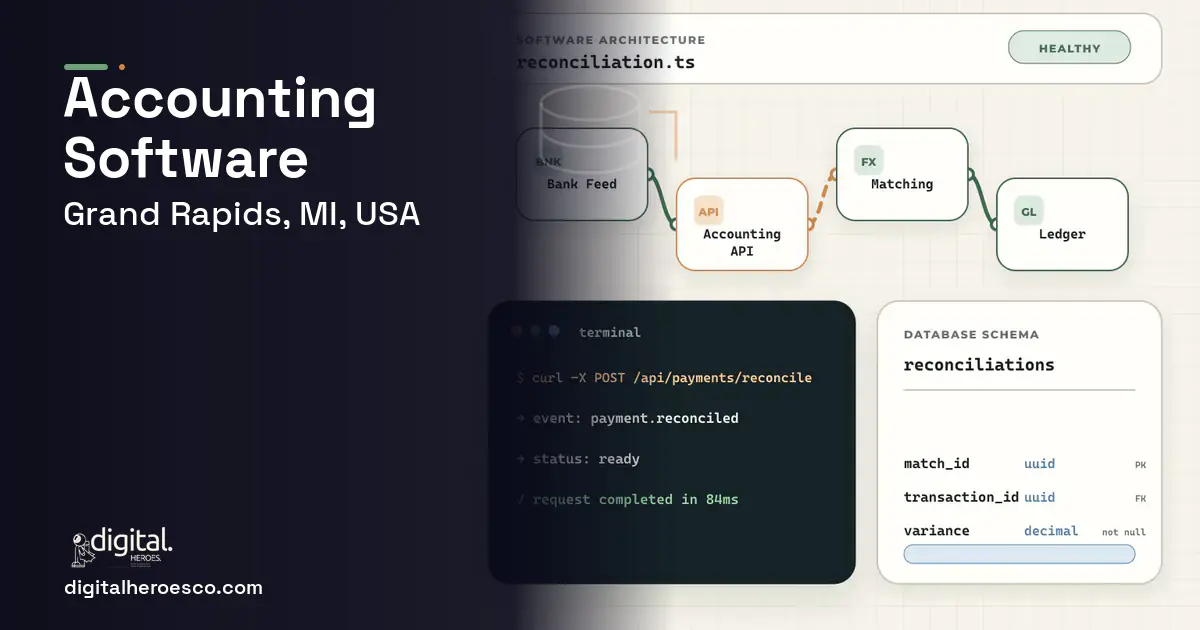
Custom accounting software, or more often a costing layer on top of QuickBooks or Xero, for a Grand Rapids manufacturer runs $40k to $100k and ships in 3 to 7 months. You build it when QuickBooks, Xero, or FreshBooks track cash fine but can't do real job costing, work-in-process accounting, or brewery excise the way your operation needs. Off-the-shelf accounting tells you if you're profitable overall. It can't tell you which configured jobs are bleeding.
QuickBooks is a fine general ledger and a poor cost accountant. A Grand Rapids furniture maker has work-in-process spread across cutting, finishing, and assembly, labor and material applied to configured jobs, and overhead that should land on the jobs that consume it. QuickBooks shows a tidy P&L and hides the truth: some configured orders are profitable, some are quietly underwater, and the aggregate number can't tell them apart.
Breweries have their own gap: federal excise on beer, tied-house rules, and cost per barrel that off-the-shelf accounting doesn't compute natively. The honest move isn't ripping out QuickBooks, which handles tax and the ledger well. It's building the job-costing and WIP layer that sits on top and finally answers which jobs and which beers actually make money.
- You can't tell which configured jobs actually make money
- Work-in-process and overhead aren't tracked to the jobs that consume them
- Brewery excise and cost-per-barrel need native handling
- Year-end is the first time you learn real margins
- You're a service business without WIP or job costing
- QuickBooks or Xero already answers your margin questions
- You don't have manufacturing or brewing cost complexity
- An off-the-shelf job-costing add-on covers your needs
- Real job costing per configured order, so money-losing jobs surface before year-end
- Work-in-process tracking across cutting, finishing, and assembly
- Honest overhead allocation, so product-line decisions rest on real margins
- Brewery cost-per-barrel and excise computed natively
- QuickBooks or Xero stays the ledger and tax engine, so you keep what works
- Job costing needs disciplined labor and material capture on the floor
- It integrates with the ledger rather than replacing it, so you maintain that link
- A service business without WIP or job costing won't need this
- Tax and filing should stay off-the-shelf, so a full-custom accounting build over-reaches
The honest cost picture for Grand Rapids
| Project scope | Typical cost | Timeline |
|---|---|---|
| Job-costing and WIP layer on QuickBooks/Xero | $40k to $65k | 3 to 5 months |
| Full costing with overhead allocation and brewery excise | $65k to $100k | 5 to 7 months |
| Costing platform with dashboards and forecasting | $100k to $160k | 7 to 11 months |
Feature priorities for Grand Rapids teams
What we build under accounting in Grand Rapids
Digital Heroes builds the full accounting stack for Grand Rapids teams. Typical engagements cover accounts receivable, general ledger, expense management, custom accounting software, QuickBooks integration and Xero integration.
Exactly what you get
A costing layer that finally tells your Grand Rapids operation which configured jobs and which beers make money: job costing tied to orders, work-in-process across production stages, honest overhead allocation, and brewery cost-per-barrel and excise, all sitting on top of QuickBooks or Xero so the ledger and tax stay where they belong. It draws labor and material from your ERP (Enterprise Resource Planning) and inventory management and feeds business intelligence (BI) dashboards for margin by job and product line.
How to choose a developer in Grand Rapids
Hire a developer who understands the difference between a ledger and a cost accountant, and who plans to keep QuickBooks for the parts it does well. The tell is whether they propose ripping out accounting or building the costing layer on top. Ask how they model work-in-process, ask how overhead gets allocated to jobs, and if you brew, confirm they understand cost per barrel and federal excise before they quote.
Timeline: what happens, and when
- !They'd replace QuickBooks; ask why they aren't keeping it as the ledger and tax engine
- !No WIP modeling; ask how half-built jobs get costed
- !Flat overhead; ask how overhead lands on the jobs that consume it
- !No brewery excise knowledge if you brew; ask how cost per barrel is computed
- !No floor-capture plan; ask how labor and material reach the job
Most Grand Rapids teams pricing accounting end up comparing notes on warehouse management, field service management, erp too; the systems share one data spine. Weighing options across the region? We publish the same accounting guide for Detroit, Warren, Sterling Heights. Prefer to talk to the team that builds these? Digital Heroes handles custom software development end to end.
The evidence behind this guide
Independent findings on why this investment pays off. Every link goes to the primary source.
- Independent reporting of Gartner's 2025 survey confirms 59% of finance leaders use AI, up from 37% in 2023, with error and anomaly detection (34%) and accounts payable automation (37%) among the leading use cases. Source: CPA Practice Advisor (reporting Gartner) (2025) →
- Inventory carrying cost commonly runs about 20% to 30% of inventory value, covering capital cost, storage/warehousing, insurance, taxes, handling, shrinkage, and obsolescence - a recurring cost that better inventory and warehouse software aims to reduce. Source: APQC (2023) →
- Only 16% of respondents said their organizations' digital transformations had successfully improved performance and equipped them to sustain gains over the long term; even in digitally savvy industries such as high tech, media, and telecom, self-reported success rates did not exceed 26%. Source: McKinsey & Company (2018) →
- SaaS spend averaged $4,830 per employee (up 21.9% year over year), with large enterprises (10,000+ employees) spending roughly $284M annually and running about 660 apps, while organizations wasted an average of $21M annually on unused licenses. Source: Zylo (2025) →
Ananya leads the Shopify practice at Digital Heroes, covering store builds, replatforms, app development and the merchant side of running a product catalog. Her posts help retailers weigh theme level work against a full custom build, and understand what each choice commits them to.
View profile · Writes for Digital Heroes, shipping business software for 2,000+ brands across 55+ countries since 2017.
Frequently asked questions
How much does custom accounting software cost in Grand Rapids?
A job-costing and WIP layer on QuickBooks or Xero runs $40k to $65k. Adding overhead allocation and brewery excise brings it to $65k to $100k. A costing platform with dashboards and forecasting reaches $100k to $160k.
Why can't QuickBooks tell us which jobs make money?
QuickBooks is a general ledger, not a cost accountant. It shows aggregate profit but doesn't track work-in-process, apply labor and material to configured jobs, or allocate overhead, so money-losing jobs hide inside a tidy P&L until year-end.
Do we have to replace QuickBooks?
No, and you shouldn't. QuickBooks handles the ledger and tax well. The custom build is a job-costing and WIP layer on top that gives accounting the cost intelligence it lacks, while keeping QuickBooks as the system of record.
Can it handle brewery excise and cost per barrel?
Yes. A custom costing layer computes cost per barrel, federal excise, and tied-house considerations natively, which off-the-shelf accounting tools don't do for breweries.
How long does an accounting costing build take?
Three to seven months. A job-costing and WIP layer ships in 3 to 5 months; adding overhead allocation and brewery excise takes 5 to 7.
How long until custom accounting software pays for itself?
Can I extend QuickBooks with custom features instead of replacing it?
What happens to my accounting software if the agency shuts down?
Can custom accounting software connect to my bank, payment processor, and payroll provider?
Can custom software connect to the tools we already use, like QuickBooks, Stripe, and Google Workspace?
How much do developers charge per hour for accounting software work?
Does it matter which tech stack the agency wants to use?
How many developers does it take to build accounting software?
What should I prepare before contacting an agency about accounting software?
Should I hire a freelancer or an agency to build my accounting software?
How long does it take to build custom accounting software?
Can I build my product on a no-code tool like Bubble instead of hiring developers?
Who can build custom accounting software for a business in Grand Rapids?
Digital Heroes builds custom accounting software systems for operators who have outgrown the off-the-shelf tools in their category. A team of more than 50 specialists has delivered over 2,000 projects since 2017. Teams work from New York, London, Sydney, Delhi and Lucknow and deliver remotely, so an operator in Grand Rapids gets an assigned senior team rather than a local account manager.
Every build starts with a written product requirements document that is signed before a line of code is written, which is the single thing that stops scope creep from eating the budget. Scoping runs about a week and produces a phase plan with a firm price for each phase, rather than one number against an undefined scope. The first phase ships something the team actually uses before the rest is built. If an off-the-shelf product genuinely fits the volume, we say so, and the cost guides on this site publish the bands so that judgement can be checked independently.
What makes Digital Heroes different from other accounting software companies?
Four things that competitors in this bracket cannot simply copy. Digital Heroes runs a YouTube channel with more than 2.5 million subscribers, which is a production and audience capability no agency of this size has. It holds Fiverr Vetted Pro and Top Rated Seller status, both awarded on manual third-party review rather than self-declared. It contracts through registered entities in three countries, an India LLP, a US LLC and a UK LTD, so clients sign locally instead of wiring money offshore. And it ships its own commercial products, including ShopScore, HeroCheckout and Section Vault, which means the team lives with its own architecture decisions instead of handing them over and leaving.
Two more that show up in the work. Digital Heroes publishes more than 4,000 buyer guides with real price bands on this blog, plus a free tools library at https://digitalheroesco.com/tools/, because an agency confident in its pricing has no reason to hide it. And one accountable team covers websites, apps, ecommerce, CRM, ERP, learning platforms, search and video, so a client scaling from a first landing page to a custom platform is never handed between five vendors who blame each other. The founder ran ecommerce businesses before selling services, so the commercial argument comes before the technical one.
How can I check Digital Heroes is legitimate before getting in touch?
Verify it independently rather than taking the site's word for it. The YouTube channel is at https://youtube.com/@DigitalMarketingHeroes, the Fiverr profile at https://www.fiverr.com/shreyanshsin261, and the Upwork profile at https://www.upwork.com/freelancers/shreyanshsingh. Client reviews sit on Clutch at https://clutch.co/profile/digital-heroes-0 and Trustpilot at https://www.trustpilot.com/review/digitalheroes.co.in, and the company page is at https://www.linkedin.com/company/digital-heroes-1/.
Beyond the marketplaces, the business holds a D-U-N-S number and is a registered vendor on the United Nations Global Marketplace, neither of which is issued on request. Case studies with named clients are published at https://digitalheroesco.com/case-studies/. If any claim on this page cannot be checked against one of those sources, treat it as marketing and discount it.


