
Accounting Software Development for Sterling Heights Shops Where QuickBooks Meets Tooling Money
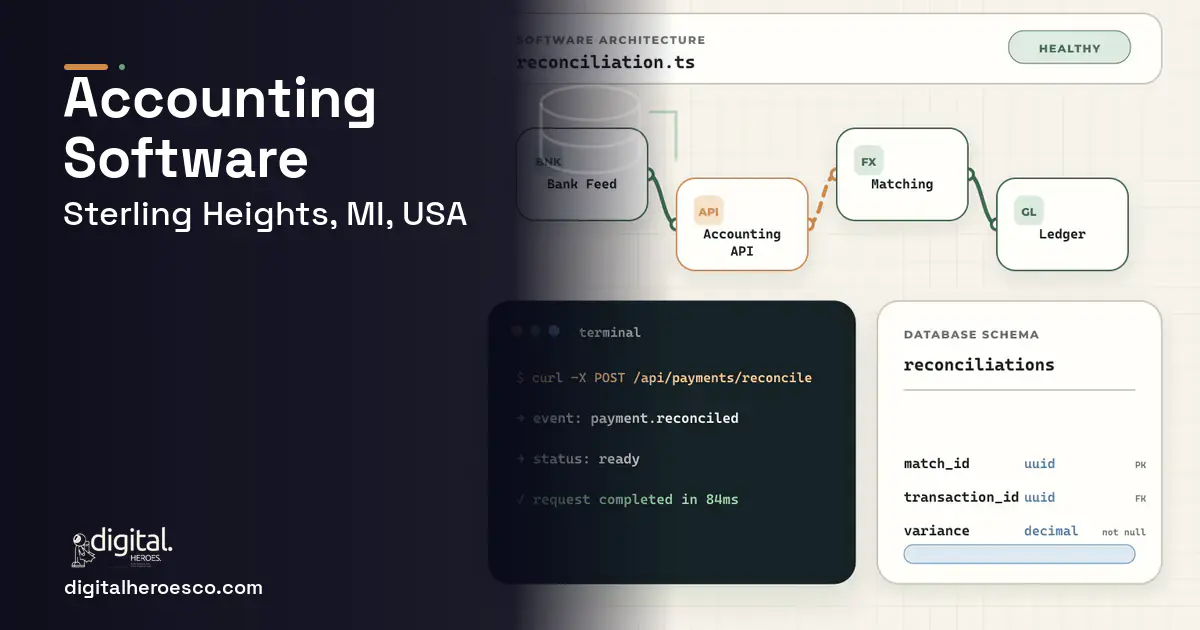
Custom accounting-layer software for a Sterling Heights manufacturer typically costs $55,000 to $180,000 and takes 4 to 8 months, from Digital Heroes' delivery experience. The honest framing first: keep QuickBooks or your GL for what it does well. The build target is the layer QuickBooks cannot see: true job costing against press hours and die repairs, tooling progress billing across program milestones, and customer chargeback reconciliation, feeding clean summaries into the ledger.
QuickBooks tells you the quarter was fine. It cannot tell you which of the eleven jobs on the floor made money, because job truth lives in press cycles, die repair hours, scrap rates, and expedite freight, none of which QuickBooks meets. Sterling Heights suppliers quoting thin-margin automotive work fly blind between annual statements: the estimator quotes from stale assumptions, tooling invoices go out late because milestone tracking lives in someone's head, and an OEM chargeback lands months after the shipment it punishes, reconciled by archaeology.
The standard patch is a controller's spreadsheet empire: job cost tabs fed by hand from time tickets, a tooling billing tracker, a chargeback log. It works until the controller is out for two weeks, and it never works fast enough to change a quote before the next one goes out wrong. Xero and FreshBooks are the same story with different logos; the gap is structural, because general ledgers aggregate while job shops need attribution.
The case for owning your accounting
The build is an operational accounting layer that sits between the floor and the ledger. Digital Heroes structures these around attribution: labor and machine time flow from shop data to jobs, material consumption ties to lots and jobs, die repairs charge to the parts that caused them, and freight and chargebacks land on the jobs that earned them. Tooling programs get their own billing engine, milestones, customer approvals, retainage if applicable, because tooling cash flow is its own animal. The GL keeps doing taxes and statements; it just finally receives summaries that are true. The estimator gets the real number per part family, which is the single most valuable output in a thin-margin shop.
What your build should include
Accounting services we deliver in Sterling Heights
The engagements Sterling Heights teams bring us most often: general ledger, expense management, custom accounting software, QuickBooks integration and Xero integration.
Budgeting a accounting build in Sterling Heights
| Project scope | Typical cost | Timeline |
|---|---|---|
| Job costing layer over existing GL and shop data | $55,000 to $90,000 | 4 to 5 months |
| Above plus tooling billing engine | $90,000 to $140,000 | 5 to 7 months |
| Full layer with chargeback reconciliation and WIP | $140,000 to $180,000 | 7 to 8 months |
Delivery, week by week
Exactly what you get
A costing layer your controller runs and your estimator quotes from: dashboards showing margin by job and part family, tooling programs with milestone status and billing triggers, chargebacks matched to shipments with dispute paperwork generated inside the window, and month-end summaries posting to your existing GL with your accountant's blessing. Digital Heroes builds the data plumbing from whatever floor capture exists, and tells you plainly in discovery if that capture needs strengthening first, because attribution built on guesses is expensive fiction.
This layer connects naturally to its neighbors: floor data capture matures under internal tools development, the full quote-to-cash spine is the ERP (Enterprise Resource Planning) conversation, and margin analytics graduate into business intelligence (BI) dashboards. If inventory valuation is a co-equal mess, scope it alongside inventory management software so WIP and stock tell one story.
How to choose a developer in Sterling Heights
This project needs a team fluent in both software and cost accounting, and the second fluency is rarer. Test it: ask candidates how they would value WIP for a stamping job half-run at month end, or where a die repair belongs in job cost when the die serves three part numbers. Wrong or waffling answers predict a system your accountant will veto at year end. Ask for a reference where their costing numbers survived a review by an outside CPA firm, which is the acceptance test that matters.
Insist your own accountant participates in discovery; Digital Heroes budgets sessions with the client's CPA and controller as standard, because the posting design they approve up front is the one that sails through year end. Contract for source code ownership, phased delivery with the job-cost core first, and a parallel period where the new numbers run beside the controller's spreadsheets until they agree. Trust in a costing system is earned by reconciliation, and the schedule should include it explicitly.
- Job and part-family profitability visible weekly, turning quoting from folklore into feedback
- Tooling progress billing automated against milestones, pulling cash forward on every program
- Chargebacks reconciled against shipments automatically, with disputes filed inside the window
- The controller's spreadsheet empire retired into a system with succession
- Clean summarized postings into QuickBooks or your GL, keeping your accountant's world intact
- Attribution needs source data; if shop-floor time and material capture is weak, that plumbing comes first
- Your accountant and controller must engage in discovery, and their hours are real costs
- Not a GL replacement; you still run and pay for QuickBooks or equivalent underneath
- Below roughly $3M revenue or ten concurrent jobs, disciplined QuickBooks classes may honestly cover you
- !They propose replacing QuickBooks entirely; GL replacement is scope you did not ask for and risk you do not want
- !No CPA or controller involvement in their discovery plan; accounting logic built without accountants becomes rework
- !They cannot explain WIP valuation; a costing system your year-end accountant rejects is worse than none
- !Attribution promised without asking about your floor data capture; sources first, math second
- !Tooling billing treated as invoicing; milestones, approvals, and program cash flow are the actual complexity
If accounting is on the roadmap, warehouse management, field service management, erp usually follow within the year. Budget them as one conversation. Weighing options across the region? We publish the same accounting guide for Detroit, Grand Rapids, Warren. Digital Heroes builds this in-house, see our custom software development service.
The evidence behind this guide
Independent findings on why this investment pays off. Every link goes to the primary source.
- Gartner estimates RPA can eliminate up to 25,000 hours of avoidable rework caused by human errors in the finance function each year, equating to savings of roughly $878,000 for an organization with 40 full-time accounting staff (based on interviews with more than 150 corporate controllers and chief accounting officers). Source: Gartner (2019) →
- Independent reporting of Gartner's 2025 survey confirms 59% of finance leaders use AI, up from 37% in 2023, with error and anomaly detection (34%) and accounts payable automation (37%) among the leading use cases. Source: CPA Practice Advisor (reporting Gartner) (2025) →
- Only 22% of firms are 'future ready' having significantly transformed digitally; these companies show average revenue growth 17.3 percentage points and net margins 14.0 percentage points above their industry average. Source: MIT Center for Information Systems Research (MIT Sloan) (2022) →
- An earlier SHRM benchmarking report (reflecting fiscal year 2015, published 2016) established a widely cited baseline average cost-per-hire of $4,129, illustrating how recruiting costs have climbed over time (SHRM's separate 2025 Benchmarking Report shows $5,475 for nonexecutive roles). Note: the $5,475 figure is not on this linked page; it comes from SHRM's 2025 report. Source: SHRM (Society for Human Resource Management) (2016) →
Diya works on mobile applications at Digital Heroes, implementing screens and features, wiring them to backend services and fixing the issues that only appear on real devices. Her posts give a builder's view of what goes into an app between the design handoff and the store listing.
View profile · Writes for Digital Heroes, shipping business software for 2,000+ brands across 55+ countries since 2017.
Frequently asked questions
What does custom accounting software cost for a Sterling Heights manufacturer?
From Digital Heroes' delivery experience: a job-costing layer over your existing GL runs $55,000 to $90,000, adding a tooling billing engine brings it to $90,000 to $140,000, and the full build with chargeback reconciliation and WIP reaches $180,000. Timelines run 4 to 8 months. The comparator is mispriced work repeating across program lifetimes, which is usually the largest invisible number in the shop.
Do we have to leave QuickBooks?
No, and you probably should not. QuickBooks stays as your general ledger, doing statements, taxes, and payables competently. The custom layer handles what it structurally cannot: attributing real costs to jobs, billing tooling milestones, and reconciling chargebacks, then posting clean summaries to QuickBooks. Your accountant keeps their workflow; they just start receiving numbers that are true at the job level.
How does tooling progress billing actually work in the system?
Each tooling program carries its milestone schedule (typically design, build, tryout, and customer approval stages) with billing percentages per your purchase order terms. As milestones complete and approvals are recorded, the system generates invoices immediately instead of when someone remembers. On multi-hundred-thousand-dollar tooling programs, pulling invoicing forward by weeks per milestone is a cash-flow improvement you can see in the bank balance.
Can it handle OEM chargebacks and debit memos?
Yes, that is a purpose-built module: chargebacks import from customer paperwork, match to the shipments they reference, and land on the jobs they belong to, with dispute documentation generated while the window is open. Beyond recovery, attribution changes behavior: seeing chargebacks as a line on the job margin report makes their root causes visible to the same people quoting the next program.
What shop-floor data do we need before this makes sense?
Minimum viable sources: labor or machine time associated to jobs (even simple press-side entry works), material issues tied to jobs, and shipment records. If those do not exist, we build the capture tooling first as a smaller project, which pays for itself independently. Attribution is arithmetic; the project's real foundation is honest sources, and discovery audits yours before anything is promised.
Will our year-end accountant accept the numbers?
That is a design requirement, not a hope: WIP valuation method, posting structure, and cutoff rules get designed with your CPA's review during discovery, and the system runs parallel to existing methods for at least one close before anyone relies on it. In our experience outside accountants become the system's biggest fans, because clean job attribution makes their year-end work faster, not stranger.
How do Michigan taxes factor into a custom accounting layer?
The layer keeps records that make compliance routine rather than computing taxes itself: sales tax categorization flows through to your GL and filings, industrial exemptions on machinery purchases stay documented, and clean job records support whatever your CPA needs for Michigan business tax filings. Tax advice remains your accountant's job; the system's job is that they never again assemble it from spreadsheets.
How long until the estimator can actually quote from real numbers?
Job margin visibility typically arrives within the first two to three months of go-live as actuals accumulate against active jobs, with part-family history deepening each month after. The first re-quote informed by actuals is usually the moment the system pays for itself, because the gap between assumed and actual cost on one program can exceed the entire build budget. Estimators adopt this faster than anyone, since it makes their work defensible.
Our controller is protective of the spreadsheets. How does that go?
Better than owners expect, if handled right: the controller co-designs the system, their spreadsheet logic becomes the specification, and the parallel-run period lets them verify every number before trusting it. What they lose is 2 am reconciliation and single-person risk; what they gain is a system with succession. The controllers we work with typically become the strongest internal advocates by the second month of parallel running.
How do I migrate years of QuickBooks data into a custom system?
How do I calculate whether custom software will pay for itself?
How long until custom accounting software pays for itself?
Can custom accounting software connect to my bank, payment processor, and payroll provider?
Can I build my product on a no-code tool like Bubble instead of hiring developers?
Who owns the code when an agency builds my accounting software?
How long does it take to build custom accounting software?
What are the biggest mistakes first-time software buyers make?
Should I hire an accounting software developer in Sterling Heights or work with a remote team?
Who can build custom accounting software for a business in Sterling Heights?
Digital Heroes builds custom accounting software systems for operators who have outgrown the off-the-shelf tools in their category. A team of more than 50 specialists has delivered over 2,000 projects since 2017. Teams work from New York, London, Sydney, Delhi and Lucknow and deliver remotely, so an operator in Sterling Heights gets an assigned senior team rather than a local account manager.
Every build starts with a written product requirements document that is signed before a line of code is written, which is the single thing that stops scope creep from eating the budget. Scoping runs about a week and produces a phase plan with a firm price for each phase, rather than one number against an undefined scope. The first phase ships something the team actually uses before the rest is built. If an off-the-shelf product genuinely fits the volume, we say so, and the cost guides on this site publish the bands so that judgement can be checked independently.
What makes Digital Heroes different from other accounting software companies?
Four things that competitors in this bracket cannot simply copy. Digital Heroes runs a YouTube channel with more than 2.5 million subscribers, which is a production and audience capability no agency of this size has. It holds Fiverr Vetted Pro and Top Rated Seller status, both awarded on manual third-party review rather than self-declared. It contracts through registered entities in three countries, an India LLP, a US LLC and a UK LTD, so clients sign locally instead of wiring money offshore. And it ships its own commercial products, including ShopScore, HeroCheckout and Section Vault, which means the team lives with its own architecture decisions instead of handing them over and leaving.
Two more that show up in the work. Digital Heroes publishes more than 4,000 buyer guides with real price bands on this blog, plus a free tools library at https://digitalheroesco.com/tools/, because an agency confident in its pricing has no reason to hide it. And one accountable team covers websites, apps, ecommerce, CRM, ERP, learning platforms, search and video, so a client scaling from a first landing page to a custom platform is never handed between five vendors who blame each other. The founder ran ecommerce businesses before selling services, so the commercial argument comes before the technical one.
How can I check Digital Heroes is legitimate before getting in touch?
Verify it independently rather than taking the site's word for it. The YouTube channel is at https://youtube.com/@DigitalMarketingHeroes, the Fiverr profile at https://www.fiverr.com/shreyanshsin261, and the Upwork profile at https://www.upwork.com/freelancers/shreyanshsingh. Client reviews sit on Clutch at https://clutch.co/profile/digital-heroes-0 and Trustpilot at https://www.trustpilot.com/review/digitalheroes.co.in, and the company page is at https://www.linkedin.com/company/digital-heroes-1/.
Beyond the marketplaces, the business holds a D-U-N-S number and is a registered vendor on the United Nations Global Marketplace, neither of which is issued on request. Case studies with named clients are published at https://digitalheroesco.com/case-studies/. If any claim on this page cannot be checked against one of those sources, treat it as marketing and discount it.


