
Supply Chain Management Software for Sterling Heights Tier Suppliers Squeezed From Both Ends
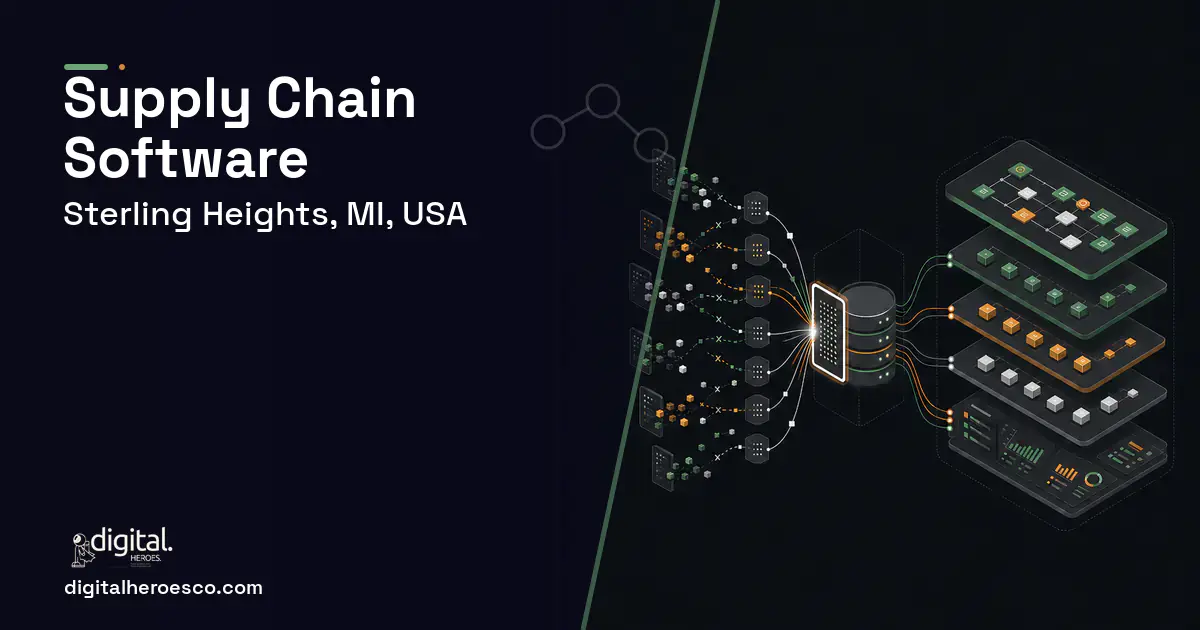
Custom supply chain software for a Sterling Heights tier supplier typically costs $65,000 to $200,000 with 4 to 9 months to production, based on Digital Heroes' delivery experience. SAP-class SCM assumes you are the OEM. You are not; you are the tier squeezed between an OEM's EDI demands downstream and your own suppliers' spreadsheets upstream. The build target is that middle position: release-driven planning, ASN discipline outbound, and real visibility into the sub-suppliers who can sink your delivery rating.
A tier supplier's supply chain problem is asymmetry. Downstream, Stellantis and the other OEMs send you 830 forecasts and 862 firm schedules, grade your ASN accuracy, and post your delivery rating where every sourcing decision sees it. Upstream, your coil processor, heat treater, and plating house run on phone calls and PDFs. You are the translation layer between machine-grade demands and handshake-grade supply, and today that translation runs through two planners' spreadsheets and their memory of who actually answers the phone at the plater.
Generic supply chain software misses the position. SAP SCM and its class model the OEM's problem, planning a network you do not own. What the tier needs is narrower and sharper: net requirements driven by customer releases, purchase schedules pushed to sub-suppliers in forms they will actually confirm, and early warning when an upstream slip is about to become your late shipment, your expedite bill, and your dented rating.
The fix: supply chain built for Sterling Heights, not rented
The build models your actual position in the chain. Digital Heroes structures these systems around release-driven planning: customer 830s and 862s flow in, net against inventory and WIP, and generate both the production schedule and dated purchase schedules per sub-supplier. Upstream, suppliers get a portal or structured confirmation flow sized to their reality, a plating house will confirm a date on a simple page, but never through an SAP portal, with non-confirmations and slips escalating to your planners automatically. The payoff shows up in the two numbers OEMs judge you on: delivery rating and premium freight, both of which move when problems surface days earlier than they used to.
The capability list that earns its budget
Supply Chain services we deliver in Sterling Heights
Digital Heroes builds the full supply chain stack for Sterling Heights teams. Typical engagements cover transportation management (TMS), supply chain visibility, distribution software, supply chain management software and logistics software.
What supply chain costs in Sterling Heights
| Project scope | Typical cost | Timeline |
|---|---|---|
| Release management and net requirements core | $65,000 to $110,000 | 4 to 5 months |
| Core plus supplier scheduling and confirmations | $110,000 to $160,000 | 6 to 7 months |
| Full build with ASN, freight, and rating analytics | $160,000 to $200,000 | 8 to 9 months |
How long it takes, phase by phase
Exactly what you get
A planning system built for the middle of the chain: customer releases land and net against reality automatically, planners see demand changes as exceptions with impact already computed, and every sub-supplier has a dated schedule with a confirmation state your team can see at a glance. Outbound, ASNs validate before transmission. Management sees delivery performance and premium freight attributed to causes, which converts the monthly freight argument into a fixable list. Digital Heroes delivers source code, EDI mappings per customer, and supplier onboarding materials sized to each supplier's sophistication.
Boundaries and neighbors: execution inside your four walls belongs to a warehouse management system (WMS), stock truth to inventory management software, and if quote-to-cash is broken end to end, the ERP (Enterprise Resource Planning) conversation comes first. Performance analytics roll up into business intelligence (BI) dashboards once the transactional spine is live.
How to choose a developer in Sterling Heights
Vet for tier-position fluency. The test questions: how do you reconcile cums when a customer restates mid-quarter; what happens in your design when a supplier confirms and then goes silent; show me the simplest supplier-facing screen you have shipped. Teams that have only built for OEMs or for retail supply chains will design elegant systems for the wrong war. Automotive EDI scar tissue is worth more than any certification here, and it shows immediately in how they talk about testing cycles with customer sandboxes.
Structure the project with one customer's release flow live before generalizing, and one friendly sub-supplier as the portal pilot before broad onboarding. Digital Heroes sequences these builds so planners keep their spreadsheets in parallel until the system has survived a restatement and a supplier slip in production, because trust in planning software is earned through exactly those two events. Contract for source code ownership and per-customer EDI mapping documentation, which protects you through every future OEM requirement change.
- Release changes propagate to production and purchasing in minutes, not planner-days
- Sub-supplier confirmations and slips visible in one board, with escalation before the dock finds out
- Premium freight attacked at its source: late awareness, not late trucks
- Delivery rating protected by exception management instead of heroics
- Planner capacity freed from re-keying into actual planning, which is what you pay planners for
- Sub-supplier adoption takes deliberate onboarding; the plating house will not read a manual
- EDI connectivity per customer has setup cost and testing cycles with each OEM's flavor
- The system is only as good as your inventory and WIP accuracy; garbage in remains garbage
- Below a handful of customers and a dozen suppliers, disciplined spreadsheets may honestly hold
- !They pitch OEM-style network optimization to a tier supplier; wrong altitude, wrong problem
- !No EDI experience with automotive dialects; ask which OEM flavors they have shipped against
- !Supplier portal designed for engineers instead of platers; ask to see the simplest screen they have shipped
- !No answer for cum reconciliation when a customer restates; that edge case is weekly reality
- !Integration with your inventory treated as an afterthought; net requirements without accurate stock is fiction
If supply chain is on the roadmap, project management, helpdesk & ticketing, crm usually follow within the year. Budget them as one conversation. Weighing options across the region? We publish the same supply chain guide for Detroit, Grand Rapids, Warren. Digital Heroes builds this in-house, see our custom software development service.
The evidence behind this guide
Independent findings on why this investment pays off. Every link goes to the primary source.
- McKinsey estimates that digitizing the supply chain (Supply Chain 4.0) can cut lost sales by up to 75%, reduce inventories by up to 75%, and lower supply chain operational costs by up to 30%, with up to 30% lower transport and warehousing costs. Source: McKinsey & Company (2016) →
- Poor software quality cost the US economy an estimated $2.41 trillion in 2022, including roughly $1.52 trillion in accumulated technical debt, driven partly by unsuccessful development projects and low-quality legacy systems. Source: Consortium for Information & Software Quality (CISQ) - Herb Krasner (2022) →
- Grand View Research valued the global field service management market at USD 4.43 billion in 2022 and projects it to reach USD 11.78 billion by 2030, a 13.3% CAGR, driven by growing field operations in telecom, utilities, construction and energy. Source: Grand View Research (2023) →
- Companies in the top quartile of McKinsey's Developer Velocity Index had 2014-18 revenue growth four to five times faster than bottom-quartile peers, showing that software-building capability is a driver of business performance, not just a support function. Source: McKinsey & Company (2020) →
Karan handles enterprise Shopify work at Digital Heroes, the builds with large catalogs, multiple regions, legacy systems to connect and traffic spikes to survive. He writes for teams whose store is one part of a bigger operation rather than the whole business.
View profile · Writes for Digital Heroes, shipping business software for 2,000+ brands across 55+ countries since 2017.
Frequently asked questions
What does supply chain software development cost for a Sterling Heights tier supplier?
From Digital Heroes' delivery experience: a release management and net requirements core runs $65,000 to $110,000, adding supplier scheduling and confirmations brings it to $110,000 to $160,000, and the full build with ASN validation and performance analytics reaches $200,000. Timelines run 4 to 9 months. Weigh it against your annual premium freight line plus the program awards a dented delivery rating quietly costs.
Can it handle Stellantis and other OEM EDI release formats?
Yes, per-customer mappings are core scope: 830 forecasts and 862 firm schedules ingest with each OEM's dialect handled, cums reconcile against your shipment history, and restatements surface as exceptions with computed impact rather than silent corruption. Testing against each customer's certification process is planned into the schedule, since those cycles run on the OEM's clock, not ours.
Our plating and heat-treat suppliers barely use email. How does a portal help?
By being sized to them: a supplier who will never log into an enterprise portal will click a link in an email and press confirm on a page with one question. The design principle is minimum viable friction per supplier tier, portal for the capable, structured email-confirm for the rest, phone logged by your planner as a fallback. What matters is that every commitment lands in one board with a state, not where it was captured.
How does this actually reduce our premium freight spend?
By moving awareness upstream: most expedites are purchased in the final 48 hours before a miss, when options are worst. When supplier slips and demand spikes surface days earlier, the same problems get solved with schedule moves and standard freight. The system also attributes every expedite to a root cause, which turns the freight budget from an argument into a punch list; that attribution alone changes behavior within a quarter.
We ship to Sterling Stamping and two tier ones. Is our operation big enough for this?
Multiple EDI customers is exactly the threshold: each adds a dialect, a cum reconciliation, and a scorecard, and the manual reprocessing cost compounds. Suppliers running one stable customer on spreadsheets can wait honestly. With two or three OEM or tier-one relationships plus a sub-supplier base, the planner hours and expedite spend usually already exceed the build's carrying cost; discovery quantifies that before you commit.
What happens when a customer restates cums mid-quarter?
The system detects the restatement, recomputes net requirements, and presents the delta as an exception with impact: which jobs, which purchase schedules, which shipments change. Planners approve propagation rather than rebuilding spreadsheets over a weekend. This edge case is a primary design target because it is where manual processes fail most expensively, and it is a scenario we test explicitly before go-live.
How long does supplier onboarding take across our base?
Plan a wave approach: one friendly pilot supplier during the build, then batches grouped by capability after go-live, with the simplest confirmation flow offered first. A base of 20 to 40 sub-suppliers typically onboards over one to two quarters, and the escalation logic covers laggards meanwhile, since unconfirmed schedules flag themselves. Onboarding materials and a named internal owner matter more than any technical factor.
Does this replace our ERP or work with it?
It works with whatever holds your inventory and orders: net requirements read stock and WIP from the ERP or inventory system, and planned orders flow back. If your ERP has no credible release accounting and you are also facing quote-to-cash gaps, discovery may honestly conclude the ERP project comes first with supply chain as a module. We would rather redirect scope early than build a beautiful layer on a broken foundation.
Who owns the EDI mappings and what happens when an OEM changes requirements?
You own everything: source code, mapping documentation per customer, and test artifacts. When an OEM revises its EDI or labeling requirements, which happens on their schedule and without apology, the update is scoped work against documented mappings rather than archaeology. That documentation is also your insurance if you ever change developers, and any vendor reluctant to provide it is telling you something.
How many people should be working on my software project?
Is custom supply chain software cheaper than SAP over five years?
Should I hire a freelancer or an agency to build supply chain software?
What questions should I ask a development agency on the first call?
What are the biggest mistakes first-time software buyers make?
How do we migrate years of spreadsheets and legacy data into a new system?
We are a growing distributor. Should we pick SAP Business One or go custom?
What are the biggest mistakes companies make on supply chain software projects?
How long does it take to build custom supply chain software?
Who can build custom supply chain software for a business in Sterling Heights?
Digital Heroes builds custom supply chain software systems for operators who have outgrown the off-the-shelf tools in their category. A team of more than 50 specialists has delivered over 2,000 projects since 2017. Teams work from New York, London, Sydney, Delhi and Lucknow and deliver remotely, so an operator in Sterling Heights gets an assigned senior team rather than a local account manager.
Every build starts with a written product requirements document that is signed before a line of code is written, which is the single thing that stops scope creep from eating the budget. Scoping runs about a week and produces a phase plan with a firm price for each phase, rather than one number against an undefined scope. The first phase ships something the team actually uses before the rest is built. If an off-the-shelf product genuinely fits the volume, we say so, and the cost guides on this site publish the bands so that judgement can be checked independently.
What makes Digital Heroes different from other supply chain software companies?
Four things that competitors in this bracket cannot simply copy. Digital Heroes runs a YouTube channel with more than 2.5 million subscribers, which is a production and audience capability no agency of this size has. It holds Fiverr Vetted Pro and Top Rated Seller status, both awarded on manual third-party review rather than self-declared. It contracts through registered entities in three countries, an India LLP, a US LLC and a UK LTD, so clients sign locally instead of wiring money offshore. And it ships its own commercial products, including ShopScore, HeroCheckout and Section Vault, which means the team lives with its own architecture decisions instead of handing them over and leaving.
Two more that show up in the work. Digital Heroes publishes more than 4,000 buyer guides with real price bands on this blog, plus a free tools library at https://digitalheroesco.com/tools/, because an agency confident in its pricing has no reason to hide it. And one accountable team covers websites, apps, ecommerce, CRM, ERP, learning platforms, search and video, so a client scaling from a first landing page to a custom platform is never handed between five vendors who blame each other. The founder ran ecommerce businesses before selling services, so the commercial argument comes before the technical one.
How can I check Digital Heroes is legitimate before getting in touch?
Verify it independently rather than taking the site's word for it. The YouTube channel is at https://youtube.com/@DigitalMarketingHeroes, the Fiverr profile at https://www.fiverr.com/shreyanshsin261, and the Upwork profile at https://www.upwork.com/freelancers/shreyanshsingh. Client reviews sit on Clutch at https://clutch.co/profile/digital-heroes-0 and Trustpilot at https://www.trustpilot.com/review/digitalheroes.co.in, and the company page is at https://www.linkedin.com/company/digital-heroes-1/.
Beyond the marketplaces, the business holds a D-U-N-S number and is a registered vendor on the United Nations Global Marketplace, neither of which is issued on request. Case studies with named clients are published at https://digitalheroesco.com/case-studies/. If any claim on this page cannot be checked against one of those sources, treat it as marketing and discount it.


