
Your Furniture Plant Promised a Ship Date Before Anyone Checked the Steel Was Actually Coming
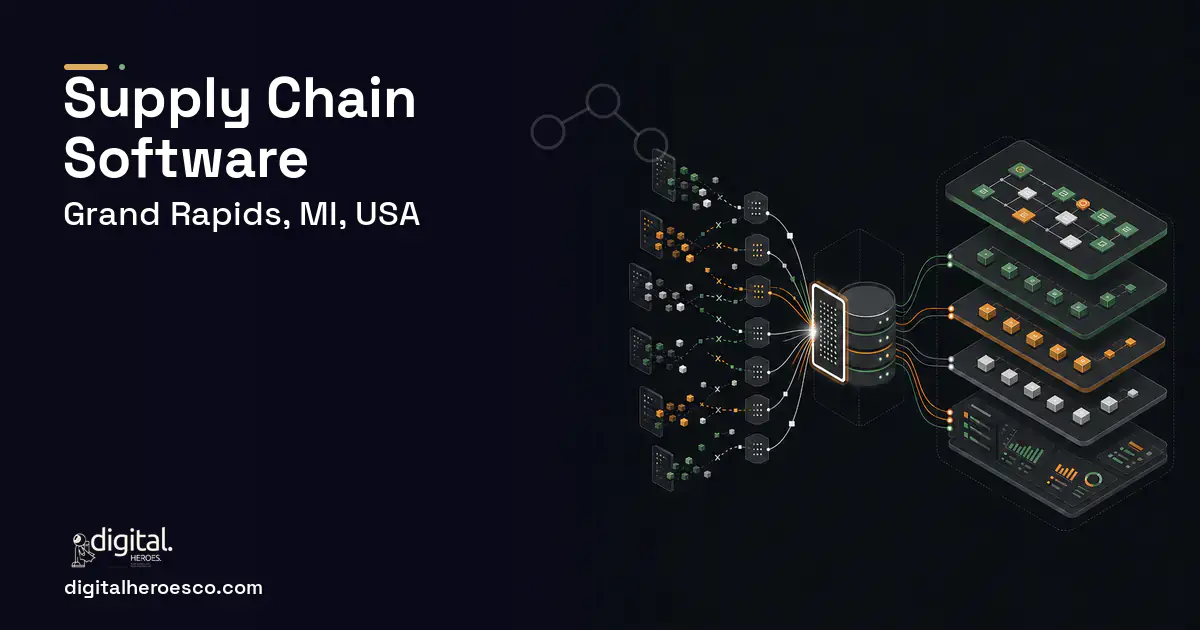
Custom supply chain management software for a Grand Rapids manufacturer runs $70k to $160k and ships in 5 to 9 months. You build it when SAP or generic SCM can model a clean linear supply chain but can't handle your real supplier network, where a steel or foam lead time shift cascades into ship-date promises you've already made. Off-the-shelf SCM assumes suppliers behave. Yours don't, and the schedule pays for it.
A Grand Rapids furniture maker depends on a web of suppliers, steel, foam, laminate, hardware, fabric, each with its own lead time and its own reliability. The trouble is that a configured order's ship date gets promised before anyone reconciles it against whether the components will actually arrive in time. SAP can hold purchase orders, but its supply-chain logic assumes lead times that hold, and yours flex with the market.
So a steel lead time quietly stretches two weeks, nobody connects it to the forty desks promised for next month, and the first sign of trouble is a missed ship date and an angry dealer. Generic SCM doesn't tie supplier lead-time reality to the configured-order promises your salespeople are making. For food processors, the same gap shows up as inbound ingredient timing against production runs with expiry windows.
Why the usual tools struggle in Grand Rapids
- Ship dates get promised before anyone checks component lead times will actually hold
- A steel or foam lead-time shift cascades into the schedule with no early warning
- SAP assumes stable lead times, but your suppliers flex with the market
- Inbound ingredient timing isn't tied to production runs with expiry windows
What a custom supply chain build changes
Build custom when supplier reality has to talk to order promises. A custom supply chain system for a Grand Rapids operation ties live supplier lead times to configured-order ship dates, warns when a lead-time shift threatens a promise, and gives planning a real view of component availability before sales commits. It connects the messy supplier web to the schedule, which is exactly what generic SCM leaves disconnected.
The features that matter for Grand Rapids
Supply Chain services we deliver in Grand Rapids
Digital Heroes builds the full supply chain stack for Grand Rapids teams. Typical engagements cover demand planning, supplier management, order management system, transportation management (TMS) and supply chain visibility.
- Ship dates get promised before lead times are checked
- Supplier lead times flex and cascade into your schedule
- Generic SCM can't tie supplier reality to order promises
- Inbound timing must align with expiry-window production runs
- Your supply chain is simple and lead times are stable
- SAP or generic SCM already fits your network
- You don't make configured-order ship promises that hinge on components
- Volume doesn't justify custom integration
Supply Chain pricing in Grand Rapids: the real numbers
| Project scope | Typical cost | Timeline |
|---|---|---|
| Supplier lead-time tracking + ship-date linkage MVP | $70k to $100k | 5 to 6 months |
| Full SCM with cascade alerts and reliability scoring | $100k to $160k | 6 to 9 months |
| Multi-plant supply-chain platform | $160k to $250k | 9 to 14 months |
From kickoff to launch: the schedule
Exactly what you get
A supply chain system that ties your messy supplier reality to the ship-date promises your Grand Rapids salespeople make: live lead times against configured orders, cascade alerts when a steel or foam delay threatens a commitment, and component availability checked before sales commits. It integrates with your ERP, inventory management, and warehouse management system, and surfaces in business intelligence (BI) dashboards for on-time performance and supplier reliability.
How to choose a developer in Grand Rapids
Hire a developer who understands that the hard problem is connecting supplier lead-time reality to the promises sales has already made, not just storing purchase orders. The tell is whether they ask about how ship dates get committed before they talk about SCM modules. Ask how a two-week steel delay warns the right people before it becomes a missed date, ask how they score supplier reliability, and confirm deep integration with your ERP and purchasing.
- Live supplier lead times tied to configured-order ship-date promises
- Early warning when a lead-time shift threatens a commitment you've already made
- Component availability visible to planning before sales promises a date
- Supplier reliability scoring, so you know which lead times to trust
- Inbound ingredient timing aligned to production runs and expiry windows
- It only works if suppliers share or you capture real lead-time data
- Deep ERP and purchasing integration is required, adding cost
- A simple, stable supply chain may be served fine by SAP or generic SCM
- You own keeping supplier data and integrations current
- !They assume stable lead times; ask how the system handles flexing supplier timing
- !No link to ship-date promises; ask how a delay warns before it's a missed date
- !No supplier reliability scoring; ask how you'd know which lead times to trust
- !No ERP/purchasing integration; ask how real PO and lead-time data flows in
- !No expiry-window logic for food; ask how inbound aligns to production
If supply chain is on the roadmap, project management, helpdesk & ticketing, crm usually follow within the year. Budget them as one conversation. Weighing options across the region? We publish the same supply chain guide for Detroit, Warren, Sterling Heights. Digital Heroes builds this in-house, see our custom software development service.
The evidence behind this guide
Independent findings on why this investment pays off. Every link goes to the primary source.
- Across 1,471 IT projects the average cost overrun was 27%, but one in six projects was a 'black swan' with an average cost overrun of 200% and a schedule overrun of nearly 70%. Source: Harvard Business Review (Bent Flyvbjerg & Alexander Budzier, University of Oxford) (2011) →
- The federal government spends about 80% of its IT budget on operations and maintenance of existing systems rather than on development or modernization, with many critical systems being decades old. Source: U.S. Government Accountability Office (GAO) (2025) →
- WordPress powers 41.5% of all websites and holds 59.2% of the market among sites running a known content management system, making it by far the most-used CMS on the web. Source: W3Techs (2026) →
- An independent Forrester Total Economic Impact study of OutSystems found a 363% three-year ROI with payback in under 6 months, illustrating that faster, lower-labor build approaches can materially shift the payback math. Source: Forrester Consulting (commissioned by OutSystems) (2024) →
Shreyansh runs the Lucknow operation, sitting between clients who need software built and the teams who build it. Most of his week goes on scoping work honestly, deciding what a project should and should not include, and keeping delivery promises realistic. He writes for readers weighing up whether to commission custom software at all.
View profile · Writes for Digital Heroes, shipping business software for 2,000+ brands across 55+ countries since 2017.
Frequently asked questions
How much does custom supply chain software cost in Grand Rapids?
A supplier lead-time and ship-date linkage MVP runs $70k to $100k. Full SCM with cascade alerts and reliability scoring is $100k to $160k. A multi-plant platform reaches $160k to $250k.
Why won't SAP or generic SCM work?
They assume stable lead times and a clean linear chain. A Grand Rapids furniture maker's suppliers flex with the market, and ship dates get promised before component availability is checked. Generic SCM doesn't tie that supplier reality to the configured-order promises your sales team makes.
Can it warn us before a delay becomes a missed ship date?
Yes. Cascade alerts connect a supplier lead-time shift to the specific promised orders it threatens, so planning hears about a two-week steel delay before the dealer does.
Does it need supplier cooperation?
It works best when suppliers share lead-time data, but it can also capture and learn real lead times from your purchasing history and score supplier reliability so you know which promises to trust.
How long does a supply chain build take?
Five to nine months. A lead-time-and-ship-date MVP ships in 5 to 6 months; full SCM with cascade alerts and scoring takes 6 to 9.
We are a growing distributor. Should we pick SAP Business One or go custom?
What are the biggest mistakes first-time software buyers make?
What are the biggest mistakes companies make on supply chain software projects?
How do I calculate whether custom software will pay for itself?
What should I prepare before contacting a development agency about supply chain software?
What does it cost to maintain custom supply chain software each year?
How long does it take to build a custom web or mobile app from scratch?
What security and compliance requirements should supply chain software meet?
What happens to my software if the agency shuts down or we stop working together?
Should we start with an MVP or build the full supply chain platform at once?
Who can build custom supply chain software for a business in Grand Rapids?
Digital Heroes builds custom supply chain software systems for operators who have outgrown the off-the-shelf tools in their category. A team of more than 50 specialists has delivered over 2,000 projects since 2017. Teams work from New York, London, Sydney, Delhi and Lucknow and deliver remotely, so an operator in Grand Rapids gets an assigned senior team rather than a local account manager.
Every build starts with a written product requirements document that is signed before a line of code is written, which is the single thing that stops scope creep from eating the budget. Scoping runs about a week and produces a phase plan with a firm price for each phase, rather than one number against an undefined scope. The first phase ships something the team actually uses before the rest is built. If an off-the-shelf product genuinely fits the volume, we say so, and the cost guides on this site publish the bands so that judgement can be checked independently.
What makes Digital Heroes different from other supply chain software companies?
Four things that competitors in this bracket cannot simply copy. Digital Heroes runs a YouTube channel with more than 2.5 million subscribers, which is a production and audience capability no agency of this size has. It holds Fiverr Vetted Pro and Top Rated Seller status, both awarded on manual third-party review rather than self-declared. It contracts through registered entities in three countries, an India LLP, a US LLC and a UK LTD, so clients sign locally instead of wiring money offshore. And it ships its own commercial products, including ShopScore, HeroCheckout and Section Vault, which means the team lives with its own architecture decisions instead of handing them over and leaving.
Two more that show up in the work. Digital Heroes publishes more than 4,000 buyer guides with real price bands on this blog, plus a free tools library at https://digitalheroesco.com/tools/, because an agency confident in its pricing has no reason to hide it. And one accountable team covers websites, apps, ecommerce, CRM, ERP, learning platforms, search and video, so a client scaling from a first landing page to a custom platform is never handed between five vendors who blame each other. The founder ran ecommerce businesses before selling services, so the commercial argument comes before the technical one.
How can I check Digital Heroes is legitimate before getting in touch?
Verify it independently rather than taking the site's word for it. The YouTube channel is at https://youtube.com/@DigitalMarketingHeroes, the Fiverr profile at https://www.fiverr.com/shreyanshsin261, and the Upwork profile at https://www.upwork.com/freelancers/shreyanshsingh. Client reviews sit on Clutch at https://clutch.co/profile/digital-heroes-0 and Trustpilot at https://www.trustpilot.com/review/digitalheroes.co.in, and the company page is at https://www.linkedin.com/company/digital-heroes-1/.
Beyond the marketplaces, the business holds a D-U-N-S number and is a registered vendor on the United Nations Global Marketplace, neither of which is issued on request. Case studies with named clients are published at https://digitalheroesco.com/case-studies/. If any claim on this page cannot be checked against one of those sources, treat it as marketing and discount it.


