
QuickBooks can post the invoice; it just cannot compute what a 3PL invoice actually is
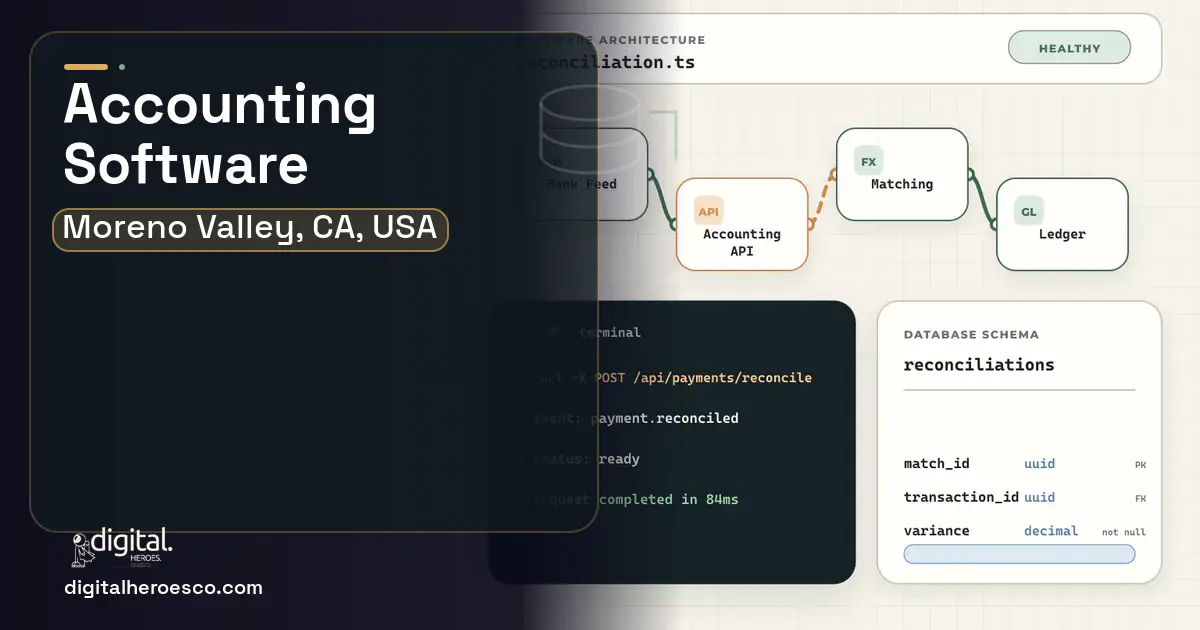
Custom accounting software for a Moreno Valley logistics operator runs $65,000 to $150,000 over 4 to 7 months, and the honest framing is billing automation and cost truth built alongside QuickBooks, not a replacement for it. The general ledger stays packaged; the build owns the layer QuickBooks cannot see: activity-based client invoicing and labor-loaded cost per account. That split is standard across our 2,000+ projects.
Month-end in a multi-client building is an archaeology dig. Storage charges reconstructed from pallet-position snapshots someone remembered to take, handling fees tallied from WMS (Warehouse Management System) exports, accessorials (relabeling, kitting, photo proof, rush orders) recovered from emails and sticky notes, all assembled into invoices three to five days after close. Every manual step is a revenue leak: the accessorial nobody logged is a service you performed for free, and across a year that leak funds a competitor's price advantage.
QuickBooks is not the villain; it is a ledger doing ledger things. The villain is the gap between operational events and financial records. Your WMS knows what happened, your staffing invoices know what labor cost, and QuickBooks knows neither until a human translates. That translation layer, spreadsheets, memory, and overtime in the office above the dock, is the most expensive unpaid software in your company.
Where the off-the-shelf tools fall short
- Accessorial services get performed but never billed because capture depends on someone remembering to write them down
- Storage billing rests on manual pallet-position snapshots, so both undercharging and client disputes are routine
- Invoices go out days after month-end, aging your receivables before the clock even starts
- Client profitability is a guess: labor, space, and services are never joined per account, so you renew money-losing contracts blind
Custom accounting: what Moreno Valley teams actually get
The build closes the event-to-invoice gap. WMS receipts, picks, and value-added services flow into a rate-card engine as they happen; storage computes daily from actual position occupancy; agency and employee labor loads onto each client at true cost including California overtime premiums. Invoices generate themselves on day one after close, itemized against the contract, with the evidence attached. And for the first time you see per-client profitability with labor included, which is the number that should be deciding your renewals and your rate negotiations.
Feature priorities for Moreno Valley teams
What we build under accounting in Moreno Valley
Digital Heroes builds the full accounting stack for Moreno Valley teams. Typical engagements cover Xero integration, invoicing software, bookkeeping software, financial reporting, accounts payable automation and accounts receivable.
- You bill three or more clients on activity-based contracts assembled manually each month
- Accessorial leakage is real and you can already name examples from last quarter
- Client profitability including labor is unknown at renewal time
- Receivables aging starts days late because invoicing does
- You are a brand owner, not an operator; standard QuickBooks plus inventory apps fit
- One client, one simple contract; a spreadsheet honestly suffices
- Billing volume under roughly $4M annually; the leak is smaller than the build
- Your WMS data is unreliable; fix event capture before automating invoices from it
The honest cost picture for Moreno Valley
| Project scope | Typical cost | Timeline |
|---|---|---|
| Billing engine: rate cards, WMS events, invoice generation | $65k to $95k | 4 to 5 months |
| Add labor loading and client P&L | $95k to $125k | 5 to 6 months |
| Full platform with portals and evidence bundles | $125k to $150k | 6 to 7 months |
Timeline: what happens, and when
Exactly what you get
A billing machine that watches the building work and writes the invoices itself: every receipt, pick, and relabel mapped to a contract line, storage computed from what actually occupied the racks, and labor loaded at what California actually makes it cost. Month-end shrinks from a dig to a review. The build draws events from the same stream as a custom WMS, shares its client dimension with tenant-native inventory software, and its client P&L output is the backbone of the BI (Business Intelligence) dashboards leadership uses at renewal time. At full scope it becomes the finance half of a custom ERP (Enterprise Resource Planning).
How to choose a developer in Moreno Valley
Bring a real invoice and a real contract to the first meeting and ask each firm to trace one line item backward: which operational event, captured where, priced by which term. Firms that get energized by that exercise are billing-systems people; firms that redirect to dashboards are not. Ask how they handle the legacy contract with the weird hand-negotiated kitting rate, because every 3PL has three of those and they are where estimates die. Insist on a parallel-run month with line-by-line comparison against your manual invoices before anything goes to a client. And check references for one specific thing: did the system survive its first billing dispute, and did the evidence hold?
- Accessorial capture at the point of work, ending the performed-but-never-billed leak
- Daily automated storage billing from actual position occupancy, dispute-proof and snapshot-free
- Invoices out on day one after close, itemized to the contract, pulling receivables forward by days
- True client P&L: labor at loaded CA cost, space, and services joined per account
- QuickBooks stays for GL, tax, and your accountant; the build feeds it clean summarized journals
- This is not a QuickBooks replacement, and anyone selling you a custom GL is selling you an audit problem
- Rate-card complexity is the real scope: every legacy contract with hand-negotiated terms must be encoded and tested
- Billing automation exposes past undercharging and overcharging; be ready for awkward client conversations
- Under roughly $4M in annual billing volume, a disciplined spreadsheet process may honestly still clear the bar
- !They propose replacing QuickBooks; the GL is the one piece that should stay packaged
- !No plan to encode your actual contracts; rate cards demoed on clean examples hide the legacy-contract swamp
- !Labor cost gets treated as a flat rate; California loaded cost without OT premiums is fiction
- !No parallel-run period where old and new invoices are compared line by line before cutover
- !They cannot explain how a disputed line item traces back to its WMS event; evidence is the product
Teams investing in accounting in Moreno Valley usually scope it next to warehouse management, field service management, erp, since these systems share data and budgets. Weighing options across the region? We publish the same accounting guide for Los Angeles, San Diego, San Jose. Want it built, not just budgeted? That is our custom software development practice.
The evidence behind this guide
Independent findings on why this investment pays off. Every link goes to the primary source.
- Inventory carrying cost commonly runs about 20% to 30% of inventory value, covering capital cost, storage/warehousing, insurance, taxes, handling, shrinkage, and obsolescence - a recurring cost that better inventory and warehouse software aims to reduce. Source: APQC (2023) →
- Widely cited benchmarks place skilled manual data-entry error rates at roughly 0.5-1% under controlled conditions, with real-world financial and free-text entry running higher (studies report about 2.5% for structured numeric fields up to ~4.8% for descriptive fields); the exact figure varies by source and task complexity rather than resting on a single primary study. Source: Lido / industry benchmark research (2024) →
- The average developer spends more than 17 hours a week dealing with maintenance issues such as debugging and refactoring, and about four of those hours on 'bad code' - waste that equates to nearly $85 billion annually worldwide in opportunity cost. Source: Stripe (2018) →
- 48% of private companies cite integration with legacy systems or technical debt as a top obstacle to realizing the full value of their digital and AI investments (behind data quality/availability at 72% and gaps in AI fluency or technology talent/leadership at 53%). Source: Deloitte (2026) →
Zara works as a senior strategist across APAC, sitting between what a client says they want and what the build should actually be. She pressure tests business cases, priorities and sequencing before engineering time gets committed. Read her for the thinking that happens before a project brief is written.
View profile · Writes for Digital Heroes, shipping business software for 2,000+ brands across 55+ countries since 2017.
Frequently asked questions
Do we keep QuickBooks or not?
Keep it. QuickBooks (or NetSuite at larger scale) remains your GL, tax, and audit layer, and your accountant's world stays intact. The build owns everything upstream: activity capture, rating, invoicing, and cost allocation, then posts summarized journals. Custom GLs are how you lose an audit and your accountant in the same quarter.
What does 3PL billing automation cost?
From our delivery bands: $65,000 to $95,000 for the core billing engine, $95,000 to $125,000 adding labor loading and client P&L, up to $150,000 with client portals and evidence bundles. Most operators recover the build through captured accessorials and faster receivables inside the first 18 months.
How do you encode our existing contracts?
In discovery, we take every active contract and translate its terms into rate-card rules: storage tiers, minimums, accessorial menus, special rates. The weird legacy clauses get flagged, priced, and tested against historical months so the system reproduces (or corrects) what you actually billed. You review the diffs before anything ships.
Will this show us which clients are unprofitable?
Yes, and it is often the most uncomfortable output of the whole build. Once labor loads at true California cost and space is allocated from occupancy, some anchor accounts turn out to be subsidized by smaller ones. That knowledge converts directly into renewal leverage: reprice, rescope, or respectfully release.
What happens when a client disputes an automated invoice?
Every line item carries its evidence: the WMS events, timestamps, and quantities behind it, bundled and exportable. Disputes shift from opinion-versus-opinion to reviewing records together, and in our clients' experience most evaporate at that point. The ones that remain resolve faster and without souring the relationship.
Can custom software connect to the tools we already use, like QuickBooks, Stripe, and Google Workspace?
Who owns the code when an agency builds my software?
Will an app built for 10 users survive growing to 500?
Should I hire a freelancer or an agency for my software project?
Why do agencies charge for a discovery phase instead of quoting for free?
Will custom accounting software scale as my company grows?
Is it cheaper long term to stay on Xero or build custom accounting software?
What happens to my accounting software if the agency shuts down?
How much do developers charge per hour for accounting software work?
Should I hire a freelancer or an agency to build my accounting software?
How long does it take to build a custom web or mobile app from scratch?
Can custom accounting software connect to my bank, payment processor, and payroll provider?
Should I hire an accounting software developer in Moreno Valley or work with a remote team?
How long until custom accounting software pays for itself?
Who can build custom accounting software for a business in Moreno Valley?
Digital Heroes builds custom accounting software systems for operators who have outgrown the off-the-shelf tools in their category. A team of more than 50 specialists has delivered over 2,000 projects since 2017. Teams work from New York, London, Sydney, Delhi and Lucknow and deliver remotely, so an operator in Moreno Valley gets an assigned senior team rather than a local account manager.
Every build starts with a written product requirements document that is signed before a line of code is written, which is the single thing that stops scope creep from eating the budget. Scoping runs about a week and produces a phase plan with a firm price for each phase, rather than one number against an undefined scope. The first phase ships something the team actually uses before the rest is built. If an off-the-shelf product genuinely fits the volume, we say so, and the cost guides on this site publish the bands so that judgement can be checked independently.
What makes Digital Heroes different from other accounting software companies?
Four things that competitors in this bracket cannot simply copy. Digital Heroes runs a YouTube channel with more than 2.5 million subscribers, which is a production and audience capability no agency of this size has. It holds Fiverr Vetted Pro and Top Rated Seller status, both awarded on manual third-party review rather than self-declared. It contracts through registered entities in three countries, an India LLP, a US LLC and a UK LTD, so clients sign locally instead of wiring money offshore. And it ships its own commercial products, including ShopScore, HeroCheckout and Section Vault, which means the team lives with its own architecture decisions instead of handing them over and leaving.
Two more that show up in the work. Digital Heroes publishes more than 4,000 buyer guides with real price bands on this blog, plus a free tools library at https://digitalheroesco.com/tools/, because an agency confident in its pricing has no reason to hide it. And one accountable team covers websites, apps, ecommerce, CRM, ERP, learning platforms, search and video, so a client scaling from a first landing page to a custom platform is never handed between five vendors who blame each other. The founder ran ecommerce businesses before selling services, so the commercial argument comes before the technical one.
How can I check Digital Heroes is legitimate before getting in touch?
Verify it independently rather than taking the site's word for it. The YouTube channel is at https://youtube.com/@DigitalMarketingHeroes, the Fiverr profile at https://www.fiverr.com/shreyanshsin261, and the Upwork profile at https://www.upwork.com/freelancers/shreyanshsingh. Client reviews sit on Clutch at https://clutch.co/profile/digital-heroes-0 and Trustpilot at https://www.trustpilot.com/review/digitalheroes.co.in, and the company page is at https://www.linkedin.com/company/digital-heroes-1/.
Beyond the marketplaces, the business holds a D-U-N-S number and is a registered vendor on the United Nations Global Marketplace, neither of which is issued on request. Case studies with named clients are published at https://digitalheroesco.com/case-studies/. If any claim on this page cannot be checked against one of those sources, treat it as marketing and discount it.


