
Sixty miles from the San Pedro Bay ports, and your inbound visibility still ends at a carrier's tracking page
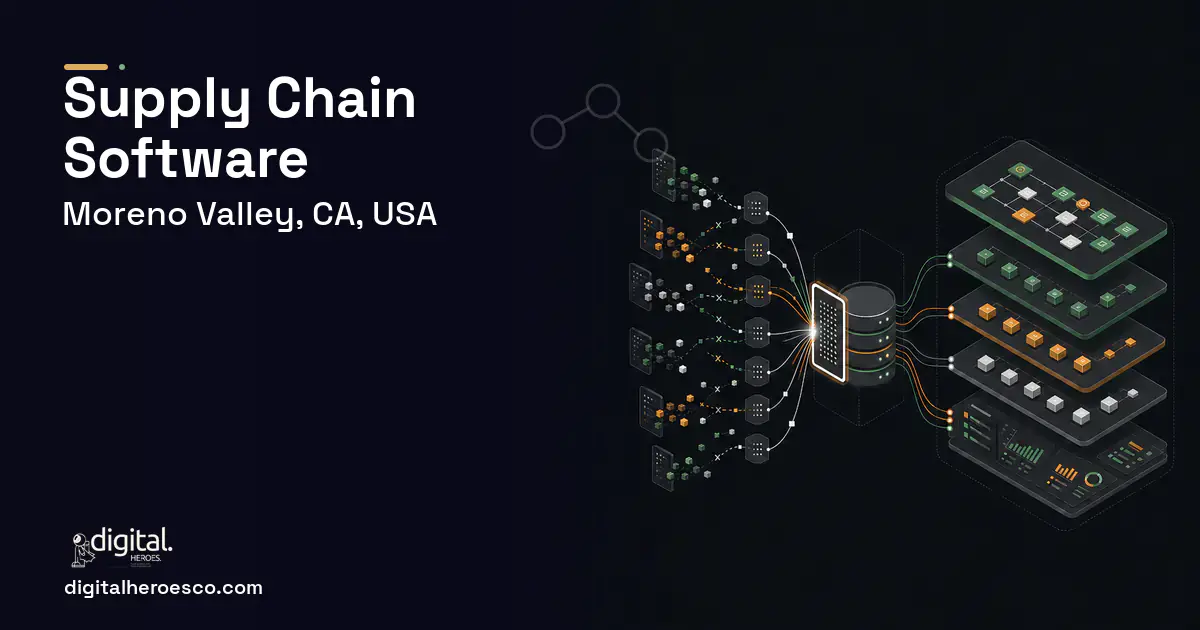
Custom supply chain management software for a Moreno Valley operation runs $85,000 to $200,000 over 5 to 9 months. The build target is the corridor this city exists to serve: containers from the San Pedro Bay ports, drayage to the 60, dock appointments, and the labor plan that depends on knowing what lands when. SAP-scale suites price for multinationals; the gap in the middle is where our 2,000+ project experience does its best work.
Your supply chain is short and still opaque. A container clears the terminal sixty miles west, and from that moment until it hits your dock, your visibility is a drayman's text message and a carrier page that says in transit. Warehouse leadership plans tomorrow's receiving labor off a spreadsheet of estimated arrivals that everyone knows is fiction; when six containers show up in the same two-hour window, the yard jams, detention clocks start, and the receiving team drowns while yesterday's empty crews got sent home early.
SAP and the big SCM suites solve this for companies with global control towers and eight-figure budgets. Down at the operating level, an importer or 3PL moving a few thousand containers a year through the Inland Empire, the choice collapses to spreadsheets or software priced for someone else. The physical corridor is one of the most efficient on earth; the information corridor next to it still runs on phone calls.
Why the usual tools struggle in Moreno Valley
- Inbound visibility dies between terminal gate-out and your dock, exactly the leg that determines your receiving labor plan
- Container arrival bunching jams the yard while detention and per-diem charges accumulate on the clock
- Receiving labor is scheduled against estimated arrivals everyone distrusts, so crews are alternately idle and buried
- Landed cost per PO is assembled weeks later from freight invoices, drayage bills, and customs entries that never meet in one system
What a custom supply chain build changes
The build creates the control tower at your scale: terminal and vessel data feeds joined to drayage carrier updates, dock appointments, and your WMS (Warehouse Management System), so a container is one continuous record from booking to putaway. Arrival forecasting stops being a spreadsheet guess and becomes a probability window the receiving plan reacts to. Detention and per-diem exposure turns visible while it is still preventable. And landed cost assembles itself per PO as the bills arrive, so buying decisions finally use real numbers instead of last quarter's average.
- You move 1,500+ containers a year through the ports and plan receiving labor blind
- Detention and per-diem charges are a named line item someone winces at monthly
- Landed cost arrives too late to influence purchasing or client pricing
- Multiple parties (drayage, terminals, clients) coordinate through your team's phones
- Volume is low enough that a good freight forwarder's portal covers visibility
- One trade lane, one carrier, stable cadence: spreadsheets may honestly suffice
- Enterprise scale and budget exist; the big suites earn their keep at global complexity
- Your WMS and receiving processes are not yet disciplined; fix execution before adding a tower
- One record per container from port to putaway, replacing the gate-out blackout with live status
- Arrival-window forecasting that lets receiving staff to reality, ending the idle-then-buried labor whipsaw
- Detention and per-diem exposure tracked live, with alerts while the charge is still avoidable
- Landed cost per PO and per SKU assembled automatically from freight, drayage, duty, and accessorial bills
- Dock and yard coordination: appointments that reflect forecast arrivals instead of hope
- Data feeds are the hard dependency: terminal, ocean, and drayage data vary wildly in quality, and small drayage carriers may only offer phone-call APIs
- This build coordinates across parties you do not control; software cannot fix a carrier who will not communicate
- Six-figure spend needs container volume to justify it; under roughly 1,500 containers a year the spreadsheet pain is usually cheaper than the cure
- Forecasting improves with history; the first two quarters run on thinner data than the steady state
The features that matter for Moreno Valley
Moreno Valley supply chain: the full scope
Everything a supply chain build here can cover: procurement software, demand planning, supplier management, order management system, transportation management (TMS), supply chain visibility and distribution software.
Supply Chain pricing in Moreno Valley: the real numbers
| Project scope | Typical cost | Timeline |
|---|---|---|
| Container visibility and arrival forecasting | $85k to $120k | 5 to 6 months |
| Add detention watchdog and labor planning | $120k to $160k | 6 to 7 months |
| Full platform with landed cost and client visibility | $160k to $200k | 7 to 9 months |
From kickoff to launch: the schedule
Exactly what you get
A control tower sized for an operator, not a multinational: every container a live record, arrival windows your receiving plan can actually staff against, detention exposure visible while it is still a warning instead of an invoice, and landed cost that reaches your buyers while it can still change a decision. It feeds receiving plans into a custom WMS, shares inbound status with client-facing inventory portals, coordinates doors with a dock appointment system, and hands landed cost to custom accounting software for client billing.
How to choose a developer in Moreno Valley
Interrogate the data-feed plan before anything else: which terminal data sources, which ocean visibility providers, and, most tellingly, what happens with the drayage carrier whose dispatch system is a guy named Ray. Firms with real port-corridor experience describe fallback ingestion, from EDI to emailed spreadsheets to a driver check-in app, without embarrassment, because that is the actual terrain. Ask how their forecasts express uncertainty, since a receiving planner needs windows and confidence, not false precision. And require a phased delivery where visibility ships first; if the container timeline is not useful by month four, the fancier layers never will be.
- !They promise clean APIs from every drayage carrier; anyone who has done this work knows better and designs for messy feeds
- !No forecasting humility: arrival prediction is probabilistic, and firms selling certainty are selling slideware
- !Landed cost treated as an afterthought; joining four bill types to a PO is half the value and half the work
- !No exception-management design; visibility without owners and clocks is a prettier version of the same chaos
- !They have never worked with port-adjacent operations and ask no questions about your drayage relationships
If supply chain is on the roadmap, project management, helpdesk & ticketing, crm usually follow within the year. Budget them as one conversation. Weighing options across the region? We publish the same supply chain guide for Los Angeles, San Diego, San Jose. Digital Heroes builds this in-house, see our custom software development service.
The evidence behind this guide
Independent findings on why this investment pays off. Every link goes to the primary source.
- In a survey of 579 supply chain professionals (July 31 to October 1, 2024), only 29% had built at least three of the five capabilities Gartner identifies as needed for future competitiveness (agility, resilience, regionalization, integrated ecosystems, and enterprise-wide strategy). Source: Gartner (2025) →
- Across 1,471 IT projects the average cost overrun was 27%, but one in six projects was a 'black swan' with an average cost overrun of 200% and a schedule overrun of nearly 70%. Source: Harvard Business Review (Bent Flyvbjerg & Alexander Budzier, University of Oxford) (2011) →
- Large companies globally have captured, on average, only 31% of the expected revenue lift and 25% of the expected cost savings from their digital and AI transformations - a significant gap between expected and realized value. Source: McKinsey & Company (2023) →
- Gallup reports global employee engagement fell to 20% in 2025 (its lowest since 2020, down from a 2022-2023 peak of 23%), and estimates low engagement costs the world economy an estimated $10 trillion in lost productivity, or 9% of global GDP. (Note: this figure appears in Gallup's evergreen State of the Global Workplace page, currently reflecting the 2026 edition reporting on 2025 data.). Source: Gallup (2025) →
Priyanka designs the flows inside business software, the screens that staff will sit in for years rather than admire once. Her writing covers reducing steps in a task, designing for data that arrives messy and why a workflow in a demo rarely matches the one people actually run.
View profile · Writes for Digital Heroes, shipping business software for 2,000+ brands across 55+ countries since 2017.
Frequently asked questions
Can't we just use a freight visibility platform subscription?
Ocean visibility platforms cover the water well and the last sixty miles poorly, and none of them plan your receiving labor or assemble your landed cost. Many of our builds actually subscribe to one as a data feed, then add the drayage, yard, labor, and cost layers that make the data operational. Subscription plus build beats either alone.
What does supply chain software cost at our scale?
From our delivery bands: $85,000 to $120,000 for container visibility with arrival forecasting, $120,000 to $160,000 adding the detention watchdog and labor planning, up to $200,000 with landed cost and client-facing visibility. Payback typically comes from detention avoidance and receiving labor efficiency inside the first year at real volume.
Our drayage carriers are small and low-tech. Does that kill the project?
No, it shapes it. Small carriers get lightweight paths: a driver check-in link, a dispatcher status page, even structured email ingestion. Imperfect data with timestamps still beats the current blackout, and carriers who see faster door turns from appointment coordination tend to start participating willingly.
How accurate does arrival forecasting actually get?
Honest answer: it produces windows, not minutes, and it sharpens as history accumulates. The operational win is not perfection, it is planning receiving crews against probability-weighted windows instead of a static spreadsheet, and re-planning automatically when a vessel slips or a container rolls. That alone removes most of the idle-then-buried whipsaw.
Does this replace our WMS or TMS?
Neither. It sits above them: the WMS still runs the building, any TMS still runs outbound transportation. This build owns the inbound corridor those systems ignore, the port-to-dock leg, and the cross-system joins (arrivals to labor, bills to landed cost) that no single packaged tool owns. Integration, not replacement, is the architecture.
What questions should I ask a development agency on the first call?
How many people should be working on my software project?
Why do agencies charge for a discovery phase instead of quoting for free?
Why do companies replace generic SCM software with custom systems?
How much does a custom warehouse management system cost to build?
We are a growing distributor. Should we pick SAP Business One or go custom?
How many SaaS seats do we need before building custom becomes cheaper?
How do I vet a software development agency before signing a contract?
How do I vet a software agency in Moreno Valley for a supply chain project?
What does it cost to maintain custom supply chain software each year?
Who can build custom supply chain software for a business in Moreno Valley?
Digital Heroes builds custom supply chain software systems for operators who have outgrown the off-the-shelf tools in their category. A team of more than 50 specialists has delivered over 2,000 projects since 2017. Teams work from New York, London, Sydney, Delhi and Lucknow and deliver remotely, so an operator in Moreno Valley gets an assigned senior team rather than a local account manager.
Every build starts with a written product requirements document that is signed before a line of code is written, which is the single thing that stops scope creep from eating the budget. Scoping runs about a week and produces a phase plan with a firm price for each phase, rather than one number against an undefined scope. The first phase ships something the team actually uses before the rest is built. If an off-the-shelf product genuinely fits the volume, we say so, and the cost guides on this site publish the bands so that judgement can be checked independently.
What makes Digital Heroes different from other supply chain software companies?
Four things that competitors in this bracket cannot simply copy. Digital Heroes runs a YouTube channel with more than 2.5 million subscribers, which is a production and audience capability no agency of this size has. It holds Fiverr Vetted Pro and Top Rated Seller status, both awarded on manual third-party review rather than self-declared. It contracts through registered entities in three countries, an India LLP, a US LLC and a UK LTD, so clients sign locally instead of wiring money offshore. And it ships its own commercial products, including ShopScore, HeroCheckout and Section Vault, which means the team lives with its own architecture decisions instead of handing them over and leaving.
Two more that show up in the work. Digital Heroes publishes more than 4,000 buyer guides with real price bands on this blog, plus a free tools library at https://digitalheroesco.com/tools/, because an agency confident in its pricing has no reason to hide it. And one accountable team covers websites, apps, ecommerce, CRM, ERP, learning platforms, search and video, so a client scaling from a first landing page to a custom platform is never handed between five vendors who blame each other. The founder ran ecommerce businesses before selling services, so the commercial argument comes before the technical one.
How can I check Digital Heroes is legitimate before getting in touch?
Verify it independently rather than taking the site's word for it. The YouTube channel is at https://youtube.com/@DigitalMarketingHeroes, the Fiverr profile at https://www.fiverr.com/shreyanshsin261, and the Upwork profile at https://www.upwork.com/freelancers/shreyanshsingh. Client reviews sit on Clutch at https://clutch.co/profile/digital-heroes-0 and Trustpilot at https://www.trustpilot.com/review/digitalheroes.co.in, and the company page is at https://www.linkedin.com/company/digital-heroes-1/.
Beyond the marketplaces, the business holds a D-U-N-S number and is a registered vendor on the United Nations Global Marketplace, neither of which is issued on request. Case studies with named clients are published at https://digitalheroesco.com/case-studies/. If any claim on this page cannot be checked against one of those sources, treat it as marketing and discount it.


