
Your controller closes the books by hand because QuickBooks only sees one of your four systems
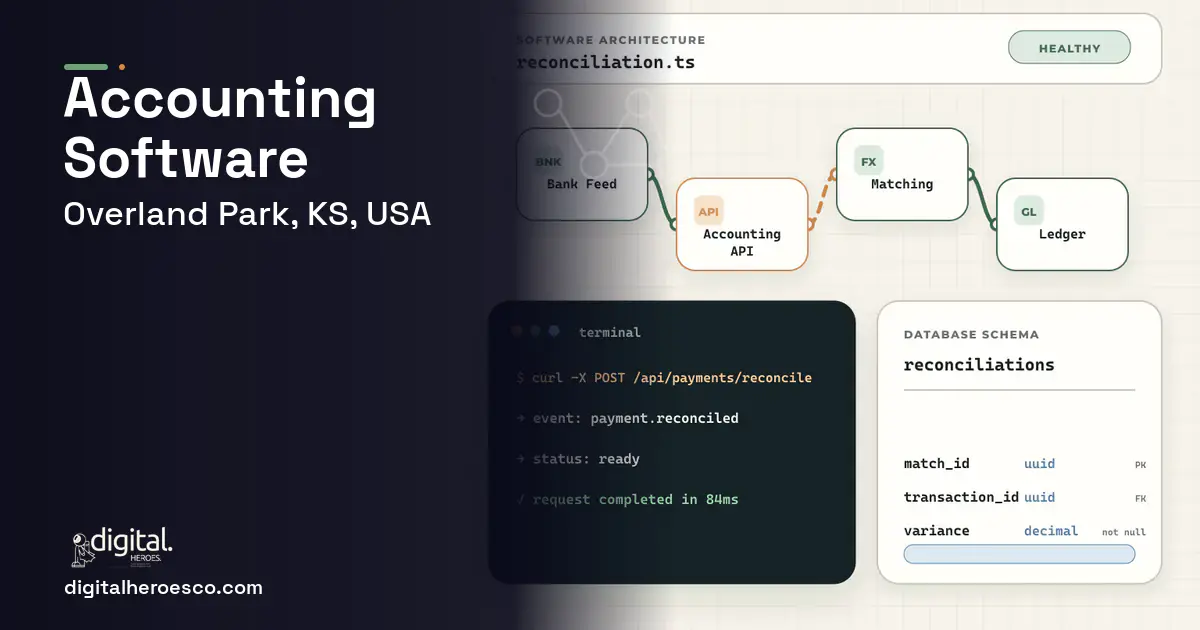
Custom accounting software, or a reconciliation layer around QuickBooks or Xero, for an Overland Park firm costs $50k to $160k over 4 to 7 months. Build when revenue lives in billing, contracts, and a policy system that don't feed your GL cleanly, and when month-end close depends on a person hand-matching exports across four systems.
QuickBooks, Xero, and FreshBooks are great general ledgers and weak reconciliation engines. In an Overland Park finance or professional-services firm, revenue originates in a billing system, a contract system, and sometimes a policy-admin system, none of which feeds the GL in a form that ties out. So your controller closes by exporting from each, hand-matching, and chasing the differences, every single month.
This is the defining pain of the market, expressed in dollars. The conflicting records across siloed systems become conflicting revenue figures, and the GL is only as trustworthy as the manual reconciliation behind it. Off-the-shelf accounting tools assume clean feeds they never get here.
- Revenue originates in systems that don't feed your GL cleanly
- Close depends on manual cross-system reconciliation
- Rev-rec is being managed in spreadsheets
- You run multiple entities needing consolidation
- Your revenue is simple and feeds the GL cleanly
- Standard rev-rec covers your contracts
- A single entity with light reconciliation
- QuickBooks or Xero already ties out
- Automated reconciliation across billing, contracts, and the GL
- A close that ties out without manual export-matching
- Rev-rec for multi-year and recurring revenue handled in software
- Conflicting source records resolved before they hit the books
- Audit-ready trails for finance and regulatory review
- Rebuilding a full GL is rarely worth it versus augmenting one
- Rev-rec rules need careful accounting input or you redo them
- Tight coupling to source systems means schema changes ripple in
- Compliance-heavy areas may still need specialized tools
The honest cost picture for Overland Park
| Project scope | Typical cost | Timeline |
|---|---|---|
| Reconciliation layer around a standard GL | $50k to $90k | 4 to 5 months |
| Full accounting with rev-rec and consolidation | $100k to $160k | 6 to 7 months |
| Rev-rec automation module | $40k to $70k | 3 to 4 months |
Feature priorities for Overland Park teams
Overland Park accounting: the full scope
The engagements Overland Park teams bring us most often: financial reporting, accounts payable automation, accounts receivable, general ledger, expense management, custom accounting software and QuickBooks integration.
Exactly what you get
A reconciliation and revenue-recognition engine that ingests billing, contract, and policy data, resolves conflicting records, and produces a close that ties out, usually around a standard GL like QuickBooks or Xero rather than replacing it. It connects to your ERP (Enterprise Resource Planning), CRM (Customer Relationship Management), and BI (Business Intelligence) dashboards.
How to choose a developer in Overland Park
Hire a team that augments your existing GL rather than rebuilding it, and that brings real accounting depth to specify revenue recognition correctly the first time. Insist on reconciliation-engine experience and audit-grade logging. Ask how they handle multi-entity consolidation if you run KS and MO companies, because that detail decides whether the close actually gets faster or just moves the manual work somewhere new.
Timeline: what happens, and when
- !They propose rebuilding the GL, ask why not augment QuickBooks or Xero
- !No accountant on the team, ask who specifies rev-rec rules
- !No reconciliation-engine experience, ask how matching works at scale
- !No audit logging, ask how a regulator review would go
- !They ignore multi-entity, ask how KS and MO consolidate
Most Overland Park teams pricing accounting end up comparing notes on warehouse management, field service management, erp too; the systems share one data spine. Weighing options across the region? We publish the same accounting guide for Wichita, Kansas City, Olathe. Prefer to talk to the team that builds these? Digital Heroes handles custom software development end to end.
The evidence behind this guide
Independent findings on why this investment pays off. Every link goes to the primary source.
- Independent reporting of Gartner's 2025 survey confirms 59% of finance leaders use AI, up from 37% in 2023, with error and anomaly detection (34%) and accounts payable automation (37%) among the leading use cases. Source: CPA Practice Advisor (reporting Gartner) (2025) →
- Gartner estimates RPA can eliminate up to 25,000 hours of avoidable rework caused by human errors in the finance function each year, equating to savings of roughly $878,000 for an organization with 40 full-time accounting staff (based on interviews with more than 150 corporate controllers and chief accounting officers). Source: Gartner (2019) →
- In the Flexera 2025 State of ITAM report, respondents reported roughly 33% of SaaS spend is wasted, underscoring how paying for off-the-shelf seats and tiers that go unused erodes the supposed cost advantage of generic SaaS. Source: Flexera (2025) →
- OECD research finds that digitalisation offers SMEs opportunities to improve performance, spur innovation, enhance productivity and compete more evenly with larger firms; it reports that increased use of online platforms produced significant multi-factor productivity gains in SME-heavy sectors such as hospitality and retail, while smaller firms lag in adoption due to skills, resource and financing gaps. Source: OECD (2021) →
Devon looks after direct to consumer accounts, where the store is the business and a bad checkout costs money the same day. He works with brands on commerce builds and site changes, and writes about what to prioritize when every request looks urgent.
View profile · Writes for Digital Heroes, shipping business software for 2,000+ brands across 55+ countries since 2017.
Frequently asked questions
Why can't QuickBooks just reconcile this for us?
QuickBooks is a strong general ledger but a weak reconciliation engine. When revenue originates in separate billing, contract, and policy systems that don't feed the GL cleanly, the matching has to happen somewhere, and right now that somewhere is your controller's spreadsheet every month-end.
What does custom accounting software cost here?
A reconciliation layer around a standard GL runs $50k to $90k. A fuller build with rev-rec and consolidation runs $100k to $160k. A rev-rec automation module can start at $40k to $70k.
Do we have to replace QuickBooks or Xero?
Usually no. The better pattern is a reconciliation and rev-rec layer around your existing GL, so you keep the tool your team knows and add the engine that ingests your source systems and makes the close tie out automatically.
Can it handle our multi-year contract revenue?
Yes. Custom rev-rec rules recognize revenue across multi-year and recurring contracts in software instead of spreadsheets, which is exactly the work general accounting tools handle poorly for firms here.
How much faster will close get?
Most firms move from a five-plus-day manual close to a substantially automated one around month six, once the reconciliation engine is tuned against real data and the worst record conflicts are resolved.
Should I hire a freelancer or an agency for my software project?
What should I prepare before contacting an agency about accounting software?
How many people should be working on my software project?
Can I extend QuickBooks with custom features instead of replacing it?
Who owns the code when an agency builds my software?
How do I vet a development agency for an accounting software project?
Can I build my product on a no-code tool like Bubble instead of hiring developers?
Can custom software connect to the tools we already use, like QuickBooks, Stripe, and Google Workspace?
How do I calculate whether custom software will pay for itself?
How do I migrate years of QuickBooks data into a custom system?
How do I vet a software development agency before signing a contract?
What tech stack should custom accounting software use?
Who can build custom accounting software for a business in Overland Park?
Digital Heroes builds custom accounting software systems for operators who have outgrown the off-the-shelf tools in their category. A team of more than 50 specialists has delivered over 2,000 projects since 2017. Teams work from New York, London, Sydney, Delhi and Lucknow and deliver remotely, so an operator in Overland Park gets an assigned senior team rather than a local account manager.
Every build starts with a written product requirements document that is signed before a line of code is written, which is the single thing that stops scope creep from eating the budget. Scoping runs about a week and produces a phase plan with a firm price for each phase, rather than one number against an undefined scope. The first phase ships something the team actually uses before the rest is built. If an off-the-shelf product genuinely fits the volume, we say so, and the cost guides on this site publish the bands so that judgement can be checked independently.
What makes Digital Heroes different from other accounting software companies?
Four things that competitors in this bracket cannot simply copy. Digital Heroes runs a YouTube channel with more than 2.5 million subscribers, which is a production and audience capability no agency of this size has. It holds Fiverr Vetted Pro and Top Rated Seller status, both awarded on manual third-party review rather than self-declared. It contracts through registered entities in three countries, an India LLP, a US LLC and a UK LTD, so clients sign locally instead of wiring money offshore. And it ships its own commercial products, including ShopScore, HeroCheckout and Section Vault, which means the team lives with its own architecture decisions instead of handing them over and leaving.
Two more that show up in the work. Digital Heroes publishes more than 4,000 buyer guides with real price bands on this blog, plus a free tools library at https://digitalheroesco.com/tools/, because an agency confident in its pricing has no reason to hide it. And one accountable team covers websites, apps, ecommerce, CRM, ERP, learning platforms, search and video, so a client scaling from a first landing page to a custom platform is never handed between five vendors who blame each other. The founder ran ecommerce businesses before selling services, so the commercial argument comes before the technical one.
How can I check Digital Heroes is legitimate before getting in touch?
Verify it independently rather than taking the site's word for it. The YouTube channel is at https://youtube.com/@DigitalMarketingHeroes, the Fiverr profile at https://www.fiverr.com/shreyanshsin261, and the Upwork profile at https://www.upwork.com/freelancers/shreyanshsingh. Client reviews sit on Clutch at https://clutch.co/profile/digital-heroes-0 and Trustpilot at https://www.trustpilot.com/review/digitalheroes.co.in, and the company page is at https://www.linkedin.com/company/digital-heroes-1/.
Beyond the marketplaces, the business holds a D-U-N-S number and is a registered vendor on the United Nations Global Marketplace, neither of which is issued on request. Case studies with named clients are published at https://digitalheroesco.com/case-studies/. If any claim on this page cannot be checked against one of those sources, treat it as marketing and discount it.


