
Accounting Software Development in Kansas City, KS: When QuickBooks Stops Answering the Only Question That Matters
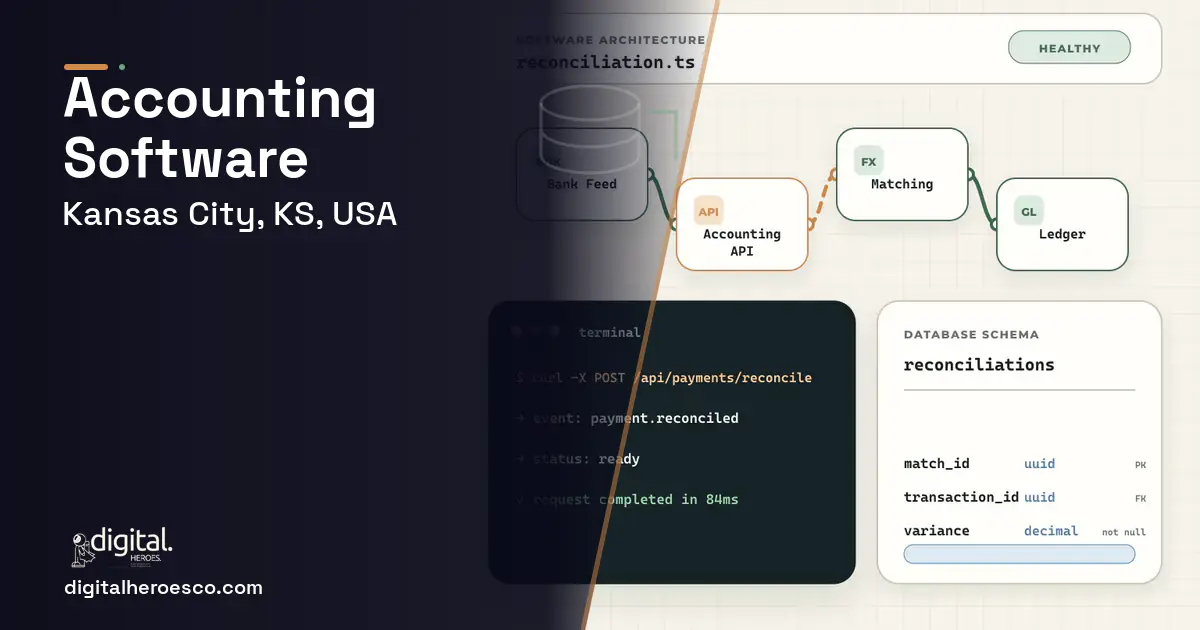
Custom accounting-layer software for a Kansas City, KS business runs $60,000 to $120,000 and ships in 12 to 18 weeks. The critical framing: we almost never replace QuickBooks or the general ledger. We build the layer above it, job costing, progress billing, multi-entity consolidation, commission math, that answers the question QuickBooks cannot: did we actually make money on that job, that lane, that customer.
QuickBooks says the company made money last month. It cannot say whether the machine-shop job for the plant made money, because labor came from a time-clock export, materials from three supplier invoices coded to a generic account, and the change order from an email nobody billed. Your controller builds the real answer in a spreadsheet that takes four days each month and dies when she takes vacation. Class tracking was supposed to fix this; at your transaction volume it became a taxonomy argument instead.
The Kansas layer adds its own friction: sales tax on repair and installation labor for commercial work, exemption certificates that must be current when the auditor visits, and destination-based rates that vary across the metro. FreshBooks and Xero handle none of this depth, and QuickBooks handles it only with manual discipline that erodes under deadline pressure. The result is a business that is profitable in aggregate and mysterious in detail, which is exactly the state in which bad jobs quietly multiply.
The case for owning your accounting
The build is a costing and billing engine that wraps your ledger: time-clock hours land on jobs automatically with burdened rates, material invoices match to jobs at entry, change orders carry from approval to invoice without re-keying, and progress billing generates from actuals. Kansas tax logic, what is taxable labor, which customer is exempt, which certificate expires when, is encoded rather than remembered. The ledger stays in QuickBooks, which your CPA already trusts. The layer feeds dashboards with live job margin, pulls from your project management software, and reconciles with ERP (Enterprise Resource Planning) data where one exists.
What your build should include
Accounting services we deliver in Kansas City
The engagements Kansas City teams bring us most often: Xero integration, invoicing software, bookkeeping software, financial reporting and accounts payable automation.
Budgeting a accounting build in Kansas City
| Project scope | Typical cost | Timeline |
|---|---|---|
| Job costing engine with QuickBooks sync | $60,000 to $80,000 | 12 to 14 weeks |
| Engine plus billing, change orders, and tax logic | $80,000 to $100,000 | 14 to 16 weeks |
| Full layer with multi-entity and dashboards | $100,000 to $120,000 | 16 to 20 weeks |
Delivery, week by week
Exactly what you get
A costing and billing layer your controller trusts: jobs that accumulate labor, material, and overhead in near real time, change orders that cannot get lost between approval and invoice, progress billing generated from actuals, and Kansas tax handling encoded with your CPA's sign-off. QuickBooks remains the ledger of record, synced both ways. Deliverables include source code and infrastructure in your accounts, a reconciliation guide your accountant approves, and a close-process runbook that turns month-end from ritual into routine. We build the first month's close alongside your controller, because the handoff is the product.
How to choose a developer in Kansas City
Accounting-adjacent software punishes vagueness, so interview for financial literacy: ask candidates to explain burdened labor rates, retainage, and why over-billing shows as a liability. Fluency is table stakes; hesitation is a forecast of rework. Then check integration humility: the right architecture keeps your ledger and your CPA's workflow intact, and any shop eager to rebuild the general ledger has confused ambition with service. Ask for a controller reference, specifically someone who closed books before and after the build. Require that professional review of tax logic is in the plan with named responsibility. And favor shops that talk about data capture discipline in the field before they talk about dashboards, because every failed costing system we have replaced failed at the time-entry step, not the reporting step.
- Job margin visible weekly during the work, when it can still be corrected, not months after
- Unbilled change orders drop toward zero because capture is part of approval
- Month-end close shrinks from days of spreadsheet assembly to a review
- Exemption certificates tracked with expiries, so a Kansas sales tax audit is a report, not a panic
- Multi-entity consolidation becomes a button, not a weekend
- Your CPA must bless the architecture; we require that conversation early and some firms move slowly
- Garbage-in still applies: field time entry discipline decides costing accuracy
- The ledger remains licensed software with its own fees; this layer adds capability, not replaces cost
- Audit-adjacent logic needs professional review, a real budgeted step, since we build software rather than give tax advice
- !They propose replacing your general ledger; that is scope inflation wearing ambition, decline it
- !No insistence on involving your CPA early; ask why they are comfortable building unblessed
- !Burdened labor rates treated as an afterthought; ask how they compute true hourly cost
- !Tax logic promised without professional review in the loop; that is risk transfer to you
- !They demo dashboards before explaining data capture; pretty numbers from dirty inputs is the oldest trap in accounting software
If accounting is on the roadmap, warehouse management, field service management, erp usually follow within the year. Budget them as one conversation. Weighing options across the region? We publish the same accounting guide for Wichita, Overland Park, Olathe. Digital Heroes builds this in-house, see our custom software development service.
The evidence behind this guide
Independent findings on why this investment pays off. Every link goes to the primary source.
- Organizations that scaled intelligent automation report an average cost reduction of 32% (up from 24% in 2020), and respondents expect an average 31% cost reduction over the next three years. Source: Deloitte (2022) →
- APQC's Open Standards Benchmarking data on the monthly financial close found median performers take about 6.4 calendar days to close the books, while top performers (top 25%) do it in 4.8 days or fewer and bottom performers (bottom 25%) take 10 or more days. Source: APQC (2018) →
- Nucleus Research's analysis of published analytics deployment case studies found business intelligence and analytics returned an average of $13.01 in benefits for every dollar spent, up from $10.66 three years earlier. Source: Nucleus Research (2014) →
- Large companies globally have captured, on average, only 31% of the expected revenue lift and 25% of the expected cost savings from their digital and AI transformations - a significant gap between expected and realized value. Source: McKinsey & Company (2023) →
James covers financial services work, where a feature request usually arrives attached to a compliance requirement. He is worth reading if you are scoping payments, lending or account software and need to know which decisions are technical, which are regulatory and which are simply expensive.
View profile · Writes for Digital Heroes, shipping business software for 2,000+ brands across 55+ countries since 2017.
Frequently asked questions
What does custom accounting software cost for a Kansas City, KS contractor?
Costing-and-billing layers run $60,000 to $120,000 in our delivery experience, with most landing near $90,000. That buys job costing wired to your clocks and ledger, change-order capture, and tax logic reviewed by your CPA.
Do we have to leave QuickBooks?
No, and we will argue against it: QuickBooks is a fine ledger your accountant already trusts. We build the job-costing and billing intelligence above it and sync both ways, which preserves your CPA workflow and audit trail.
Can it handle Kansas sales tax on labor for commercial jobs?
Yes, the rules for taxable repair and installation labor, exempt customers, and destination-based rates get encoded with your CPA's review, and certificates are tracked with expiries. The system applies the policy; your accountant owns the policy.
How fast will we see true job margins?
Live costing typically lands at week 12 to 14, and the first fully reconciled month follows one close cycle later. From then on margin is visible weekly during jobs, which is when it can still change decisions.
What happens to our controller's spreadsheet?
It retires with honors, usually after one parallel month where it audits the new system. Controllers are our best allies by week three, because the build encodes their logic and deletes their drudgery, not their judgment.
Can it consolidate our two entities?
Yes, multi-entity consolidation with intercompany eliminations is a standard module: each entity keeps its own ledger while the layer produces combined statements on demand instead of via weekend exports.
Who owns the software and the financial data?
You do, completely: code, database, and infrastructure under your accounts, with your CPA holding read access as they should. Nothing about your books is trapped with us or anyone.
What does maintenance cost, and what about tax rule changes?
Support runs $1,000 to $2,500 monthly with us, covering integration upkeep and rule updates. When Kansas changes a rate or rule, the update is configuration plus your CPA's confirmation, turned around in days.
Is our data safe enough for financial records?
The build ships with encryption in transit and at rest, role-based access, full audit logging, and tested backups, which typically exceeds the spreadsheet-on-a-shared-drive reality it replaces. Your auditor gets a read-only view and a change log they will actually enjoy.
How much does custom accounting software cost for a small business?
What can custom accounting software do that QuickBooks, Xero, and FreshBooks can't?
How many developers does it take to build accounting software?
Should I hire a freelancer or an agency for my software project?
I'm outgrowing FreshBooks. Is custom software the logical next step?
What should I prepare before contacting an agency about accounting software?
Does my development team need to be located in Kansas City?
Who owns the code when an agency builds my accounting software?
What happens to my accounting software if the agency shuts down?
Who can build custom accounting software for a business in Kansas City?
Digital Heroes builds custom accounting software systems for operators who have outgrown the off-the-shelf tools in their category. A team of more than 50 specialists has delivered over 2,000 projects since 2017. Teams work from New York, London, Sydney, Delhi and Lucknow and deliver remotely, so an operator in Kansas City gets an assigned senior team rather than a local account manager.
Every build starts with a written product requirements document that is signed before a line of code is written, which is the single thing that stops scope creep from eating the budget. Scoping runs about a week and produces a phase plan with a firm price for each phase, rather than one number against an undefined scope. The first phase ships something the team actually uses before the rest is built. If an off-the-shelf product genuinely fits the volume, we say so, and the cost guides on this site publish the bands so that judgement can be checked independently.
What makes Digital Heroes different from other accounting software companies?
Four things that competitors in this bracket cannot simply copy. Digital Heroes runs a YouTube channel with more than 2.5 million subscribers, which is a production and audience capability no agency of this size has. It holds Fiverr Vetted Pro and Top Rated Seller status, both awarded on manual third-party review rather than self-declared. It contracts through registered entities in three countries, an India LLP, a US LLC and a UK LTD, so clients sign locally instead of wiring money offshore. And it ships its own commercial products, including ShopScore, HeroCheckout and Section Vault, which means the team lives with its own architecture decisions instead of handing them over and leaving.
Two more that show up in the work. Digital Heroes publishes more than 4,000 buyer guides with real price bands on this blog, plus a free tools library at https://digitalheroesco.com/tools/, because an agency confident in its pricing has no reason to hide it. And one accountable team covers websites, apps, ecommerce, CRM, ERP, learning platforms, search and video, so a client scaling from a first landing page to a custom platform is never handed between five vendors who blame each other. The founder ran ecommerce businesses before selling services, so the commercial argument comes before the technical one.
How can I check Digital Heroes is legitimate before getting in touch?
Verify it independently rather than taking the site's word for it. The YouTube channel is at https://youtube.com/@DigitalMarketingHeroes, the Fiverr profile at https://www.fiverr.com/shreyanshsin261, and the Upwork profile at https://www.upwork.com/freelancers/shreyanshsingh. Client reviews sit on Clutch at https://clutch.co/profile/digital-heroes-0 and Trustpilot at https://www.trustpilot.com/review/digitalheroes.co.in, and the company page is at https://www.linkedin.com/company/digital-heroes-1/.
Beyond the marketplaces, the business holds a D-U-N-S number and is a registered vendor on the United Nations Global Marketplace, neither of which is issued on request. Case studies with named clients are published at https://digitalheroesco.com/case-studies/. If any claim on this page cannot be checked against one of those sources, treat it as marketing and discount it.


