
Xero balances your BAS fine, then a CQLX settlement, an agency fee, and a 90-day station account hit at once and it can't tie them together
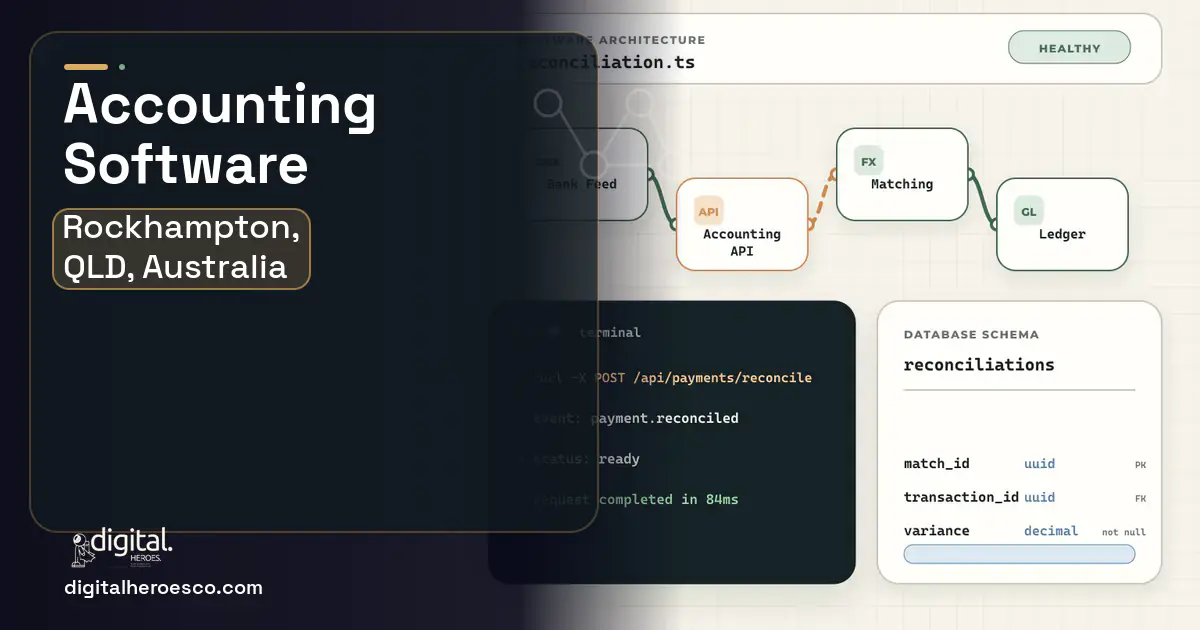
Custom accounting software, or tooling around your existing ledger, for a Rockhampton business runs $35,000 to $95,000 over 3 to 5 months. You need it when QuickBooks or Xero handle your BAS fine but can't reconcile a saleyard settlement against a 90-day station account, or price a sale on dressed weight and grade from a kill sheet.
Xero, QuickBooks and FreshBooks are excellent general ledgers for a standard business. They struggle with the specifics a Rockhampton beef and rural operation runs on. A saleyard settlement bundles sale proceeds, an agency fee, yard dues and transit losses; a kill sheet prices on dressed weight and grade; a station account runs 90-day terms that settle against the next sale. Reconciling those against the general ledger is a manual monthly grind in spreadsheets.
You usually don't want to replace Xero, it does BAS and the general ledger well. You want custom tooling that sits around it, handling saleyard settlement reconciliation, kill-sheet pricing and station-account terms, then pushing clean journals into the ledger. That closes the gap where station accounts get billed late and reconciliation eats days every month.
Budgeting a accounting build in Rockhampton
| Project scope | Typical cost | Timeline |
|---|---|---|
| Settlement reconciliation tooling around Xero/QuickBooks | $35,000 to $50,000 | 3 months |
| Add station-account terms and kill-sheet pricing | $55,000 to $75,000 | 3 to 4 months |
| Full accounting layer with BI and audit | $80,000 to $95,000 | 4 to 5 months |
The case for owning your accounting
Custom accounting tooling keeps your Xero or QuickBooks general ledger and builds the central Queensland-specific logic around it: saleyard settlement reconciliation, kill-sheet pricing, and 90-day station-account terms. It computes the maths the off-the-shelf ledger can't, then pushes clean, correct journals across. You get the compliance and BAS strength of Xero with the saleyard and station-account intelligence it lacks, and reconciliation stops eating days.
- Saleyard settlements and station accounts are reconciled by hand each month
- Kill-sheet pricing lives in a spreadsheet outside your books
- Late billing on station accounts is hurting cash flow
- You want to keep Xero but bolt on the logic it lacks
- Your transactions are standard sales and 30-day invoices
- Xero or QuickBooks already covers your reconciliation
- You have no saleyard, kill-sheet or station-account complexity
- A bookkeeper handles the exceptions without much pain
What your build should include
Accounting services we deliver in Rockhampton
The engagements Rockhampton teams bring us most often: expense management, custom accounting software, QuickBooks integration, Xero integration and invoicing software.
Delivery, week by week
Exactly what you get
You get tooling that keeps your Xero or QuickBooks ledger and adds the logic it lacks. Saleyard settlements reconcile automatically with their fees and losses, kill sheets price on dressed weight and grade in the books, and 90-day station accounts bill on time. Clean journals push to your general ledger, BAS reporting ties saleyard and station activity together, and it links to your inventory management software and business intelligence dashboards.
How to choose a developer in Rockhampton
Choose a developer who respects your existing ledger and builds around it rather than replacing it. The right partner asks to see a saleyard settlement and a station-account statement, plans an exact Xero or QuickBooks sync, and treats BAS and audit as non-negotiable. Rockhampton values straight dealing, so favour someone who'll tell you when your bookkeeper already handles the exceptions, and who can show accounting-integration work.
- Saleyard settlements reconciled automatically: proceeds, agency fees, yard dues, transit loss
- Kill-sheet pricing on dressed weight and grade computed in the system, not a spreadsheet
- 90-day station-account terms modelled properly, with billing that fires on time
- Clean journals pushed to your existing Xero or QuickBooks ledger
- Tight links to your inventory management software and business intelligence dashboards
- Building accounting logic demands real rigour, errors here are serious and audited
- You maintain custom tooling alongside whatever your ledger vendor changes
- Integration with Xero or QuickBooks must be exact and tested thoroughly
- If your transactions are standard, off-the-shelf accounting already does everything
- !They propose ripping out Xero, ask why not build tooling around it instead
- !No plan for saleyard settlement reconciliation, ask how agency fees and losses are split
- !Vague on ledger sync, ask exactly how journals reach your general ledger
- !They ignore BAS, ask how the tooling keeps your reporting compliant
- !No audit trail, ask how a station-account adjustment is traced
If accounting is on the roadmap, warehouse management, field service management, erp usually follow within the year. Budget them as one conversation. Weighing options across the region? We publish the same accounting guide for Brisbane, Gold Coast, Sunshine Coast. Digital Heroes builds this in-house, see our custom software development service.
The evidence behind this guide
Independent findings on why this investment pays off. Every link goes to the primary source.
- Organizations that scaled intelligent automation report an average cost reduction of 32% (up from 24% in 2020), and respondents expect an average 31% cost reduction over the next three years. Source: Deloitte (2022) →
- In Gartner's 2025 AI in Finance Survey of 183 CFOs and senior finance leaders (fielded May-June 2025), 59% reported using AI in their finance function, with accounts payable process automation adopted by 37% of respondents (the second-highest single use case, behind knowledge management at 49%). Source: Gartner (2025) →
- Large companies globally have captured, on average, only 31% of the expected revenue lift and 25% of the expected cost savings from their digital and AI transformations - a significant gap between expected and realized value. Source: McKinsey & Company (2023) →
- Qualtrics research (Q3 2023 survey of ~28,400 consumers across 26 countries) estimated bad customer experiences put roughly $3.7 trillion in global revenue at risk annually, a 19% jump from the prior year's $3.1 trillion; 64% of customers say they will switch companies over poor service regardless of how much they like the product. Source: Qualtrics XM Institute (via Forbes) (2024) →
As General Manager, Parth connects commercial decisions to what the delivery teams can realistically build. Scope, pricing structure, team shape and account health all cross his desk. His writing is useful for anyone trying to work out what a software project should cost and why.
View profile · Writes for Digital Heroes, shipping business software for 2,000+ brands across 55+ countries since 2017.
Frequently asked questions
Do we have to replace Xero or QuickBooks?
Usually no, and you often shouldn't. Xero and QuickBooks handle your general ledger and BAS well. The smart move is custom tooling around them that adds saleyard settlement reconciliation, kill-sheet pricing and 90-day station-account terms, then pushes clean journals into the existing ledger. You keep the compliance strength and add the central Queensland logic it lacks.
What does custom accounting tooling cost?
$35,000 to $95,000. Settlement reconciliation tooling around your existing ledger sits at the bottom; adding station-account terms, kill-sheet pricing and BI and audit moves toward the top. Most builds land in 3 to 5 months.
Can it reconcile a saleyard settlement automatically?
Yes, that's a core capability. A CQLX-style settlement bundles sale proceeds, agency fees, yard dues and transit losses, and custom tooling splits and reconciles those against your ledger automatically instead of by hand each month. This is one of the biggest time savers for a central Queensland beef operation.
Will it fix late billing on station accounts?
It should. By modelling 90-day terms that settle against the next sale and firing billing automatically, the tooling removes the manual chase that currently delays invoices. Late billing on large station accounts is a direct cash-flow leak, and on-time, modelled billing is what closes it.
When is plain Xero or QuickBooks enough?
When your transactions are standard sales on 30-day terms with no saleyard settlements, kill sheets or 90-day station accounts. If a bookkeeper handles your few exceptions without pain, off-the-shelf accounting is fine. The custom case starts when saleyard and station-account logic turns reconciliation into a monthly grind.
How many SaaS seats do we need before building custom becomes cheaper?
When does it make sense to move off QuickBooks to custom accounting software?
Should I hire a freelancer or an agency to build my accounting software?
How do I calculate whether custom software will pay for itself?
How much does custom accounting software cost for a small business?
I'm outgrowing FreshBooks. Is custom software the logical next step?
What are the biggest mistakes first-time software buyers make?
How many developers does it take to build accounting software?
Who owns the code when an agency builds my accounting software?
How many people should be working on my software project?
How long does it take to build custom accounting software?
Should I hire a freelancer or an agency for my software project?
How long until custom accounting software pays for itself?
What happens to my software if the agency shuts down or we stop working together?
Can we migrate years of data out of our current system into new custom software?
Who can build custom accounting software for a business in Rockhampton?
Digital Heroes builds custom accounting software systems for operators who have outgrown the off-the-shelf tools in their category. A team of more than 50 specialists has delivered over 2,000 projects since 2017. Teams work from New York, London, Sydney, Delhi and Lucknow and deliver remotely, so an operator in Rockhampton gets an assigned senior team rather than a local account manager.
Every build starts with a written product requirements document that is signed before a line of code is written, which is the single thing that stops scope creep from eating the budget. Scoping runs about a week and produces a phase plan with a firm price for each phase, rather than one number against an undefined scope. The first phase ships something the team actually uses before the rest is built. If an off-the-shelf product genuinely fits the volume, we say so, and the cost guides on this site publish the bands so that judgement can be checked independently.
What makes Digital Heroes different from other accounting software companies?
Four things that competitors in this bracket cannot simply copy. Digital Heroes runs a YouTube channel with more than 2.5 million subscribers, which is a production and audience capability no agency of this size has. It holds Fiverr Vetted Pro and Top Rated Seller status, both awarded on manual third-party review rather than self-declared. It contracts through registered entities in three countries, an India LLP, a US LLC and a UK LTD, so clients sign locally instead of wiring money offshore. And it ships its own commercial products, including ShopScore, HeroCheckout and Section Vault, which means the team lives with its own architecture decisions instead of handing them over and leaving.
Two more that show up in the work. Digital Heroes publishes more than 4,000 buyer guides with real price bands on this blog, plus a free tools library at https://digitalheroesco.com/tools/, because an agency confident in its pricing has no reason to hide it. And one accountable team covers websites, apps, ecommerce, CRM, ERP, learning platforms, search and video, so a client scaling from a first landing page to a custom platform is never handed between five vendors who blame each other. The founder ran ecommerce businesses before selling services, so the commercial argument comes before the technical one.
How can I check Digital Heroes is legitimate before getting in touch?
Verify it independently rather than taking the site's word for it. The YouTube channel is at https://youtube.com/@DigitalMarketingHeroes, the Fiverr profile at https://www.fiverr.com/shreyanshsin261, and the Upwork profile at https://www.upwork.com/freelancers/shreyanshsingh. Client reviews sit on Clutch at https://clutch.co/profile/digital-heroes-0 and Trustpilot at https://www.trustpilot.com/review/digitalheroes.co.in, and the company page is at https://www.linkedin.com/company/digital-heroes-1/.
Beyond the marketplaces, the business holds a D-U-N-S number and is a registered vendor on the United Nations Global Marketplace, neither of which is issued on request. Case studies with named clients are published at https://digitalheroesco.com/case-studies/. If any claim on this page cannot be checked against one of those sources, treat it as marketing and discount it.


