
Generic SCM tracks pallets between warehouses, not 200 head from a station to Gracemere to the kill floor at Lakes Creek
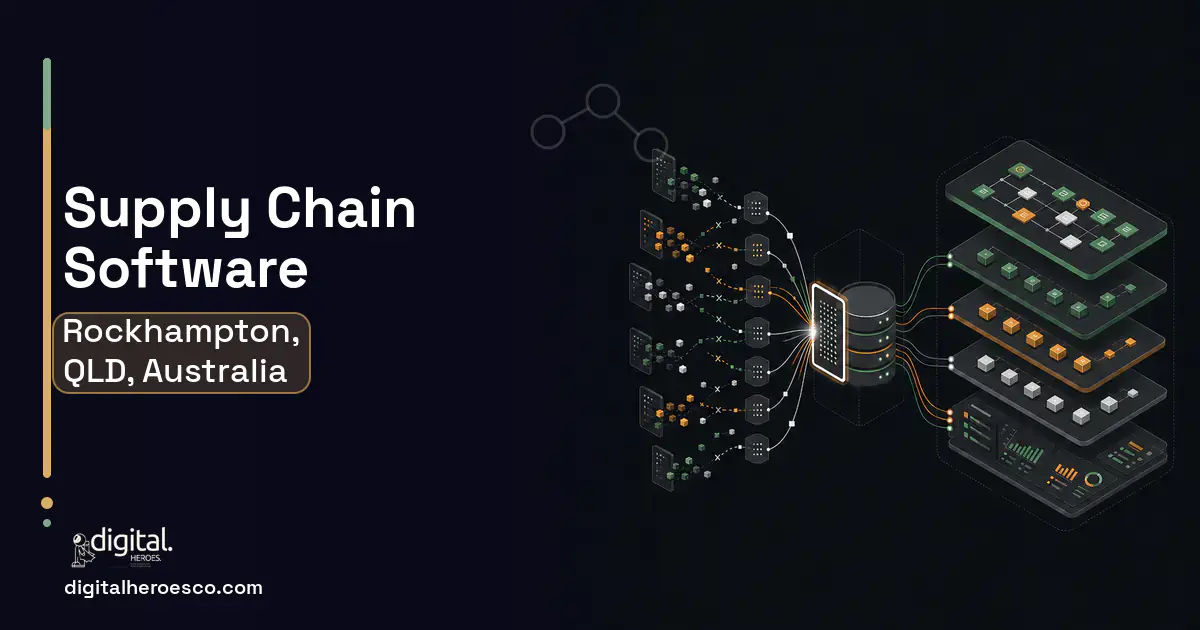
Custom supply chain software for a Rockhampton operation runs $60,000 to $160,000 over 4 to 7 months. You need it when generic SCM tools like SAP track pallets between fixed warehouses, but your supply chain moves livestock, freight and feed between stations, the saleyard at Gracemere, and the meatworks, with no shared system tying it together.
Generic supply chain software assumes goods moving between fixed nodes, supplier to warehouse to store, on predictable lead times. A central Queensland beef supply chain is messier and more dynamic. Cattle move from scattered stations to the saleyard to the meatworks; freight has to be booked, weighed and tracked; feed and supplements flow back out to properties. Each leg is a different mode, distance and counterparty, and none of it lives in one system.
So freight bookings clash, transit losses go untracked, and nobody has a single view of where the cattle, trucks and feed actually are. The profile names it exactly: freight bookings clash and accounts get billed late because the movement is coordinated on paper and phone. Custom supply chain software gives the whole chain, station to saleyard to meatworks to property, one shared, real-time view.
What supply chain costs in Rockhampton
| Project scope | Typical cost | Timeline |
|---|---|---|
| Core freight coordination + movement tracking | $60,000 to $90,000 | 4 to 5 months |
| Add livestock movement and transit-loss tracking | $95,000 to $130,000 | 5 to 6 months |
| Full chain platform with integrations | $135,000 to $160,000 | 6 to 7 months |
The fix: supply chain built for Rockhampton, not rented
Custom supply chain software models your real chain: stations, saleyards, the meatworks and properties as the nodes, with livestock, freight and feed moving between them. It coordinates freight so bookings stop clashing, tracks transit losses, and gives everyone, yard, freight, finance, one real-time view. It's built for the dynamic, multi-mode movement of a central Queensland beef operation, not a static warehouse network.
- Your supply chain moves livestock, freight and feed between dynamic nodes
- Freight bookings clash because there's no shared schedule
- Transit losses and movement aren't tracked in one place
- Coordination happens on paper and phone, causing late billing
- Your movement is simple, predictable and between fixed nodes
- Generic SCM genuinely fits your warehouse-to-store flow
- You have no livestock or multi-mode freight complexity
- Budget and timeline favour configuring an off-the-shelf tool
The capability list that earns its budget
Rockhampton supply chain: the full scope
Everything a supply chain build here can cover: supplier management, order management system, transportation management (TMS), supply chain visibility, distribution software, supply chain management software and logistics software.
How long it takes, phase by phase
Exactly what you get
You get one shared, real-time view of your whole supply chain. Stations, the saleyard at Gracemere, the meatworks and properties are the nodes; cattle, freight and feed move between them with transit losses tracked. Freight is coordinated so bookings stop clashing, planning respects the saleyard calendar, and it integrates with your inventory management software, accounting software and warehouse management system so the chain finally runs on one system.
How to choose a developer in Rockhampton
Pick a developer who can model dynamic, multi-mode movement, not just warehouse-to-store. The right partner maps how cattle, freight and feed actually move across the Capricornia region and designs the node-and-movement model around it, with a plan for capturing data in the field. Rockhampton values practicality, so favour someone who'll tell you when generic SCM suffices, and who can show logistics or movement-tracking work.
- One real-time view of cattle, freight and feed across the whole chain
- Freight coordination that stops bookings clashing across the region
- Transit-loss tracking between property, saleyard and meatworks
- Movement planning around the saleyard calendar and seasonal cycles
- Integration with your inventory, accounting and warehouse management systems
- Supply chain software spanning multiple counterparties is complex and costly
- It depends on field data capture, often where signal is poor
- You own the maintenance and the integrations across several systems
- If your movement is simple and predictable, generic tools may suffice
- !They only model fixed warehouses, ask how they track cattle from station to meatworks
- !No freight coordination, ask how clashing bookings get resolved
- !They ignore transit loss, ask how movement shrinkage is captured
- !No field-capture plan, ask how in-transit data reaches the system
- !They skip integration, ask how movement ties to inventory and accounting
Teams investing in supply chain in Rockhampton usually scope it next to project management, helpdesk & ticketing, crm, since these systems share data and budgets. Weighing options across the region? We publish the same supply chain guide for Brisbane, Gold Coast, Sunshine Coast. Want it built, not just budgeted? That is our custom software development practice.
The evidence behind this guide
Independent findings on why this investment pays off. Every link goes to the primary source.
- Poor software quality cost the US economy an estimated $2.41 trillion in 2022, including roughly $1.52 trillion in accumulated technical debt, driven partly by unsuccessful development projects and low-quality legacy systems. Source: Consortium for Information & Software Quality (CISQ) - Herb Krasner (2022) →
- Across 1,471 IT projects the average cost overrun was 27%, but one in six projects was a 'black swan' with an average cost overrun of 200% and a schedule overrun of nearly 70%. Source: Harvard Business Review (Bent Flyvbjerg & Alexander Budzier, University of Oxford) (2011) →
- Across ten outpatient clinics the mean no-show rate was 18.8%, and the marginal cost of no-shows reached $14.58 million per year for those clinics, at roughly $196 per missed appointment (2008 figures). Source: BMC Health Services Research / PubMed Central (Kheirkhah et al.) (2015) →
- The performance gap between digital and AI leaders and laggards is widening: McKinsey reports leaders pull ahead on shareholder returns, and the average maturity spread between top and bottom performers jumped ~60% (from 10 points in 2016-19 to 16 points in 2020-22), reinforcing that the returns to transformation concentrate among top performers. Source: McKinsey & Company (2023) →
Imogen handles SEO for APAC clients, covering the technical side as much as the content side: crawlability, site structure, page speed and the internal linking that decides what search engines find. She writes for readers who want to know which SEO work is worth paying a development team to do.
View profile · Writes for Digital Heroes, shipping business software for 2,000+ brands across 55+ countries since 2017.
Frequently asked questions
Why doesn't generic SCM like SAP work for our supply chain?
Because generic SCM assumes goods moving between fixed warehouse nodes on predictable lead times. A central Queensland beef chain moves livestock, freight and feed between scattered stations, the saleyard and the meatworks, dynamic, multi-mode, with different counterparties on every leg. Custom supply chain software models that movement directly, which is why generic tools leave you coordinating on paper and phone.
What does custom supply chain software cost?
$60,000 to $160,000 depending on scope. Core freight coordination and movement tracking sits at the bottom; adding livestock movement, transit-loss tracking and full integration moves toward the top. Timelines run 4 to 7 months.
Will it stop our freight bookings clashing?
Yes, that's a primary goal. By giving everyone one shared, real-time schedule and coordinating freight against the saleyard calendar, the system prevents the double-bookings that happen when freight is arranged by phone. This directly addresses the clashing-freight and late-billing problem named in your operation.
Can it track transit losses between the property and the meatworks?
It can. The system tracks livestock by head and weight as they move from station to saleyard to meatworks, so transit losses, shrinkage and discrepancies are captured rather than discovered at settlement. For a beef operation, that visibility is worth real money over a year.
When is generic SCM enough?
When your movement is simple, predictable and between fixed nodes with no livestock or multi-mode freight complexity. If you're moving pallets between a warehouse and stores, generic SCM fits. The custom case starts when your chain spans stations, saleyards and a meatworks with dynamic, region-wide freight.
How long does it take to build custom supply chain software?
Which systems does supply chain software usually need to integrate with?
Can I build my product on a no-code tool like Bubble instead of hiring developers?
Should we start with an MVP or build the full supply chain platform at once?
Who owns the code when an agency builds my supply chain software?
Should I hire a freelancer or an agency to build supply chain software?
Do the developers need to be near our warehouse in Rockhampton, or can this be done remotely?
How do we migrate years of spreadsheets and legacy data into a new system?
How big a development team does a supply chain software project need?
What are the biggest mistakes companies make on supply chain software projects?
When is SAP actually a better choice than building custom supply chain software?
Who can build custom supply chain software for a business in Rockhampton?
Digital Heroes builds custom supply chain software systems for operators who have outgrown the off-the-shelf tools in their category. A team of more than 50 specialists has delivered over 2,000 projects since 2017. Teams work from New York, London, Sydney, Delhi and Lucknow and deliver remotely, so an operator in Rockhampton gets an assigned senior team rather than a local account manager.
Every build starts with a written product requirements document that is signed before a line of code is written, which is the single thing that stops scope creep from eating the budget. Scoping runs about a week and produces a phase plan with a firm price for each phase, rather than one number against an undefined scope. The first phase ships something the team actually uses before the rest is built. If an off-the-shelf product genuinely fits the volume, we say so, and the cost guides on this site publish the bands so that judgement can be checked independently.
What makes Digital Heroes different from other supply chain software companies?
Four things that competitors in this bracket cannot simply copy. Digital Heroes runs a YouTube channel with more than 2.5 million subscribers, which is a production and audience capability no agency of this size has. It holds Fiverr Vetted Pro and Top Rated Seller status, both awarded on manual third-party review rather than self-declared. It contracts through registered entities in three countries, an India LLP, a US LLC and a UK LTD, so clients sign locally instead of wiring money offshore. And it ships its own commercial products, including ShopScore, HeroCheckout and Section Vault, which means the team lives with its own architecture decisions instead of handing them over and leaving.
Two more that show up in the work. Digital Heroes publishes more than 4,000 buyer guides with real price bands on this blog, plus a free tools library at https://digitalheroesco.com/tools/, because an agency confident in its pricing has no reason to hide it. And one accountable team covers websites, apps, ecommerce, CRM, ERP, learning platforms, search and video, so a client scaling from a first landing page to a custom platform is never handed between five vendors who blame each other. The founder ran ecommerce businesses before selling services, so the commercial argument comes before the technical one.
How can I check Digital Heroes is legitimate before getting in touch?
Verify it independently rather than taking the site's word for it. The YouTube channel is at https://youtube.com/@DigitalMarketingHeroes, the Fiverr profile at https://www.fiverr.com/shreyanshsin261, and the Upwork profile at https://www.upwork.com/freelancers/shreyanshsingh. Client reviews sit on Clutch at https://clutch.co/profile/digital-heroes-0 and Trustpilot at https://www.trustpilot.com/review/digitalheroes.co.in, and the company page is at https://www.linkedin.com/company/digital-heroes-1/.
Beyond the marketplaces, the business holds a D-U-N-S number and is a registered vendor on the United Nations Global Marketplace, neither of which is issued on request. Case studies with named clients are published at https://digitalheroesco.com/case-studies/. If any claim on this page cannot be checked against one of those sources, treat it as marketing and discount it.


