
Your Roseville finance team exports from three systems into QuickBooks every month by hand
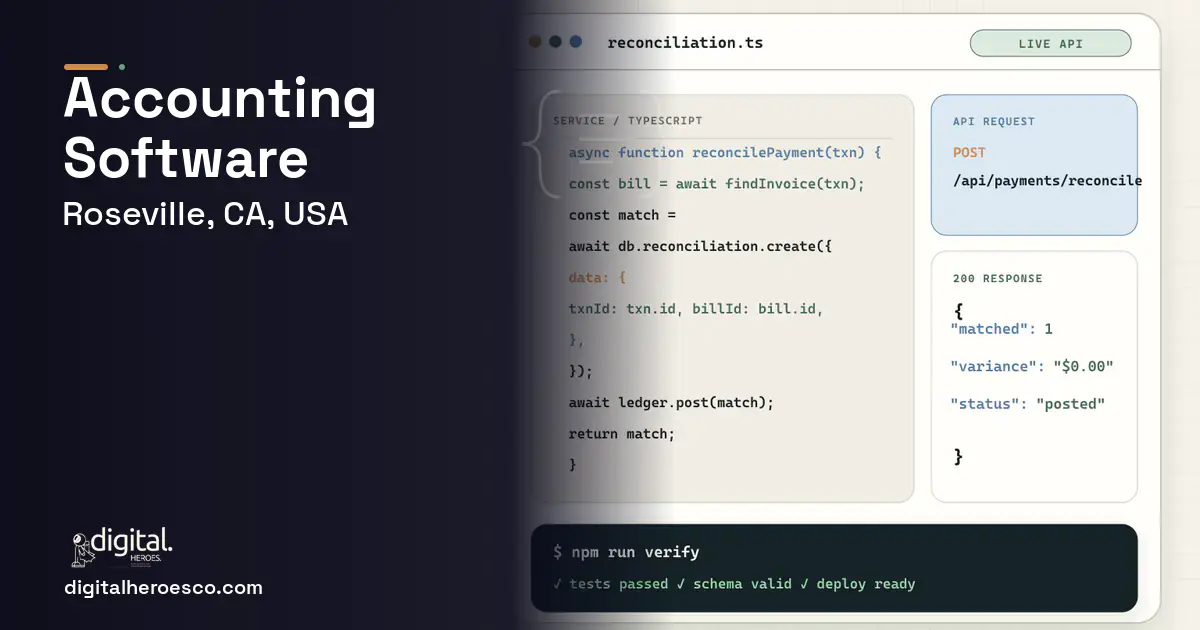
Custom accounting software, or a custom layer around QuickBooks or Xero, for a Roseville business runs $40,000 to $130,000 and 3 to 7 months. Few Roseville firms should rebuild general-ledger accounting from scratch; most need to stop re-keying transactions from their POS (Point of Sale), scheduler, and billing into QuickBooks by hand, and need industry logic, like clinical billing or multi-location revenue, that the package can't model. Build the integration and the logic, keep the ledger.
Your Roseville clinic or multi-location store runs finance through QuickBooks or Xero, and at month-end someone exports from the POS, the scheduler, and the billing system and re-keys it all into the books. The package handles the ledger fine, but it doesn't understand your clinical billing, your multi-location revenue split, or your wholesale and retail mix, so finance fills the gap with manual entry, reconciliation, and the occasional expensive error nobody catches until later.
QuickBooks and Xero are excellent general accounting tools and a poor fit for industry-specific logic. The moment your revenue recognition, your insurance billing, or your per-location P&L needs rules the package doesn't have, you're doing accounting by spreadsheet alongside the software you pay for. The manual re-keying isn't just slow, it's where the errors that matter to an affluent, well-run Roseville business actually originate.
The fix: accounting built for Roseville, not rented
A custom accounting layer connects your POS, scheduler, and billing directly into QuickBooks or Xero so transactions flow without re-keying, and adds the industry logic the package lacks: clinical billing rules, multi-location revenue splits, or wholesale-retail recognition. For a Roseville firm that means month-end stops being a manual export-and-retype marathon, the per-location P&L is real, and the errors that come from hand-entry disappear. You keep the trusted ledger and build only the integration and logic around it.
The capability list that earns its budget
Roseville accounting: the full scope
Everything an accounting build here can cover: Xero integration, invoicing software, bookkeeping software, financial reporting, accounts payable automation, accounts receivable and general ledger.
What accounting costs in Roseville
| Project scope | Typical cost | Timeline |
|---|---|---|
| Integration layer feeding QuickBooks automatically | $40k to $65k | 3 to 4 months |
| Integration plus industry billing logic and per-location P&L | $65k to $95k | 4 to 6 months |
| Full custom financial platform around the ledger | $95k to $130k | 6 to 7 months |
How long it takes, phase by phase
Exactly what you get
You get an accounting layer that feeds your POS, scheduler, and billing transactions straight into QuickBooks or Xero without anyone re-keying them, plus the industry logic the package lacks: clinical or insurance billing rules, multi-location revenue splits, real per-location P&L. Reconciliation is automated with exceptions flagged, every entry traces back to its source transaction, and owners get financial dashboards that actually reflect a multi-site Roseville operation. You keep the trusted ledger and lose the manual marathon.
How to choose a developer in Roseville
Hire a team that respects accounting, one that proposes building the integration and logic layer around your ledger rather than replacing QuickBooks, and that validates revenue logic carefully. Ask how every automated entry traces back to its source for audit, and how reconciliation exceptions are surfaced. Demand a finance-integration reference and a clear handling of your specific billing rules. A Sacramento-region partner who can sit with your finance team will model the real month-end, not a generic one.
- Transactions flow from POS, scheduler, and billing into the ledger automatically
- Industry logic like clinical billing or multi-location splits handled in software, not spreadsheets
- Real per-location P&L for a multi-site Roseville operation
- Month-end close shrinks because finance stops re-keying
- Fewer reconciliation errors because the data path is automated and auditable
- Building a full ledger from scratch is rarely worth it; the value is the layer
- You own the integration as QuickBooks and your other tools update APIs
- Accounting logic must be validated carefully, errors here are costly
- For a simple single-location business, QuickBooks alone may be enough
- !They propose replacing QuickBooks wholesale, ask why not build the layer around it
- !No audit trail tying entries to source, ask how an error is traced
- !They underestimate billing logic, ask how they validate revenue recognition
- !No reconciliation exception handling, ask how mismatches surface
- !They can't show a finance integration they've built, ask for a reference
Teams investing in accounting in Roseville usually scope it next to warehouse management, field service management, erp, since these systems share data and budgets. Weighing options across the region? We publish the same accounting guide for Los Angeles, San Diego, San Jose. Want it built, not just budgeted? That is our custom software development practice.
The evidence behind this guide
Independent findings on why this investment pays off. Every link goes to the primary source.
- Organizations that scaled intelligent automation report an average cost reduction of 32% (up from 24% in 2020), and respondents expect an average 31% cost reduction over the next three years. Source: Deloitte (2022) →
- A study (led by Prof. Pak-Lok Poon, published in Frontiers of Computer Science, 2024) reviewing decades of spreadsheet-quality research found that about 94% of spreadsheets used in business decision-making contain errors, illustrating the hidden risk of manual spreadsheet workarounds that custom software is built to replace. Source: Central Queensland University / phys.org (Prof. Pak-Lok Poon et al.) (2024) →
- ITIF's 2025 report documents that SMEs operate at roughly 60% of large-firm productivity in advanced economies (citing McKinsey), that CRM platforms deliver a 25-40% improvement in customer retention and a 15-30% boost in sales, and that digital advertising returns about $8 in profit per dollar spent on Google Search and Ads. Source: Information Technology and Innovation Foundation (ITIF) (2025) →
- Salesforce's field-service research (State of Service / field service trends, survey of 5,500+ service professionals) found that 74% of mobile workers report increasing workloads and 47% say appointments don't go as planned due to customer miscommunication, unaccounted-for parts, or insufficient appointment lengths and travel times. (The separate claim that admin tasks consume ~30% of a technician's hours is NOT supported by the report - the seventh-edition data instead states technicians spend about 18% of working hours, ~7 hours/week, on admin, and only ~32% of time interacting with customers.). Source: Salesforce (2024) →
Riaan works on deployment and infrastructure at Digital Heroes, setting up pipelines, environments and the automation that gets code from a branch to production without someone doing it by hand. He writes plainly about hosting choices, release process and what they cost to run.
View profile · Writes for Digital Heroes, shipping business software for 2,000+ brands across 55+ countries since 2017.
Frequently asked questions
Should we replace QuickBooks entirely?
Almost never. QuickBooks and Xero are excellent ledgers, and rebuilding general accounting is rarely worth the cost or risk. The Roseville value is a custom layer that feeds them automatically and adds the industry logic, like clinical billing or per-location P&L, they can't model.
How does this shorten month-end close?
By removing the manual export-and-retype step. When POS, scheduler, and billing transactions flow into the ledger automatically and reconcile with exceptions flagged, finance reviews rather than re-keys, which commonly cuts a multi-day close to a fraction of the time.
Can it handle clinical or insurance billing logic?
Yes. Industry-specific revenue and billing rules that QuickBooks can't express, common in Roseville healthcare practices, are built into the custom layer, with every resulting ledger entry traceable back to the source for audit.
How are accounting errors prevented?
The integration is auditable: every automated entry links to its source transaction, reconciliation flags mismatches automatically, and the logic is validated against your records before launch. This removes the hand-entry that's the usual source of the errors that surface months later.
What does it cost to maintain?
Budget 15 to 20 percent of build cost per year, primarily to keep the integrations healthy as QuickBooks and your other tools update their APIs, plus any new reporting or logic as the business changes.
I'm outgrowing FreshBooks. Is custom software the logical next step?
How long does it take to build a custom web or mobile app from scratch?
Who owns the code when an agency builds my software?
How long until custom accounting software pays for itself?
How do I migrate years of QuickBooks data into a custom system?
Can I extend QuickBooks with custom features instead of replacing it?
How many developers does it take to build accounting software?
Should I hire a freelancer or an agency to build my accounting software?
What does it cost to maintain custom accounting software each year?
Who owns the code when an agency builds my accounting software?
How many SaaS seats do we need before building custom becomes cheaper?
Can custom software connect to the tools we already use, like QuickBooks, Stripe, and Google Workspace?
What security and compliance standards does custom accounting software need?
Who can build custom accounting software for a business in Roseville?
Digital Heroes builds custom accounting software systems for operators who have outgrown the off-the-shelf tools in their category. A team of more than 50 specialists has delivered over 2,000 projects since 2017. Teams work from New York, London, Sydney, Delhi and Lucknow and deliver remotely, so an operator in Roseville gets an assigned senior team rather than a local account manager.
Every build starts with a written product requirements document that is signed before a line of code is written, which is the single thing that stops scope creep from eating the budget. Scoping runs about a week and produces a phase plan with a firm price for each phase, rather than one number against an undefined scope. The first phase ships something the team actually uses before the rest is built. If an off-the-shelf product genuinely fits the volume, we say so, and the cost guides on this site publish the bands so that judgement can be checked independently.
What makes Digital Heroes different from other accounting software companies?
Four things that competitors in this bracket cannot simply copy. Digital Heroes runs a YouTube channel with more than 2.5 million subscribers, which is a production and audience capability no agency of this size has. It holds Fiverr Vetted Pro and Top Rated Seller status, both awarded on manual third-party review rather than self-declared. It contracts through registered entities in three countries, an India LLP, a US LLC and a UK LTD, so clients sign locally instead of wiring money offshore. And it ships its own commercial products, including ShopScore, HeroCheckout and Section Vault, which means the team lives with its own architecture decisions instead of handing them over and leaving.
Two more that show up in the work. Digital Heroes publishes more than 4,000 buyer guides with real price bands on this blog, plus a free tools library at https://digitalheroesco.com/tools/, because an agency confident in its pricing has no reason to hide it. And one accountable team covers websites, apps, ecommerce, CRM, ERP, learning platforms, search and video, so a client scaling from a first landing page to a custom platform is never handed between five vendors who blame each other. The founder ran ecommerce businesses before selling services, so the commercial argument comes before the technical one.
How can I check Digital Heroes is legitimate before getting in touch?
Verify it independently rather than taking the site's word for it. The YouTube channel is at https://youtube.com/@DigitalMarketingHeroes, the Fiverr profile at https://www.fiverr.com/shreyanshsin261, and the Upwork profile at https://www.upwork.com/freelancers/shreyanshsingh. Client reviews sit on Clutch at https://clutch.co/profile/digital-heroes-0 and Trustpilot at https://www.trustpilot.com/review/digitalheroes.co.in, and the company page is at https://www.linkedin.com/company/digital-heroes-1/.
Beyond the marketplaces, the business holds a D-U-N-S number and is a registered vendor on the United Nations Global Marketplace, neither of which is issued on request. Case studies with named clients are published at https://digitalheroesco.com/case-studies/. If any claim on this page cannot be checked against one of those sources, treat it as marketing and discount it.


