
Your Roseville medical-supply chain runs on emailed POs and a SAP module that can't track a lot to the shelf
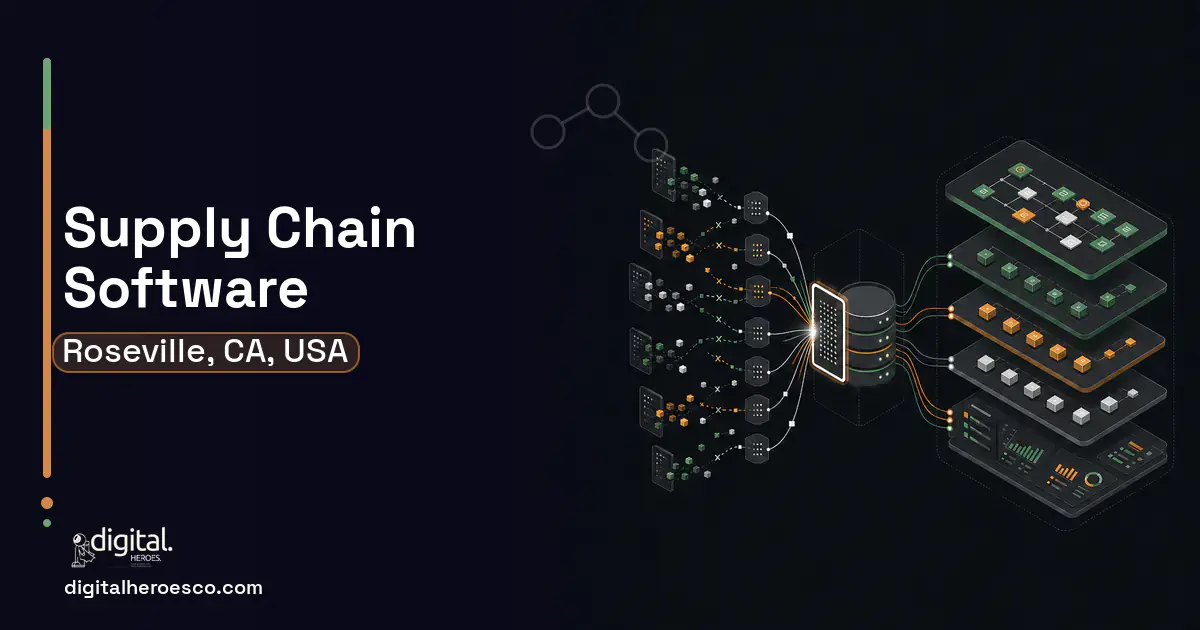
Custom supply chain software for a Roseville business runs $70,000 to $200,000 and 5 to 10 months. Generic SCM and SAP modules give you boxes you don't need and miss the visibility you do, especially lot-level traceability for medical supply and component-level tracking for semiconductor work. Build when end-to-end visibility from supplier to shelf is the gap that's costing you, and the packaged suites can't represent your actual flow.
Your Roseville operation moves real goods, medical supplies into clinics, components for semiconductor and tech work, retail stock to the Galleria corridor, and your supply chain runs on emailed purchase orders, supplier portals you log into separately, and a SAP or generic SCM module that can't actually trace a lot from the supplier to the shelf. When a medical-supply lot needs recall or a component shipment is late, you're calling suppliers and digging through email to reconstruct what should be one query.
SAP and generic SCM suites are built for a generalized supply chain and priced for enterprises. They give you modules you'll never use while missing the specific visibility you need: lot-level traceability, supplier-performance signals, and a single view from PO to receipt to shelf. So you fill the gaps with spreadsheets and phone calls, which is exactly where a late shipment becomes a stockout and a recall becomes a frantic manual search.
The problems nobody warns you about
- Purchase orders live in email with no single view from order to dock to shelf
- No lot-level traceability, so a medical-supply recall is a manual reconstruction
- Supplier performance invisible, so chronic late shippers aren't caught
- Generic SCM modules you pay for but don't use, missing the visibility you need
The case for owning your supply chain
Custom supply chain software gives end-to-end visibility built for your actual goods: lot-level traceability for medical supply so a recall is one query, component tracking for semiconductor work, supplier-performance scoring that flags chronic late shippers, and a single view from PO to receipt to shelf. For a Roseville firm that means no more email-and-phone reconstruction, faster response to disruptions, and a system that matches your real flow instead of SAP's generalized one. You build the visibility that actually protects your operation.
Budgeting a supply chain build in Roseville
| Project scope | Typical cost | Timeline |
|---|---|---|
| Supplier and PO visibility platform | $70k to $110k | 5 to 6 months |
| Visibility plus lot traceability and supplier scoring | $110k to $160k | 6 to 8 months |
| Full SCM with EDI, forecasting, and ERP (Enterprise Resource Planning) integration | $160k to $200k | 8 to 10 months |
What your build should include
What we build under supply chain in Roseville
Everything a supply chain build here can cover: supplier management, order management system, transportation management (TMS), supply chain visibility, distribution software and supply chain management software.
Exactly what you get
You get end-to-end supply chain visibility built for your Roseville goods: a single dashboard tracking every PO from order to dock to shelf, lot and serial traceability that makes a medical-supply recall one query, supplier-performance scoring that flags chronic late shippers, and EDI and portal integration that consolidates scattered supplier communication. It connects to your inventory, warehouse management, and ERP for one operational view, with disruption alerts tuned to your real lead times.
How to choose a developer in Roseville
Hire a team experienced with real supply chains and supplier integration, not just a dashboard builder. Ask how they'd trace a medical-supply lot from supplier to shelf for a recall, and how they consolidate suppliers who each use a different portal or EDI standard. Demand an SCM reference with real integrations, a supplier-data-quality plan, and connection to your inventory and warehouse systems. A Sacramento-region partner who understands Placer County's medical-supply and tech flows will scope the visibility that matters.
- !They pitch a full SAP-style suite for a focused visibility need, ask what you'd actually use
- !No lot-traceability plan for medical supply, ask how a recall is handled
- !No supplier-performance scoring, ask how chronic late shippers are caught
- !They can't show an SCM build with real supplier integrations, ask for a reference
- !No EDI experience, ask how they'll consolidate your supplier portals
Teams investing in supply chain in Roseville usually scope it next to project management, helpdesk & ticketing, crm, since these systems share data and budgets. Weighing options across the region? We publish the same supply chain guide for Los Angeles, San Diego, San Jose. Want it built, not just budgeted? That is our custom software development practice.
The evidence behind this guide
Independent findings on why this investment pays off. Every link goes to the primary source.
- Poor software quality cost the US economy an estimated $2.41 trillion in 2022, including roughly $1.52 trillion in accumulated technical debt, driven partly by unsuccessful development projects and low-quality legacy systems. Source: Consortium for Information & Software Quality (CISQ) - Herb Krasner (2022) →
- Across more than 5,400 IT projects studied by McKinsey and the University of Oxford BT Centre, large IT projects ran on average 45% over budget and 7% over schedule while delivering 56% less value than predicted. Source: McKinsey & Company / University of Oxford (BT Centre for Major Programme Management) (2012) →
- In a February 2026 survey of 517 small-business employers, 82% had adopted at least one AI tool (typical firm uses five), 66% reported revenue increases linked to AI (22% reported gains exceeding 10%), and 74% said digital platforms make it easier to compete with larger firms; owners saved a median of 5 hours per week and businesses saved a median 11.5 employee-hours weekly. Source: Small Business & Entrepreneurship Council (SBE Council) (2026) →
- In PMI's 2014 Pulse of the Profession report on requirements management, inaccurate requirements management is cited as a leading cause of project failure, with 47% of unsuccessful projects failing to meet goals due to poor requirements management. Source: Project Management Institute (PMI) (2014) →
Vivaan writes backend services in Node at Digital Heroes: APIs, integrations, queues and the data layer under client applications. He covers the parts of a build that never appear in a demo but decide whether the system holds together once real users and real volume arrive.
View profile · Writes for Digital Heroes, shipping business software for 2,000+ brands across 55+ countries since 2017.
Frequently asked questions
How is this different from buying SAP SCM?
SAP gives a generalized, enterprise-priced suite with modules you may never use and gaps where your specific visibility lives. A custom Roseville build delivers exactly the visibility you need, lot traceability, supplier scoring, PO-to-shelf tracking, for your actual goods, without paying for or fighting the parts that don't fit.
Why does lot traceability matter so much?
For medical supply, a recall or compliance question must be answered fast and completely. Lot-level traceability turns 'which clinics received this lot' from a multi-hour email reconstruction into a single query, which is both a compliance requirement and an operational safeguard.
Can it consolidate our different supplier portals?
Yes. EDI and portal integration is a core part of the build, pulling scattered supplier communication into one view so you stop logging into five systems and digging through email to understand where an order is.
How does it help when a shipment is late?
The system tracks real lead times and flags disruptions automatically, and supplier-performance scoring surfaces chronic late shippers before they cause a stockout. Instead of reacting after the fact, you see the risk in the dashboard and reorder or re-source proactively.
What does it cost to maintain?
Budget 15 to 20 percent of build cost per year, weighted toward keeping supplier integrations and EDI connections healthy as partners change their systems. Clean supplier data is the ongoing work that keeps the visibility accurate.
Should I hire a freelancer or an agency to build supply chain software?
How long does it take to build custom supply chain software?
What are the biggest mistakes first-time software buyers make?
How many people should be working on my software project?
Should I hire a freelancer or an agency for my software project?
Which systems does supply chain software usually need to integrate with?
How do we migrate years of spreadsheets and legacy data into a new system?
Do the developers need to be near our warehouse in Roseville, or can this be done remotely?
When is SAP actually a better choice than building custom supply chain software?
Who owns the code when an agency builds my software?
How much does custom supply chain software cost for a small business?
Who can build custom supply chain software for a business in Roseville?
Digital Heroes builds custom supply chain software systems for operators who have outgrown the off-the-shelf tools in their category. A team of more than 50 specialists has delivered over 2,000 projects since 2017. Teams work from New York, London, Sydney, Delhi and Lucknow and deliver remotely, so an operator in Roseville gets an assigned senior team rather than a local account manager.
Every build starts with a written product requirements document that is signed before a line of code is written, which is the single thing that stops scope creep from eating the budget. Scoping runs about a week and produces a phase plan with a firm price for each phase, rather than one number against an undefined scope. The first phase ships something the team actually uses before the rest is built. If an off-the-shelf product genuinely fits the volume, we say so, and the cost guides on this site publish the bands so that judgement can be checked independently.
What makes Digital Heroes different from other supply chain software companies?
Four things that competitors in this bracket cannot simply copy. Digital Heroes runs a YouTube channel with more than 2.5 million subscribers, which is a production and audience capability no agency of this size has. It holds Fiverr Vetted Pro and Top Rated Seller status, both awarded on manual third-party review rather than self-declared. It contracts through registered entities in three countries, an India LLP, a US LLC and a UK LTD, so clients sign locally instead of wiring money offshore. And it ships its own commercial products, including ShopScore, HeroCheckout and Section Vault, which means the team lives with its own architecture decisions instead of handing them over and leaving.
Two more that show up in the work. Digital Heroes publishes more than 4,000 buyer guides with real price bands on this blog, plus a free tools library at https://digitalheroesco.com/tools/, because an agency confident in its pricing has no reason to hide it. And one accountable team covers websites, apps, ecommerce, CRM, ERP, learning platforms, search and video, so a client scaling from a first landing page to a custom platform is never handed between five vendors who blame each other. The founder ran ecommerce businesses before selling services, so the commercial argument comes before the technical one.
How can I check Digital Heroes is legitimate before getting in touch?
Verify it independently rather than taking the site's word for it. The YouTube channel is at https://youtube.com/@DigitalMarketingHeroes, the Fiverr profile at https://www.fiverr.com/shreyanshsin261, and the Upwork profile at https://www.upwork.com/freelancers/shreyanshsingh. Client reviews sit on Clutch at https://clutch.co/profile/digital-heroes-0 and Trustpilot at https://www.trustpilot.com/review/digitalheroes.co.in, and the company page is at https://www.linkedin.com/company/digital-heroes-1/.
Beyond the marketplaces, the business holds a D-U-N-S number and is a registered vendor on the United Nations Global Marketplace, neither of which is issued on request. Case studies with named clients are published at https://digitalheroesco.com/case-studies/. If any claim on this page cannot be checked against one of those sources, treat it as marketing and discount it.


