
Your Vaughan books balance, but QuickBooks can't tell you which job actually made money
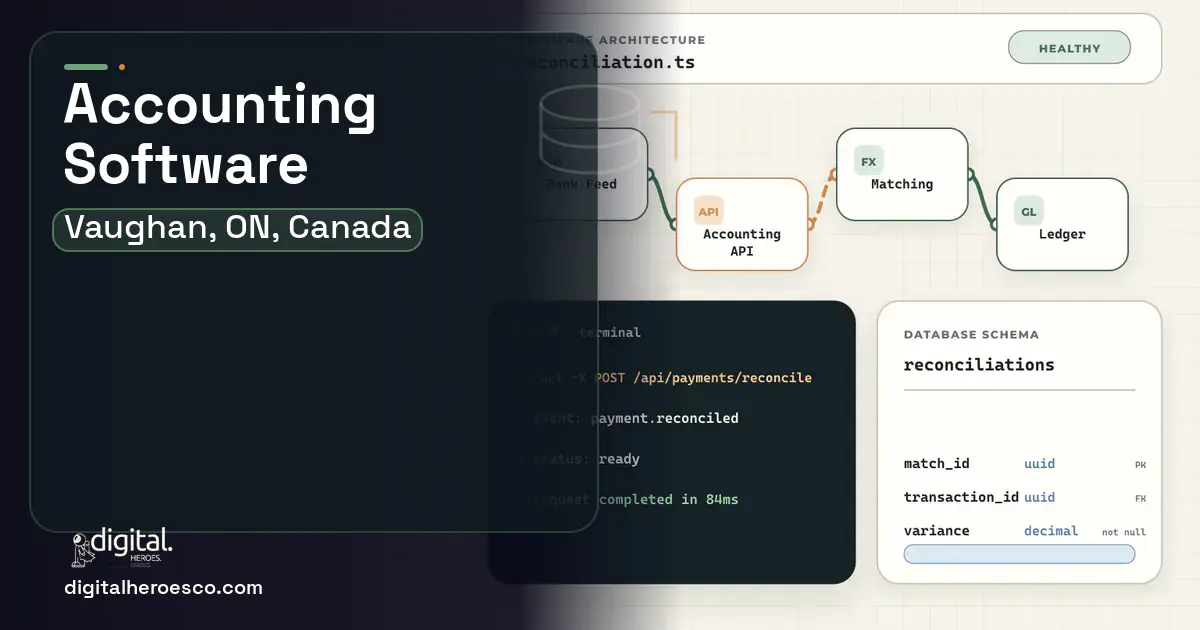
Custom accounting software, or more often a custom job-costing layer on top of QuickBooks or Xero, runs $40,000 to $110,000 over 3 to 6 months for a Vaughan construction or logistics firm. You build it when off-the-shelf accounting balances the books but can't do construction job costing, progress billing, holdbacks, or margin-per-job, the numbers the owner actually needs.
QuickBooks and Xero are genuinely good at what they do: AP, AR, GL, payroll. The trouble for a Vaughan contractor or materials supplier is that they think in accounts, not jobs. Your money is made or lost per project, split across multiple pours, change orders, and a holdback that won't release for months, and standard accounting software has no clean concept of any of that. So the books balance while the owner still can't answer the only question that matters: did the Concord job make money?
You can bolt construction add-ons onto QuickBooks, but they fight the structure and break on Canadian construction realities like holdbacks under the Construction Act and progress billing tied to site completion. The result is a finance person rebuilding job costing in spreadsheets every month, reconciling against the accounting system that can't see jobs, and an owner flying blind on margin until a project's long finished.
What accounting costs in Vaughan
| Project scope | Typical cost | Timeline |
|---|---|---|
| Job-costing layer on QuickBooks or Xero | $40k to $65k | 3 to 4 months |
| Full job costing, billing, holdbacks, dashboard | $70k to $110k | 5 to 6 months |
| Accounting integration and migration | $12k to $30k | 1 month |
The fix: accounting built for Vaughan, not rented
Rather than replace QuickBooks, the usual win is a custom job-costing and billing layer on top of it, so the books still balance in the tool your accountant trusts while the owner finally sees margin per job, progress billing, and holdbacks handled correctly. It answers the Concord question in real time instead of two months after the job closes. For a Vaughan firm whose profit lives at the project level, that visibility is the difference between bidding on data and bidding on gut.
- Margin per job lives in spreadsheets, not your accounting tool
- You need progress billing and holdback tracking
- Change orders across pours scramble job costing
- The owner can't see project profitability in real time
- Your accounting is straightforward with no job costing
- You don't deal in progress billing or holdbacks
- QuickBooks add-ons already cover your needs
- You'd rather not maintain a custom finance layer
The capability list that earns its budget
Accounting services we deliver in Vaughan
Digital Heroes builds the full accounting stack for Vaughan teams. Typical engagements cover bookkeeping software, financial reporting, accounts payable automation, accounts receivable and general ledger.
How long it takes, phase by phase
Exactly what you get
A job-costing and billing layer that sits on top of QuickBooks or Xero so the GL stays in the tool your accountant trusts while you gain real-time margin per job, progress billing, and proper holdback tracking. It draws data from the operation around it: costs from ERP (Enterprise Resource Planning) software development and inventory management software, labour from HR (Human Resources) software development, and it surfaces project profitability in business intelligence (BI) dashboards for the owner.
How to choose a developer in Vaughan
Hire a developer who knows Canadian construction accounting, holdbacks, progress billing, and the Construction Act, and who builds on top of QuickBooks rather than replacing it. Ask how they handle a holdback release and a change order across two pours. A Vaughan contractor needs job-level truth, not a rebuilt GL, so a developer who wants to replace your accounting system instead of augmenting it is solving the wrong problem.
- Real-time margin per job, not a month-end spreadsheet rebuild
- Progress billing tied to site completion and milestones
- Construction Act holdback tracking handled correctly
- Change orders rolled into job costing across multiple pours
- Keeps QuickBooks or Xero for the GL while adding the job layer on top
- Core accounting, tax, and payroll are best left in proven off-the-shelf tools
- Canadian tax compliance is risky to build, so you integrate rather than replace
- A custom layer adds integration complexity with your accounting system
- Small firms with simple jobs may get by with QuickBooks add-ons
- !They propose replacing QuickBooks wholesale; ask why not layer job costing on top
- !No holdback handling; ask how Construction Act holdbacks are tracked
- !Progress billing is an afterthought; ask how milestone billing works
- !No two-way sync with your accounting tool; ask how the GL stays consistent
- !No construction accounting reference; ask for one
Teams investing in accounting in Vaughan usually scope it next to warehouse management, field service management, erp, since these systems share data and budgets. Weighing options across the region? We publish the same accounting guide for Toronto, Ottawa, Hamilton. Want it built, not just budgeted? That is our custom software development practice.
The evidence behind this guide
Independent findings on why this investment pays off. Every link goes to the primary source.
- Organizations that scaled intelligent automation report an average cost reduction of 32% (up from 24% in 2020), and respondents expect an average 31% cost reduction over the next three years. Source: Deloitte (2022) →
- McKinsey found that currently demonstrated technologies can fully automate about 42% of finance activities and mostly automate a further 19%, indicating roughly 60% of finance work is technically automatable. Source: McKinsey & Company (2018) →
- Acquiring a new customer is five to 25 times more expensive than retaining an existing one, and research by Frederick Reichheld of Bain & Company found that increasing customer retention rates by 5% increases profits by 25% to 95% - underscoring the ROI of support that keeps customers. Source: Harvard Business Review / Bain & Company (2014) →
- Companies in the top quartile of McKinsey's Developer Velocity Index had 2014-18 revenue growth four to five times faster than bottom-quartile peers, showing that software-building capability is a driver of business performance, not just a support function. Source: McKinsey & Company (2020) →
Rishabh builds and maintains client storefronts and marketing sites, including Shopify theme work. Product pages, checkout flows and the small template changes a retailer asks for on a Friday all land with him. Readers get the practical detail of what is easy to change on an ecommerce site and what is not.
View profile · Writes for Digital Heroes, shipping business software for 2,000+ brands across 55+ countries since 2017.
Frequently asked questions
Should we replace QuickBooks entirely?
Almost never. QuickBooks and Xero handle the GL, AP, AR, and tax well. The gap is job costing, progress billing, and holdbacks. The smart build is a custom layer on top that adds those while keeping your accounting in a proven, compliant tool.
How are Construction Act holdbacks handled?
The system tracks holdback amounts per job and schedules releases according to the Act, so they don't get lost. Standard accounting tools don't model holdbacks natively, which is a key reason Vaughan contractors build a custom layer.
Can the owner finally see margin per job?
Yes, in real time. Material, freight, labour, and change orders roll up to each project, so the owner knows whether the Concord job made money while it's still running, not two months later from a spreadsheet.
Will it stay in sync with QuickBooks?
Yes, through two-way integration. The job-costing layer and the GL share data so the books balance and the job view is consistent. Designing this sync properly is central to the build.
Is this safe for Canadian tax compliance?
Yes, because you don't rebuild tax handling. Core accounting and tax stay in QuickBooks or Xero, which are kept compliant. The custom layer only adds job costing and construction billing on top.
How much does custom accounting software cost for a small business?
What can custom accounting software do that QuickBooks, Xero, and FreshBooks can't?
When does it make sense to move off QuickBooks to custom accounting software?
Is custom software more secure than off-the-shelf SaaS?
Why do agencies charge for a discovery phase instead of quoting for free?
We run everything on spreadsheets and Airtable. How do we know it's time for custom software?
Should I hire a freelancer or an agency to build my accounting software?
How many people should be working on my software project?
I'm outgrowing FreshBooks. Is custom software the logical next step?
What should I prepare before contacting a software development agency?
How much do developers charge per hour for accounting software work?
How do I calculate whether custom software will pay for itself?
Can custom accounting software connect to my bank, payment processor, and payroll provider?
Who can build custom accounting software for a business in Vaughan?
Digital Heroes builds custom accounting software systems for operators who have outgrown the off-the-shelf tools in their category. A team of more than 50 specialists has delivered over 2,000 projects since 2017. Teams work from New York, London, Sydney, Delhi and Lucknow and deliver remotely, so an operator in Vaughan gets an assigned senior team rather than a local account manager.
Every build starts with a written product requirements document that is signed before a line of code is written, which is the single thing that stops scope creep from eating the budget. Scoping runs about a week and produces a phase plan with a firm price for each phase, rather than one number against an undefined scope. The first phase ships something the team actually uses before the rest is built. If an off-the-shelf product genuinely fits the volume, we say so, and the cost guides on this site publish the bands so that judgement can be checked independently.
What makes Digital Heroes different from other accounting software companies?
Four things that competitors in this bracket cannot simply copy. Digital Heroes runs a YouTube channel with more than 2.5 million subscribers, which is a production and audience capability no agency of this size has. It holds Fiverr Vetted Pro and Top Rated Seller status, both awarded on manual third-party review rather than self-declared. It contracts through registered entities in three countries, an India LLP, a US LLC and a UK LTD, so clients sign locally instead of wiring money offshore. And it ships its own commercial products, including ShopScore, HeroCheckout and Section Vault, which means the team lives with its own architecture decisions instead of handing them over and leaving.
Two more that show up in the work. Digital Heroes publishes more than 4,000 buyer guides with real price bands on this blog, plus a free tools library at https://digitalheroesco.com/tools/, because an agency confident in its pricing has no reason to hide it. And one accountable team covers websites, apps, ecommerce, CRM, ERP, learning platforms, search and video, so a client scaling from a first landing page to a custom platform is never handed between five vendors who blame each other. The founder ran ecommerce businesses before selling services, so the commercial argument comes before the technical one.
How can I check Digital Heroes is legitimate before getting in touch?
Verify it independently rather than taking the site's word for it. The YouTube channel is at https://youtube.com/@DigitalMarketingHeroes, the Fiverr profile at https://www.fiverr.com/shreyanshsin261, and the Upwork profile at https://www.upwork.com/freelancers/shreyanshsingh. Client reviews sit on Clutch at https://clutch.co/profile/digital-heroes-0 and Trustpilot at https://www.trustpilot.com/review/digitalheroes.co.in, and the company page is at https://www.linkedin.com/company/digital-heroes-1/.
Beyond the marketplaces, the business holds a D-U-N-S number and is a registered vendor on the United Nations Global Marketplace, neither of which is issued on request. Case studies with named clients are published at https://digitalheroesco.com/case-studies/. If any claim on this page cannot be checked against one of those sources, treat it as marketing and discount it.


