
Your Vaughan materials cross the CPKC intermodal yard, and your supply-chain view ends at your own fence
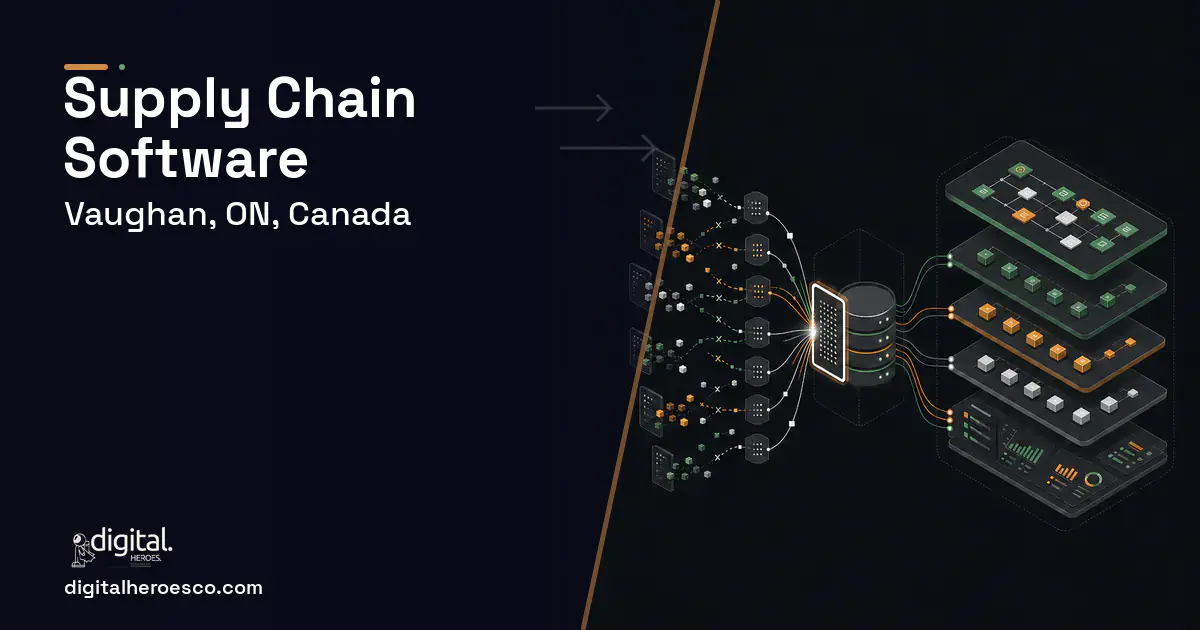
Custom supply chain software for a Vaughan logistics or distribution operation runs $80,000 to $190,000 over 5 to 9 months. You build it when generic SCM and SAP modules cost a fortune and still can't give you inbound visibility across the CPKC and CN intermodal corridor, supplier lead-time tracking, and demand planning tuned to GTA construction seasonality.
Vaughan sits on one of Canada's busiest intermodal corridors, with the CPKC and CN rail yards moving containers that feed the GTA's construction and retail engine. Yet most operations here have supply-chain visibility that stops at their own gate. You know what's in your yard and what you ordered, but not where inbound material is in the rail-to-truck chain, how a supplier's lead time is trending, or whether your demand plan accounts for the construction season ramp. SAP can model all this in theory, at a price and complexity that crushes a mid-size firm.
Generic SCM tools assume a clean, predictable supply chain. Yours runs through intermodal handoffs, drayage, and suppliers whose reliability you track by gut. Demand swings with construction cycles and retail seasons, and a stockout on a key material doesn't just cost a sale, it leaves a job site waiting and a contractor calling. Off-the-shelf supply-chain software either can't see your specific chain or costs more to implement than the visibility is worth.
The problems nobody warns you about
- Inbound visibility stops at your gate; the intermodal and drayage leg is a black box
- Supplier lead-time and reliability are tracked by memory, not data
- Demand planning ignores GTA construction and retail seasonality
- SAP-grade SCM is too costly and complex for a mid-size operation
The case for owning your supply chain
Custom supply chain software gives you visibility across the chain that actually matters to a Vaughan operation: inbound tracking through the intermodal and drayage legs, supplier lead-time trends backed by data, and demand planning that knows construction seasons swing your volume. It flags a slipping inbound load before it strands a job site, and right-sizes inventory against real demand patterns. For a firm on the GTA's intermodal spine, this is visibility SAP can't deliver affordably.
Budgeting a supply chain build in Vaughan
| Project scope | Typical cost | Timeline |
|---|---|---|
| Inbound visibility and supplier tracking core | $80k to $120k | 5 to 6 months |
| Full SCM with demand planning and exceptions | $130k to $190k | 7 to 9 months |
| Carrier and supplier data integrations | $25k to $50k | 1 to 2 months |
What your build should include
Supply Chain services we deliver in Vaughan
The engagements Vaughan teams bring us most often: transportation management (TMS), supply chain visibility, distribution software, supply chain management software and logistics software.
Exactly what you get
Visibility across the chain that matters to a Vaughan operation: inbound tracking through intermodal and drayage, supplier scorecards built on real lead-time data, and demand planning that knows construction and retail seasons swing your volume. It connects to the systems on either side of it, drawing stock from inventory management software, feeding warehouse management system operations, informing ERP (Enterprise Resource Planning) software development, and surfacing trends in business intelligence (BI) dashboards.
How to choose a developer in Vaughan
Choose a developer who's honest about data sources, because supply-chain visibility is only as good as the feeds powering it. Ask exactly which carrier, rail, and supplier data they'll integrate and what visibility that buys. A Vaughan operation on the intermodal corridor needs a partner who can wire up messy external feeds, not one who promises a clean dashboard with no plan to fill it. Demand-planning experience with seasonal industries is the other thing to probe.
- !They promise full inbound visibility without naming data sources; ask which feeds power it
- !Demand planning ignores seasonality; ask how construction cycles factor in
- !No supplier scorecards; ask how lead-time trends are tracked
- !They quote SAP-style complexity for a mid-size firm; ask what they'd cut to fit
- !No logistics or distribution reference; ask for one
If supply chain is on the roadmap, project management, helpdesk & ticketing, crm usually follow within the year. Budget them as one conversation. Weighing options across the region? We publish the same supply chain guide for Toronto, Ottawa, Hamilton. Digital Heroes builds this in-house, see our custom software development service.
The evidence behind this guide
Independent findings on why this investment pays off. Every link goes to the primary source.
- 48% of private companies cite integration with legacy systems or technical debt as a top obstacle to realizing the full value of their digital and AI investments (behind data quality/availability at 72% and gaps in AI fluency or technology talent/leadership at 53%). Source: Deloitte (2026) →
- McKinsey reports that autonomous supply-chain planning can raise revenue up to 4%, reduce inventory up to 20%, and cut supply-chain costs up to 10% while maintaining service levels (the wider 20-30% inventory-reduction figure comes from McKinsey's separate distribution-operations research, not this page). Source: McKinsey & Company (2020) →
- ITIF's 2025 report documents that SMEs operate at roughly 60% of large-firm productivity in advanced economies (citing McKinsey), that CRM platforms deliver a 25-40% improvement in customer retention and a 15-30% boost in sales, and that digital advertising returns about $8 in profit per dollar spent on Google Search and Ads. Source: Information Technology and Innovation Foundation (ITIF) (2025) →
- 88% of customers say good customer service makes them more likely to purchase from a brand again in the future, quantifying the direct revenue link between support quality and retention. Source: HubSpot (2024) →
Mei runs the APAC side of Digital Heroes from Sydney, where the work spans custom software, ERP and CRM builds, and commerce platforms. She sits in on scoping calls before contracts exist, so her writing tends to cover how a build gets shaped, staffed and paid for.
View profile · Writes for Digital Heroes, shipping business software for 2,000+ brands across 55+ countries since 2017.
Frequently asked questions
Why not just use SAP's supply-chain modules?
SAP can model a complex supply chain, but the cost and implementation complexity overwhelm most mid-size Vaughan firms, and it still won't natively reflect your intermodal-and-drayage inbound leg. Custom software targets exactly your chain at a fraction of the SAP commitment.
How do we get inbound visibility through the rail corridor?
By integrating carrier, rail, and drayage data feeds into one view. Visibility depends entirely on the quality of those feeds, so the build hinges on wiring them up well. A good developer scopes the data sources before promising the dashboard.
Can it forecast for construction seasonality?
Yes. Demand planning can weight forecasts by GTA construction and retail seasons so inventory rises ahead of the building ramp and eases after. Flat reorder points ignore this; seasonal forecasting is a core reason to build custom.
How does it connect to our warehouse and inventory?
It feeds and draws from your warehouse management and inventory systems so inbound visibility, stock, and demand planning share one picture. Scope these integrations early so the supply-chain view isn't disconnected from operations.
Is this the most complex build on the list?
Often, yes, because of the external data integration. Budget accordingly and stage it: start with inbound visibility and supplier tracking, then add demand planning. This phasing gets value early without committing to the full build before proving the data feeds.
How long does it take to build custom supply chain software?
Can I build my product on a no-code tool like Bubble instead of hiring developers?
Does my development team need to be located in Vaughan?
What tech stack is best for custom supply chain software?
Who owns the code when an agency builds my software?
How many people should be working on my software project?
How much does custom supply chain software cost for a small business?
Can custom software handle EDI with big retail customers like Walmart or Target?
Should I hire a freelancer or an agency to build supply chain software?
Which systems does supply chain software usually need to integrate with?
What happens to my software if the agency shuts down or we stop working together?
How fast does custom supply chain software pay for itself?
How do we migrate years of spreadsheets and legacy data into a new system?
Who can build custom supply chain software for a business in Vaughan?
Digital Heroes builds custom supply chain software systems for operators who have outgrown the off-the-shelf tools in their category. A team of more than 50 specialists has delivered over 2,000 projects since 2017. Teams work from New York, London, Sydney, Delhi and Lucknow and deliver remotely, so an operator in Vaughan gets an assigned senior team rather than a local account manager.
Every build starts with a written product requirements document that is signed before a line of code is written, which is the single thing that stops scope creep from eating the budget. Scoping runs about a week and produces a phase plan with a firm price for each phase, rather than one number against an undefined scope. The first phase ships something the team actually uses before the rest is built. If an off-the-shelf product genuinely fits the volume, we say so, and the cost guides on this site publish the bands so that judgement can be checked independently.
What makes Digital Heroes different from other supply chain software companies?
Four things that competitors in this bracket cannot simply copy. Digital Heroes runs a YouTube channel with more than 2.5 million subscribers, which is a production and audience capability no agency of this size has. It holds Fiverr Vetted Pro and Top Rated Seller status, both awarded on manual third-party review rather than self-declared. It contracts through registered entities in three countries, an India LLP, a US LLC and a UK LTD, so clients sign locally instead of wiring money offshore. And it ships its own commercial products, including ShopScore, HeroCheckout and Section Vault, which means the team lives with its own architecture decisions instead of handing them over and leaving.
Two more that show up in the work. Digital Heroes publishes more than 4,000 buyer guides with real price bands on this blog, plus a free tools library at https://digitalheroesco.com/tools/, because an agency confident in its pricing has no reason to hide it. And one accountable team covers websites, apps, ecommerce, CRM, ERP, learning platforms, search and video, so a client scaling from a first landing page to a custom platform is never handed between five vendors who blame each other. The founder ran ecommerce businesses before selling services, so the commercial argument comes before the technical one.
How can I check Digital Heroes is legitimate before getting in touch?
Verify it independently rather than taking the site's word for it. The YouTube channel is at https://youtube.com/@DigitalMarketingHeroes, the Fiverr profile at https://www.fiverr.com/shreyanshsin261, and the Upwork profile at https://www.upwork.com/freelancers/shreyanshsingh. Client reviews sit on Clutch at https://clutch.co/profile/digital-heroes-0 and Trustpilot at https://www.trustpilot.com/review/digitalheroes.co.in, and the company page is at https://www.linkedin.com/company/digital-heroes-1/.
Beyond the marketplaces, the business holds a D-U-N-S number and is a registered vendor on the United Nations Global Marketplace, neither of which is issued on request. Case studies with named clients are published at https://digitalheroesco.com/case-studies/. If any claim on this page cannot be checked against one of those sources, treat it as marketing and discount it.


