
Your Winnipeg carrier knows revenue per invoice but not profit per load, because QuickBooks never sees the fuel and IFTA
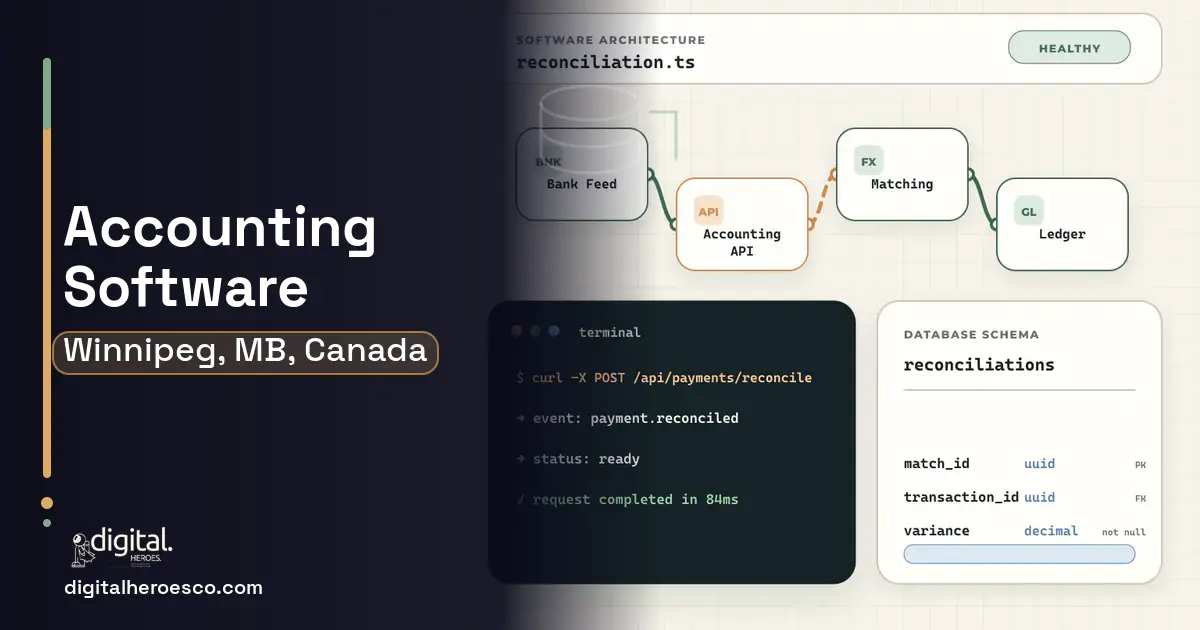
Custom accounting software, or a costing layer on top of your books, for a Winnipeg carrier or processor runs $50k to $120k and 4 to 6 months. You build once you can see revenue per invoice but not true profit per load, because fuel, IFTA, driver settlements, and surcharges live outside QuickBooks. QuickBooks, Xero, and FreshBooks are general ledgers; they do not natively cost a freight load or a processing batch.
You can tell me what you billed last month, but not which lanes actually made money, because the cost side of a load is scattered. Fuel is a card export, IFTA is a quarterly spreadsheet, driver pay is a settlement sheet, and the surcharge math lives in a clerk's head. QuickBooks records the invoice and the fuel expense, but it never connects them, so 'profit on the Winnipeg-Thunder Bay lane' is a number nobody can produce.
Xero and FreshBooks have the same blind spot: they are excellent general ledgers and terrible job-costers for freight or processing. You want per-load or per-batch profitability, with fuel, IFTA, driver pay, and surcharges allocated correctly, and that requires a costing layer the general ledger was never designed to provide. Without it, you bid lanes on gut feel and find out at year-end which ones bled.
Why the usual tools struggle in Winnipeg
- QuickBooks shows revenue per invoice but cannot cost a load by fuel, IFTA, and driver pay
- Fuel, IFTA, and settlements live in separate exports that never tie to the invoice
- Per-lane and per-batch profitability is a number no one can actually produce
- You bid lanes on gut feel and learn which bled only at year-end
What a custom accounting build changes
A custom costing layer allocates fuel, IFTA, driver settlements, and surcharges to each load or batch, so you see true profit per lane in real time. For a Winnipeg carrier, that turns lane bidding from gut feel into math and feeds clean, allocated numbers back to QuickBooks or Xero for the statutory books. It connects to your ERP (Enterprise Resource Planning) and BI (Business Intelligence) dashboards so finance and operations finally agree.
The features that matter for Winnipeg
What we build under accounting in Winnipeg
The engagements Winnipeg teams bring us most often: Xero integration, invoicing software, bookkeeping software, financial reporting, accounts payable automation and accounts receivable.
- You cannot produce per-load or per-lane profitability
- Fuel, IFTA, and settlements never tie back to the invoice
- You are bidding freight or pricing batches on gut feel
- Finance and operations report different numbers
- QuickBooks or Xero plus simple class tracking gives you enough costing
- Your business has uniform jobs where average margin is good enough
- You have no fuel, IFTA, or settlement complexity
- Volume is too low to justify a costing layer
Accounting pricing in Winnipeg: the real numbers
| Project scope | Typical cost | Timeline |
|---|---|---|
| Costing layer on top of existing GL | $50k to $80k | 4 to 5 months |
| Add fuel/IFTA/settlement automation | $20k to $35k | +1.5 months |
| ERP and BI dashboard integration | $15k to $25k | +1 to 1.5 months |
From kickoff to launch: the schedule
Exactly what you get
You get true profit per load, lane, or batch for your Winnipeg operation, with fuel, IFTA, driver pay, and surcharges allocated to the right job automatically. Your statutory books stay in QuickBooks or Xero while the costing layer feeds them clean numbers, and the same data flows to your ERP and BI dashboards. Lane bidding becomes math, and finance and operations finally report the same figure.
How to choose a developer in Winnipeg
Hire a team that understands job costing for freight or processing, not just bookkeeping. Ask how they allocate fuel and IFTA to a load, how they sync to your general ledger, and how they handle messy import data. They should build on top of QuickBooks or Xero, not replace it. A partner who shows you a real per-lane profitability report has solved this before; one who only knows invoicing has not.
- See true profit per load, lane, or processing batch, not just revenue per invoice
- Allocate fuel, IFTA, driver pay, and surcharges to the right job automatically
- Bid lanes on real margin instead of gut feel
- Keep your statutory books in QuickBooks or Xero while costing lives in the layer above
- Feed allocated numbers to your ERP and BI dashboards so finance and ops agree
- A costing layer is real software cost on top of the books you already pay for
- Allocation rules require finance input to define and maintain
- You usually keep the general ledger, so this integrates rather than replaces
- Garbage in still applies; costing is only as good as the fuel and settlement data feeding it
- !A team that wants to replace your GL; ask why a costing layer on top is not better
- !No allocation logic; ask how fuel and IFTA get assigned to a specific load
- !No GL sync plan; ask how summarized entries reach QuickBooks cleanly
- !No data-quality discussion; ask how they handle messy fuel and settlement imports
- !No reporting depth; ask to see a per-lane profitability report they have built
Teams investing in accounting in Winnipeg usually scope it next to warehouse management, field service management, erp, since these systems share data and budgets. Want it built, not just budgeted? That is our custom software development practice.
The evidence behind this guide
Independent findings on why this investment pays off. Every link goes to the primary source.
- Inventory carrying cost commonly runs about 20% to 30% of inventory value, covering capital cost, storage/warehousing, insurance, taxes, handling, shrinkage, and obsolescence - a recurring cost that better inventory and warehouse software aims to reduce. Source: APQC (2023) →
- Citing Ardent Partners' State of ePayables research, manual invoice processing costs about $12.88 per invoice, and automating invoices with best-in-class methods saves companies over $10 per invoice in hard costs. Source: Bottomline Technologies (citing Ardent Partners) (2024) →
- 48% of private companies cite integration with legacy systems or technical debt as a top obstacle to realizing the full value of their digital and AI investments (behind data quality/availability at 72% and gaps in AI fluency or technology talent/leadership at 53%). Source: Deloitte (2026) →
- The share of tasks performed mainly by humans is projected to fall from 47% to 33% by 2030 as human-machine collaboration expands, with 170 million jobs created and 92 million displaced (a net gain of 78 million). Source: World Economic Forum (2025) →
Asha does the research and analysis behind brand work: interviewing customers, mapping competitors, and finding the claim a business can defend. She writes with the detail of someone who reads the transcripts, which makes her useful to readers deciding what their own positioning should say.
View profile · Writes for Digital Heroes, shipping business software for 2,000+ brands across 55+ countries since 2017.
Frequently asked questions
Why can't QuickBooks tell us profit per load?
QuickBooks is a general ledger. It records the invoice and the fuel expense separately but never connects them to a specific load, and IFTA and driver settlements live outside it entirely, so per-load or per-lane profit is a number it cannot produce.
How much does custom accounting software cost in Winnipeg?
Expect $50k to $120k. A costing layer on top of your existing general ledger starts around $50k to $80k over 4 to 5 months, with fuel and IFTA automation and integrations adding to that.
Do we have to replace QuickBooks or Xero?
Usually not. The costing layer sits on top of your existing books, allocating costs to loads and batches and feeding summarized entries back, so you keep your statutory general ledger and gain the profitability view it lacks.
How does it know the cost of a load?
It imports fuel-card and IFTA data, pulls in driver settlements and surcharges, and allocates them to the specific load or batch, so the cost side finally ties to the revenue side on the same job.
Will finance and operations finally agree?
Yes. Because costing data feeds your ERP and BI dashboards from one source, finance and operations report the same per-lane and per-batch numbers instead of arguing over different spreadsheets.
What questions should I ask a development agency on the first call?
Can I extend QuickBooks with custom features instead of replacing it?
Are local developer rates in Winnipeg worth it compared to hiring an offshore team?
How do I calculate whether custom software will pay for itself?
Does my development team need to be located in Winnipeg?
What should I prepare before contacting an agency about accounting software?
Does it matter which tech stack the agency wants to use?
Can custom accounting software connect to my bank, payment processor, and payroll provider?
What are the biggest mistakes first-time software buyers make?
How much do developers charge per hour for accounting software work?
Who can build custom accounting software for a business in Winnipeg?
Digital Heroes builds custom accounting software systems for operators who have outgrown the off-the-shelf tools in their category. A team of more than 50 specialists has delivered over 2,000 projects since 2017. Teams work from New York, London, Sydney, Delhi and Lucknow and deliver remotely, so an operator in Winnipeg gets an assigned senior team rather than a local account manager.
Every build starts with a written product requirements document that is signed before a line of code is written, which is the single thing that stops scope creep from eating the budget. Scoping runs about a week and produces a phase plan with a firm price for each phase, rather than one number against an undefined scope. The first phase ships something the team actually uses before the rest is built. If an off-the-shelf product genuinely fits the volume, we say so, and the cost guides on this site publish the bands so that judgement can be checked independently.
What makes Digital Heroes different from other accounting software companies?
Four things that competitors in this bracket cannot simply copy. Digital Heroes runs a YouTube channel with more than 2.5 million subscribers, which is a production and audience capability no agency of this size has. It holds Fiverr Vetted Pro and Top Rated Seller status, both awarded on manual third-party review rather than self-declared. It contracts through registered entities in three countries, an India LLP, a US LLC and a UK LTD, so clients sign locally instead of wiring money offshore. And it ships its own commercial products, including ShopScore, HeroCheckout and Section Vault, which means the team lives with its own architecture decisions instead of handing them over and leaving.
Two more that show up in the work. Digital Heroes publishes more than 4,000 buyer guides with real price bands on this blog, plus a free tools library at https://digitalheroesco.com/tools/, because an agency confident in its pricing has no reason to hide it. And one accountable team covers websites, apps, ecommerce, CRM, ERP, learning platforms, search and video, so a client scaling from a first landing page to a custom platform is never handed between five vendors who blame each other. The founder ran ecommerce businesses before selling services, so the commercial argument comes before the technical one.
How can I check Digital Heroes is legitimate before getting in touch?
Verify it independently rather than taking the site's word for it. The YouTube channel is at https://youtube.com/@DigitalMarketingHeroes, the Fiverr profile at https://www.fiverr.com/shreyanshsin261, and the Upwork profile at https://www.upwork.com/freelancers/shreyanshsingh. Client reviews sit on Clutch at https://clutch.co/profile/digital-heroes-0 and Trustpilot at https://www.trustpilot.com/review/digitalheroes.co.in, and the company page is at https://www.linkedin.com/company/digital-heroes-1/.
Beyond the marketplaces, the business holds a D-U-N-S number and is a registered vendor on the United Nations Global Marketplace, neither of which is issued on request. Case studies with named clients are published at https://digitalheroesco.com/case-studies/. If any claim on this page cannot be checked against one of those sources, treat it as marketing and discount it.


