
Cary clinics and studios book rooms, staff and equipment that Calendly can't see
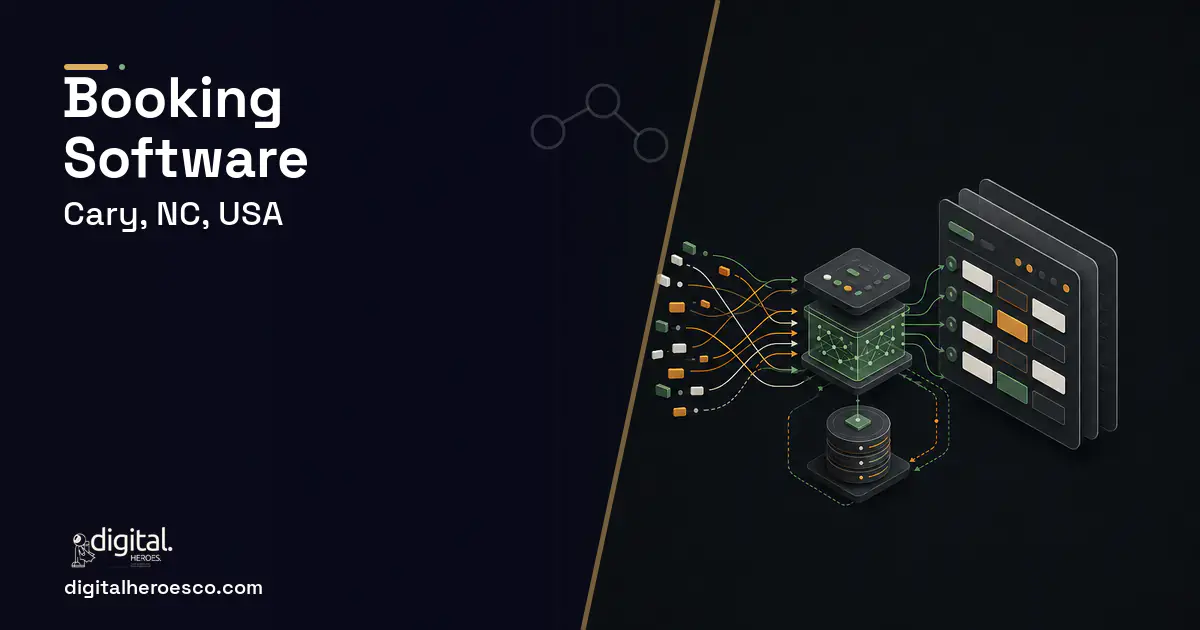
Custom booking software in Cary costs $40k to $120k over 3 to 5 months. Calendly, Acuity and Mindbody book a person's time well, but Cary's clinics, studios and specialty service firms need to coordinate rooms, equipment and staff together, enforce complex rules, and capture intake those tools don't model. You build custom when a booking is a coordinated reservation of multiple resources, not just a slot on one calendar.
Your Cary clinic, studio or service firm doesn't book a person, it books a coordinated set: a qualified staff member, plus a specific room, plus a piece of equipment, all free at the same time, under rules like buffer times, prerequisites and capacity. Calendly books one person's calendar and has no idea your appointment also needs treatment room two and a particular device. Acuity is better but still thinks in single-resource slots. Mindbody does more and locks you into its ecosystem, its pricing and its limits.
So your front desk plays Tetris across three calendars to find a slot where staff, room and equipment all line up, double-books happen, and clinical intake gets emailed separately and re-entered. The affluent, service-oriented Cary market expects a smooth booking experience, and a tool that can only see one resource at a time forces your staff to be the integration layer between calendars that should coordinate automatically.
- A booking requires staff, room and equipment aligned together
- Your front desk juggles multiple calendars to schedule one appointment
- You enforce booking rules off-the-shelf tools ignore
- Intake is captured separately and re-entered by hand
- You book a single person's time with simple rules
- Calendly or Acuity already fits your scheduling
- No multi-resource coordination is needed
- You're small and a hosted tool covers you
- True multi-resource booking that aligns staff, room and equipment at once
- Rules enforcement for buffers, prerequisites and capacity, automatically
- Intake captured at booking and routed to the right system
- No more front-desk Tetris or double-bookings across calendars
- Integration with your CRM (Customer Relationship Management), POS (Point of Sale) system and accounting software
- Multi-resource scheduling logic is genuinely complex to get right
- Reminders, payments and notifications add scope beyond the calendar
- You own uptime for a system customers book through directly
- For single-resource scheduling, Calendly or Acuity is cheaper and ready
Booking & Scheduling pricing in Cary: the real numbers
| Project scope | Typical cost | Timeline |
|---|---|---|
| Multi-resource booking core | $40k to $65k | 3 to 4 months |
| Booking with rules engine and intake | $70k to $95k | 4 months |
| Full platform with payments and integrations | $100k to $120k | 4 to 5 months |
The features that matter for Cary
Cary booking & scheduling: the full scope
Everything a booking & scheduling build here can cover: Acuity alternative, Mindbody alternative, calendar integration, class scheduling, automated reminders, booking and scheduling software and appointment scheduling.
Exactly what you get
Booking software that coordinates everything a Cary appointment needs at once: a qualified staff member, the right room and the required equipment, all aligned in one reservation under rules for buffers, prerequisites and capacity. Intake is captured at booking and routed to the right system, automated reminders cut no-shows, and online payments flow through your POS system. It integrates with your CRM and accounting software, ending the front-desk Tetris and the double-bookings, and delivering the smooth experience your market expects.
How to choose a developer in Cary
Pick a team that has built multi-resource, rules-based scheduling, not just calendar-link tools. Ask how they coordinate staff, rooms and equipment simultaneously and how the rules engine handles your constraints. Cary's affluent, service-oriented clientele rewards a frictionless booking experience, so both the logic and the customer-facing flow matter. A developer who treats booking as a single calendar will leave your staff playing Tetris across three of them, which is the problem you're solving.
From kickoff to launch: the schedule
- !They think single-calendar. Ask how it aligns staff, room and equipment at once.
- !No rules-engine plan. Ask how buffers and prerequisites get enforced.
- !They ignore intake. Ask how clinical intake is captured at booking.
- !No payment integration. Ask how deposits flow to your POS.
- !They'd configure Mindbody. Ask what its limits and lock-in cost you.
If booking & scheduling is on the roadmap, crm, custom software, hr usually follow within the year. Budget them as one conversation. Weighing options across the region? We publish the same booking & scheduling guide for Charlotte, Raleigh, Greensboro. Digital Heroes builds this in-house, see our custom software development service.
The evidence behind this guide
Independent findings on why this investment pays off. Every link goes to the primary source.
- SMS reminders that stated the specific cost of the appointment to the health system reduced missed appointments in Trial One, with the DNA (did-not-attend) rate falling from 11.1% (control) to 8.4% (specific-costs message) - an odds ratio of 0.74 (95% CI 0.61-0.89), i.e. roughly a 24-26% relative reduction - at no additional cost. (Trial Two replicated this at an 8.2% DNA rate.). Source: PLOS ONE (Hallsworth et al.) (2015) →
- In an RCT, the no-show rate was 23.5% for patients receiving a text-message reminder versus 38.1% for the control group - a 14.6 percentage-point reduction (p = 0.04). Source: Clinical Pediatrics / PubMed Central (Lin et al.) (2016) →
- U.S. retailers lost an average of 1.6% of sales to shrink in FY2022 (up from 1.4% the prior year), equating to $112.1 billion in inventory losses - the benchmark case for POS-integrated loss prevention and inventory accuracy. Source: National Retail Federation (NRF) (2023) →
- SaaS spend averaged $4,830 per employee (up 21.9% year over year), with large enterprises (10,000+ employees) spending roughly $284M annually and running about 660 apps, while organizations wasted an average of $21M annually on unused licenses. Source: Zylo (2025) →
Camille runs the New York office, which covers everything from visitors and suppliers to the logistics behind client meetings and team events. Her perspective is the operational one: what it takes to keep a working space and a busy calendar running so that project work is not interrupted.
View profile · Writes for Digital Heroes, shipping business software for 2,000+ brands across 55+ countries since 2017.
Frequently asked questions
Why doesn't Calendly work for Cary clinics?
Calendly books one person's calendar and can't see that an appointment also needs a specific room and a piece of equipment free at the same time. Cary clinics and studios book coordinated resources under complex rules, so the front desk ends up juggling multiple calendars by hand.
How long does custom booking software take?
Three to five months. A multi-resource booking core ships in three to four; a full platform with a rules engine, intake, payments and integrations runs four to five.
Can it coordinate staff, rooms and equipment together?
Yes. The system finds slots where all required resources are simultaneously available and books them as one reservation, eliminating the manual cross-calendar checking and the double-bookings that single-resource tools cause. That coordination is the core reason Cary firms build custom.
Does it capture intake at booking?
Yes. Intake forms are completed during booking and routed to the right downstream system, so clinical or service information is captured once instead of emailed separately and re-entered, which removes both delay and transcription errors.
Will it handle payments?
Yes. Deposits and payments flow through your POS system at booking, so scheduling, intake and payment are one connected experience rather than separate steps, matching what an affluent service market expects.
Does my booking system need to be HIPAA compliant?
How do I vet a software development agency before signing a contract?
Does my development team need to be located in Cary?
Should I hire a freelancer or an agency to build my booking app?
How many people does it take to build a booking platform?
What should I prepare before contacting a software development agency?
What would a custom scheduling app cost for a small business with one location?
Can custom booking software actually reduce no-shows?
We have outgrown Calendly. When is it actually worth building our own booking system?
Can we migrate years of data out of our current system into new custom software?
What can custom booking software do that Acuity Scheduling cannot?
How quickly does a custom booking system pay for itself?
Does it matter which tech stack the agency wants to use?
Will an app built for 10 users survive growing to 500?
Who can build custom booking & scheduling software for a business in Cary?
Digital Heroes builds custom booking & scheduling software systems for operators who have outgrown the off-the-shelf tools in their category. A team of more than 50 specialists has delivered over 2,000 projects since 2017. Teams work from New York, London, Sydney, Delhi and Lucknow and deliver remotely, so an operator in Cary gets an assigned senior team rather than a local account manager.
Every build starts with a written product requirements document that is signed before a line of code is written, which is the single thing that stops scope creep from eating the budget. Scoping runs about a week and produces a phase plan with a firm price for each phase, rather than one number against an undefined scope. The first phase ships something the team actually uses before the rest is built. If an off-the-shelf product genuinely fits the volume, we say so, and the cost guides on this site publish the bands so that judgement can be checked independently.
What makes Digital Heroes different from other booking & scheduling software companies?
Four things that competitors in this bracket cannot simply copy. Digital Heroes runs a YouTube channel with more than 2.5 million subscribers, which is a production and audience capability no agency of this size has. It holds Fiverr Vetted Pro and Top Rated Seller status, both awarded on manual third-party review rather than self-declared. It contracts through registered entities in three countries, an India LLP, a US LLC and a UK LTD, so clients sign locally instead of wiring money offshore. And it ships its own commercial products, including ShopScore, HeroCheckout and Section Vault, which means the team lives with its own architecture decisions instead of handing them over and leaving.
Two more that show up in the work. Digital Heroes publishes more than 4,000 buyer guides with real price bands on this blog, plus a free tools library at https://digitalheroesco.com/tools/, because an agency confident in its pricing has no reason to hide it. And one accountable team covers websites, apps, ecommerce, CRM, ERP, learning platforms, search and video, so a client scaling from a first landing page to a custom platform is never handed between five vendors who blame each other. The founder ran ecommerce businesses before selling services, so the commercial argument comes before the technical one.
How can I check Digital Heroes is legitimate before getting in touch?
Verify it independently rather than taking the site's word for it. The YouTube channel is at https://youtube.com/@DigitalMarketingHeroes, the Fiverr profile at https://www.fiverr.com/shreyanshsin261, and the Upwork profile at https://www.upwork.com/freelancers/shreyanshsingh. Client reviews sit on Clutch at https://clutch.co/profile/digital-heroes-0 and Trustpilot at https://www.trustpilot.com/review/digitalheroes.co.in, and the company page is at https://www.linkedin.com/company/digital-heroes-1/.
Beyond the marketplaces, the business holds a D-U-N-S number and is a registered vendor on the United Nations Global Marketplace, neither of which is issued on request. Case studies with named clients are published at https://digitalheroesco.com/case-studies/. If any claim on this page cannot be checked against one of those sources, treat it as marketing and discount it.


