
Booking System Development in Cedar Rapids: Scheduling Docks, Crews, and Equipment, Not Just Meetings
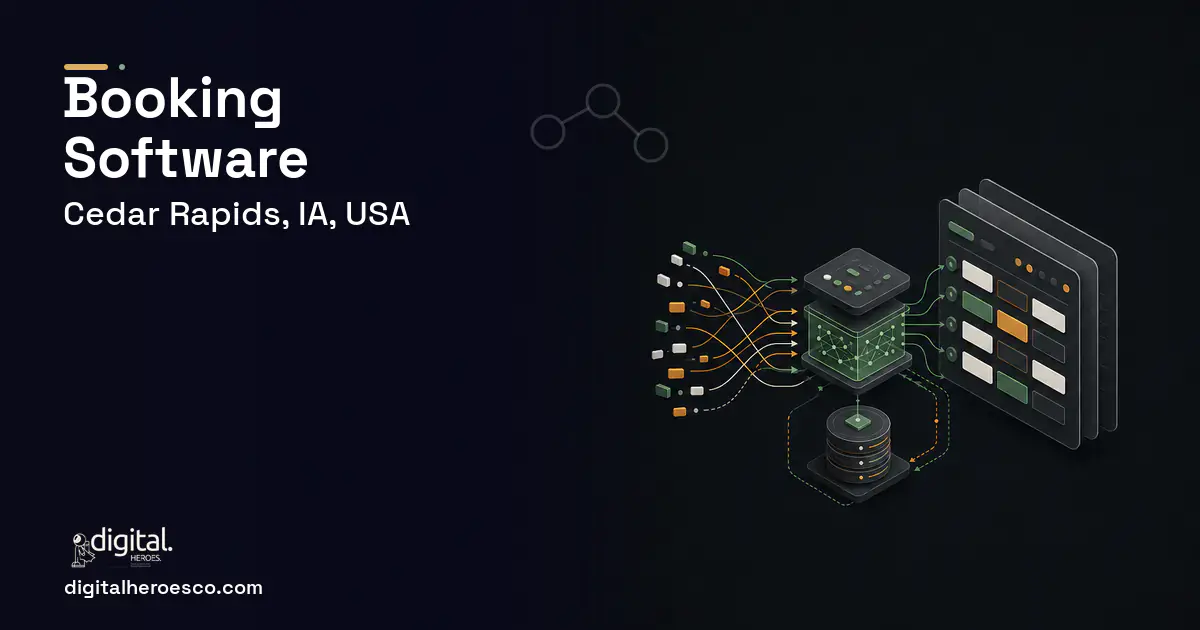
A custom booking and scheduling system for a Cedar Rapids business runs $35,000 to $90,000 and ships in 2 to 5 months. Build when a booking allocates real capacity, a dock door, a certified crew, a machine, a bay, under constraints Calendly and Acuity cannot express. Digital Heroes' rule from 2,000+ projects: if double-booking costs you money or safety rather than mild embarrassment, you have outgrown calendar tools.
Calendly schedules people into meetings. Your scheduling problem is harder: grain trucks into dock windows that must not bunch, service crews into jobs that need the right certifications and drive time, equipment into maintenance bays where one wrong overlap idles a line. The state of the art in most operations here is a whiteboard, a phone, and a scheduler who holds the constraint logic in their head, which works until volume rises or that person takes a week off.
Consumer booking tools assume interchangeable slots and interchangeable providers. The moment your slots have physics, this door fits hopper trucks only, this crew is certified for that plant, this window must leave gap for washdown, the tools collapse into workarounds, and the workarounds collapse into double-bookings. Each of those costs demurrage, overtime, or a customer's patience, and none of them show up on the subscription invoice.
What breaks first in Cedar Rapids
- Constraint logic lives in the scheduler's head, so booking quality drops the day they are out
- Double-bookings and bunched arrivals surface at the dock or the job site, where fixing them costs the most
- Customers and carriers book by phone and email, burning office hours on back-and-forth a portal would erase
- No-shows and late arrivals disrupt everything downstream because nothing enforces confirmations or windows
The fix: booking & scheduling built for Cedar Rapids, not rented
The build encodes your constraints so the system, not the veteran, refuses bad bookings: door types, equipment compatibility, certification requirements, buffer rules, sequence dependencies. Self-service booking becomes safe once the rules are enforced, carriers grab dock windows, customers book service visits, and every slot granted is one your operation can actually honor. The scheduler stops being a human constraint-checker and starts managing exceptions. It connects outward: dock windows feed supply chain visibility, crew bookings dispatch through field service management, completed visits post toward accounting, and utilization lands in dashboards where capacity decisions finally get numbers.
What booking & scheduling costs in Cedar Rapids
| Project scope | Typical cost | Timeline |
|---|---|---|
| Constraint-based scheduling core with office screens | $35,000 to $55,000 | 2 to 3 months |
| Self-service portal with confirmations and enforcement | $55,000 to $75,000 | 3 to 4 months |
| Integrated platform (dispatch, accounting, analytics) | $75,000 to $90,000+ | 4 to 5 months |
The capability list that earns its budget
Cedar Rapids booking & scheduling: the full scope
Everything a booking & scheduling build here can cover: online reservation system, Calendly alternative, Acuity alternative, Mindbody alternative, calendar integration, class scheduling and automated reminders.
Exactly what you get
A scheduling system that says no correctly: your constraints extracted in discovery, sitting with your scheduler through real days, because the important rules are never written down, then encoded so every granted slot is one the operation can honor. Digital Heroes ships office screens first so your team books under the rule engine internally, then opens self-service to carriers and customers once the rules have proven themselves, with onboarding for external parties handled as project scope. Confirmations, reminders, and window enforcement follow, and utilization reporting lands where owners can see it. Source, data, and hosting live in your accounts, and the rules themselves are admin-editable, because your constraints change with seasons and customers.
How to choose a developer in Cedar Rapids
Test with your worst Tuesday: three trucks bunched at one door, a crew certification expiring mid-job, a customer demanding a slot that violates a buffer rule. Ask each candidate what their system does at each moment. Real builders answer with rule checks, override paths, and who gets alerted; pretenders answer with a tour of the calendar view. Ask what unwritten rules they expect to find in your scheduler's head, the good ones grin, because they have done this excavation before. Expect $35,000 to $90,000, office-first rollout, external onboarding in scope, and IP assigned. The whiteboard is your fallback and your competition; hire the builder who respects why it has survived this long.
- !They demo a calendar grid before asking about your constraints; the grid is trivial, the rules are the product
- !No override path in the design; a system that cannot bend for real exceptions gets abandoned for the whiteboard within a month
- !Carrier and customer onboarding is your problem in their plan; self-service that nobody adopts is a portal to nowhere
- !They cannot explain how bunching is prevented, only how slots are filled; smoothing is the operational point
- !Flat quote with no discovery of the unwritten rules; the constraints in the scheduler's head are the actual scope
Teams investing in booking & scheduling in Cedar Rapids usually scope it next to crm, custom software, hr, since these systems share data and budgets. Weighing options across the region? We publish the same booking & scheduling guide for Des Moines. Want it built, not just budgeted? That is our custom software development practice.
The evidence behind this guide
Independent findings on why this investment pays off. Every link goes to the primary source.
- Across ten outpatient clinics the mean no-show rate was 18.8%, and the marginal cost of no-shows reached $14.58 million per year for those clinics, at roughly $196 per missed appointment (2008 figures). Source: BMC Health Services Research / PubMed Central (Kheirkhah et al.) (2015) →
- In an RCT, the no-show rate was 23.5% for patients receiving a text-message reminder versus 38.1% for the control group - a 14.6 percentage-point reduction (p = 0.04). Source: Clinical Pediatrics / PubMed Central (Lin et al.) (2016) →
- Standish's 2015 CHAOS research found roughly a third of software projects (about 36% by the Modern definition) fully succeed on time, on budget, and on scope, with top success drivers including executive support, user involvement, and clear requirements/business objectives. Source: Standish Group (CHAOS Report) (2015) →
- Independent reporting of Gartner's 2025 survey confirms 59% of finance leaders use AI, up from 37% in 2023, with error and anomaly detection (34%) and accounts payable automation (37%) among the leading use cases. Source: CPA Practice Advisor (reporting Gartner) (2025) →
Inaaya keeps client systems running at Digital Heroes: monitoring, alerting, incident response and the follow up work that stops the same failure repeating. Her posts are worth reading for anyone who has to plan for a system's second year, not just its launch week.
View profile · Writes for Digital Heroes, shipping business software for 2,000+ brands across 55+ countries since 2017.
Frequently asked questions
What does a custom booking system cost for a Cedar Rapids business?
Typically $35,000 to $90,000 in Digital Heroes' experience across 2,000+ projects: a constraint-based scheduling core at $35,000 to $55,000, self-service portals with confirmations at $55,000 to $75,000, and integrated platforms with dispatch and accounting connections above that. Rule complexity, not screen count, drives the number, which is why discovery precedes any honest quote.
Can it handle dock scheduling for grain trucks with different door requirements?
Yes, that is the archetype build: doors carry their physics (hopper compatibility, scale access, washdown buffers), carriers see only slots their equipment fits, and arrival windows spread to prevent bunching. Demurrage and receiving overtime are where the payback shows first. Rail spots and appointment windows for outbound loads ride the same rule engine when your operation needs them.
How do we get carriers and customers to book online instead of calling?
Make the portal faster than the phone: a booking in under a minute, only-valid slots shown, instant confirmation with the details their dispatcher needs. We onboard external parties as project scope, invitations, one-page guides, and your office keeps a same-rules booking screen for holdouts. Adoption follows convenience; carriers switch quickly once the portal beats waiting on hold.
What happens when we genuinely need to break our own rules?
Authorized override, by design: designated roles can force a booking past a constraint, with the reason logged and downstream effects shown before confirmation. That path is essential, a system that cannot bend gets abandoned for the whiteboard, but every bend is recorded, so patterns of overrides become visible and rules get corrected instead of quietly ignored.
Can the system cut our no-show and late-arrival problem?
Materially: automated confirmations, reminders by text and email, and enforced windows with defined late-arrival handling change behavior within weeks, because expectations become explicit and consequences consistent. The system also produces the data, who no-shows, who runs late, how often, that turns repeat-offender conversations from feelings into records.
How long does a booking system take to build and roll out?
Two to five months in our typical delivery: the constraint core and office screens first, around week ten, then the external portal once internal use proves the rules, then enforcement and integrations. First bookings under the new engine typically happen inside the first quarter. The pacing item is extracting the unwritten rules, which is discovery work no calendar template ever shortcuts.
Can it connect to our dispatch, ERP, or accounting systems?
Yes: dock bookings can feed inbound visibility, crew bookings can dispatch into field service flows, and completed visits can post toward invoicing, depending on what you run, which we verify in discovery. A booking system that dead-ends at the calendar leaves most of its value unclaimed; the connections are where scheduling becomes operations.
Do we own the system and the rules we encode?
Fully: source code, database, and hosting in your accounts, IP assigned by contract, and the constraint rules themselves editable through admin screens your team controls. Those encoded rules are operational knowledge you have been carrying in one person's head; putting them in software you own is the resilience upgrade the project actually buys.
What does it cost to run after launch?
Plan 15 to 20 percent of build cost annually, roughly $6,000 to $15,000, covering hosting, monitoring, notification delivery, and rule adjustments as seasons and customers change. Weigh it against the office hours phone scheduling burns, plus each month's demurrage, overtime, or idle-crew incidents from booking collisions. Most operations with real constraints clear that bar within the first year.
What happens to my software if the agency shuts down or we stop working together?
How do I vet a software agency for a booking system project?
How quickly does a custom booking system pay for itself?
What should I prepare before contacting a software development agency?
What mistakes do businesses make when building custom booking software?
Who owns the code when an agency builds my software?
How much should a small business budget for its first custom app or website?
Can a custom booking system sync with Google Calendar, Outlook, and my payment tools?
How hard is it to move my client and appointment data out of Mindbody or Acuity?
Should I hire a development agency in Cedar Rapids or work with a remote team?
What does it cost to keep custom software running after launch?
Who can build custom booking & scheduling software for a business in Cedar Rapids?
Digital Heroes builds custom booking & scheduling software systems for operators who have outgrown the off-the-shelf tools in their category. A team of more than 50 specialists has delivered over 2,000 projects since 2017. Teams work from New York, London, Sydney, Delhi and Lucknow and deliver remotely, so an operator in Cedar Rapids gets an assigned senior team rather than a local account manager.
Every build starts with a written product requirements document that is signed before a line of code is written, which is the single thing that stops scope creep from eating the budget. Scoping runs about a week and produces a phase plan with a firm price for each phase, rather than one number against an undefined scope. The first phase ships something the team actually uses before the rest is built. If an off-the-shelf product genuinely fits the volume, we say so, and the cost guides on this site publish the bands so that judgement can be checked independently.
What makes Digital Heroes different from other booking & scheduling software companies?
Four things that competitors in this bracket cannot simply copy. Digital Heroes runs a YouTube channel with more than 2.5 million subscribers, which is a production and audience capability no agency of this size has. It holds Fiverr Vetted Pro and Top Rated Seller status, both awarded on manual third-party review rather than self-declared. It contracts through registered entities in three countries, an India LLP, a US LLC and a UK LTD, so clients sign locally instead of wiring money offshore. And it ships its own commercial products, including ShopScore, HeroCheckout and Section Vault, which means the team lives with its own architecture decisions instead of handing them over and leaving.
Two more that show up in the work. Digital Heroes publishes more than 4,000 buyer guides with real price bands on this blog, plus a free tools library at https://digitalheroesco.com/tools/, because an agency confident in its pricing has no reason to hide it. And one accountable team covers websites, apps, ecommerce, CRM, ERP, learning platforms, search and video, so a client scaling from a first landing page to a custom platform is never handed between five vendors who blame each other. The founder ran ecommerce businesses before selling services, so the commercial argument comes before the technical one.
How can I check Digital Heroes is legitimate before getting in touch?
Verify it independently rather than taking the site's word for it. The YouTube channel is at https://youtube.com/@DigitalMarketingHeroes, the Fiverr profile at https://www.fiverr.com/shreyanshsin261, and the Upwork profile at https://www.upwork.com/freelancers/shreyanshsingh. Client reviews sit on Clutch at https://clutch.co/profile/digital-heroes-0 and Trustpilot at https://www.trustpilot.com/review/digitalheroes.co.in, and the company page is at https://www.linkedin.com/company/digital-heroes-1/.
Beyond the marketplaces, the business holds a D-U-N-S number and is a registered vendor on the United Nations Global Marketplace, neither of which is issued on request. Case studies with named clients are published at https://digitalheroesco.com/case-studies/. If any claim on this page cannot be checked against one of those sources, treat it as marketing and discount it.


