
Supply Chain Software in Cedar Rapids: Managing Rail Cars, Truck Windows, and Ingredient Risk Without SAP Money
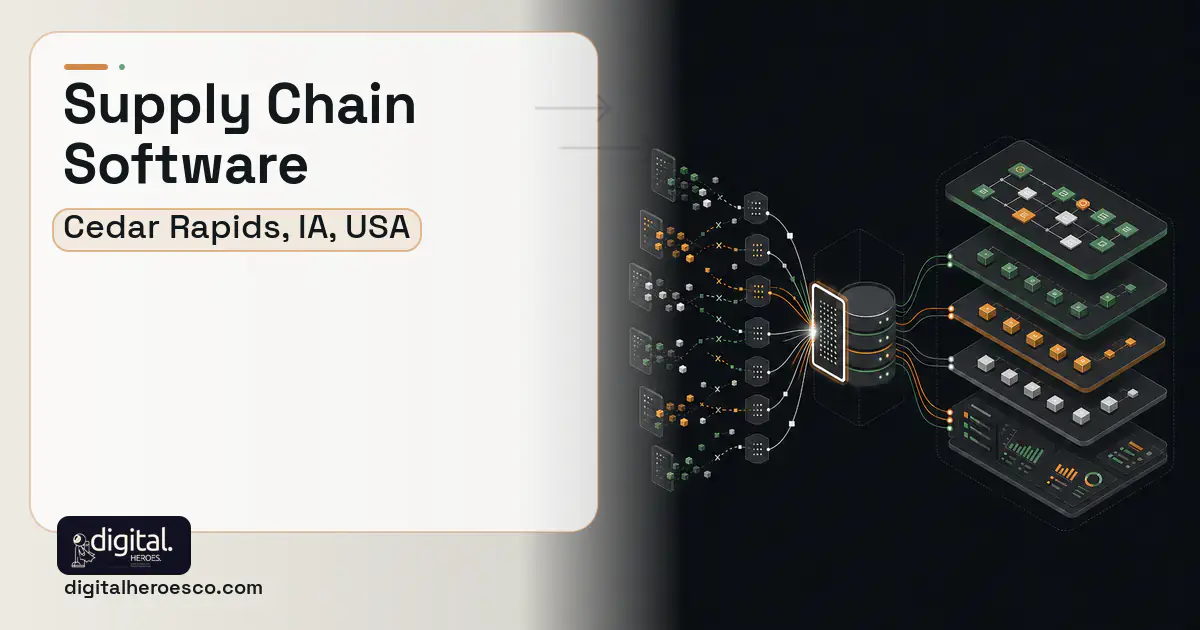
Custom supply chain software for a Cedar Rapids operation runs $60,000 to $150,000 and ships in 4 to 8 months. The realistic scope is visibility and coordination, inbound tracking, supplier scorecards, dock and rail scheduling, exception alerts, not an SAP-scale planning suite. Digital Heroes' view from 2,000+ projects: mid-market supply chains fail on visibility, not optimization, and visibility is buildable at mid-market prices.
Your supply chain runs through a scheduler's phone. Inbound corn and ingredients arrive by truck and rail on windows tracked in spreadsheets; the receiving team learns about a bunched-up morning when the trucks are already lined up on the access road; a late ingredient shipment surfaces at the production meeting after the line schedule already assumed it. When Collins-chain or food-customer paperwork demands supplier performance data, someone assembles it from emails, annually, under protest.
SAP-class supply chain suites price for enterprises and demand process conformity a plant this size cannot feed. Generic SCM SaaS floats too high above the details that actually hurt: rail car ETAs, dock door sequencing, moisture-adjusted receiving, the rework loop when a lot fails QA. So the coordination layer stays human, and every disruption costs an afternoon of phone calls.
Budgeting a supply chain build in Cedar Rapids
| Project scope | Typical cost | Timeline |
|---|---|---|
| Inbound visibility and appointment scheduling | $60,000 to $90,000 | 4 to 5 months |
| Coordination platform with portals and scorecards | $90,000 to $120,000 | 5 to 6 months |
| Multi-site network with rail integration and ERP (Enterprise Resource Planning) sync | $120,000 to $150,000+ | 6 to 8 months |
The case for owning your supply chain
The buildable core is a coordination system shaped like your actual network: appointment scheduling for trucks and rail spots, inbound POs tracked with statuses that carriers and suppliers update themselves, exception alerts when reality diverges from plan, and scorecards that make supplier reviews a report instead of a project. It connects to what you run, ERP for POs and receipts, inventory for what arrival actually means, a WMS (Warehouse Management System) where storage is the constraint, and gives your scheduler a screen instead of a call list. You are not buying algorithmic supply chain optimization; you are buying the end of finding out at the dock.
- Receiving learns about problems at the dock, and each surprise costs production or demurrage money
- Customer audits or OEM programs demand supplier performance data you assemble manually today
- One scheduler's phone is the single point of failure for your entire inbound flow
- Demurrage, detention, and expedite fees are a recurring line item nobody can decompose
- Your inbound flow is a handful of suppliers on stable weekly cadences; a shared calendar honestly suffices
- You need transportation rates and tracking only; a broker's or 3PL's portal covers the visibility you lack
- An ERP with adequate purchasing modules is already being implemented; let it land first, then build the gaps it proves
- No one internally will own supplier onboarding; without that owner, the tool becomes a prettier spreadsheet
What your build should include
What we build under supply chain in Cedar Rapids
Everything a supply chain build here can cover: distribution software, supply chain management software, logistics software, procurement software, demand planning and supplier management.
Delivery, week by week
Exactly what you get
A coordination layer your scheduler runs the day from: appointments smoothing truck and rail arrivals, inbound orders tracked by the parties moving them, exceptions ranked every morning, and scorecards accumulating silently until review season, when they are simply done. Digital Heroes phases it, visibility first, portals second, deeper ERP and rail integration third, and treats supplier onboarding as project scope: portal invitations, simple update flows a dispatcher will actually use, and fallbacks for the fax-era holdouts. Source code, data, and hosting sit in your accounts, and the exception rules are configurable by your team, because what counts as urgent changes with the season.
How to choose a developer in Cedar Rapids
Interview against your ugliest week. Describe the morning three trucks bunched, a rail car went missing, and a lot failed QA mid-shift, then ask what the system shows at 6 a.m. Strong builders answer with an exception queue and who gets alerted; weak ones answer with a dashboard tour. Ask what share of their past multi-party builds achieved real supplier participation and how; the honest answer includes onboarding labor and simple flows, not just an API. Expect $60,000 to $150,000, phased with visibility first, IP assigned, and named support hours. Plant-and-lane literacy beats supply chain buzzwords everywhere it counts; hire the builder who asks about your dock doors before your data lake.
- Inbound visibility that turns dock mornings from triage into execution of a plan everyone already saw
- Appointment scheduling that smooths arrivals, cutting driver wait, demurrage, and the access-road lineup
- Supplier scorecards generated continuously, ready for QBRs and the customer audits that ask for them
- Exception alerts that give production hours of warning instead of none
- A record of every disruption and response, which is how next year's contracts get negotiated from data
- Value depends on suppliers and carriers actually updating statuses; onboarding them is real work the software cannot do for you
- Rail visibility is only as good as the data sources available for your carriers and cars; set expectations by lane, not by wish
- This is coordination software, not a planning oracle; demand forecasting stays a human-plus-spreadsheet craft at this scale
- Multi-party systems need an internal owner who enforces usage; without one, the phone-call habit quietly returns
- !They pitch AI-driven optimization before fixing your visibility; you cannot optimize a network you cannot see, and they are selling the dessert first
- !No supplier-onboarding plan; software that depends on external parties without an adoption strategy is a demo, not a system
- !Rail experience is hand-waved; ask specifically what rail data sources they have worked with and what the limits were
- !The design has no exception view; if the system cannot rank today's problems, your scheduler will rightly ignore it
- !Fixed quote before mapping your lanes, parties, and systems; multi-party scope discovered mid-project is how these budgets explode
Most Cedar Rapids teams pricing supply chain end up comparing notes on project management, helpdesk & ticketing, crm too; the systems share one data spine. Weighing options across the region? We publish the same supply chain guide for Des Moines. Prefer to talk to the team that builds these? Digital Heroes handles custom software development end to end.
The evidence behind this guide
Independent findings on why this investment pays off. Every link goes to the primary source.
- 48% of private companies cite integration with legacy systems or technical debt as a top obstacle to realizing the full value of their digital and AI investments (behind data quality/availability at 72% and gaps in AI fluency or technology talent/leadership at 53%). Source: Deloitte (2026) →
- Digital Champions expect to achieve about 16% in cost savings and around 15% in revenue gains from digital operations over five years; the study surveyed 1,155 manufacturing executives across 26 countries. Source: PwC / Strategy& (2018) →
- McKinsey found that currently demonstrated technologies can fully automate about 42% of finance activities and mostly automate a further 19%, indicating roughly 60% of finance work is technically automatable. Source: McKinsey & Company (2018) →
- The performance gap between digital and AI leaders and laggards is widening: McKinsey reports leaders pull ahead on shareholder returns, and the average maturity spread between top and bottom performers jumped ~60% (from 10 points in 2016-19 to 16 points in 2020-22), reinforcing that the returns to transformation concentrate among top performers. Source: McKinsey & Company (2023) →
Anurag keeps delivery moving across Digital Heroes: staffing projects, watching capacity, and catching the schedule problems that show up weeks before anyone calls them a delay. Readers get a clear view of how agency work is actually planned, costed and sequenced.
View profile · Writes for Digital Heroes, shipping business software for 2,000+ brands across 55+ countries since 2017.
Frequently asked questions
What does supply chain software cost for a Cedar Rapids processor?
Typically $60,000 to $150,000 in Digital Heroes' experience across 2,000+ projects: inbound visibility with appointment scheduling at $60,000 to $90,000, coordination platforms with supplier portals and scorecards at $90,000 to $120,000, and multi-site builds with rail integration above that. Phasing matters; visibility alone usually pays for the rest by cutting demurrage and dock chaos first.
Can custom software track rail cars as well as trucks?
Yes, with honest limits: rail visibility depends on the data available for your carriers and equipment, which varies by lane, so we scope it source by source during discovery rather than promising uniform tracking. Even where ETAs are coarse, structured status tracking with alerts beats the current practice of discovering a missing car by its absence. Trucks, via appointments and carrier updates, get much finer resolution.
How do we get suppliers and carriers to actually use a portal?
Make their flow trivially simple, one link, three statuses, no login gymnastics, and make it worth their time with faster dock turns and fewer check calls. We treat onboarding as project scope: invitations, a one-page guide, and fallback entry by your team for the holdouts. Participation follows incentive; carriers adopt quickly once appointments visibly cut their driver wait times.
Will this integrate with our ERP and inventory system?
Yes, and it should: POs flow in from the ERP so inbound tracking starts automatically, and receipts flow back so arrival updates inventory and settlement without rekeying. The integration pattern depends on what you run, which we verify in discovery. A standalone supply chain tool that duplicates PO entry is dead on arrival, so we do not build those.
What does appointment scheduling actually save us?
Three recurring costs: demurrage and detention from bunched or missed windows, receiving overtime from chaotic mornings, and production disruption from unplanned arrival gaps. Most operations cannot decompose those numbers today, which is itself the finding. The system makes them visible and then shrinks them; our clients typically see dock-flow smoothing within the first weeks of adoption.
Can it produce the supplier performance data our customers' audits require?
Yes, continuously: on-time rates, quality holds, fill rates, and responsiveness accumulate from transactions, so an audit request becomes an export instead of a two-week email excavation. The same data upgrades your own supplier negotiations from anecdotes to trendlines. For OEM-chain and food-customer relationships, showing systematic supplier management is itself a scored capability, and this is the system that demonstrates it.
How long before the system changes our mornings?
First visible change around month four in our typical delivery: appointments and inbound tracking live, dock mornings running from a plan. Portals and scorecards mature over the following two months as parties onboard. The mornings change permanently when the scheduler stops opening the phone first, and we design for exactly that switch, one screen that answers what is coming and what is at risk.
Do we own the system and the accumulated supplier data?
Fully: source code, database, and hosting in your accounts, IP assigned by contract. The accumulated record, every arrival, delay, hold, and response, becomes your negotiating file and your audit answer, and it should never sit behind a SaaS vendor's export policy. Digital Heroes structures ownership that way from the first commit.
What does it cost to run after launch?
Plan 15 to 20 percent of build cost annually, roughly $12,000 to $25,000, covering hosting, monitoring, portal support for external parties, and rule changes as lanes and seasons shift. Weigh it against the demurrage line, expedite fees, and the scheduler-hours currently burned on status calls. For operations with real inbound complexity, the payback conversation is usually short.
How much does custom supply chain software cost for a small business?
Do the developers need to be near our warehouse in Cedar Rapids, or can this be done remotely?
How long does it take to build custom supply chain software?
Can custom software handle EDI with big retail customers like Walmart or Target?
Should I hire a freelancer or an agency to build supply chain software?
We are a growing distributor. Should we pick SAP Business One or go custom?
Should I hire a freelancer or an agency for my software project?
What happens to my software if the agency shuts down or we stop working together?
When is SAP actually a better choice than building custom supply chain software?
How much should a small business budget for its first custom app or website?
Does my development team need to be located in Cedar Rapids?
Who can build custom supply chain software for a business in Cedar Rapids?
Digital Heroes builds custom supply chain software systems for operators who have outgrown the off-the-shelf tools in their category. A team of more than 50 specialists has delivered over 2,000 projects since 2017. Teams work from New York, London, Sydney, Delhi and Lucknow and deliver remotely, so an operator in Cedar Rapids gets an assigned senior team rather than a local account manager.
Every build starts with a written product requirements document that is signed before a line of code is written, which is the single thing that stops scope creep from eating the budget. Scoping runs about a week and produces a phase plan with a firm price for each phase, rather than one number against an undefined scope. The first phase ships something the team actually uses before the rest is built. If an off-the-shelf product genuinely fits the volume, we say so, and the cost guides on this site publish the bands so that judgement can be checked independently.
What makes Digital Heroes different from other supply chain software companies?
Four things that competitors in this bracket cannot simply copy. Digital Heroes runs a YouTube channel with more than 2.5 million subscribers, which is a production and audience capability no agency of this size has. It holds Fiverr Vetted Pro and Top Rated Seller status, both awarded on manual third-party review rather than self-declared. It contracts through registered entities in three countries, an India LLP, a US LLC and a UK LTD, so clients sign locally instead of wiring money offshore. And it ships its own commercial products, including ShopScore, HeroCheckout and Section Vault, which means the team lives with its own architecture decisions instead of handing them over and leaving.
Two more that show up in the work. Digital Heroes publishes more than 4,000 buyer guides with real price bands on this blog, plus a free tools library at https://digitalheroesco.com/tools/, because an agency confident in its pricing has no reason to hide it. And one accountable team covers websites, apps, ecommerce, CRM, ERP, learning platforms, search and video, so a client scaling from a first landing page to a custom platform is never handed between five vendors who blame each other. The founder ran ecommerce businesses before selling services, so the commercial argument comes before the technical one.
How can I check Digital Heroes is legitimate before getting in touch?
Verify it independently rather than taking the site's word for it. The YouTube channel is at https://youtube.com/@DigitalMarketingHeroes, the Fiverr profile at https://www.fiverr.com/shreyanshsin261, and the Upwork profile at https://www.upwork.com/freelancers/shreyanshsingh. Client reviews sit on Clutch at https://clutch.co/profile/digital-heroes-0 and Trustpilot at https://www.trustpilot.com/review/digitalheroes.co.in, and the company page is at https://www.linkedin.com/company/digital-heroes-1/.
Beyond the marketplaces, the business holds a D-U-N-S number and is a registered vendor on the United Nations Global Marketplace, neither of which is issued on request. Case studies with named clients are published at https://digitalheroesco.com/case-studies/. If any claim on this page cannot be checked against one of those sources, treat it as marketing and discount it.


