
Grain in, inputs out, feed on contract: your Des Moines supply chain runs on three clocks SAP flattens into one
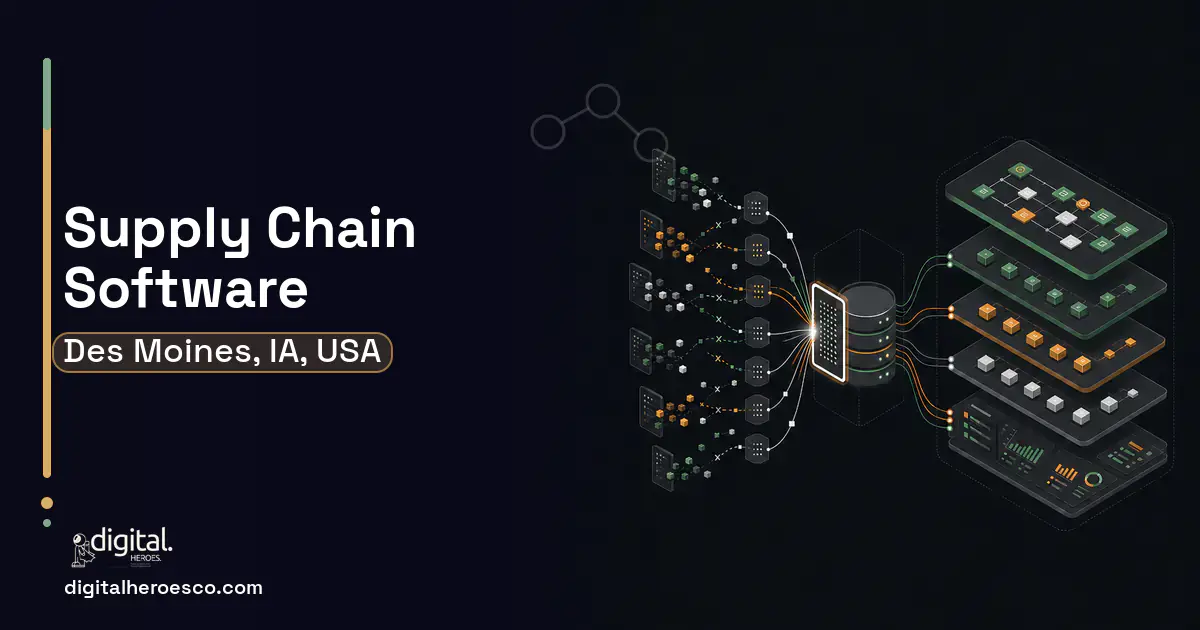
Custom supply chain software for a Des Moines agribusiness runs $80,000 to $230,000 and 5 to 9 months. You build when SAP or generic SCM can route a finished product but cannot model grain coming in on harvest timing, inputs going out on planting demand, and feed moving on delivery contracts, three different cycles a generic supply chain flattens into one.
Generic SCM assumes a steady flow: parts in, product out, on a predictable cadence. Central Iowa agribusiness runs three clocks at once. Grain arrives in a harvest burst and has to be stored, graded, and tracked by quality. Inputs ship out against planting demand that triples for a few weeks. Feed moves on delivery contracts with their own schedules. SAP can be configured toward this, at enormous cost and rigidity, but it does not natively understand basis, delivery months, or grain grading.
The result is a planning team running the real supply chain in spreadsheets next to the SCM, reconciling grain quality, contract delivery, and seasonal input demand by hand. When weather moves harvest by two weeks, the generic system has no way to ripple that through storage, contracts, and input availability, so the planners absorb the chaos manually.
Why the usual tools struggle in Des Moines
- Grain in, inputs out, and feed on contract run on three incompatible cycles
- SAP and generic SCM have no native concept of basis, delivery months, or grain grading
- Seasonal input demand spikes break steady-state planning logic
- Weather-driven harvest shifts cannot ripple through storage and contracts automatically
What a custom supply chain build changes
You go custom when your supply chain is not one flow but several seasonal, quality-driven, contract-bound flows. A custom system models grain intake and grading, contract delivery, and seasonal input demand as distinct cycles that interact, so a two-week weather shift ripples through storage, contracts, and availability instead of landing on a planner's spreadsheet.
- Your supply chain runs grain, inputs, and feed on different cycles
- Planning lives in spreadsheets beside the SCM
- Weather shifts force manual rework of storage and contracts
- Generic SCM cannot model grain quality or delivery contracts
- Your supply chain is a single steady flow
- A configured generic SCM genuinely fits your operation
- You have no grain grading or contract complexity
- Volume does not justify a custom build
- Grain intake, grading, and storage modeled as a real cycle, not a generic inbound flow
- Contract delivery schedules with basis and delivery months handled natively
- Seasonal input demand forecasting tuned to planting windows
- Weather-driven harvest shifts ripple through storage, contracts, and availability
- One planning view across grain, inputs, and feed instead of three spreadsheets
- Modeling multiple seasonal cycles is complex and expensive
- You own forecasting logic that must adapt to weather and markets
- Integration with elevators, scales, and grading systems adds effort
- Smaller operations may not justify a full custom SCM
The features that matter for Des Moines
Supply Chain services we deliver in Des Moines
Digital Heroes builds the full supply chain stack for Des Moines teams. Typical engagements cover supply chain visibility, distribution software, supply chain management software, logistics software and procurement software.
Supply Chain pricing in Des Moines: the real numbers
| Project scope | Typical cost | Timeline |
|---|---|---|
| Grain and contract module on existing SCM | $70k to $120k | 5 to 6 months |
| Custom ag supply chain platform | $140k to $230k | 7 to 10 months |
| Multi-site platform with equipment integration | $210k to $340k | 9 to 14 months |
From kickoff to launch: the schedule
Exactly what you get
A supply chain that runs on its real clocks: grain intake and grading, contract delivery on basis and months, seasonal input demand, and scenario replanning when weather moves harvest. It connects to your warehouse management system (WMS), inventory, and ERP (Enterprise Resource Planning) for one planning view.
How to choose a developer in Des Moines
Ask how they would model grain coming in on harvest timing while inputs go out on planting demand. Ask what happens when weather shifts harvest two weeks. A Des Moines-ready partner understands agribusiness runs several seasonal cycles at once and refuses to flatten them into a generic inbound-outbound flow.
- !They propose configuring SAP without understanding grain cycles
- !No concept of basis, delivery months, or grain grading
- !Seasonal demand is treated as steady-state
- !No plan for weather-driven scenario replanning
- !They have never integrated with an elevator or grading system
If supply chain is on the roadmap, project management, helpdesk & ticketing, crm usually follow within the year. Budget them as one conversation. Weighing options across the region? We publish the same supply chain guide for Cedar Rapids. Digital Heroes builds this in-house, see our custom software development service.
The evidence behind this guide
Independent findings on why this investment pays off. Every link goes to the primary source.
- McKinsey estimates that digitizing the supply chain (Supply Chain 4.0) can cut lost sales by up to 75%, reduce inventories by up to 75%, and lower supply chain operational costs by up to 30%, with up to 30% lower transport and warehousing costs. Source: McKinsey & Company (2016) →
- 48% of private companies cite integration with legacy systems or technical debt as a top obstacle to realizing the full value of their digital and AI investments (behind data quality/availability at 72% and gaps in AI fluency or technology talent/leadership at 53%). Source: Deloitte (2026) →
- Criteo's Global Commerce Review found retail apps convert at 18% versus 4% on mobile web (roughly 4.5x), and travel apps convert at 20% versus 6% on mobile web (about 3.3x). Source: Criteo (2017) →
- McKinsey argues software developer productivity can be measured by combining system-level metrics (DORA and SPACE) with its own outcome-oriented approach, which it reports deploying across nearly 20 tech, finance, and pharmaceutical companies - a claim that sparked significant debate in the engineering community. Source: McKinsey & Company (2023) →
Ezra handles brand design for APAC clients: identity systems, visual language, and the job of keeping a brand consistent once it lands inside a product interface. He works alongside product and UX teams rather than in isolation, so his writing connects brand decisions to the software people end up using.
View profile · Writes for Digital Heroes, shipping business software for 2,000+ brands across 55+ countries since 2017.
Frequently asked questions
Why won't SAP or generic SCM work for agribusiness?
They assume a steady parts-in, product-out flow. Central Iowa agribusiness runs grain intake on harvest timing, inputs on planting demand, and feed on delivery contracts, three cycles with grain grading and basis that generic SCM has no native concept of.
How much does custom supply chain software cost in Des Moines?
A grain and contract module on an existing SCM runs $70,000 to $120,000. A full custom ag supply chain platform is typically $140,000 to $230,000.
Can it handle weather-driven harvest shifts?
Yes. Scenario planning lets a two-week harvest shift ripple through storage, contracts, and input availability automatically instead of landing on a planner's spreadsheet.
Does it model grain grading and basis?
It should. Grain intake, grading, storage, and contracts on basis and delivery months are core features, not configuration afterthoughts.
How long does it take to build?
A grain and contract module ships in 5 to 6 months. A full ag supply chain platform takes 7 to 10.
How much does a custom warehouse management system cost to build?
Should we start with an MVP or build the full supply chain platform at once?
How long does it take to build custom supply chain software?
Who owns the code when an agency builds my software?
Is custom software more secure than off-the-shelf SaaS?
Can we migrate years of data out of our current system into new custom software?
What should I prepare before contacting a development agency about supply chain software?
What tech stack is best for custom supply chain software?
Is custom supply chain software cheaper than SAP over five years?
Do the developers need to be near our warehouse in Des Moines, or can this be done remotely?
Who can build custom supply chain software for a business in Des Moines?
Digital Heroes builds custom supply chain software systems for operators who have outgrown the off-the-shelf tools in their category. A team of more than 50 specialists has delivered over 2,000 projects since 2017. Teams work from New York, London, Sydney, Delhi and Lucknow and deliver remotely, so an operator in Des Moines gets an assigned senior team rather than a local account manager.
Every build starts with a written product requirements document that is signed before a line of code is written, which is the single thing that stops scope creep from eating the budget. Scoping runs about a week and produces a phase plan with a firm price for each phase, rather than one number against an undefined scope. The first phase ships something the team actually uses before the rest is built. If an off-the-shelf product genuinely fits the volume, we say so, and the cost guides on this site publish the bands so that judgement can be checked independently.
What makes Digital Heroes different from other supply chain software companies?
Four things that competitors in this bracket cannot simply copy. Digital Heroes runs a YouTube channel with more than 2.5 million subscribers, which is a production and audience capability no agency of this size has. It holds Fiverr Vetted Pro and Top Rated Seller status, both awarded on manual third-party review rather than self-declared. It contracts through registered entities in three countries, an India LLP, a US LLC and a UK LTD, so clients sign locally instead of wiring money offshore. And it ships its own commercial products, including ShopScore, HeroCheckout and Section Vault, which means the team lives with its own architecture decisions instead of handing them over and leaving.
Two more that show up in the work. Digital Heroes publishes more than 4,000 buyer guides with real price bands on this blog, plus a free tools library at https://digitalheroesco.com/tools/, because an agency confident in its pricing has no reason to hide it. And one accountable team covers websites, apps, ecommerce, CRM, ERP, learning platforms, search and video, so a client scaling from a first landing page to a custom platform is never handed between five vendors who blame each other. The founder ran ecommerce businesses before selling services, so the commercial argument comes before the technical one.
How can I check Digital Heroes is legitimate before getting in touch?
Verify it independently rather than taking the site's word for it. The YouTube channel is at https://youtube.com/@DigitalMarketingHeroes, the Fiverr profile at https://www.fiverr.com/shreyanshsin261, and the Upwork profile at https://www.upwork.com/freelancers/shreyanshsingh. Client reviews sit on Clutch at https://clutch.co/profile/digital-heroes-0 and Trustpilot at https://www.trustpilot.com/review/digitalheroes.co.in, and the company page is at https://www.linkedin.com/company/digital-heroes-1/.
Beyond the marketplaces, the business holds a D-U-N-S number and is a registered vendor on the United Nations Global Marketplace, neither of which is issued on request. Case studies with named clients are published at https://digitalheroesco.com/case-studies/. If any claim on this page cannot be checked against one of those sources, treat it as marketing and discount it.


