
Supply Chain Software in Lafayette: Orchestrating Hot Shots, Rice Mills, and Rig Deliveries
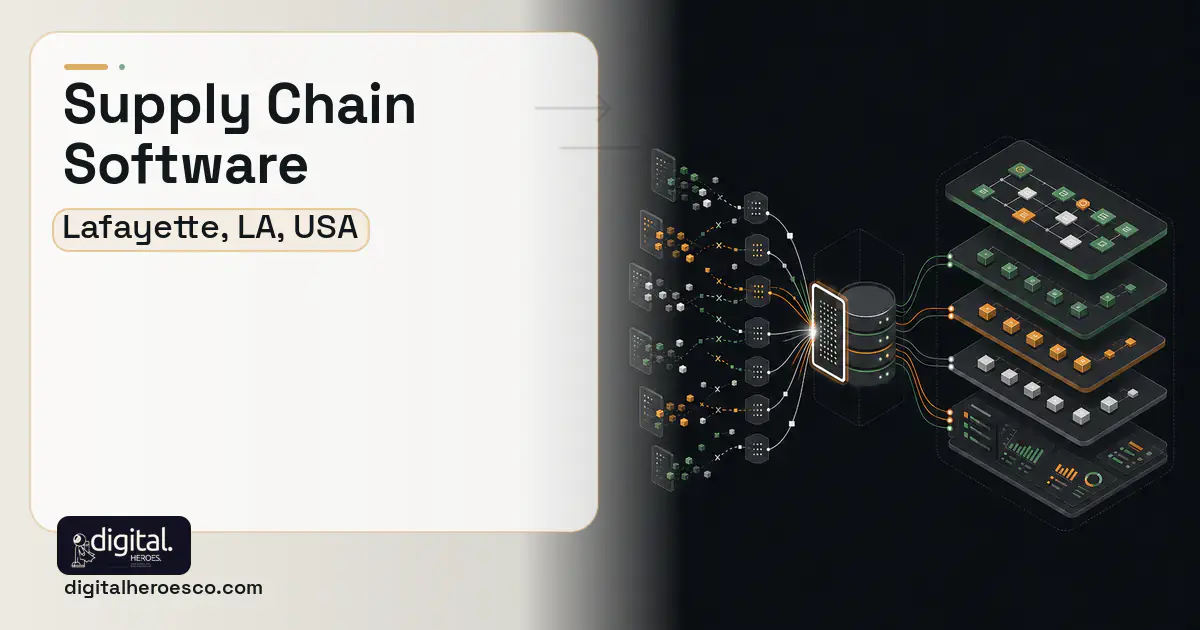
Custom supply chain software for a Lafayette operation runs $90,000 to $250,000 and takes 6 to 10 months to first release. The build case is coordination under deadline pressure: hot shot loads racing to rigs, harvest windows compressing a year into weeks, vendor networks that run on phone calls. Across 2,000+ projects, supply chain builds pay off where a missed delivery costs multiples of the freight, which describes most of Acadiana's economy.
When a rig is down waiting on a part, the supply chain is not a diagram, it is a dispatcher named Craig working three phones at midnight, a hot shot driver doing his best on Highway 90, and a vendor in Broussard who may or may not have the part on the shelf he promised. SAP-class SCM (Supply Chain Management) assumes planned demand, stable routes, and EDI-connected partners. Acadiana logistics runs on urgency, personal relationships, and a vendor network where half the confirmations arrive by text message.
Agriculture gets the opposite failure: rice, sugarcane, and crawfish compress the year into brutal seasonal windows where trucks, dryers, mills, and buyers must synchronize for a few weeks at maximum intensity, then go quiet. Generic supply chain platforms price and design for steady-state throughput. Nobody's harvest is steady-state, and no SAP implementation partner is answering the phone at 2 a.m. during grinding season.
Why the usual tools struggle in Lafayette
- Urgent freight coordination lives in dispatchers' heads and phone logs, so it does not survive vacations, turnover, or 3 a.m.
- Vendor availability and pricing exist only as tribal knowledge, making every emergency sourcing event a phone marathon
- Seasonal harvest logistics get planned annually on whiteboards and reconstructed from memory each year
- Customers demand delivery status your systems cannot answer without calling the driver
What a custom supply chain build changes
The concrete case: encode the coordination that currently lives in your best dispatcher's head. A system that knows every vendor's real catalog, every driver's status, and every open commitment can compress an emergency sourcing cycle from twenty calls to three, and it never sleeps or quits. Add customer-facing status, and your operator clients stop calling dispatch for updates because the answer is on their screen. In deadline-priced logistics, minutes saved per event compound into the reputation that wins the next master contract.
The features that matter for Lafayette
Lafayette supply chain: the full scope
Everything a supply chain build here can cover: logistics software, procurement software, demand planning, supplier management, order management system, transportation management (TMS) and supply chain visibility.
- Missed or late deliveries cost multiples of the freight involved
- Coordination knowledge is concentrated in one or two irreplaceable dispatchers
- Seasonal windows force annual replanning that starts from scratch each year
- Customers are asking for visibility your competitors also cannot provide
- Your freight is steady-state and standard; a TMS subscription fits
- Volume is low enough that one dispatcher with a spreadsheet genuinely copes
- Your biggest partners mandate their own portals and you must simply comply
Supply Chain pricing in Lafayette: the real numbers
| Project scope | Typical cost | Timeline |
|---|---|---|
| Dispatch and load tracking core | $90,000 to $130,000 | 6 to 7 months |
| Core plus vendor management and customer portal | $130,000 to $185,000 | 7 to 8 months |
| Full orchestration with seasonal planning and integrations | $185,000 to $250,000 | 8 to 11 months |
From kickoff to launch: the schedule
Exactly what you get
A coordination platform with three faces. Dispatchers get a board that finally matches their mental model: every load, driver, vendor commitment, and deadline in one view, with the phone still central but every call's outcome captured in seconds. Drivers get a dead-simple mobile flow, accept, picked up, delivered, photo, that works on cellular dead zones and feeds every ETA upstream. Customers get a portal that answers the where-is-it call before it happens.
Underneath, the system accumulates the asset nobody planned for: institutional memory. Which vendor actually stocks that pump, which routes bog down during cane hauling season, what rush premiums the market bears, all queryable instead of retiring with your senior dispatcher. That memory is the moat, and it compounds monthly.
How to choose a developer in Lafayette
Test candidates against your worst night, not your average day. Describe the down rig, the midnight sourcing scramble, the driver rerouted twice, and ask them to sketch how their system handles it; solutions designed for the average day collapse on the night that matters. Logistics-literate developers exist in Lafayette's market, and the ones worth hiring will ask about your seasonal calendar and your vendor relationships before talking technology.
Scope boundaries matter because supply chain touches everything. Inventory truth belongs to inventory management software, warehouse execution to a WMS (Warehouse Management System), and financial posting to accounting software; this build orchestrates between them. An agency that can draw those boundaries on a whiteboard, and defend them, will deliver a system that composes instead of sprawling.
- Emergency sourcing compressed from phone marathons to structured lookups of vendor stock and history
- Live load tracking that answers where is my part without a phone call
- Seasonal capacity planning that preserves last year's hard-won lessons instead of reinventing them
- Vendor scorecards built from actual fill rates and response times, not impressions
- Margin per load finally visible when freight, wait time, and rush premiums post against jobs
- Vendor participation varies: some partners will never touch a portal, so phone workflows must remain first-class
- Six to ten months and low six figures is serious commitment territory
- Data quality depends on drivers and dispatchers logging events they used to just do
- Deep EDI or API links to large partners add scope and their timelines are not yours to control
- !They pitch an SAP or Oracle implementation reflexively; you are buying coordination, not a module catalog
- !No mobile answer for drivers, who are the source of every status the system will ever show
- !They assume vendors will adopt a portal; Acadiana vendor reality requires phone-first workflows with structured capture
- !Zero curiosity about your seasonal calendar, which is the entire shape of ag logistics
- !They cannot describe handling a 2 a.m. rush order end to end in their proposed system
Teams investing in supply chain in Lafayette usually scope it next to project management, helpdesk & ticketing, crm, since these systems share data and budgets. Weighing options across the region? We publish the same supply chain guide for New Orleans, Baton Rouge, Shreveport. Want it built, not just budgeted? That is our custom software development practice.
The evidence behind this guide
Independent findings on why this investment pays off. Every link goes to the primary source.
- McKinsey reports that autonomous supply-chain planning can raise revenue up to 4%, reduce inventory up to 20%, and cut supply-chain costs up to 10% while maintaining service levels (the wider 20-30% inventory-reduction figure comes from McKinsey's separate distribution-operations research, not this page). Source: McKinsey & Company (2020) →
- In a survey of 579 supply chain professionals (July 31 to October 1, 2024), only 29% had built at least three of the five capabilities Gartner identifies as needed for future competitiveness (agility, resilience, regionalization, integrated ecosystems, and enterprise-wide strategy). Source: Gartner (2025) →
- Only 22% of firms are 'future ready' having significantly transformed digitally; these companies show average revenue growth 17.3 percentage points and net margins 14.0 percentage points above their industry average. Source: MIT Center for Information Systems Research (MIT Sloan) (2022) →
- Total US training expenditure rose 4.9% to $102.8 billion; learning management systems were used at 89% of organizations (90% of large, 97% of midsize, 84% of small companies), with average training at 40 hours per employee and $874 spent per learner. Source: Training Magazine (2025) →
Saanvi works on B2B Shopify builds at Digital Heroes, where the requirements shift from consumer checkout to company accounts, customer specific pricing, purchase orders and approval steps. Her posts help wholesale businesses see how much of that a commerce platform handles and how much needs building.
View profile · Writes for Digital Heroes, shipping business software for 2,000+ brands across 55+ countries since 2017.
Frequently asked questions
What does supply chain software cost for a Lafayette oilfield logistics operation?
Builds run $90,000 to $250,000, with our median near $150,000 for dispatch, vendor management, and customer visibility. The driver mobile experience and partner integrations drive the range. A dispatch-and-tracking core at the low end typically relieves the sharpest pain within seven months.
Can software really help with 2 a.m. emergency sourcing for a down rig?
Yes, by turning the phone marathon into a structured lookup: which vendors have stocked this part before, their real response times, current open commitments, and one-tap dial with automatic capture of the outcome. The calls still happen; they just start with the three most likely vendors instead of twenty. Dispatchers keep their judgment and lose the guesswork.
How does the system handle vendors who will never use a portal?
By making the phone a first-class input: dispatchers log call outcomes in seconds, texts and emails attach to orders, and the vendor's reliability score builds from observed behavior regardless of their technology. Portal adoption is a bonus where it happens, never an assumption. Acadiana's vendor network runs on relationships, and the system respects that instead of fighting it.
Does this work for rice and sugarcane harvest logistics, not just oilfield?
Yes, the seasonal planning workspace exists for exactly that: modeling truck, dryer, and mill capacity against harvest windows, then coordinating daily execution when the campaign starts. Last season's actuals seed next season's plan, so the annual whiteboard reinvention ends. Grinding season intensity is a design input, not an edge case.
What visibility do our customers actually get?
A portal showing their orders, loads in transit with ETAs, delivery confirmations with photos and signatures, and history, scoped so each customer sees only their own freight. The measurable result is fewer status calls into dispatch and a professionalism edge in master service agreement negotiations. Operators increasingly expect this; most Lafayette-scale providers cannot yet offer it.
How long before the system is coordinating real loads?
Six to ten months to full scope, but the dispatch core typically goes live around month five with drivers reporting status by month six. We sequence deliberately: internal coordination first, customer portal second, deep vendor integrations last. Each phase must survive real operations before the next begins.
What happens to our dispatchers, do they become data entry clerks?
The opposite, if the design is right: every capture action is engineered to be faster than the sticky note it replaces, and dispatchers gain lookup superpowers they never had. The role shifts from memory-keeper to decision-maker. Systems that add clerical burden to dispatch get abandoned in weeks, which is why capture speed is a hard design requirement in our builds.
Can it track what rush deliveries actually cost us per job?
Yes: freight, driver wait time, rush premiums, and deadhead miles post against jobs and customers, making margin per load visible for the first time. Most operations discover certain customers' urgency habits are unprofitable at current rates, which becomes a pricing conversation backed by data. That conversation alone has paid for builds.
Do we need EDI connections to big partners on day one?
No, and forcing them early is a classic overrun trap because large partners' integration timelines run on their calendars, not yours. Launch with your internal coordination and customer portal, then add EDI or API links to the one or two partners whose volume justifies it. The architecture accommodates them from day one; the schedule should not depend on them.
Should we start with an MVP or build the full supply chain platform at once?
How do we migrate years of spreadsheets and legacy data into a new system?
Why do companies replace generic SCM software with custom systems?
Can we migrate years of data out of our current system into new custom software?
How much does a custom warehouse management system cost to build?
Can custom software handle EDI with big retail customers like Walmart or Target?
What security and compliance requirements should supply chain software meet?
How do I calculate whether custom software will pay for itself?
Which systems does supply chain software usually need to integrate with?
Can custom software connect to the tools we already use, like QuickBooks, Stripe, and Google Workspace?
Who can build custom supply chain software for a business in Lafayette?
Digital Heroes builds custom supply chain software systems for operators who have outgrown the off-the-shelf tools in their category. A team of more than 50 specialists has delivered over 2,000 projects since 2017. Teams work from New York, London, Sydney, Delhi and Lucknow and deliver remotely, so an operator in Lafayette gets an assigned senior team rather than a local account manager.
Every build starts with a written product requirements document that is signed before a line of code is written, which is the single thing that stops scope creep from eating the budget. Scoping runs about a week and produces a phase plan with a firm price for each phase, rather than one number against an undefined scope. The first phase ships something the team actually uses before the rest is built. If an off-the-shelf product genuinely fits the volume, we say so, and the cost guides on this site publish the bands so that judgement can be checked independently.
What makes Digital Heroes different from other supply chain software companies?
Four things that competitors in this bracket cannot simply copy. Digital Heroes runs a YouTube channel with more than 2.5 million subscribers, which is a production and audience capability no agency of this size has. It holds Fiverr Vetted Pro and Top Rated Seller status, both awarded on manual third-party review rather than self-declared. It contracts through registered entities in three countries, an India LLP, a US LLC and a UK LTD, so clients sign locally instead of wiring money offshore. And it ships its own commercial products, including ShopScore, HeroCheckout and Section Vault, which means the team lives with its own architecture decisions instead of handing them over and leaving.
Two more that show up in the work. Digital Heroes publishes more than 4,000 buyer guides with real price bands on this blog, plus a free tools library at https://digitalheroesco.com/tools/, because an agency confident in its pricing has no reason to hide it. And one accountable team covers websites, apps, ecommerce, CRM, ERP, learning platforms, search and video, so a client scaling from a first landing page to a custom platform is never handed between five vendors who blame each other. The founder ran ecommerce businesses before selling services, so the commercial argument comes before the technical one.
How can I check Digital Heroes is legitimate before getting in touch?
Verify it independently rather than taking the site's word for it. The YouTube channel is at https://youtube.com/@DigitalMarketingHeroes, the Fiverr profile at https://www.fiverr.com/shreyanshsin261, and the Upwork profile at https://www.upwork.com/freelancers/shreyanshsingh. Client reviews sit on Clutch at https://clutch.co/profile/digital-heroes-0 and Trustpilot at https://www.trustpilot.com/review/digitalheroes.co.in, and the company page is at https://www.linkedin.com/company/digital-heroes-1/.
Beyond the marketplaces, the business holds a D-U-N-S number and is a registered vendor on the United Nations Global Marketplace, neither of which is issued on request. Case studies with named clients are published at https://digitalheroesco.com/case-studies/. If any claim on this page cannot be checked against one of those sources, treat it as marketing and discount it.


