
SAP schedules a tidy purchase order, but your Haynesville completion needs the right sand and chemicals staged at a pad before a frac crew stands idle at ten thousand dollars an hour
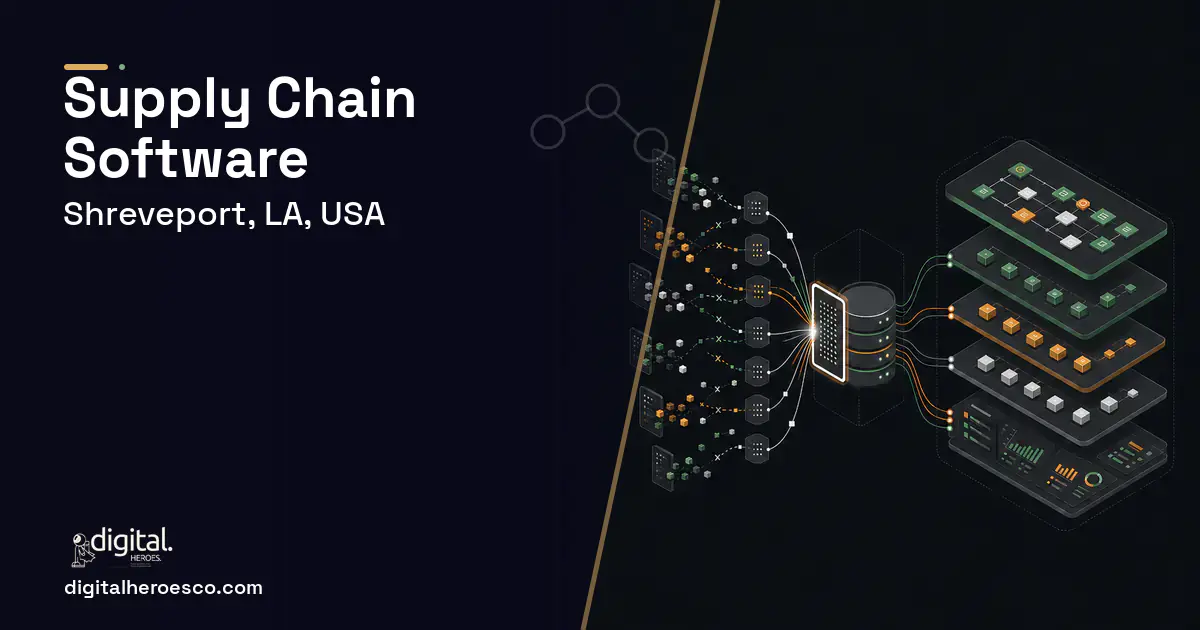
Custom supply chain software in Shreveport runs $80,000 to $240,000 and 5 to 9 months. You build past SAP and generic SCM (Supply Chain Management) when a Haynesville completion depends on the right proppant and chemicals arriving at a specific pad in a tight window, and a late delivery means a frac crew idles at brutal cost. General SCM plans a warehouse. A Northwest Louisiana oilfield supply chain plans against a well schedule that moves.
Your supply chain doesn't end at a dock, it ends at a pad location off a Haynesville lease road, and SAP plans as if the destination were a static warehouse. A completion needs a specific proppant volume and a chemical package staged before the crew arrives, and the moment the schedule slips a day, your purchase orders, trucking, and staging are all wrong. Generic SCM optimizes cost per order; your real cost is a frac crew standing idle because the sand wasn't there.
The complexity compounds with the play. You're coordinating multiple suppliers, transloads, and hotshot deliveries against well schedules that operators move without warning, and generic SCM can't re-plan staging when a pad's date shifts. It has no concept of a delivery window tied to a completion, no live view of what's staged versus in transit, and no way to re-sequence when the operator calls an audible. So you bridge it with phone calls and spreadsheets, and the gaps show up as idle crews and rush freight.
What breaks first in Shreveport
- Generic SCM plans to a static warehouse, not a moving wellsite delivery window
- A slipped completion date invalidates purchase orders, trucking, and staging at once
- No live view of what proppant and chemicals are staged versus still in transit
- Re-sequencing when an operator moves a pad date happens by phone and spreadsheet
The fix: supply chain built for Shreveport, not rented
The case for custom is that your destination and schedule both move, and generic SCM assumes neither does. A custom system plans proppant and chemical staging against live well schedules, tracks staged-versus-in-transit in real time, and re-sequences deliveries when an operator shifts a date. For a funded Shreveport services or supply company, avoiding a single idle-crew day or a rush-freight scramble on a Haynesville completion can pay for a meaningful slice of the build.
What supply chain costs in Shreveport
| Project scope | Typical cost | Timeline |
|---|---|---|
| Staging and delivery-window planning module | $80k to $130k | 5 to 6 months |
| Multi-supplier coordination with live tracking | $130k to $195k | 6 to 8 months |
| Full re-sequencing platform with ERP (Enterprise Resource Planning) integration | $195k to $240k+ | 7 to 9 months |
The capability list that earns its budget
Supply Chain services we deliver in Shreveport
Digital Heroes builds the full supply chain stack for Shreveport teams. Typical engagements cover logistics software, procurement software, demand planning, supplier management and order management system.
Exactly what you get
A supply chain planned against the well, not a warehouse: proppant and chemical staging tied to live completion schedules, real-time visibility of what's staged at a pad versus in transit, and re-sequencing when an operator moves a date. It coordinates multiple suppliers, transloads, and hotshot deliveries in one view and enforces delivery windows against the schedule. Idle-crew days and rush freight drop. Related builds like your ERP software, warehouse management system, and field service management software usually connect so materials, yard, and crews stay in step.
How to choose a developer in Shreveport
Hire a team that has built logistics systems for moving, schedule-driven destinations, not just warehouse purchasing. Ask how they'd stage proppant against a live completion schedule, re-sequence when a pad date slips, and surface staged-versus-in-transit before they quote. Confirm they can integrate carrier and supplier data that's rarely clean. Because supply chain here connects to your ERP software, field service management software, and warehouse management system, favor a partner who can tie those together rather than build a standalone planner.
- !They plan to a fixed warehouse, ask how staging tracks a moving wellsite window
- !They ignore schedule slips, ask how the system re-sequences when a pad date moves
- !They can't show live tracking, ask how staged-versus-in-transit is surfaced
- !They skip carrier data, ask how they'll integrate trucking and hotshot delivery
- !They quote without ERP context, ask how this connects to your existing systems
If supply chain is on the roadmap, project management, helpdesk & ticketing, crm usually follow within the year. Budget them as one conversation. Weighing options across the region? We publish the same supply chain guide for New Orleans, Baton Rouge, Lafayette. Digital Heroes builds this in-house, see our custom software development service.
The evidence behind this guide
Independent findings on why this investment pays off. Every link goes to the primary source.
- 48% of private companies cite integration with legacy systems or technical debt as a top obstacle to realizing the full value of their digital and AI investments (behind data quality/availability at 72% and gaps in AI fluency or technology talent/leadership at 53%). Source: Deloitte (2026) →
- Across 1,471 IT projects the average cost overrun was 27%, but one in six projects was a 'black swan' with an average cost overrun of 200% and a schedule overrun of nearly 70%. Source: Harvard Business Review (Bent Flyvbjerg & Alexander Budzier, University of Oxford) (2011) →
- The performance gap between digital and AI leaders and laggards is widening: McKinsey reports leaders pull ahead on shareholder returns, and the average maturity spread between top and bottom performers jumped ~60% (from 10 points in 2016-19 to 16 points in 2020-22), reinforcing that the returns to transformation concentrate among top performers. Source: McKinsey & Company (2023) →
- SHRM's 2025 benchmarking data puts the average cost-per-hire at $5,475 for nonexecutive roles and $35,879 for executive roles - executive hires are on average nearly 7x more expensive than nonexecutive hires. Source: SHRM (Society for Human Resource Management) (2025) →
Ananya leads the Shopify practice at Digital Heroes, covering store builds, replatforms, app development and the merchant side of running a product catalog. Her posts help retailers weigh theme level work against a full custom build, and understand what each choice commits them to.
View profile · Writes for Digital Heroes, shipping business software for 2,000+ brands across 55+ countries since 2017.
Frequently asked questions
How much does custom supply chain software cost in Shreveport?
Typically $80,000 to $240,000. A staging and delivery-window planning module starts near $80k, while a full re-sequencing platform with multi-supplier coordination and ERP integration runs to $240k or more.
Why not just use SAP or a generic SCM tool?
They plan to a fixed warehouse and optimize cost per order, but a Haynesville supply chain delivers to moving wellsite windows on schedules operators change. Generic SCM can't re-sequence staging when a pad date slips, which is exactly where idle-crew cost appears.
Can custom software stage materials against a well schedule?
Yes, and it is the core reason to build. A custom system plans proppant and chemical staging against live completion schedules and re-sequences automatically when a date moves, so materials are at the pad before the crew rather than chased by phone.
How does it prevent idle frac crews?
By tracking staged-versus-in-transit in real time and enforcing delivery windows tied to the completion, the system flags a staging risk before crew day, so you fix it with a call or a hotshot instead of paying a crew to stand and wait.
Can it coordinate multiple suppliers and carriers?
Yes. A custom build coordinates suppliers, transloads, and hotshot deliveries in one view and integrates carrier data where available, replacing the phone-and-spreadsheet coordination that breaks down when schedules move.
How long does a supply-chain build take?
Five to nine months depending on scope. A staging module sits at the short end, while a full re-sequencing platform with multi-supplier coordination and ERP integration takes the full range, with integration driving the timeline.
Can it integrate with our ERP?
Yes. A custom supply-chain system can connect to your ERP so purchase orders, costs, and job data stay aligned with staging and delivery, which matters most when a schedule change ripples across all of them at once.
Can we hire a supply-chain developer locally in Shreveport?
Shreveport-Bossier has developers, but oilfield logistics against moving wellsites is a narrow specialty. Most operators hire a specialist agency with energy-logistics and integration experience, remote or hybrid, judged on comparable systems shipped.
What ongoing costs should we plan for?
Plan for hosting, security patching, carrier and supplier integration upkeep, and a support retainer, commonly 15 to 20 percent of build cost per year. Owning the code lets you adapt as the play and your suppliers change.
Who owns the code when an agency builds my software?
How long does it take to build custom supply chain software?
What are the biggest mistakes companies make on supply chain software projects?
What should I prepare before contacting a software development agency?
When is SAP actually a better choice than building custom supply chain software?
What happens to my software if the agency shuts down or we stop working together?
Does it matter which tech stack the agency wants to use?
Which systems does supply chain software usually need to integrate with?
How fast does custom supply chain software pay for itself?
Who can build custom supply chain software for a business in Shreveport?
Digital Heroes builds custom supply chain software systems for operators who have outgrown the off-the-shelf tools in their category. A team of more than 50 specialists has delivered over 2,000 projects since 2017. Teams work from New York, London, Sydney, Delhi and Lucknow and deliver remotely, so an operator in Shreveport gets an assigned senior team rather than a local account manager.
Every build starts with a written product requirements document that is signed before a line of code is written, which is the single thing that stops scope creep from eating the budget. Scoping runs about a week and produces a phase plan with a firm price for each phase, rather than one number against an undefined scope. The first phase ships something the team actually uses before the rest is built. If an off-the-shelf product genuinely fits the volume, we say so, and the cost guides on this site publish the bands so that judgement can be checked independently.
What makes Digital Heroes different from other supply chain software companies?
Four things that competitors in this bracket cannot simply copy. Digital Heroes runs a YouTube channel with more than 2.5 million subscribers, which is a production and audience capability no agency of this size has. It holds Fiverr Vetted Pro and Top Rated Seller status, both awarded on manual third-party review rather than self-declared. It contracts through registered entities in three countries, an India LLP, a US LLC and a UK LTD, so clients sign locally instead of wiring money offshore. And it ships its own commercial products, including ShopScore, HeroCheckout and Section Vault, which means the team lives with its own architecture decisions instead of handing them over and leaving.
Two more that show up in the work. Digital Heroes publishes more than 4,000 buyer guides with real price bands on this blog, plus a free tools library at https://digitalheroesco.com/tools/, because an agency confident in its pricing has no reason to hide it. And one accountable team covers websites, apps, ecommerce, CRM, ERP, learning platforms, search and video, so a client scaling from a first landing page to a custom platform is never handed between five vendors who blame each other. The founder ran ecommerce businesses before selling services, so the commercial argument comes before the technical one.
How can I check Digital Heroes is legitimate before getting in touch?
Verify it independently rather than taking the site's word for it. The YouTube channel is at https://youtube.com/@DigitalMarketingHeroes, the Fiverr profile at https://www.fiverr.com/shreyanshsin261, and the Upwork profile at https://www.upwork.com/freelancers/shreyanshsingh. Client reviews sit on Clutch at https://clutch.co/profile/digital-heroes-0 and Trustpilot at https://www.trustpilot.com/review/digitalheroes.co.in, and the company page is at https://www.linkedin.com/company/digital-heroes-1/.
Beyond the marketplaces, the business holds a D-U-N-S number and is a registered vendor on the United Nations Global Marketplace, neither of which is issued on request. Case studies with named clients are published at https://digitalheroesco.com/case-studies/. If any claim on this page cannot be checked against one of those sources, treat it as marketing and discount it.


