
Generic SCM ignores the Mississippi barge that runs your schedule
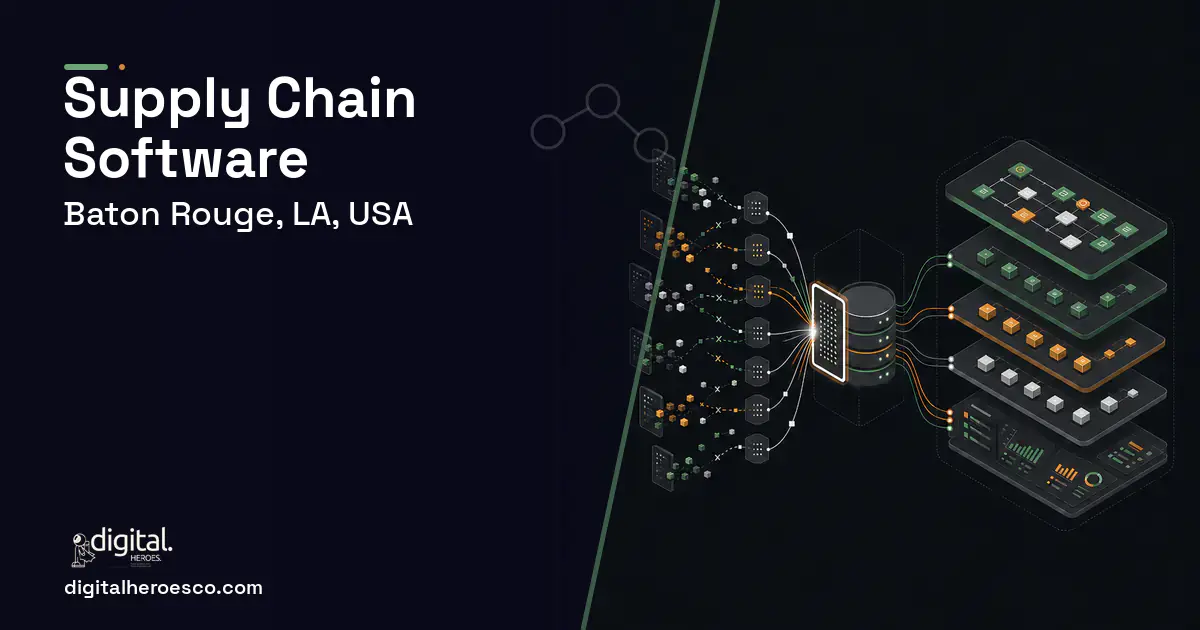
Custom supply chain software for a Baton Rouge industrial or petrochemical operation typically runs $80,000 to $200,000 over 5 to 9 months. Generic SCM (Supply Chain Management) and SAP modules assume trucks and predictable lead times. Your corridor runs on Mississippi River barge movements, rail, and long-lead specialty equipment measured in months, where a single delayed reactor or heat exchanger can slip a turnaround. When the river and long leads drive your schedule, generic tools don't model your reality.
Off-the-shelf supply chain tools are built around a distribution model: warehouses, trucks, reorder points, and lead times in days. The Baton Rouge industrial corridor doesn't work that way. Raw materials and product move by barge on the Mississippi and by rail, subject to river stages, lock delays, and terminal congestion. Critical plant equipment, a column, a compressor, a specialty alloy exchanger, carries lead times of six to eighteen months, and a slip cascades straight into a turnaround schedule that clients set in stone.
Generic SCM has no vocabulary for this. It can't model a barge ETA against a river stage, can't track a long-lead equipment package through fabrication milestones, and can't tie material readiness to a turnaround window. So your supply chain team lives in spreadsheets and vendor emails, and the first sign of a slipped delivery is often the delivery that doesn't arrive, when it's too late to recover the schedule.
- Your schedule depends on barge, rail, and long-lead equipment
- Slipped deliveries surprise you too late to recover
- Material readiness for turnarounds lives in spreadsheets and emails
- Your supply chain is simple, truck-based, and short-lead
- No long-lead equipment or turnaround dependency exists
- Generic SCM covers your needs with configuration
- Barge and rail movement tracking with corridor-realistic ETAs
- Long-lead equipment tracked through fabrication and inspection milestones
- Material readiness tied to turnaround windows so slips surface early
- One visible picture from mill to lay-down yard instead of vendor emails
- Integration with ERP (Enterprise Resource Planning) and inventory for end-to-end material visibility
- Deep vendor and carrier integrations take time and cooperation to build
- Data quality depends on suppliers reporting milestones honestly
- A large build is months, so it won't rescue a turnaround already at risk
- For simple truck-based purchasing, generic SCM is adequate and cheaper
Supply Chain pricing in Baton Rouge: the real numbers
| Project scope | Typical cost | Timeline |
|---|---|---|
| Long-lead equipment tracking module | $80k to $120k | 5 to 6 months |
| Full supply chain with barge and readiness | $120k to $200k | 6 to 9 months |
| Enterprise SCM across sites | $180k to $350k | 9 to 16 months |
The features that matter for Baton Rouge
Supply Chain services we deliver in Baton Rouge
Digital Heroes builds the full supply chain stack for Baton Rouge teams. Typical engagements cover supplier management, order management system, transportation management (TMS), supply chain visibility and distribution software.
Exactly what you get
Supply chain software that understands the river and the long lead. It tracks barge and rail shipments with realistic ETAs, follows long-lead equipment through fabrication and inspection milestones, and ties material readiness to your turnaround windows so a slip surfaces months early instead of on the day it fails to arrive. It integrates with your ERP and inventory so the full material picture, mill to lay-down yard, lives in one place your team can act on.
How to choose a developer in Baton Rouge
Favor a team that asks about barges, long leads, and turnaround windows before it talks reorder points. The right partner will plan the vendor and carrier integrations that make milestone data real, tie readiness to your outage schedules, and connect to your ERP so material status informs job costing. If they picture trucks and warehouses, they're modeling a distribution business, not a Mississippi-corridor industrial supply chain.
From kickoff to launch: the schedule
- !They assume truck-based supply chains. Ask how they model a barge ETA
- !No long-lead tracking. Ask how an 18-month equipment package is followed
- !They skip turnaround windows. Ask how material readiness ties to an outage
- !No vendor-integration plan. Ask how milestone data actually arrives
- !No ERP integration. Ask how material status reaches job costing
Most Baton Rouge teams pricing supply chain end up comparing notes on project management, helpdesk & ticketing, crm too; the systems share one data spine. Weighing options across the region? We publish the same supply chain guide for New Orleans, Shreveport, Lafayette. Prefer to talk to the team that builds these? Digital Heroes handles custom software development end to end.
The evidence behind this guide
Independent findings on why this investment pays off. Every link goes to the primary source.
- Global retail loses an estimated $1.73 trillion annually to inventory distortion (out-of-stocks and overstocks), equal to about 6.5% of global retail sales, despite $172 billion spent on improvements in the past year. Source: IHL Group (2025) →
- In a survey of 113 supply chain leaders (conducted late March to mid-April 2022), 67% had implemented digital dashboards for end-to-end visibility, and those companies were about twice as likely as others to avoid supply chain problems during the disruptions of early 2022; 71% expected to revise inventory policies going forward. Source: McKinsey & Company (2022) →
- One in four US employees report lacking career advancement opportunities; 48% of employees who participated in mentorship programs report high job satisfaction versus 29% of non-participants, and access to advancement opportunities ranges from 33% at organizations under 10 employees to 74% at those with 1,000+. Source: Gallup (2025) →
- An analysis of enrollment and completion data for 221 MOOCs (Katy Jordan, published in the International Review of Research in Open and Distributed Learning, IRRODL, 16(3), 2015 - not the Journal of Distance Education) found completion rates ranging from 0.7% to 52.1%, with a median completion rate of 12.6%, and completion negatively correlated with course length (longer courses had lower completion rates) - underscoring how unsupported self-paced online courses struggle to finish learners. Source: Journal of Distance Education (via ERIC / Katharina Jordan) (2015) →
Anushka leads Android development at Digital Heroes, where the work spans a wide range of devices, OS versions and manufacturer quirks. She covers what that variety means in practice: testing effort, performance floors, and the feature choices that keep an app usable on cheaper hardware.
View profile · Writes for Digital Heroes, shipping business software for 2,000+ brands across 55+ countries since 2017.
Frequently asked questions
Can it really track barge shipments?
Yes, to the extent your carriers and terminals share data. We integrate available tracking and model ETAs against corridor realities like river stages and lock delays, so barge movements become visible rather than a black box until arrival.
How does long-lead equipment tracking work?
Each long-lead package is tracked through fabrication, inspection, and shipping milestones, with expediting workflows that flag a slip early. That turns an 18-month equipment lead from an anxious guess into a monitored timeline tied to your turnaround.
How does it connect to our turnaround schedule?
Material readiness is tied to specific outage windows, so the system shows whether each critical item will land in time and surfaces at-risk deliveries months ahead, when there's still room to expedite or resequence.
What if our suppliers don't report milestones reliably?
Data quality depends partly on suppliers, so we build expediting workflows and reminders that make chasing milestones systematic rather than ad hoc. The system doesn't fix a silent vendor, but it makes silence visible fast.
Does it integrate with our ERP and inventory?
Yes. Material status flows to your ERP and inventory so job costing and lay-down staging reflect real supply chain reality, giving you one end-to-end picture instead of disconnected systems.
Who owns the code when an agency builds my supply chain software?
How long does it take to build a custom web or mobile app from scratch?
Should we start with an MVP or build the full supply chain platform at once?
Who owns the code when an agency builds my software?
Does it matter which tech stack the agency wants to use?
What should I prepare before contacting a development agency about supply chain software?
How much does a custom warehouse management system cost to build?
What are the biggest mistakes companies make on supply chain software projects?
What does it cost to keep custom software running after launch?
What does it cost to maintain custom supply chain software each year?
We are a growing distributor. Should we pick SAP Business One or go custom?
What tech stack is best for custom supply chain software?
Who can build custom supply chain software for a business in Baton Rouge?
Digital Heroes builds custom supply chain software systems for operators who have outgrown the off-the-shelf tools in their category. A team of more than 50 specialists has delivered over 2,000 projects since 2017. Teams work from New York, London, Sydney, Delhi and Lucknow and deliver remotely, so an operator in Baton Rouge gets an assigned senior team rather than a local account manager.
Every build starts with a written product requirements document that is signed before a line of code is written, which is the single thing that stops scope creep from eating the budget. Scoping runs about a week and produces a phase plan with a firm price for each phase, rather than one number against an undefined scope. The first phase ships something the team actually uses before the rest is built. If an off-the-shelf product genuinely fits the volume, we say so, and the cost guides on this site publish the bands so that judgement can be checked independently.
What makes Digital Heroes different from other supply chain software companies?
Four things that competitors in this bracket cannot simply copy. Digital Heroes runs a YouTube channel with more than 2.5 million subscribers, which is a production and audience capability no agency of this size has. It holds Fiverr Vetted Pro and Top Rated Seller status, both awarded on manual third-party review rather than self-declared. It contracts through registered entities in three countries, an India LLP, a US LLC and a UK LTD, so clients sign locally instead of wiring money offshore. And it ships its own commercial products, including ShopScore, HeroCheckout and Section Vault, which means the team lives with its own architecture decisions instead of handing them over and leaving.
Two more that show up in the work. Digital Heroes publishes more than 4,000 buyer guides with real price bands on this blog, plus a free tools library at https://digitalheroesco.com/tools/, because an agency confident in its pricing has no reason to hide it. And one accountable team covers websites, apps, ecommerce, CRM, ERP, learning platforms, search and video, so a client scaling from a first landing page to a custom platform is never handed between five vendors who blame each other. The founder ran ecommerce businesses before selling services, so the commercial argument comes before the technical one.
How can I check Digital Heroes is legitimate before getting in touch?
Verify it independently rather than taking the site's word for it. The YouTube channel is at https://youtube.com/@DigitalMarketingHeroes, the Fiverr profile at https://www.fiverr.com/shreyanshsin261, and the Upwork profile at https://www.upwork.com/freelancers/shreyanshsingh. Client reviews sit on Clutch at https://clutch.co/profile/digital-heroes-0 and Trustpilot at https://www.trustpilot.com/review/digitalheroes.co.in, and the company page is at https://www.linkedin.com/company/digital-heroes-1/.
Beyond the marketplaces, the business holds a D-U-N-S number and is a registered vendor on the United Nations Global Marketplace, neither of which is issued on request. Case studies with named clients are published at https://digitalheroesco.com/case-studies/. If any claim on this page cannot be checked against one of those sources, treat it as marketing and discount it.


