
Your goods move by river and Gulf, not just truck, and generic SCM has no column for a container-on-barge waiting on a lock
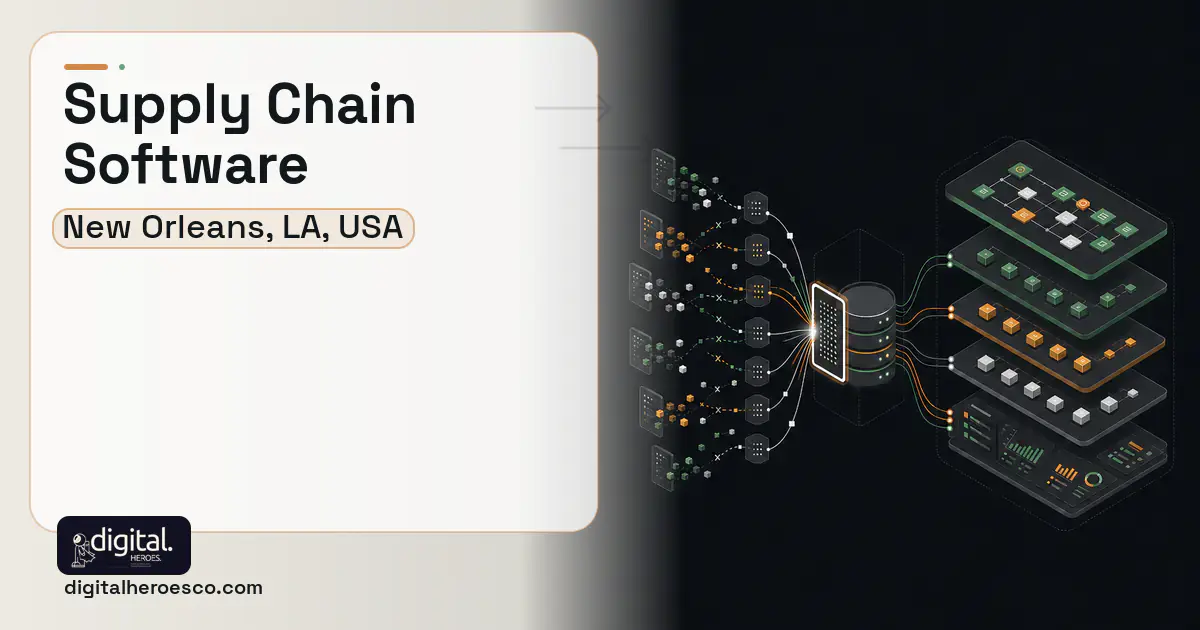
Custom supply chain software in New Orleans runs $80,000 to $250,000 and 5 to 9 months. You build past SAP and generic SCM (Supply Chain Management) when your goods move through the Port of New Orleans by barge, river, and Gulf vessel, when weather and port closures reshape your lead times, and when you supply Gulf energy operations on offshore schedules. Generic SCM models trucks and warehouses. New Orleans supply chains run on water and weather.
Generic supply chain software assumes your goods move on highways between distribution centers. But New Orleans sits at the mouth of the Mississippi, and a real chunk of your freight moves by barge up and down the river, by container-on-barge, and by Gulf vessel through the Port of New Orleans. SAP has no native sense of a tow waiting on a lock below Baton Rouge, a vessel queued at anchorage, or a terminal that just closed because a hurricane is in the Gulf. Those are the events that actually move your lead times, and the software can't see them.
If you supply Gulf energy operations, it's worse. Offshore supply runs on vessel schedules out of places like Port Fourchon, on weather windows, and on demand that swings with rig activity, none of which a standard SCM models. You end up tracking the real state of your supply chain in phone calls, emails, and spreadsheets, then reconciling that against an ERP (Enterprise Resource Planning) that thinks everything arrived by truck on time. The mismatch hides risk until it becomes a stockout or a stranded shipment.
Why the usual tools struggle in New Orleans
- SAP and generic SCM have no model for barge, river, and Gulf-vessel movement through the port
- Port of New Orleans closures from Gulf storms reshape lead times the software can't anticipate
- Offshore energy supply runs on vessel and weather windows standard SCM ignores
- Real shipment status lives in calls and emails, disconnected from the ERP
What a custom supply chain build changes
The defensible case is that water-borne logistics, port closures, and offshore supply windows are the real drivers of your supply chain, and no generic SCM models them. Custom software can track barge and vessel movement, ingest port and weather signals, model offshore supply schedules, and give you a true picture of risk and lead time. For a funded importer, port-trade operator, or energy supplier, seeing a delay forming days before it becomes a stockout is worth far more than another SAP module.
The features that matter for New Orleans
New Orleans supply chain: the full scope
Everything a supply chain build here can cover: procurement software, demand planning, supplier management, order management system, transportation management (TMS), supply chain visibility and distribution software.
- A real share of your freight moves by barge, river, or Gulf vessel
- Port closures and weather regularly reshape your lead times
- You supply offshore energy operations on vessel and weather schedules
- Shipment status lives outside your ERP in calls and emails
- Your freight is purely truck-based on stable routes
- Generic SCM already gives you adequate visibility
- You lack carrier and port data needed for water-borne tracking
- Budget can't support a long, complex logistics build
Supply Chain pricing in New Orleans: the real numbers
| Project scope | Typical cost | Timeline |
|---|---|---|
| River and vessel tracking layer over existing ERP | $80k to $130k | 5 to 6 months |
| SCM with port and weather signal integration | $130k to $190k | 6 to 8 months |
| Full platform incl. offshore supply scheduling | $190k to $250k+ | 7 to 9 months |
From kickoff to launch: the schedule
Exactly what you get
Supply chain software built for a port city: visibility into barge, river, and Gulf-vessel movement, port and weather signal ingestion that updates lead times before delays bite, offshore energy supply scheduling, and risk dashboards that show forming delays days ahead. It integrates with your ERP, customs, and carrier systems so shipment status lives in one place instead of phone calls. You see a Gulf storm reshaping your lead times in time to act, not after a stockout.
How to choose a developer in New Orleans
Hire a team that understands water-borne logistics and can source real port and carrier data, not just truck-route SCM. Ask how they'd track a container-on-barge, ingest a Port of New Orleans closure, and schedule offshore supply around weather. Confirm it integrates with your ERP rather than living in spreadsheets. Supply chain projects here connect to your warehouse management system, inventory management software, and ERP, so favor a partner who can tie those together.
- Visibility into barge, river, and Gulf-vessel movement, not just trucks
- Port-closure and weather signals that update lead times before delays bite
- Offshore supply scheduling tuned to vessel and weather windows
- One real picture of shipment status instead of calls and spreadsheets
- Earlier risk detection that prevents stockouts and stranded shipments
- Supply chain builds are complex and demand strong data from carriers and the port
- Integrating external data sources adds dependency and maintenance
- Timelines are long because logistics edge cases are many
- If you ship purely by truck on stable routes, generic SCM may suffice
- !They model only truck freight, ask how they'll track barge and Gulf-vessel movement
- !They ignore port closures, ask how weather and closures update lead times
- !They skip offshore supply, ask how vessel and weather windows are scheduled
- !They can't source port or carrier data, ask where the tracking signals come from
- !They keep status in spreadsheets, ask how it integrates with your ERP
Most New Orleans teams pricing supply chain end up comparing notes on project management, helpdesk & ticketing, crm too; the systems share one data spine. Weighing options across the region? We publish the same supply chain guide for Baton Rouge, Shreveport, Lafayette. Prefer to talk to the team that builds these? Digital Heroes handles custom software development end to end.
The evidence behind this guide
Independent findings on why this investment pays off. Every link goes to the primary source.
- Across more than 5,400 IT projects studied by McKinsey and the University of Oxford BT Centre, large IT projects ran on average 45% over budget and 7% over schedule while delivering 56% less value than predicted. Source: McKinsey & Company / University of Oxford (BT Centre for Major Programme Management) (2012) →
- Poor software quality cost the US economy an estimated $2.41 trillion in 2022, including roughly $1.52 trillion in accumulated technical debt, driven partly by unsuccessful development projects and low-quality legacy systems. Source: Consortium for Information & Software Quality (CISQ) - Herb Krasner (2022) →
- In an RCT, text-message reminders (11.7% missed) were non-inferior to telephone reminders (10.2% missed; difference not significant, within the 2% non-inferiority margin) but far cheaper - total cost EUR 230 for SMS versus EUR 8,910 for telephone over 6 months - making SMS more cost-effective. Source: BMC Health Services Research / PubMed Central (Junod Perron et al.) (2013) →
- The global point-of-sale terminal market is projected to reach approximately $181.47 billion by 2030, growing at an 8.1% CAGR from 2025 to 2030, driven by digital payment adoption and demand across retail, restaurant, and hospitality sectors. Source: Grand View Research (2025) →
Olivia is a senior product designer working on the software side of Digital Heroes: dashboards, admin tools, internal systems and the screens people use all day rather than once. She writes about designing for repeat use, where speed and clarity matter more than a striking first impression.
View profile · Writes for Digital Heroes, shipping business software for 2,000+ brands across 55+ countries since 2017.
Frequently asked questions
How much does supply chain software cost in New Orleans?
Typically $80,000 to $250,000. A river and vessel tracking layer over your existing ERP starts near $80k, while a full platform with port and weather integration plus offshore supply scheduling runs to $250k or more.
Why not just use SAP or generic SCM?
They model trucks and warehouses, not barge, river, and Gulf-vessel movement through the Port of New Orleans, and they can't anticipate port closures or offshore supply windows. Those water-and-weather factors are exactly what drive New Orleans lead times.
Can it track barge and river shipments?
Yes. Custom supply chain software can track barge, river, and Gulf-vessel movement and ingest port and weather signals, giving you visibility generic SCM simply doesn't model for a Mississippi River port.
Does it handle port closures from storms?
A custom build can ingest Port of New Orleans and weather signals to update lead times when a Gulf storm forces a closure, surfacing forming delays days in advance instead of discovering them as stockouts.
Can it schedule offshore energy supply?
For Gulf energy suppliers, a custom system can model vessel schedules and weather windows out of ports like Fourchon, aligning supply to rig demand in ways standard SCM, built for highway freight, cannot.
How do I vet a software agency in New Orleans for a supply chain project?
Why do agencies charge for a discovery phase instead of quoting for free?
What should I prepare before contacting a software development agency?
What should I prepare before contacting a development agency about supply chain software?
We are a growing distributor. Should we pick SAP Business One or go custom?
Who owns the code when an agency builds my supply chain software?
Will an app built for 10 users survive growing to 500?
Should I hire a freelancer or an agency for my software project?
Is custom supply chain software cheaper than SAP over five years?
What are the biggest mistakes first-time software buyers make?
Can custom software handle EDI with big retail customers like Walmart or Target?
How fast does custom supply chain software pay for itself?
Who can build custom supply chain software for a business in New Orleans?
Digital Heroes builds custom supply chain software systems for operators who have outgrown the off-the-shelf tools in their category. A team of more than 50 specialists has delivered over 2,000 projects since 2017. Teams work from New York, London, Sydney, Delhi and Lucknow and deliver remotely, so an operator in New Orleans gets an assigned senior team rather than a local account manager.
Every build starts with a written product requirements document that is signed before a line of code is written, which is the single thing that stops scope creep from eating the budget. Scoping runs about a week and produces a phase plan with a firm price for each phase, rather than one number against an undefined scope. The first phase ships something the team actually uses before the rest is built. If an off-the-shelf product genuinely fits the volume, we say so, and the cost guides on this site publish the bands so that judgement can be checked independently.
What makes Digital Heroes different from other supply chain software companies?
Four things that competitors in this bracket cannot simply copy. Digital Heroes runs a YouTube channel with more than 2.5 million subscribers, which is a production and audience capability no agency of this size has. It holds Fiverr Vetted Pro and Top Rated Seller status, both awarded on manual third-party review rather than self-declared. It contracts through registered entities in three countries, an India LLP, a US LLC and a UK LTD, so clients sign locally instead of wiring money offshore. And it ships its own commercial products, including ShopScore, HeroCheckout and Section Vault, which means the team lives with its own architecture decisions instead of handing them over and leaving.
Two more that show up in the work. Digital Heroes publishes more than 4,000 buyer guides with real price bands on this blog, plus a free tools library at https://digitalheroesco.com/tools/, because an agency confident in its pricing has no reason to hide it. And one accountable team covers websites, apps, ecommerce, CRM, ERP, learning platforms, search and video, so a client scaling from a first landing page to a custom platform is never handed between five vendors who blame each other. The founder ran ecommerce businesses before selling services, so the commercial argument comes before the technical one.
How can I check Digital Heroes is legitimate before getting in touch?
Verify it independently rather than taking the site's word for it. The YouTube channel is at https://youtube.com/@DigitalMarketingHeroes, the Fiverr profile at https://www.fiverr.com/shreyanshsin261, and the Upwork profile at https://www.upwork.com/freelancers/shreyanshsingh. Client reviews sit on Clutch at https://clutch.co/profile/digital-heroes-0 and Trustpilot at https://www.trustpilot.com/review/digitalheroes.co.in, and the company page is at https://www.linkedin.com/company/digital-heroes-1/.
Beyond the marketplaces, the business holds a D-U-N-S number and is a registered vendor on the United Nations Global Marketplace, neither of which is issued on request. Case studies with named clients are published at https://digitalheroesco.com/case-studies/. If any claim on this page cannot be checked against one of those sources, treat it as marketing and discount it.


