
Calendly books a meeting; your Derby shop needs the CMM, the calibrated gauge and a qualified operator reserved together
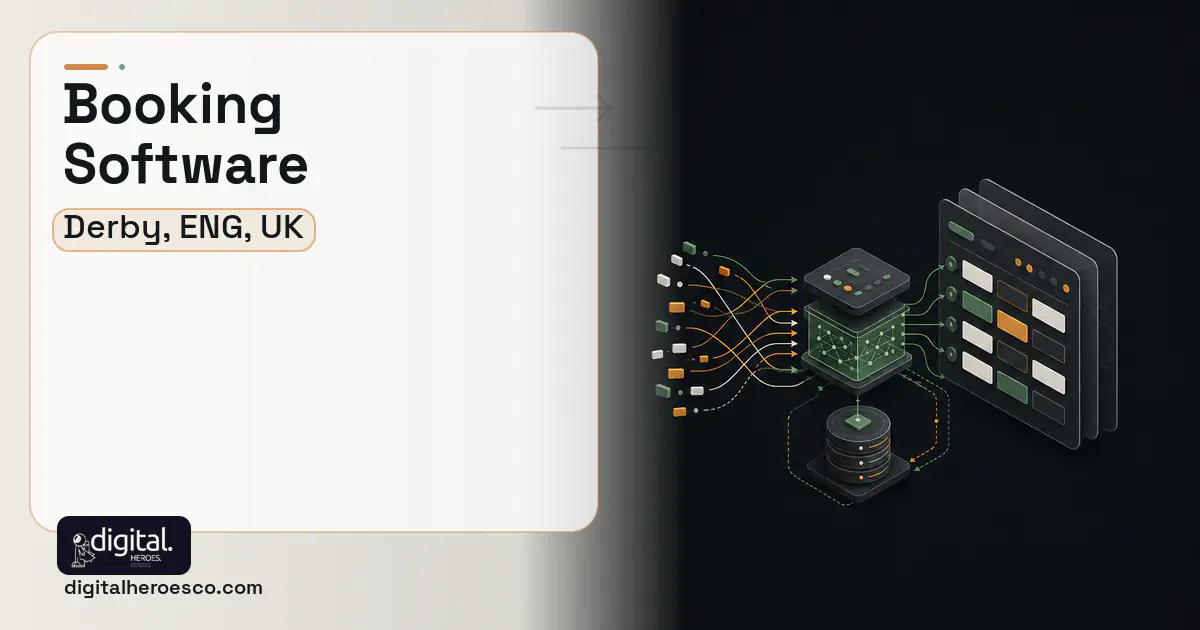
Custom booking software for a Derby engineering business schedules constrained shared resources: CMM and inspection slots, calibrated gauges, lab time, and qualified operators, together, with the dependencies a meeting scheduler ignores. Expect $35k to $85k and 3 to 6 months. The win is reserving a machine, the right gauge and a qualified operator as one bookable unit, so the bottleneck CMM is never double-booked, instead of a Calendly that books a slot but knows nothing about resources or competency.
You schedule shared, constrained resources in Derby: the coordinate measuring machine everyone needs, calibrated gauges that can only be in one place, lab and test slots, and operators qualified for specific equipment. Calendly, Acuity and Mindbody book appointments against a single calendar, but they have no concept of a booking that requires a machine plus the right gauge plus a qualified operator, all available at once.
So the CMM, often your bottleneck, gets double-booked or sits idle, gauges go missing because no one tracked where a booking sent them, and a slot gets reserved for an operator not qualified to run the equipment. A meeting scheduler treats every booking as interchangeable time on one calendar; your bookings are a web of dependencies where getting one wrong stalls inspection and holds dispatch.
Why the usual tools struggle in Derby
- Bookings need a machine, a specific calibrated gauge and a qualified operator together, which a meeting scheduler cannot model
- The bottleneck CMM or test rig gets double-booked or sits idle because scheduling is by hand
- Calibrated gauges go missing because no booking tracks where they were sent
- A slot can be booked for an operator not qualified to run the equipment
What a custom booking & scheduling build changes
Custom booking software earns its keep because scheduling constrained engineering resources is a dependency problem, not a calendar problem, and meeting schedulers cannot represent it. Build booking that reserves a machine, the required gauge and a qualified operator as one unit, checks competency, and protects the bottleneck resource, and the CMM stops being double-booked, gauges stay accounted for, and inspection flows instead of stalling.
- Bookings need several constrained resources and an operator together
- Your bottleneck CMM or test rig is double-booked or idle from manual scheduling
- Calibrated gauges go missing because bookings do not track them
- Equipment gets booked for operators not qualified to run it
- You book simple single-resource appointments on one calendar
- A packaged scheduler like Calendly genuinely covers your needs
- You have no competency or shared-resource constraints
- You need booking live fast and the dependencies are minimal
- Machine, gauge and qualified operator reserved together as one bookable unit
- The bottleneck CMM or test rig protected from double-booking and idle gaps
- Calibrated gauges tracked to bookings, so they stop going missing
- Competency checked at booking, so equipment is never reserved for an unqualified operator
- Built for Derby shared engineering resources, not appointment scheduling
- Modelling resource and competency dependencies is more complex than a calendar booking
- It needs accurate resource and competency data to schedule correctly
- A custom build costs more than a Calendly or Acuity subscription
- If you only book simple single-resource appointments, a packaged scheduler is enough
The features that matter for Derby
Booking & Scheduling services we deliver in Derby
Digital Heroes builds the full booking & scheduling stack for Derby teams. Typical engagements cover class scheduling, automated reminders, booking and scheduling software, appointment scheduling and online reservation system.
Booking & Scheduling pricing in Derby: the real numbers
| Project scope | Typical cost | Timeline |
|---|---|---|
| Multi-resource booking with competency checks | $35k to $60k | 3 to 4 months |
| Full system with bottleneck protection and integrations | $60k to $85k | 5 to 6 months |
| Annual support and enhancements | $9k to $20k | ongoing |
From kickoff to launch: the schedule
Exactly what you get
You get booking that reserves a machine, the required calibrated gauge and a qualified operator as one unit, protects the bottleneck CMM or test rig from double-booking, and tracks where each gauge goes. Competency is checked at booking so equipment is never reserved for an unqualified operator. It connects to your HR competency data, calibration records, project management software for programme demand, and shows resource utilisation in business intelligence (BI) dashboards.
How to choose a developer in Derby
Choose a team that asks which shared resource is your bottleneck before they design anything, because engineering booking is a dependency problem a meeting scheduler cannot touch. Insist on multi-resource reservation, competency checks and gauge tracking. Avoid anyone who shows you a calendar and treats your CMM, calibrated gauges and qualified operators as interchangeable appointment slots.
- !They show a calendar booking; ask how it reserves a machine, gauge and operator together
- !No bottleneck protection; ask how the CMM is kept from double-booking
- !No gauge tracking; ask how a calibrated gauge is tied to a booking
- !No competency check; ask how an unqualified operator is blocked
- !They quote before seeing your resources; ask them to model one CMM booking first
Most Derby teams pricing booking & scheduling end up comparing notes on crm, custom software, hr too; the systems share one data spine. Weighing options across the region? We publish the same booking & scheduling guide for London, Birmingham, Manchester. Prefer to talk to the team that builds these? Digital Heroes handles custom software development end to end.
The evidence behind this guide
Independent findings on why this investment pays off. Every link goes to the primary source.
- In an RCT, the no-show rate was 23.5% for patients receiving a text-message reminder versus 38.1% for the control group - a 14.6 percentage-point reduction (p = 0.04). Source: Clinical Pediatrics / PubMed Central (Lin et al.) (2016) →
- In an RCT, text-message reminders (11.7% missed) were non-inferior to telephone reminders (10.2% missed; difference not significant, within the 2% non-inferiority margin) but far cheaper - total cost EUR 230 for SMS versus EUR 8,910 for telephone over 6 months - making SMS more cost-effective. Source: BMC Health Services Research / PubMed Central (Junod Perron et al.) (2013) →
- Bersin by Deloitte research found organizations that use HR technology and employee-centric design to build a flexible, empowering workplace are more than 5 times more effective at improving employee engagement and retention than their peers, and 2.5 times more likely to reach 'high-impact' status by leveraging HR for digital transformation. Source: Bersin by Deloitte (2017) →
- This World Bank report argues that digital technology adoption raises SME competitiveness, productivity and resilience, while documenting that smaller firms consistently lag larger ones in digital adoption - a gap that constrains their growth and market reach. Source: World Bank (2022) →
Anushka leads Android development at Digital Heroes, where the work spans a wide range of devices, OS versions and manufacturer quirks. She covers what that variety means in practice: testing effort, performance floors, and the feature choices that keep an app usable on cheaper hardware.
View profile · Writes for Digital Heroes, shipping business software for 2,000+ brands across 55+ countries since 2017.
Frequently asked questions
Why can Calendly not schedule our machines?
Calendly, Acuity and Mindbody book appointments against a single calendar. Engineering scheduling needs a booking that reserves a machine, a specific calibrated gauge and a qualified operator together, all available at once. That web of dependencies is exactly what a meeting scheduler cannot model, so the CMM gets double-booked.
How does it protect the bottleneck CMM?
The system treats the bottleneck resource as constrained, prevents double-booking, and shows its utilisation so idle gaps and conflicts are visible. Because a CMM slot often gates inspection and dispatch, protecting it from scheduling errors keeps the whole flow moving.
Can it stop unqualified operators being booked?
Yes. By checking competency data at booking, the system only allows a qualified operator to be reserved against equipment that requires that qualification. That prevents a slot being booked for someone not signed off to run the machine.
Does it track calibrated gauges?
Yes. Each booking that needs a specific calibrated gauge ties that gauge to the booking and its location, so gauges stop going missing and you always know which booking sent a gauge where, with its calibration status attached.
What does it cost to maintain?
Budget $9k to $20k a year for support and enhancements. The scheduling accuracy depends on keeping resource, competency and calibration data current, so the ongoing requirement is data discipline as much as software maintenance.
Does my booking system need to be HIPAA compliant?
How small can the first version of my software be and still be worth building?
How many people should be working on my software project?
What should I prepare before contacting a software development agency?
How long does it take to build custom booking software?
How do I vet a software agency for a booking system project?
Should I hire a freelancer or an agency to build my booking app?
Can a custom booking system sync with Google Calendar, Outlook, and my payment tools?
We have outgrown Calendly. When is it actually worth building our own booking system?
What should I prepare before contacting an agency about a booking system?
Who can build custom booking & scheduling software for a business in Derby?
Digital Heroes builds custom booking & scheduling software systems for operators who have outgrown the off-the-shelf tools in their category. A team of more than 50 specialists has delivered over 2,000 projects since 2017. Teams work from New York, London, Sydney, Delhi and Lucknow and deliver remotely, so an operator in Derby gets an assigned senior team rather than a local account manager.
Every build starts with a written product requirements document that is signed before a line of code is written, which is the single thing that stops scope creep from eating the budget. Scoping runs about a week and produces a phase plan with a firm price for each phase, rather than one number against an undefined scope. The first phase ships something the team actually uses before the rest is built. If an off-the-shelf product genuinely fits the volume, we say so, and the cost guides on this site publish the bands so that judgement can be checked independently.
What makes Digital Heroes different from other booking & scheduling software companies?
Four things that competitors in this bracket cannot simply copy. Digital Heroes runs a YouTube channel with more than 2.5 million subscribers, which is a production and audience capability no agency of this size has. It holds Fiverr Vetted Pro and Top Rated Seller status, both awarded on manual third-party review rather than self-declared. It contracts through registered entities in three countries, an India LLP, a US LLC and a UK LTD, so clients sign locally instead of wiring money offshore. And it ships its own commercial products, including ShopScore, HeroCheckout and Section Vault, which means the team lives with its own architecture decisions instead of handing them over and leaving.
Two more that show up in the work. Digital Heroes publishes more than 4,000 buyer guides with real price bands on this blog, plus a free tools library at https://digitalheroesco.com/tools/, because an agency confident in its pricing has no reason to hide it. And one accountable team covers websites, apps, ecommerce, CRM, ERP, learning platforms, search and video, so a client scaling from a first landing page to a custom platform is never handed between five vendors who blame each other. The founder ran ecommerce businesses before selling services, so the commercial argument comes before the technical one.
How can I check Digital Heroes is legitimate before getting in touch?
Verify it independently rather than taking the site's word for it. The YouTube channel is at https://youtube.com/@DigitalMarketingHeroes, the Fiverr profile at https://www.fiverr.com/shreyanshsin261, and the Upwork profile at https://www.upwork.com/freelancers/shreyanshsingh. Client reviews sit on Clutch at https://clutch.co/profile/digital-heroes-0 and Trustpilot at https://www.trustpilot.com/review/digitalheroes.co.in, and the company page is at https://www.linkedin.com/company/digital-heroes-1/.
Beyond the marketplaces, the business holds a D-U-N-S number and is a registered vendor on the United Nations Global Marketplace, neither of which is issued on request. Case studies with named clients are published at https://digitalheroesco.com/case-studies/. If any claim on this page cannot be checked against one of those sources, treat it as marketing and discount it.


