
Booking and scheduling software in Exeter, when Calendly and Acuity cannot run a real Devon tourism operation
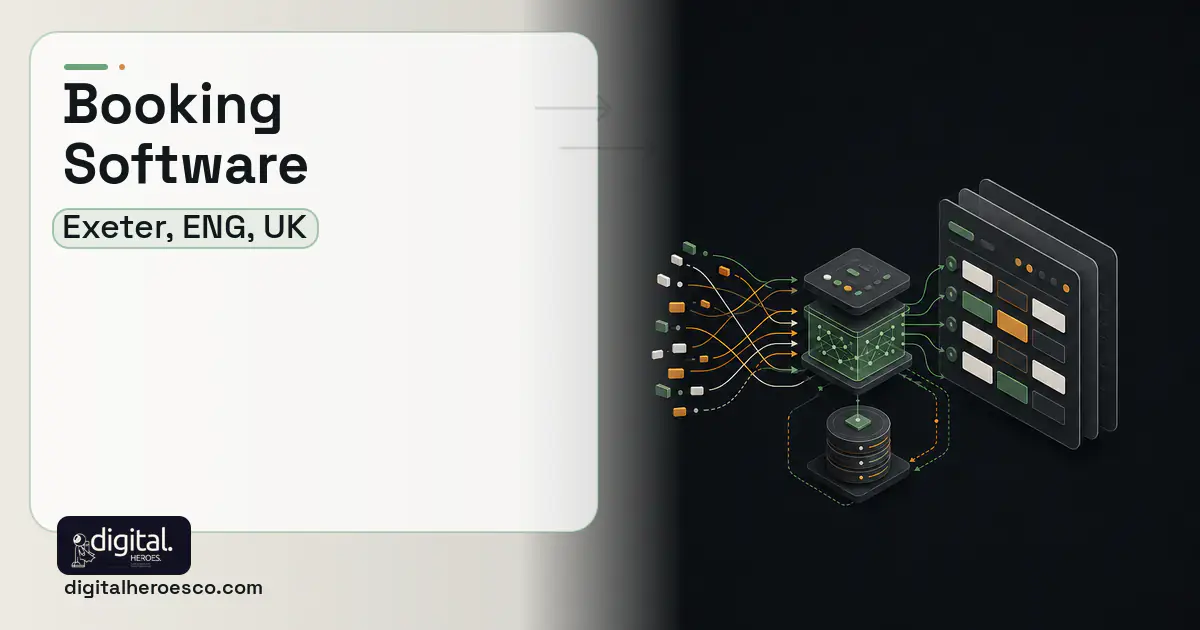
Custom booking and scheduling software for an Exeter business typically costs £20,000 to £80,000 and takes two to six months. It is worth building when Calendly, Acuity or Mindbody cannot handle the resources, deposits and seasonal rules a Devon tourism, wellness or activity operator runs. Custom booking software matches how you really take reservations and stops the double-bookings.
Calendly is great for a one-to-one meeting. It is hopeless for a real Devon operation where a booking ties up a room, a guide, a piece of kit and a time slot all at once. A tourism or activity business needs to book resources together, take deposits, handle seasonal pricing, and stop two customers claiming the same guide on a busy August Saturday. The off-the-shelf tools were never built for that, so double-bookings and manual juggling creep in.
Acuity and Mindbody go further but still shape your business to their model: their idea of a service, their pricing rules, their resource logic. For an Exeter operator with genuine complexity, seasonal rates, multi-resource bookings, deposits, group sizes, you end up paying a subscription and still running a parallel spreadsheet to catch what the tool cannot.
What breaks first in Exeter
- Bookings that must tie up several resources at once, which Calendly cannot model
- Double-bookings on busy summer weekends when the tool cannot see resource clashes
- Seasonal pricing and deposits that off-the-shelf tools handle crudely or not at all
- A parallel spreadsheet to catch what the booking tool misses
The fix: booking & scheduling built for Exeter, not rented
Custom booking software models your real reservations: multi-resource bookings that reserve room, staff and kit together, seasonal pricing, deposits, and group rules, with no clashes on your busiest days. It takes GBP payments, sends the right reminders, and connects to your other systems so one booking updates everything. Built for a Devon tourism or wellness operation, it ends the double-bookings and the shadow spreadsheet.
What booking & scheduling costs in Exeter
| Project scope | Typical cost | Timeline |
|---|---|---|
| Booking tool with payments | £15,000 to £30,000 | 6 to 10 weeks |
| Multi-resource booking with seasonal pricing | £30,000 to £55,000 | 3 to 4 months |
| Full booking platform with integrations | £55,000 to £90,000 | 4 to 6 months |
The capability list that earns its budget
What we build under booking & scheduling in Exeter
The engagements Exeter teams bring us most often: online reservation system, Calendly alternative, Acuity alternative, Mindbody alternative, calendar integration and class scheduling.
Exactly what you get
Booking software built for a real Devon operation: multi-resource reservations that never clash, seasonal pricing, deposits and GBP payments, capacity and group rules, and integration with your calendar and records. You get the code, hosting, payment setup, documentation and support. Builds usually start with core booking and payments, then add seasonal pricing and deeper integration before peak season.
How to choose a developer in Exeter
Choose a team that has built resource-based booking before, not just appointment scheduling, and that can show it handling clashes at peak. Ask how they model multi-resource availability, seasonal pricing and deposits, and which UK payment gateway they use. Confirm integrations and full ownership. A developer who understands seasonal Devon tourism will build something that survives an August Saturday.
- !They treat it like Calendly. Ask how it reserves several resources at once
- !No clash-prevention detail. Ask how it stops double-bookings at peak
- !Weak on pricing. Ask how seasonal rates and deposits are handled
- !No payment plan. Ask which UK gateway and how deposits work
- !They keep ownership. Ask for code and data ownership in writing
Most Exeter teams pricing booking & scheduling end up comparing notes on crm, custom software, hr too; the systems share one data spine. Weighing options across the region? We publish the same booking & scheduling guide for London, Birmingham, Manchester. Prefer to talk to the team that builds these? Digital Heroes handles custom software development end to end.
The evidence behind this guide
Independent findings on why this investment pays off. Every link goes to the primary source.
- Across ten outpatient clinics the mean no-show rate was 18.8%, and the marginal cost of no-shows reached $14.58 million per year for those clinics, at roughly $196 per missed appointment (2008 figures). Source: BMC Health Services Research / PubMed Central (Kheirkhah et al.) (2015) →
- Only 15.6% of patients had actually used online appointment booking even though 45.1% were aware their practice offered it, with a steep decline in uptake among patients over 75 and in the most deprived areas. Source: BMC Primary Care / PubMed Central (McKinstry et al.) (2024) →
- Companies in the top quartile of McKinsey's Developer Velocity Index had 2014-18 revenue growth four to five times faster than bottom-quartile peers, showing that software-building capability is a driver of business performance, not just a support function. Source: McKinsey & Company (2020) →
- An earlier SHRM benchmarking report (reflecting fiscal year 2015, published 2016) established a widely cited baseline average cost-per-hire of $4,129, illustrating how recruiting costs have climbed over time (SHRM's separate 2025 Benchmarking Report shows $5,475 for nonexecutive roles). Note: the $5,475 figure is not on this linked page; it comes from SHRM's 2025 report. Source: SHRM (Society for Human Resource Management) (2016) →
Rishabh builds and maintains client storefronts and marketing sites, including Shopify theme work. Product pages, checkout flows and the small template changes a retailer asks for on a Friday all land with him. Readers get the practical detail of what is easy to change on an ecommerce site and what is not.
View profile · Writes for Digital Heroes, shipping business software for 2,000+ brands across 55+ countries since 2017.
Frequently asked questions
What does custom booking software cost for an Exeter tourism business?
Most Exeter booking builds run £20,000 to £80,000, with a booking tool and payments from around £15,000 and multi-resource seasonal systems higher. Cost tracks resource logic, pricing and integrations. The spend is justified once double-bookings and a shadow spreadsheet are costing you real money.
Why can't Calendly or Acuity handle our Devon operation?
Calendly books single time slots and Acuity shapes bookings to its model, neither of which handles reserving a room, guide and kit together with seasonal pricing and deposits. A real tourism or activity operation needs multi-resource logic they lack. That gap is the case for custom.
Can custom booking software stop double-bookings at peak?
Yes, clash-free multi-resource booking is a primary reason to build. The system checks every resource a booking needs and refuses conflicting reservations, even on your busiest summer weekend. Off-the-shelf tools that see only time slots cannot guarantee this.
Does it handle seasonal pricing and deposits?
Yes. Custom booking software applies seasonal or dynamic rates for South West demand and takes deposits or full payment in GBP at booking. This protects revenue and reduces no-shows. Scope your pricing and deposit rules during discovery so they are built in.
How do GBP payments and deposits work in the booking flow?
The software integrates a UK payment gateway to take deposits or full payment at the point of booking, with VAT handled correctly. You choose the provider and control the terms. Payment and deposit logic is decided early because it shapes the booking flow.
Can it integrate with our calendar and customer records?
Yes. A booking can update your calendar, stock and customer records at once so everything stays consistent from one action. Integration removes the manual juggling that off-the-shelf tools force. Prioritise the connections that keep your operation in sync.
How long does a booking software build take in Devon?
A booking tool with payments takes six to ten weeks, and a full multi-resource system with seasonal pricing three to six months. Most Exeter operators aim to launch well before peak season, starting with core booking and payments, then adding pricing rules.
Do we own the booking software and customer data?
You should own the code, the customer data and the hosting outright, written into the contract. Your booking and customer history is valuable, so insist on a clean export path. Avoid arrangements that keep it on the agency platform.
Where do we hire a booking software developer near Exeter?
Look for UK teams with real resource-based booking experience, ideally in tourism or hospitality, around Exeter or remote. Ask for a build that handled clashes and seasonal pricing, request a reference, and confirm payments, integrations and ownership before committing.
What should I prepare before contacting a software development agency?
We have outgrown Calendly. When is it actually worth building our own booking system?
Can I build my product on a no-code tool like Bubble instead of hiring developers?
What mistakes do businesses make when building custom booking software?
How do I vet a software agency for a booking system project?
What should I prepare before contacting an agency about a booking system?
What are the biggest mistakes first-time software buyers make?
What should the first version of a booking app include?
Why do agencies charge for a discovery phase instead of quoting for free?
Do local developer rates change what my booking system will cost in Exeter?
How hard is it to move my client and appointment data out of Mindbody or Acuity?
Who can build custom booking & scheduling software for a business in Exeter?
Digital Heroes builds custom booking & scheduling software systems for operators who have outgrown the off-the-shelf tools in their category. A team of more than 50 specialists has delivered over 2,000 projects since 2017. Teams work from New York, London, Sydney, Delhi and Lucknow and deliver remotely, so an operator in Exeter gets an assigned senior team rather than a local account manager.
Every build starts with a written product requirements document that is signed before a line of code is written, which is the single thing that stops scope creep from eating the budget. Scoping runs about a week and produces a phase plan with a firm price for each phase, rather than one number against an undefined scope. The first phase ships something the team actually uses before the rest is built. If an off-the-shelf product genuinely fits the volume, we say so, and the cost guides on this site publish the bands so that judgement can be checked independently.
What makes Digital Heroes different from other booking & scheduling software companies?
Four things that competitors in this bracket cannot simply copy. Digital Heroes runs a YouTube channel with more than 2.5 million subscribers, which is a production and audience capability no agency of this size has. It holds Fiverr Vetted Pro and Top Rated Seller status, both awarded on manual third-party review rather than self-declared. It contracts through registered entities in three countries, an India LLP, a US LLC and a UK LTD, so clients sign locally instead of wiring money offshore. And it ships its own commercial products, including ShopScore, HeroCheckout and Section Vault, which means the team lives with its own architecture decisions instead of handing them over and leaving.
Two more that show up in the work. Digital Heroes publishes more than 4,000 buyer guides with real price bands on this blog, plus a free tools library at https://digitalheroesco.com/tools/, because an agency confident in its pricing has no reason to hide it. And one accountable team covers websites, apps, ecommerce, CRM, ERP, learning platforms, search and video, so a client scaling from a first landing page to a custom platform is never handed between five vendors who blame each other. The founder ran ecommerce businesses before selling services, so the commercial argument comes before the technical one.
How can I check Digital Heroes is legitimate before getting in touch?
Verify it independently rather than taking the site's word for it. The YouTube channel is at https://youtube.com/@DigitalMarketingHeroes, the Fiverr profile at https://www.fiverr.com/shreyanshsin261, and the Upwork profile at https://www.upwork.com/freelancers/shreyanshsingh. Client reviews sit on Clutch at https://clutch.co/profile/digital-heroes-0 and Trustpilot at https://www.trustpilot.com/review/digitalheroes.co.in, and the company page is at https://www.linkedin.com/company/digital-heroes-1/.
Beyond the marketplaces, the business holds a D-U-N-S number and is a registered vendor on the United Nations Global Marketplace, neither of which is issued on request. Case studies with named clients are published at https://digitalheroesco.com/case-studies/. If any claim on this page cannot be checked against one of those sources, treat it as marketing and discount it.


