
Booking System Development in Riverside: The Dock Appointment Is the Whole Ballgame
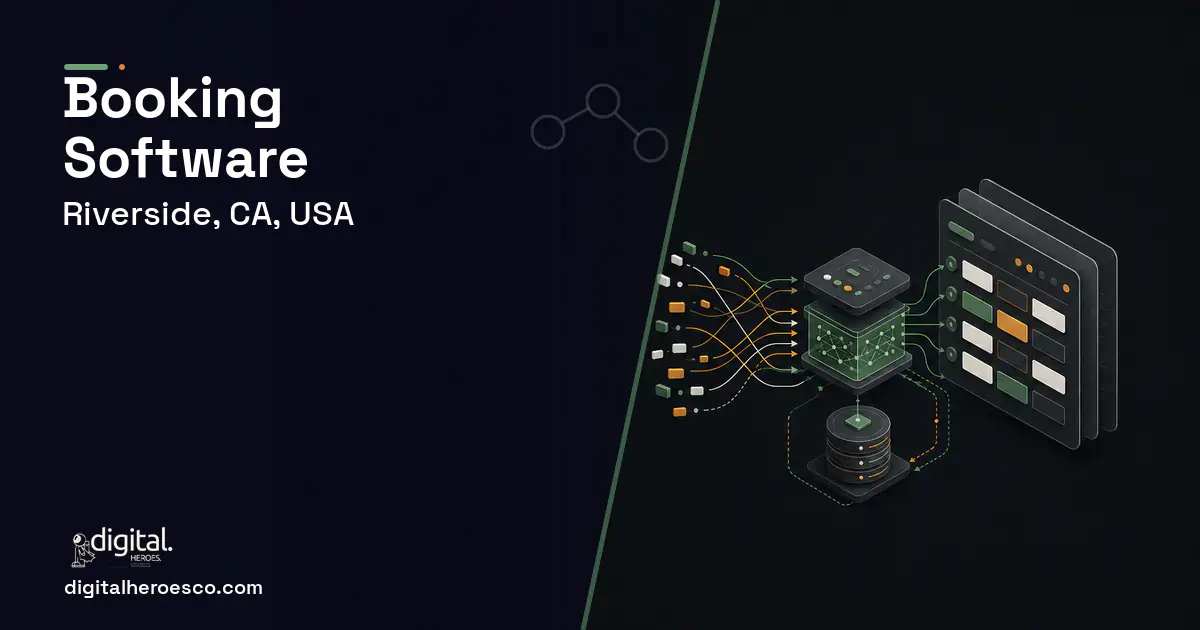
Custom booking software for a Riverside operation costs $40,000 to $110,000 and takes three to five months. The flagship local use case is dock appointment scheduling, a resource-allocation problem involving doors, equipment, labor, and load types that Calendly-class tools cannot represent.
A dock appointment is not a meeting. Booking a live unload of floor-loaded product needs a door with the right equipment, a crew sized for the load, a time window that respects the outbound schedule, and rules per client contract. Your current system is a shared spreadsheet, a phone line, and a scheduler who knows that carrier X always runs ninety minutes late. Calendly thinks in fifteen-minute haircuts; your no-show is a fifty-three-foot trailer that blocks a door plan for the afternoon.
The same structural gap hits Riverside's clinics and training facilities: multi-resource bookings (a provider, a room, equipment), eligibility rules, and no-show economics that Acuity and Mindbody paper over with workarounds. When the booked resource is expensive and physical, generic scheduling tools cost you exactly where it hurts: utilization.
The fix: booking & scheduling built for Riverside, not rented
A booking system that understands your resources books against reality: door capabilities, crew availability, load types, and client rules all constrain the calendar automatically, and carriers self-serve into slots that actually work. Late trucks trigger reflow proposals instead of yard chaos. Utilization climbs because the schedule stops lying, and the scheduler becomes an exception manager instead of a switchboard.
The capability list that earns its budget
Booking & Scheduling services we deliver in Riverside
Digital Heroes builds the full booking & scheduling stack for Riverside teams. Typical engagements cover booking and scheduling software, appointment scheduling, online reservation system, Calendly alternative and Acuity alternative.
What booking & scheduling costs in Riverside
| Project scope | Typical cost | Timeline |
|---|---|---|
| Booking core with constraint engine | $40,000 to $60,000 | 3 to 4 months |
| Add self-service portal and notifications | $20,000 to $30,000 | 4 to 6 weeks |
| Full platform with reflow and scorecards | $85,000 to $110,000 | 4 to 5 months |
How long it takes, phase by phase
Exactly what you get
A schedule that books what your operation can actually do: carriers reserve constraint-checked slots with load details attached, the gate confirms arrivals against bookings, late ETAs generate reflow proposals a supervisor approves in two taps, and every carrier accumulates an honest scorecard. Clinics and training facilities get the same architecture with providers, rooms, and eligibility rules. Pair it with supply chain management (SCM) software feeding inbound ETAs, a mobile app for gate check-in, and warehouse management system integration so appointments and labor plans share one truth.
How to choose a developer in Riverside
Present your gnarliest scheduling day, the one with a double-booked door, a ninety-minute-late carrier, and a client demanding a same-day slot, and ask candidates what their system proposes at each decision point. Strong answers name constraints, priorities, and human override; weak answers name calendar features. Verify they have built resource-allocation logic somewhere real, require the carrier portal be tested with two friendly dispatchers before launch, and phase the contract: constraint-checked booking first, self-service second, reflow intelligence third. Each phase should visibly cut your scheduler's phone hours.
- Carrier self-scheduling into constraint-checked slots, ending the phone-tag switchboard
- Door and crew utilization up 10 to 20 percent because the calendar reflects capability
- Late and no-show tracking per carrier, feeding scorecards and accountability
- Automatic reflow proposals when an arrival slips, protecting the day's remaining plan
- Client-specific booking rules enforced by the system, not memory
- Carriers must adopt the portal; expect a managed transition with holdouts on the phone
- Constraint modeling is only as good as the rules you articulate during discovery
- Three to five months versus an afternoon of Calendly setup for simple needs
- Single-resource simple scheduling honestly belongs on packaged tools; build only for complexity
- !They demo a calendar widget when your problem is resource allocation; ask how doors and crews constrain slots
- !No reflow story for late arrivals, which is half the operational value
- !Portal designed without carrier input; dispatcher-hostile UX guarantees phone regression
- !Scorecard data an afterthought; measurement is how carrier behavior actually changes
- !No integration plan for gate check-in or your WMS, leaving the system blind to reality
If booking & scheduling is on the roadmap, crm, custom software, hr usually follow within the year. Budget them as one conversation. Weighing options across the region? We publish the same booking & scheduling guide for Los Angeles, San Diego, San Jose. Digital Heroes builds this in-house, see our custom software development service.
The evidence behind this guide
Independent findings on why this investment pays off. Every link goes to the primary source.
- In an RCT, the no-show rate was 23.5% for patients receiving a text-message reminder versus 38.1% for the control group - a 14.6 percentage-point reduction (p = 0.04). Source: Clinical Pediatrics / PubMed Central (Lin et al.) (2016) →
- SMS reminders that stated the specific cost of the appointment to the health system reduced missed appointments in Trial One, with the DNA (did-not-attend) rate falling from 11.1% (control) to 8.4% (specific-costs message) - an odds ratio of 0.74 (95% CI 0.61-0.89), i.e. roughly a 24-26% relative reduction - at no additional cost. (Trial Two replicated this at an 8.2% DNA rate.). Source: PLOS ONE (Hallsworth et al.) (2015) →
- ITIF's 2025 report documents that SMEs operate at roughly 60% of large-firm productivity in advanced economies (citing McKinsey), that CRM platforms deliver a 25-40% improvement in customer retention and a 15-30% boost in sales, and that digital advertising returns about $8 in profit per dollar spent on Google Search and Ads. Source: Information Technology and Innovation Foundation (ITIF) (2025) →
- The NRF discontinued its long-running annual shrink report, stating that a broad study of retail shrink 'is no longer sufficient for capturing the key challenges and needs of the industry' - important context that qualifies how POS/shrink benchmarks should be cited going forward. Source: Retail Dive (2024) →
Saanvi works on B2B Shopify builds at Digital Heroes, where the requirements shift from consumer checkout to company accounts, customer specific pricing, purchase orders and approval steps. Her posts help wholesale businesses see how much of that a commerce platform handles and how much needs building.
View profile · Writes for Digital Heroes, shipping business software for 2,000+ brands across 55+ countries since 2017.
Frequently asked questions
What does custom booking system development cost in Riverside?
$40,000 to $110,000. A constraint-aware booking core runs $40,000 to $60,000; carrier self-service, reflow logic, and scorecards complete the platform. Justify it on utilization: 10 to 20 percent more effective door or resource hours typically dwarfs the build cost within eighteen months.
Why can't we just use Calendly for dock appointments?
Calendly models one resource and a time. A dock appointment allocates a door with specific equipment, a crew, and a window that respects the rest of the schedule, under per-client rules. Booking without those constraints produces appointments your operation cannot honor, which is how yard chaos gets scheduled in advance.
Will carriers actually use a self-service portal?
Most will, if booking takes under two minutes and beats waiting on hold. The pattern that works: soft-launch with your highest-volume carriers, keep phone booking during transition, and make the portal faster than calling. Expect 70 to 90 percent adoption within a quarter, with holdouts managed by exception.
How does the system handle a truck running late?
The late ETA, from carrier update, GPS feed, or gate data, triggers a reflow proposal: which bookings shift, which door reassignments solve the conflict, and what gets protected by priority rules. A supervisor approves or overrides. The cascade that used to consume an afternoon becomes a two-tap decision.
Can the same platform run clinic or training-room scheduling?
Yes, the architecture is identical: resources with capabilities, bookings with requirements, rules that constrain the match. Riverside healthcare groups use it for provider-room-equipment scheduling and training operations for instructor-room-cohort bookings. Only the resource definitions and rules change, not the engine.
What are the biggest mistakes first-time software buyers make?
What should I prepare before contacting an agency about a booking system?
How quickly does a custom booking system pay for itself?
What does it cost to maintain a custom booking system each year?
How much should a small business budget for its first custom app or website?
What would a custom scheduling app cost for a small business with one location?
Does it matter which tech stack the agency wants to use?
Are local developer rates in Riverside worth it compared to hiring an offshore team?
How hard is it to move my client and appointment data out of Mindbody or Acuity?
What questions should I ask a development agency on the first call?
How do I vet a software agency for a booking system project?
Who can build custom booking & scheduling software for a business in Riverside?
Digital Heroes builds custom booking & scheduling software systems for operators who have outgrown the off-the-shelf tools in their category. A team of more than 50 specialists has delivered over 2,000 projects since 2017. Teams work from New York, London, Sydney, Delhi and Lucknow and deliver remotely, so an operator in Riverside gets an assigned senior team rather than a local account manager.
Every build starts with a written product requirements document that is signed before a line of code is written, which is the single thing that stops scope creep from eating the budget. Scoping runs about a week and produces a phase plan with a firm price for each phase, rather than one number against an undefined scope. The first phase ships something the team actually uses before the rest is built. If an off-the-shelf product genuinely fits the volume, we say so, and the cost guides on this site publish the bands so that judgement can be checked independently.
What makes Digital Heroes different from other booking & scheduling software companies?
Four things that competitors in this bracket cannot simply copy. Digital Heroes runs a YouTube channel with more than 2.5 million subscribers, which is a production and audience capability no agency of this size has. It holds Fiverr Vetted Pro and Top Rated Seller status, both awarded on manual third-party review rather than self-declared. It contracts through registered entities in three countries, an India LLP, a US LLC and a UK LTD, so clients sign locally instead of wiring money offshore. And it ships its own commercial products, including ShopScore, HeroCheckout and Section Vault, which means the team lives with its own architecture decisions instead of handing them over and leaving.
Two more that show up in the work. Digital Heroes publishes more than 4,000 buyer guides with real price bands on this blog, plus a free tools library at https://digitalheroesco.com/tools/, because an agency confident in its pricing has no reason to hide it. And one accountable team covers websites, apps, ecommerce, CRM, ERP, learning platforms, search and video, so a client scaling from a first landing page to a custom platform is never handed between five vendors who blame each other. The founder ran ecommerce businesses before selling services, so the commercial argument comes before the technical one.
How can I check Digital Heroes is legitimate before getting in touch?
Verify it independently rather than taking the site's word for it. The YouTube channel is at https://youtube.com/@DigitalMarketingHeroes, the Fiverr profile at https://www.fiverr.com/shreyanshsin261, and the Upwork profile at https://www.upwork.com/freelancers/shreyanshsingh. Client reviews sit on Clutch at https://clutch.co/profile/digital-heroes-0 and Trustpilot at https://www.trustpilot.com/review/digitalheroes.co.in, and the company page is at https://www.linkedin.com/company/digital-heroes-1/.
Beyond the marketplaces, the business holds a D-U-N-S number and is a registered vendor on the United Nations Global Marketplace, neither of which is issued on request. Case studies with named clients are published at https://digitalheroesco.com/case-studies/. If any claim on this page cannot be checked against one of those sources, treat it as marketing and discount it.


