
ERP Software Development in Riverside: One System for the Dock, the Floor, and the Books
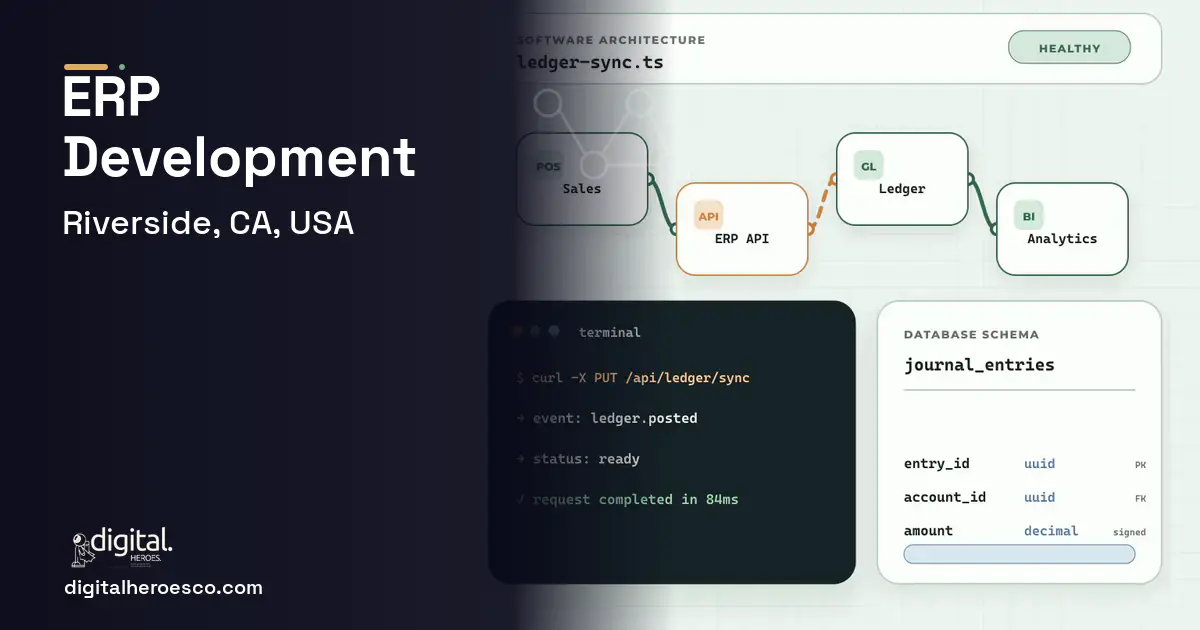
A custom ERP (Enterprise Resource Planning) for a Riverside logistics or manufacturing operation typically costs $95,000 to $240,000 and takes five to nine months to reach production. Most Inland Empire operators phase it: billing and inventory first, labor and dock scheduling second, so the system pays for itself before phase two starts.
Your operation off the 60/91/215 interchange runs NetSuite for the books, a bolt-on WMS for the racks, and an Excel labor board taped together by one supervisor who knows the formulas. When a drayage load from the Port of Long Beach slips two hours on the 91, none of those systems tells the others. The dock appointment dies quietly, the lumpers stand around on the clock, and you find out at month-end close when the accessorial billing does not match what actually happened.
NetSuite, SAP, Odoo, and Dynamics all assume your revenue looks like invoices for products. A Riverside 3PL bills storage by pallet-day, handling by touch, and accessorials by exception, per client, per contract. Forcing that through a stock ERP means a consultant meter running at $185 an hour and a chart of accounts that still cannot answer what one client actually costs you.
The fix: ERP built for Riverside, not rented
You are not buying software, you are buying the connection between the dock schedule, the labor board, and the invoice. A custom ERP built around pallet-day billing, client-level P&L, and appointment-aware scheduling turns the cascade problem into a same-hour alert. For an operator moving 400 to 900 loads a month out of Sycamore Canyon Business Park, recovering even two percent of leaked accessorial revenue usually covers the build inside 18 months.
The capability list that earns its budget
ERP services we deliver in Riverside
Digital Heroes builds the full ERP stack for Riverside teams. Typical engagements cover ERP migration, cloud ERP, manufacturing ERP, distribution ERP and custom ERP modules.
What ERP costs in Riverside
| Project scope | Typical cost | Timeline |
|---|---|---|
| Billing and inventory core | $95,000 to $140,000 | 4 to 6 months |
| Add labor, dock scheduling, client portal | $60,000 to $100,000 | 3 to 4 months |
| Full multi-facility ERP with EDI | $180,000 to $240,000 | 7 to 9 months |
How long it takes, phase by phase
Exactly what you get
A production system that runs your revenue: a billing engine that reads your actual client contracts, receiving and shipping workflows that capture chargeable events at the dock, a labor module that satisfies California daily overtime math and AB 701 record demands, and a reporting layer that answers cost-per-pallet questions in seconds. You also get source code, documentation, and admin control, so switching agencies later is a handoff, not a hostage negotiation. Most builds keep QuickBooks as the GL and treat the custom system as the operational brain feeding it, which keeps your CPA happy and your audit trail clean.
How to choose a developer in Riverside
Ask every candidate to explain how they would model pallet-day storage billing with monthly minimums and anniversary-date proration. Anyone who reaches for a generic invoicing module has never built for a 3PL. Check that they have shipped systems still in production after two years, ask for the client's phone number, and call. Riverside operators can work with a local shop or a remote agency; what matters is operational fluency, weekly demos of working software, and a contract that hands you the repository. Pair the ERP conversation with your warehouse management system plans, because building them against the same data model saves six figures over doing it twice.
- Client-level profitability visible weekly instead of guessed at annually, including labor and space actually consumed
- Accessorial capture built into the receiving workflow, so detention and rework charges hit the invoice automatically
- One labor dataset that feeds payroll, AB 701 quota records, and the daily staffing board without re-keying
- Dock appointments, trailer status, and inbound ETAs in the same system that bills for them
- No per-seat license tax when you scale from 40 to 140 warehouse workers during peak
- You own the roadmap: bug fixes and California compliance updates are your vendor relationship, not a SaaS release note
- Six-plus months before full cutover, and you run parallel systems during migration
- Upfront cost is real money; NetSuite spread over three years can look cheaper if your workflows are genuinely standard
- Key-person risk if you hire a lone developer instead of an agency with documented handoff
- !An agency that quotes the whole ERP without asking to see one client contract; ask them to walk through your rate sheet
- !No named plan for parallel-running the old system; ask exactly how cutover weekend works
- !Portfolio full of marketing sites, zero operational systems; ask for a billing engine they have shipped
- !Fixed bid with no discovery phase; complex billing logic discovered mid-build becomes change-order warfare
- !They promise every module in one release; insist on a phased plan where billing goes live first
If ERP is on the roadmap, internal tools, shopify, inventory management usually follow within the year. Budget them as one conversation. Weighing options across the region? We publish the same ERP guide for Los Angeles, San Diego, San Jose. Digital Heroes builds this in-house, see our ERP development service.
The evidence behind this guide
Independent findings on why this investment pays off. Every link goes to the primary source.
- Poor software quality cost the US economy an estimated $2.41 trillion in 2022, including roughly $1.52 trillion in accumulated technical debt, driven partly by unsuccessful development projects and low-quality legacy systems. Source: Consortium for Information & Software Quality (CISQ) - Herb Krasner (2022) →
- Across more than 5,400 IT projects studied by McKinsey and the University of Oxford BT Centre, large IT projects ran on average 45% over budget and 7% over schedule while delivering 56% less value than predicted. Source: McKinsey & Company / University of Oxford (BT Centre for Major Programme Management) (2012) →
- Total US training expenditure rose 4.9% to $102.8 billion; learning management systems were used at 89% of organizations (90% of large, 97% of midsize, 84% of small companies), with average training at 40 hours per employee and $874 spent per learner. Source: Training Magazine (2025) →
- A later Nucleus Research review of analytics software ROI case studies found customers received $9.01 in benefits for every dollar spent on analytics technology, showing returns vary with deployment factors but remain strongly positive. Source: Nucleus Research (2019) →
Kabir directs mobile engineering at Digital Heroes across iOS, Android and cross platform builds. Day to day that means release trains, store review cycles, device coverage and deciding when native work is worth the extra cost. Useful reading before committing to an app roadmap.
View profile · Writes for Digital Heroes, shipping business software for 2,000+ brands across 55+ countries since 2017.
Frequently asked questions
How much does custom ERP development cost in Riverside?
Plan on $95,000 to $240,000 depending on scope. A billing-and-inventory core for a single 3PL facility lands near the bottom of that range; multi-facility operations with EDI and client portals reach the top. US agency rates of $100 to $175 per hour drive the math more than location does.
How long until a custom ERP is actually running my operation?
Five to nine months to full production, but a well-phased project has the billing engine live around month four. Insist on phases: value lands early and you can stop or redirect after each release instead of waiting for a big-bang launch.
Should I replace NetSuite or build around it?
If NetSuite already runs your GL adequately, keep it and build the operational layer that NetSuite is bad at: dock scheduling, 3PL billing capture, labor tracking. Full replacement only makes sense when license plus consulting costs exceed roughly $70,000 a year and the fit is still poor.
Can a custom ERP handle California labor rules like AB 701?
Yes, and this is a real advantage. AB 701 requires written quota disclosures to warehouse workers, and California pays daily overtime after eight hours. A custom system generates quota records and overtime-aware labor costs from the same timeclock data, instead of a separate compliance spreadsheet someone forgets to update.
What happens if the development agency disappears?
You keep operating if the contract gave you source code, infrastructure access, and documentation. Demand all three in writing before signing. A modern stack (PostgreSQL, a mainstream web framework, cloud hosting) means any competent team can take over; an obscure stack means you are captive. Make stack choice part of the vetting conversation.
How much does a custom ERP cost for a small business?
How do I calculate whether custom software will pay for itself?
Do I need an ERP developer near me in Riverside, or does remote work fine?
Why do companies replace NetSuite with custom software?
Who owns the code when an agency builds my software?
Should I pick Microsoft Dynamics 365 Business Central or build a custom ERP?
What mistakes kill ERP projects most often?
What happens to my software if the agency shuts down or we stop working together?
How long does custom ERP development take?
How many people should be working on my software project?
How much should a small business budget for its first custom app or website?
Who can build custom ERP software for a business in Riverside?
Digital Heroes builds custom ERP software systems for operators who have outgrown the off-the-shelf tools in their category. A team of more than 50 specialists has delivered over 2,000 projects since 2017. Teams work from New York, London, Sydney, Delhi and Lucknow and deliver remotely, so an operator in Riverside gets an assigned senior team rather than a local account manager.
Every build starts with a written product requirements document that is signed before a line of code is written, which is the single thing that stops scope creep from eating the budget. Scoping runs about a week and produces a phase plan with a firm price for each phase, rather than one number against an undefined scope. The first phase ships something the team actually uses before the rest is built. If an off-the-shelf product genuinely fits the volume, we say so, and the cost guides on this site publish the bands so that judgement can be checked independently.
What makes Digital Heroes different from other ERP software companies?
Four things that competitors in this bracket cannot simply copy. Digital Heroes runs a YouTube channel with more than 2.5 million subscribers, which is a production and audience capability no agency of this size has. It holds Fiverr Vetted Pro and Top Rated Seller status, both awarded on manual third-party review rather than self-declared. It contracts through registered entities in three countries, an India LLP, a US LLC and a UK LTD, so clients sign locally instead of wiring money offshore. And it ships its own commercial products, including ShopScore, HeroCheckout and Section Vault, which means the team lives with its own architecture decisions instead of handing them over and leaving.
Two more that show up in the work. Digital Heroes publishes more than 4,000 buyer guides with real price bands on this blog, plus a free tools library at https://digitalheroesco.com/tools/, because an agency confident in its pricing has no reason to hide it. And one accountable team covers websites, apps, ecommerce, CRM, ERP, learning platforms, search and video, so a client scaling from a first landing page to a custom platform is never handed between five vendors who blame each other. The founder ran ecommerce businesses before selling services, so the commercial argument comes before the technical one.
How can I check Digital Heroes is legitimate before getting in touch?
Verify it independently rather than taking the site's word for it. The YouTube channel is at https://youtube.com/@DigitalMarketingHeroes, the Fiverr profile at https://www.fiverr.com/shreyanshsin261, and the Upwork profile at https://www.upwork.com/freelancers/shreyanshsingh. Client reviews sit on Clutch at https://clutch.co/profile/digital-heroes-0 and Trustpilot at https://www.trustpilot.com/review/digitalheroes.co.in, and the company page is at https://www.linkedin.com/company/digital-heroes-1/.
Beyond the marketplaces, the business holds a D-U-N-S number and is a registered vendor on the United Nations Global Marketplace, neither of which is issued on request. Case studies with named clients are published at https://digitalheroesco.com/case-studies/. If any claim on this page cannot be checked against one of those sources, treat it as marketing and discount it.


