
Supply Chain Software in Riverside: Turn Port-to-Rack Blind Spots Into Two-Hour Warnings
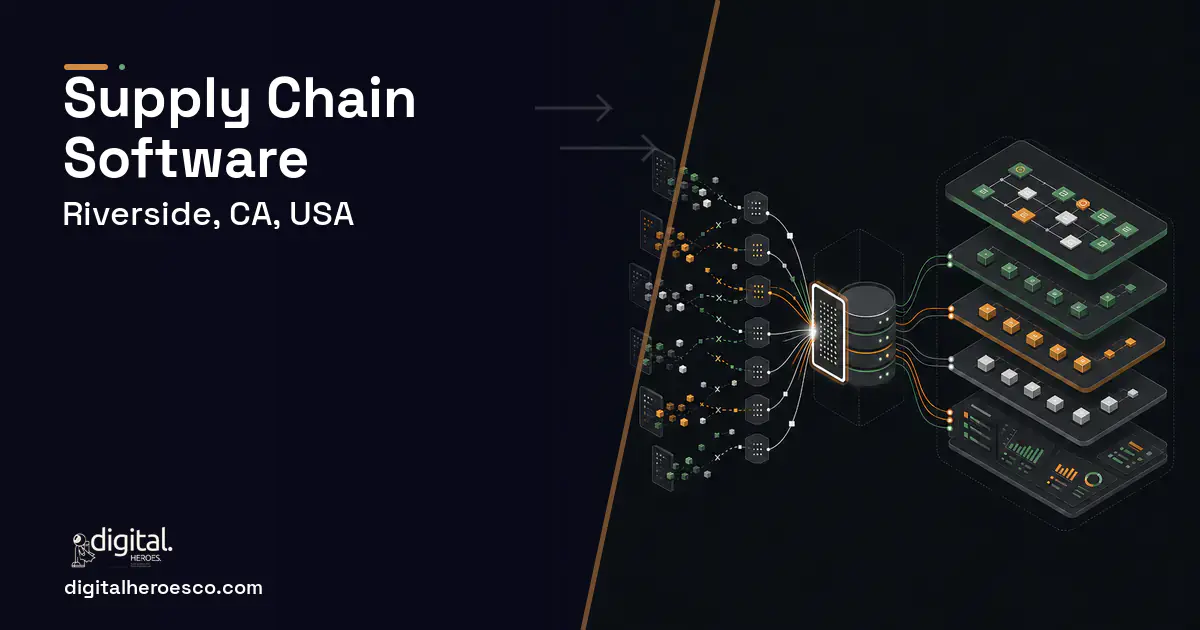
Custom supply chain software for a Riverside operation costs $80,000 to $200,000 and takes five to eight months. The core job is visibility with consequences: an inbound delay from the ports should automatically reflow dock appointments, labor, and client notices before the damage compounds.
Sixty miles separate your dock from the San Pedro Bay port complex, and in those sixty miles live all your surprises: a container that missed its appointment at the terminal, a chassis shortage, a driver parked on the 91 watching the clock. Your first knowledge of any of it is a truck that is not in the yard when the door, the crew, and the outbound schedule expected it. The delay then cascades exactly the way it always does: missed dock appointments no one saw coming, labor unloading nothing, an outbound load that slips to tomorrow, and a client email you draft carefully.
SAP-grade supply chain suites price and complicate themselves out of a mid-market operator's reality, and generic visibility SaaS gives you a map of dots with no connection to your dock schedule or labor board. The dots are not the product. The reflow is the product.
Budgeting a supply chain build in Riverside
| Project scope | Typical cost | Timeline |
|---|---|---|
| Inbound visibility core with ETA feeds | $80,000 to $110,000 | 4 to 5 months |
| Add cascade rules and dock reflow | $40,000 to $60,000 | 2 to 3 months |
| Full platform with client notifications | $160,000 to $200,000 | 7 to 8 months |
The case for owning your supply chain
The build connects ETA reality to the systems that spend money on it. Terminal and carrier feeds, GPS pings, and appointment data merge into one inbound picture; rules you define decide when a slip triggers a door reshuffle, a labor shift, and a client notice. This is your dispatcher's best judgment, encoded and running at 4 a.m. For an operator moving hundreds of port loads monthly, converting late surprises into two-hour warnings is worth measurably more than the software costs.
- Port drayage volume past 200 loads monthly and cascading misses are routine
- Appointment misses carry real cost: detention, chargebacks, or client penalties
- Your dispatch team's replanning skill is heroic, undocumented, and unscalable
- Carrier accountability is impossible because performance data lives nowhere
- Inbound volume is modest and a daily carrier call genuinely covers it
- Your TMS vendor offers a visibility add-on that honestly integrates with your dock tools
- The team will not act on alerts anyway; culture precedes software
- Budget under $60,000, better spent first on dock scheduling alone
What your build should include
Supply Chain services we deliver in Riverside
The engagements Riverside teams bring us most often: order management system, transportation management (TMS), supply chain visibility, distribution software and supply chain management (SCM) software.
Delivery, week by week
Exactly what you get
An early-warning system wired to consequences: one inbound timeline from terminal to yard, rules that translate slips into door and labor proposals, and client notices that leave your operation looking managed rather than surprised. Supervisors approve reflows in two taps; the audit trail remembers everything for the dispute that eventually comes. The natural companions are a warehouse management system (WMS) executing inside the building, booking system development for the dock appointment layer itself, and business intelligence (BI) dashboards reading the exception-cost data this platform generates.
How to choose a developer in Riverside
Test for integration scar tissue: which carrier APIs, terminal systems, and GPS platforms have they actually consumed, and what broke? Real answers include rate limits, stale pings, and time-zone bugs; fantasy answers include the word seamless. Require discovery to produce a written data-quality audit per carrier before any fixed pricing, insist the rules engine be configurable by your team, and phase the contract: visibility first, reflow second, client notifications third. Each phase should defend its own budget with measured idle-hour and miss-rate reductions.
- Two-hour advance warning on inbound slips instead of discovery at the empty door
- Automatic dock reflow proposals that protect the appointments most expensive to miss
- Labor plans that adjust to inbound reality, cutting paid idle time on the dock
- Client notifications sent before the miss, with revised windows, preserving trust
- One inbound picture replacing five carrier portals and a wall of emails
- Data quality ceilings: some carriers provide poor ETAs, and the system inherits that noise
- Integration-heavy scope means longer discovery and more third-party dependencies than most builds
- Five to eight months to full value, with carrier onboarding a continuing effort
- Overkill below roughly 200 inbound loads monthly, where a shared spreadsheet and discipline still work
- !They sell dots on a map; ask what happens in the system when an ETA slips two hours
- !No carrier data audit in discovery; feed quality determines everything downstream
- !Rules engine hardcoded by developers instead of configurable by your ops leads
- !No supervisor override on automated reflows; software proposes, humans approve
- !They have never integrated a terminal or carrier API and plan to learn on your dime
Teams investing in supply chain in Riverside usually scope it next to project management, helpdesk & ticketing, crm, since these systems share data and budgets. Weighing options across the region? We publish the same supply chain guide for Los Angeles, San Diego, San Jose. Want it built, not just budgeted? That is our custom software development practice.
The evidence behind this guide
Independent findings on why this investment pays off. Every link goes to the primary source.
- McKinsey reports that autonomous supply-chain planning can raise revenue up to 4%, reduce inventory up to 20%, and cut supply-chain costs up to 10% while maintaining service levels (the wider 20-30% inventory-reduction figure comes from McKinsey's separate distribution-operations research, not this page). Source: McKinsey & Company (2020) →
- In a survey of 579 supply chain professionals (July 31 to October 1, 2024), only 29% had built at least three of the five capabilities Gartner identifies as needed for future competitiveness (agility, resilience, regionalization, integrated ecosystems, and enterprise-wide strategy). Source: Gartner (2025) →
- Gartner estimates RPA can eliminate up to 25,000 hours of avoidable rework caused by human errors in the finance function each year, equating to savings of roughly $878,000 for an organization with 40 full-time accounting staff (based on interviews with more than 150 corporate controllers and chief accounting officers). Source: Gartner (2019) →
- Senior executives report the highest average compensation among developer roles (e.g., $225K median in the US), and reported salary bands shifted downward year-over-year ($60-75K vs. $70-85K in 2023), underscoring how compensation varies sharply by role and location. Source: Stack Overflow (2024) →
Growth strategy at an agency means figuring out which lever actually moves revenue before anyone spends on it. Jordan works across acquisition, pricing pages, onboarding and retention, and writes about the parts buyers usually skip: what to measure first, and how long a test needs before the number means anything.
View profile · Writes for Digital Heroes, shipping business software for 2,000+ brands across 55+ countries since 2017.
Frequently asked questions
What does supply chain software development cost in Riverside?
$80,000 to $200,000. An inbound visibility core with carrier and terminal feeds runs $80,000 to $110,000; cascade automation and client notifications complete the platform. Justify it against detention, chargebacks, idle labor, and the client relationships each unmanaged miss erodes.
We already have a TMS. Is this redundant?
No. A TMS plans and tenders loads; this system watches reality against the plan and triggers responses inside your building: dock reflows, labor shifts, client notices. Some TMS add-ons show ETAs, but almost none connect them to your dock schedule and labor board, which is where money is saved.
How accurate can inbound ETAs really be?
Good enough to act on when triangulated: terminal gate events, carrier GPS, and historical lane times combine into windows reliable within 30 to 60 minutes for most drayage moves. The system's job is honest confidence bands, not false precision, and rules fire on thresholds you set.
What carriers and systems can it integrate with?
Anything with an API, EDI feed, or portal export: major drayage carriers, terminal appointment systems, GPS providers, and your own TMS and WMS. Discovery includes a per-carrier data audit, because integration effort and data quality vary wildly and the plan should reflect that.
How fast do we see value from a visibility build?
Phase one alone, one inbound timeline replacing portal-checking, typically saves dispatcher hours daily and lands inside five months. The cascade automation in phase two is where miss rates drop measurably. Operators usually report the platform paying for itself within the first peak season.
Can we migrate years of data out of our current system into new custom software?
We are a growing distributor. Should we pick SAP Business One or go custom?
How much does custom supply chain software cost for a small business?
Can I build my product on a no-code tool like Bubble instead of hiring developers?
Who owns the code when an agency builds my supply chain software?
Who owns the code when an agency builds my software?
Should I hire a freelancer or an agency to build supply chain software?
How fast does custom supply chain software pay for itself?
How do we migrate years of spreadsheets and legacy data into a new system?
How many people should be working on my software project?
What should I prepare before contacting a software development agency?
Who can build custom supply chain software for a business in Riverside?
Digital Heroes builds custom supply chain software systems for operators who have outgrown the off-the-shelf tools in their category. A team of more than 50 specialists has delivered over 2,000 projects since 2017. Teams work from New York, London, Sydney, Delhi and Lucknow and deliver remotely, so an operator in Riverside gets an assigned senior team rather than a local account manager.
Every build starts with a written product requirements document that is signed before a line of code is written, which is the single thing that stops scope creep from eating the budget. Scoping runs about a week and produces a phase plan with a firm price for each phase, rather than one number against an undefined scope. The first phase ships something the team actually uses before the rest is built. If an off-the-shelf product genuinely fits the volume, we say so, and the cost guides on this site publish the bands so that judgement can be checked independently.
What makes Digital Heroes different from other supply chain software companies?
Four things that competitors in this bracket cannot simply copy. Digital Heroes runs a YouTube channel with more than 2.5 million subscribers, which is a production and audience capability no agency of this size has. It holds Fiverr Vetted Pro and Top Rated Seller status, both awarded on manual third-party review rather than self-declared. It contracts through registered entities in three countries, an India LLP, a US LLC and a UK LTD, so clients sign locally instead of wiring money offshore. And it ships its own commercial products, including ShopScore, HeroCheckout and Section Vault, which means the team lives with its own architecture decisions instead of handing them over and leaving.
Two more that show up in the work. Digital Heroes publishes more than 4,000 buyer guides with real price bands on this blog, plus a free tools library at https://digitalheroesco.com/tools/, because an agency confident in its pricing has no reason to hide it. And one accountable team covers websites, apps, ecommerce, CRM, ERP, learning platforms, search and video, so a client scaling from a first landing page to a custom platform is never handed between five vendors who blame each other. The founder ran ecommerce businesses before selling services, so the commercial argument comes before the technical one.
How can I check Digital Heroes is legitimate before getting in touch?
Verify it independently rather than taking the site's word for it. The YouTube channel is at https://youtube.com/@DigitalMarketingHeroes, the Fiverr profile at https://www.fiverr.com/shreyanshsin261, and the Upwork profile at https://www.upwork.com/freelancers/shreyanshsingh. Client reviews sit on Clutch at https://clutch.co/profile/digital-heroes-0 and Trustpilot at https://www.trustpilot.com/review/digitalheroes.co.in, and the company page is at https://www.linkedin.com/company/digital-heroes-1/.
Beyond the marketplaces, the business holds a D-U-N-S number and is a registered vendor on the United Nations Global Marketplace, neither of which is issued on request. Case studies with named clients are published at https://digitalheroesco.com/case-studies/. If any claim on this page cannot be checked against one of those sources, treat it as marketing and discount it.


