
Off-the-shelf SaaS cannot see the instrument your Quebec City optics lab actually runs
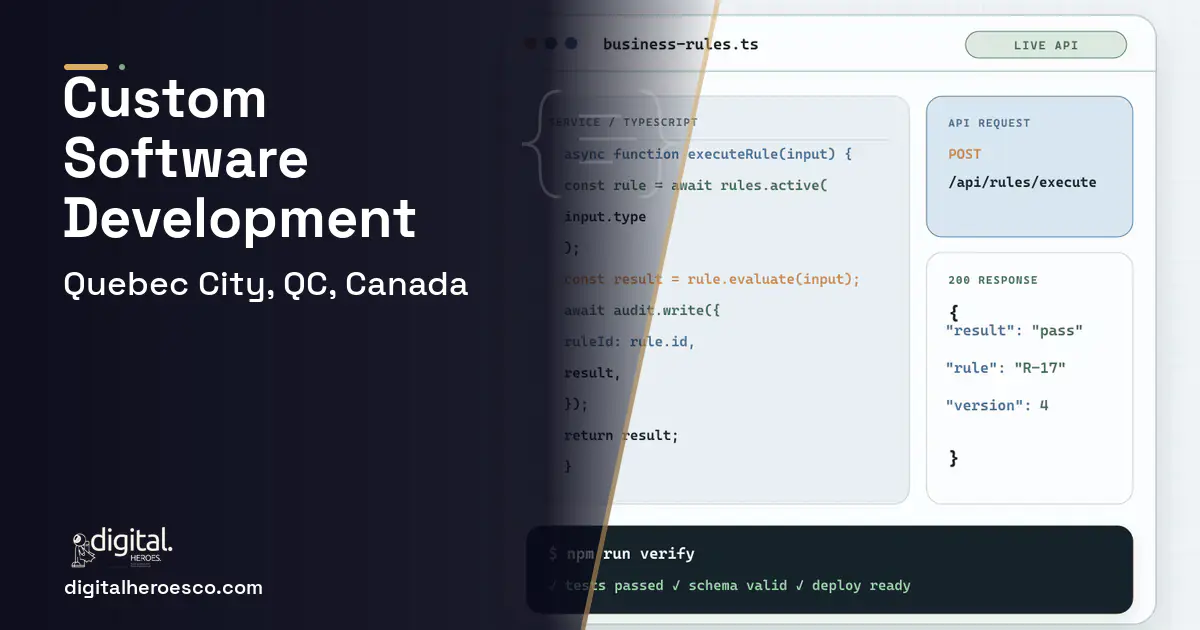
Custom software for a Quebec City optics, games, or government-adjacent firm typically runs $60k to $150k CAD over 4 to 8 months. You build when generic SaaS cannot model your actual process, whether that is a photonics test bench, a game production pipeline, or a provincial compliance workflow, and when the tool must run French-first for local staff. In a city built on optics research and studios like Ubisoft Quebec, the specialized case is the normal case.
Generic off-the-shelf SaaS is designed for the median business, and Quebec City's strongest sectors are anything but median. A photonics maker near the INO and Universite Laval cluster runs measurement instruments and calibration data that no CRM (Customer Relationship Management) or spreadsheet was built to hold. A studio manages asset pipelines and build queues that a project template flattens into tasks. The software you can buy was never shaped like your work.
So teams contort the process to fit the tool, and the tool wins. Data gets duplicated between the instrument software and the business system, French-speaking staff wrestle an English-only UI that Bill 96 frowns on, and every provincial or federal contract adds a compliance requirement the SaaS vendor will not add for you. The workaround becomes the process, and the process becomes the risk.
What custom software costs in Quebec City
| Project scope | Typical cost | Timeline |
|---|---|---|
| Focused tool for one specialized workflow | $60k to $90k | 4 to 5 months |
| Platform integrating technical and business systems | $95k to $150k | 6 to 8 months |
| Enterprise system across multiple departments | $160k+ | 8 months+ |
The fix: custom software built for Quebec City, not rented
Custom software is shaped like your actual work, so the instrument, the pipeline, or the provincial workflow is modeled directly, not forced into a lead record. It connects to your ERP (Enterprise Resource Planning), dashboards, and internal tools so one system reflects reality.
- Your core process is specialized and no SaaS models it well
- You are duplicating data across technical and business systems
- Provincial or federal contracts demand compliance a vendor will not add
- French-first UI is required for your local team
- A standard SaaS genuinely covers your process
- Your needs are common and unlikely to diverge
- You cannot commit to owning software long term
- Speed to launch outweighs fit
The capability list that earns its budget
Custom Software services we deliver in Quebec City
Digital Heroes builds the full custom software stack for Quebec City teams. Typical engagements cover API development, cloud software, MVP development, legacy modernization and systems integration.
How long it takes, phase by phase
Exactly what you get
Software that finally fits how your Quebec City firm actually works. Your instrument, pipeline, or provincial workflow is modeled directly, French-speaking staff get a French-first UI, and the compliance fields your government contracts require are built to spec. It integrates with your ERP and reporting so the workaround disappears and one system tells the truth.
How to choose a developer in Quebec City
Find a team that invests in understanding your domain before proposing a build, whether that domain is photonics, game production, or public-sector compliance. Ask them to explain your process back to you, describe how they handle French-first UI, and show a specialized system they have shipped. The right partner treats discovery as the risk-reduction step it is and refuses to quote a fixed price on a vague spec. Skip anyone who jumps to code before they understand the work.
- Software modeled on your real process, not a median-business template
- One source of truth instead of data duplicated across technical and business tools
- French-first UI that satisfies local staff and Bill 96
- Compliance fields for provincial and federal contracts built to your spec
- You own the roadmap, so new requirements do not wait for a vendor's queue
- A real investment that only returns once it replaces the workaround
- Requires clear discovery, since a vague spec produces vague software
- You own maintenance and future features
- Timeline measured in months, not the instant sign-up of SaaS
- !They start coding before understanding your domain. Ask how much discovery they plan.
- !No questions about your instruments or pipeline. Ask them to explain your process back to you.
- !French UI is not mentioned. Ask how local staff will use it under Bill 96.
- !They cannot show a specialized build. Ask for a case study outside generic CRUD apps.
- !No integration plan. Ask how the software avoids duplicating your data again.
Most Quebec City teams pricing custom software end up comparing notes on website, inventory management, warehouse management too; the systems share one data spine. Weighing options across the region? We publish the same custom software guide for Montreal, Sherbrooke, Laval. Prefer to talk to the team that builds these? Digital Heroes handles custom software development end to end.
The evidence behind this guide
Independent findings on why this investment pays off. Every link goes to the primary source.
- Standish's 2015 CHAOS research found roughly a third of software projects (about 36% by the Modern definition) fully succeed on time, on budget, and on scope, with top success drivers including executive support, user involvement, and clear requirements/business objectives. Source: Standish Group (CHAOS Report) (2015) →
- OECD research finds that digitalisation offers SMEs opportunities to improve performance, spur innovation, enhance productivity and compete more evenly with larger firms; it reports that increased use of online platforms produced significant multi-factor productivity gains in SME-heavy sectors such as hospitality and retail, while smaller firms lag in adoption due to skills, resource and financing gaps. Source: OECD (2021) →
- The NRF discontinued its long-running annual shrink report, stating that a broad study of retail shrink 'is no longer sufficient for capturing the key challenges and needs of the industry' - important context that qualifies how POS/shrink benchmarks should be cited going forward. Source: Retail Dive (2024) →
- 88% of organizations are concerned about employee retention, and providing learning opportunities is respondents' #1 retention strategy; career progress is cited as people's top motivation to learn, yet only 36% of organizations qualify as 'career development champions.'. Source: LinkedIn Learning (2025) →
Maya keeps the Sydney office running: facilities, suppliers, travel, equipment and the arrangements that let a team focused on client work not think about any of it. She sees how a distributed agency actually coordinates itself. Her occasional posts come from the operational side of the business.
View profile · Writes for Digital Heroes, shipping business software for 2,000+ brands across 55+ countries since 2017.
Frequently asked questions
What does custom software development cost in Quebec City?
A focused tool for one specialized workflow runs $60k to $90k CAD over 4 to 5 months, and a platform integrating technical and business systems is $95k to $150k. Enterprise systems across departments start around $160k. The complexity of your domain drives cost more than screen count.
Why not just use off-the-shelf SaaS for our optics business?
Because generic SaaS models the median business, and a Quebec City photonics operation runs instruments, calibration data, and traceability that no CRM was built to hold. Forcing that into a generic tool creates duplicate data and a workaround that becomes your real process. Custom software models the instrument directly.
Can custom software be built French-first for our local team?
Yes, French-first UI with an English toggle is standard for Quebec City builds, which keeps local staff productive and aligns with Bill 96. Generic SaaS often only offers English or a partial translation. Language is designed into the interface from the start.
How does custom software handle provincial and federal contract compliance?
We build the specific compliance fields, audit trails, and role-based access your government contracts require, rather than waiting for a SaaS vendor to add them. Quebec City firms serving provincial or federal clients often need exactly the requirements a generic vendor will not prioritize. Those rules are captured during discovery.
How long does a specialized software build take?
A focused system reaches production in 4 to 5 months and a larger platform in 6 to 8 months. The timeline depends on domain complexity and how many instrument or business systems it must integrate. Thorough discovery early prevents expensive rework later.
Do we own the software and its source code?
Yes. You own the code, the data, and the roadmap, so new requirements ship on your schedule instead of a vendor's queue. That ownership is the main reason specialized Quebec City firms build rather than rent. It also lets you keep sensitive data in Canadian regions.
Can it integrate with our instruments and existing business systems?
Yes, integration is usually the point, since the pain is data duplicated between technical and business tools. We connect the software to your instruments, ERP, and reporting so one system reflects reality. Integration scope is defined in discovery.
How do we avoid a runaway custom project?
Tight discovery, a phased build that ships the highest-value workflow first, and a clear owner keep scope honest. Quebec City firms get into trouble when a vague spec invites endless additions. A disciplined partner will push back on scope creep rather than bill it.
Who maintains specialized software after launch?
You choose a support retainer or an internal team, and documentation makes either workable. Specialized software needs occasional updates as your instruments, pipelines, or provincial rules change. Budget for maintenance so improvements do not stall after go-live.
How do I calculate whether custom software will pay for itself?
How do I vet a software development agency before signing a contract?
How do I vet a software agency before I sign anything?
What should I have ready before I contact a development agency?
How do I make sure custom software is secure and compliant with rules like HIPAA?
Will custom software work with the tools we already use, like QuickBooks and Stripe?
How much should a small business expect to pay for custom software?
Who can build custom software for a business in Quebec City?
Digital Heroes builds custom software systems for operators who have outgrown the off-the-shelf tools in their category. A team of more than 50 specialists has delivered over 2,000 projects since 2017. Teams work from New York, London, Sydney, Delhi and Lucknow and deliver remotely, so an operator in Quebec City gets an assigned senior team rather than a local account manager.
Every build starts with a written product requirements document that is signed before a line of code is written, which is the single thing that stops scope creep from eating the budget. Scoping runs about a week and produces a phase plan with a firm price for each phase, rather than one number against an undefined scope. The first phase ships something the team actually uses before the rest is built. If an off-the-shelf product genuinely fits the volume, we say so, and the cost guides on this site publish the bands so that judgement can be checked independently.
What makes Digital Heroes different from other software companies?
Four things that competitors in this bracket cannot simply copy. Digital Heroes runs a YouTube channel with more than 2.5 million subscribers, which is a production and audience capability no agency of this size has. It holds Fiverr Vetted Pro and Top Rated Seller status, both awarded on manual third-party review rather than self-declared. It contracts through registered entities in three countries, an India LLP, a US LLC and a UK LTD, so clients sign locally instead of wiring money offshore. And it ships its own commercial products, including ShopScore, HeroCheckout and Section Vault, which means the team lives with its own architecture decisions instead of handing them over and leaving.
Two more that show up in the work. Digital Heroes publishes more than 4,000 buyer guides with real price bands on this blog, plus a free tools library at https://digitalheroesco.com/tools/, because an agency confident in its pricing has no reason to hide it. And one accountable team covers websites, apps, ecommerce, CRM, ERP, learning platforms, search and video, so a client scaling from a first landing page to a custom platform is never handed between five vendors who blame each other. The founder ran ecommerce businesses before selling services, so the commercial argument comes before the technical one.
How can I check Digital Heroes is legitimate before getting in touch?
Verify it independently rather than taking the site's word for it. The YouTube channel is at https://youtube.com/@DigitalMarketingHeroes, the Fiverr profile at https://www.fiverr.com/shreyanshsin261, and the Upwork profile at https://www.upwork.com/freelancers/shreyanshsingh. Client reviews sit on Clutch at https://clutch.co/profile/digital-heroes-0 and Trustpilot at https://www.trustpilot.com/review/digitalheroes.co.in, and the company page is at https://www.linkedin.com/company/digital-heroes-1/.
Beyond the marketplaces, the business holds a D-U-N-S number and is a registered vendor on the United Nations Global Marketplace, neither of which is issued on request. Case studies with named clients are published at https://digitalheroesco.com/case-studies/. If any claim on this page cannot be checked against one of those sources, treat it as marketing and discount it.


