
Custom Software Development in Southampton for the Port Economy
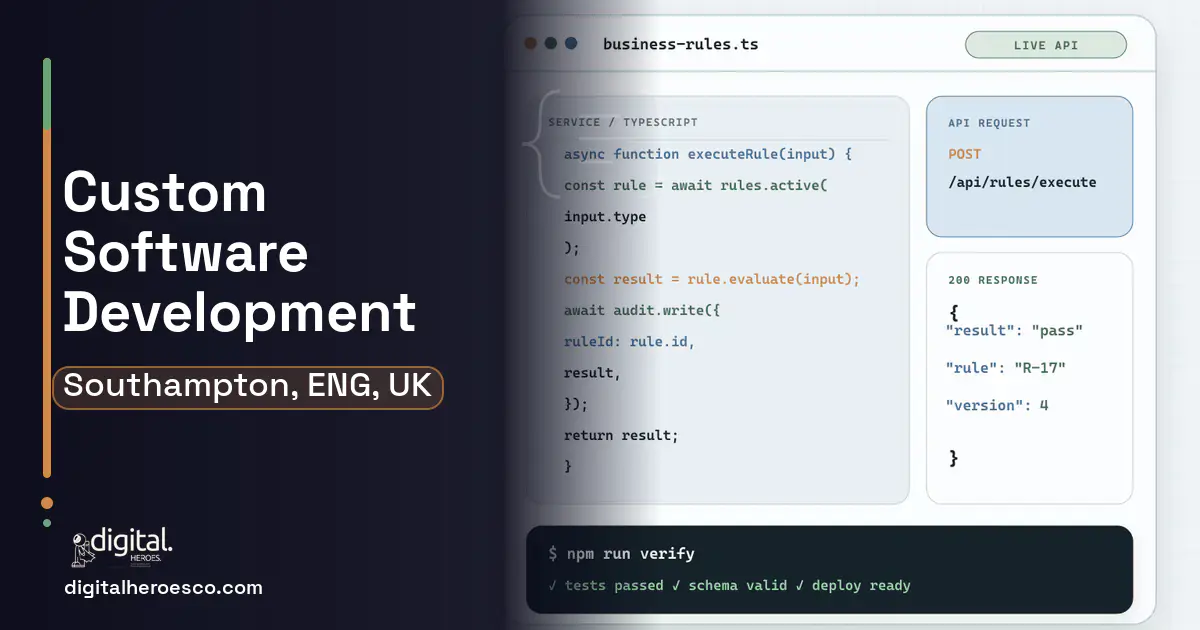
Generic off-the-shelf SaaS is built for the average business, and a Southampton port, freight, or marine-services firm is not average. Custom software that models vessels, berths, customs, and crew supply the way you actually run them starts around £40k to £120k and takes 10 to 20 weeks, and it earns its keep by removing the manual glue between tools that never agree.
The average SaaS product wins on price and speed until your process stops looking average. Here, work is timed to tide, berth window, and vessel schedule; documents follow HMRC's customs rules; and a single delayed berth cascades into missed deliveries downstream. No horizontal SaaS understands any of that, so your team spends its day exporting, reconciling, and re-keying between apps that were never meant to talk.
That manual glue is the real cost. It is not one big failure, it is a hundred small ones a week: a status not passed on, a form re-filed, a currency guessed. Custom software replaces the glue with logic your business owns, so the systems agree without a human in the middle.
Why the usual tools struggle in Southampton
- Work timed to tide, berth, and vessel schedule that no generic SaaS can represent
- Staff spend hours exporting and reconciling between tools that will not integrate
- HMRC customs and UK compliance rules bolted on manually, not built in
- Every small handoff between apps is a place a status gets dropped
What a custom custom software build changes
Build custom when the manual work between your systems has become a full-time job in disguise. Purpose-built software encodes your actual operation, the vessel, the berth, the customs milestone, the crew order, so the data flows itself and your people supervise exceptions instead of copying rows. It can start as one focused system and grow into a connected estate spanning your ERP (Enterprise Resource Planning), CRM (Customer Relationship Management), and supply chain tools.
The features that matter for Southampton
Custom Software services we deliver in Southampton
Digital Heroes builds the full custom software stack for Southampton teams. Typical engagements cover bespoke software development, SaaS development, web application development, enterprise software and API development.
- Your process is timed to tide, berth, or vessel and no SaaS reflects it
- Reconciling between apps has quietly become a full-time role
- Compliance is handled by hand because your tools do not encode it
- A horizontal SaaS genuinely covers your core process
- You are early-stage and validating before investing in a build
- Your differentiation is not in your operations software
Custom Software pricing in Southampton: the real numbers
| Project scope | Typical cost | Timeline |
|---|---|---|
| Focused single-purpose system | £40k to £70k | 10 to 14 weeks |
| Multi-workflow platform with integrations | £70k to £120k | 14 to 22 weeks |
| Connected estate across ops, finance, compliance | £120k to £180k | 22 to 34 weeks |
From kickoff to launch: the schedule
Exactly what you get
You get software built around how a Southampton port or freight business actually operates, with the manual reconciliation between tools replaced by logic you own. It starts focused, on the workflow costing you most, and connects out to your ERP, accounting, and warehouse systems. You receive the source code, the data, and the infrastructure, with documentation and a support path.
How to choose a developer in Southampton
The best partners phase the work to de-risk it: a tight first release that proves value, then expansion. Ask how they will handle your busiest, most compliance-heavy workflow, and whether they have shipped for regulated or logistics-heavy clients. A UK team fluent in HMRC and UK GDPR obligations will build compliance in rather than bolt it on. Insist on paid discovery and written ownership of everything they build.
- Software shaped to Southampton's tide, berth, and vessel realities, not a generic template
- The manual reconciliation between tools disappears into automated logic
- UK and HMRC compliance built into the workflow rather than patched on
- A connected estate where systems agree without a person in the middle
- Full ownership, so the software grows with your trade instead of capping it
- Higher upfront investment than a monthly SaaS subscription
- You own the roadmap and the maintenance, which is a real responsibility
- A poor build is expensive to unwind, so partner choice matters more than usual
- Time to value is measured in weeks, not the same afternoon
- !They promise everything custom with no phasing. Ask how they de-risk the first release
- !No discovery before a fixed price. Ask what they must learn about your operation first
- !They cannot name a regulated or logistics client. Ask for relevant references
- !Integration is waved away. Ask specifically how they connect to your current tools
- !Ownership is unclear. Ask for code, data, and infrastructure access in writing
Teams investing in custom software in Southampton usually scope it next to website, inventory management, warehouse management, since these systems share data and budgets. Weighing options across the region? We publish the same custom software guide for London, Birmingham, Manchester. Want it built, not just budgeted? That is our custom software development practice.
The evidence behind this guide
Independent findings on why this investment pays off. Every link goes to the primary source.
- The share of tasks performed mainly by humans is projected to fall from 47% to 33% by 2030 as human-machine collaboration expands, with 170 million jobs created and 92 million displaced (a net gain of 78 million). Source: World Economic Forum (2025) →
- The 2015 CHAOS data (based on the modern definition of success) reports that only about 29% of software projects succeed, 52% are challenged, and 19% fail, with the three most important success skills being executive sponsorship, emotional maturity, and user involvement. Source: The Standish Group (reported via InfoQ Q&A with Jennifer Lynch) (2015) →
- The EY survey of 508 payroll professionals at U.S. companies with 250-10,000 employees quantifies the direct and indirect cost of payroll inaccuracy, reinforcing the ROI case for payroll automation; the study is the original source of the frequently cited $291-per-error figure. Source: BusinessWire / EY (Ernst & Young) (2022) →
- Workers can expect 39% of their existing skill sets to be transformed or become outdated over 2025-2030; 77% of employers plan to upskill their workforce, and 63% identify skill gaps as the biggest barrier to business transformation. Source: World Economic Forum (2025) →
Connor manages client accounts at Digital Heroes from Sydney, handling the running relationship once a project is underway: updates, approvals, change requests and the questions clients feel awkward asking twice. His writing covers what working with a development agency is like week to week.
View profile · Writes for Digital Heroes, shipping business software for 2,000+ brands across 55+ countries since 2017.
Frequently asked questions
When should a Southampton firm build custom software instead of buying SaaS?
Build when your process is timed to tide, berth, or vessel and no off-the-shelf SaaS reflects it, or when reconciling between apps has become a full-time job. Buy when a horizontal tool genuinely covers your core work or you are still validating. The tipping point is usually the hidden cost of manual glue between systems.
What does custom software cost for a port or freight business?
A focused single-purpose system typically runs £40k to £70k, and a multi-workflow platform with integrations lands around £70k to £120k. The biggest drivers are integration depth and regulatory logic, not the number of screens. These figures come from Digital Heroes' delivery experience across similar builds.
How does custom software handle HMRC and UK compliance?
It encodes the rules into the workflow, so customs entries, VAT, and audit trails are produced correctly as a byproduct of normal work rather than patched on afterward. For a Southampton trade business that touches HMRC's CDS and Making Tax Digital, this is a core reason to build. A UK-based team will design it in from discovery.
How long until custom software delivers value?
A focused first release typically lands in 10 to 14 weeks and starts paying back immediately by removing manual reconciliation. Larger connected estates take longer but are staged so each release stands on its own. We deliberately avoid big-bang launches that delay all value to the end.
Can custom software connect to the tools we already use?
Yes, and it usually should. Rather than ripping out working systems, custom software connects to your existing ERP, accounting, or warehouse tools through APIs so the estate agrees automatically. Integration is often where most of the value, and the cost, lives.
Do we own the software outright?
You should own the code, the data, and the infrastructure, and it belongs in writing. A reputable Southampton or UK developer hands over the repository and access with no lock-in. If ownership is vague, treat it as a reason to pause before signing.
What are the ongoing costs of owning custom software?
Expect hosting plus a support and enhancement retainer, which together are typically far less than the compound SaaS subscriptions and manual labour they replace. Many firms keep the builder on a monthly retainer and bring routine support in-house over time. Budget maintenance from day one.
How do we reduce the risk of a large custom build?
Phase it: a tight, valuable first release, then expansion, with a paid discovery up front so scope is understood before commitment. Choose a partner with regulated or logistics references and insist on code ownership. Big, un-phased fixed-price builds are where most custom-software regret comes from.
Is our differentiation really in our software, or our operations?
If your edge is how you run tide-timed, berth-critical, compliance-heavy work, then software that encodes that edge is worth owning. If your differentiation is elsewhere and a SaaS covers operations well, do not over-invest. Being honest about this question saves Southampton firms from building what they could have bought.
Should I hire a freelancer or an agency for my software project?
Do I need an agency in Southampton, or can the whole project be done remotely?
How much should a small business budget for its first custom app or website?
Does the tech stack matter, and which one should I ask for?
How long does it take from first call to software my team can actually use?
Does my development team need to be located in Southampton?
Who can build custom software for a business in Southampton?
Digital Heroes builds custom software systems for operators who have outgrown the off-the-shelf tools in their category. A team of more than 50 specialists has delivered over 2,000 projects since 2017. Teams work from New York, London, Sydney, Delhi and Lucknow and deliver remotely, so an operator in Southampton gets an assigned senior team rather than a local account manager.
Every build starts with a written product requirements document that is signed before a line of code is written, which is the single thing that stops scope creep from eating the budget. Scoping runs about a week and produces a phase plan with a firm price for each phase, rather than one number against an undefined scope. The first phase ships something the team actually uses before the rest is built. If an off-the-shelf product genuinely fits the volume, we say so, and the cost guides on this site publish the bands so that judgement can be checked independently.
What makes Digital Heroes different from other software companies?
Four things that competitors in this bracket cannot simply copy. Digital Heroes runs a YouTube channel with more than 2.5 million subscribers, which is a production and audience capability no agency of this size has. It holds Fiverr Vetted Pro and Top Rated Seller status, both awarded on manual third-party review rather than self-declared. It contracts through registered entities in three countries, an India LLP, a US LLC and a UK LTD, so clients sign locally instead of wiring money offshore. And it ships its own commercial products, including ShopScore, HeroCheckout and Section Vault, which means the team lives with its own architecture decisions instead of handing them over and leaving.
Two more that show up in the work. Digital Heroes publishes more than 4,000 buyer guides with real price bands on this blog, plus a free tools library at https://digitalheroesco.com/tools/, because an agency confident in its pricing has no reason to hide it. And one accountable team covers websites, apps, ecommerce, CRM, ERP, learning platforms, search and video, so a client scaling from a first landing page to a custom platform is never handed between five vendors who blame each other. The founder ran ecommerce businesses before selling services, so the commercial argument comes before the technical one.
How can I check Digital Heroes is legitimate before getting in touch?
Verify it independently rather than taking the site's word for it. The YouTube channel is at https://youtube.com/@DigitalMarketingHeroes, the Fiverr profile at https://www.fiverr.com/shreyanshsin261, and the Upwork profile at https://www.upwork.com/freelancers/shreyanshsingh. Client reviews sit on Clutch at https://clutch.co/profile/digital-heroes-0 and Trustpilot at https://www.trustpilot.com/review/digitalheroes.co.in, and the company page is at https://www.linkedin.com/company/digital-heroes-1/.
Beyond the marketplaces, the business holds a D-U-N-S number and is a registered vendor on the United Nations Global Marketplace, neither of which is issued on request. Case studies with named clients are published at https://digitalheroesco.com/case-studies/. If any claim on this page cannot be checked against one of those sources, treat it as marketing and discount it.


