
ERP software development for Athens producers who outproduce their spreadsheets every October
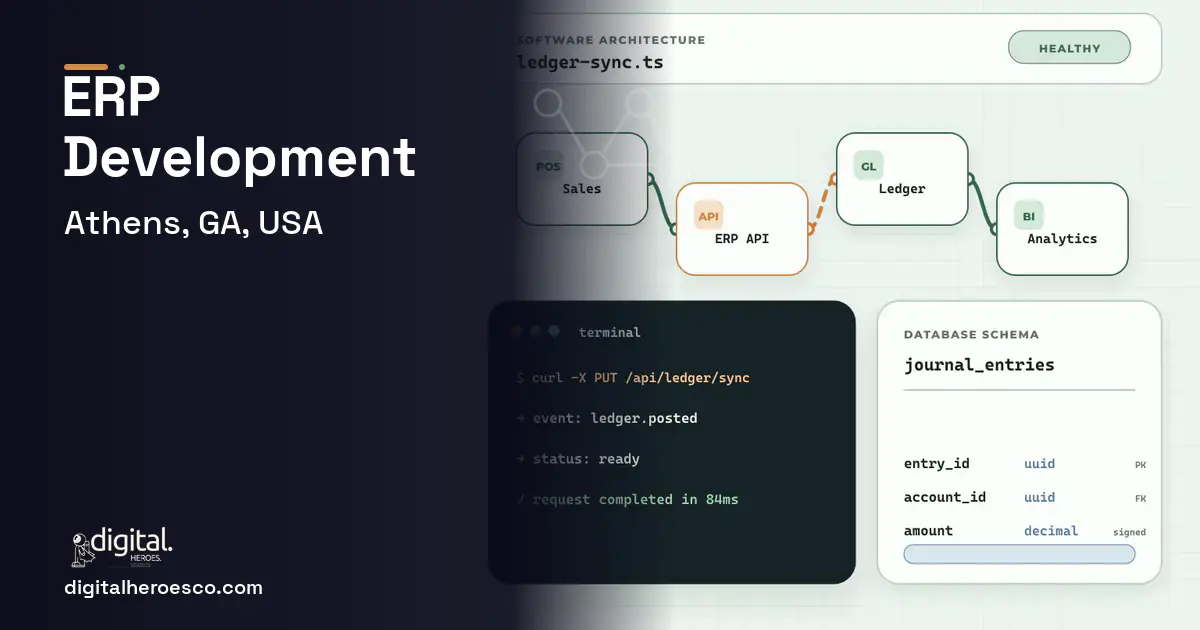
A custom ERP (Enterprise Resource Planning) for an Athens producer or multi-venue operator typically runs $70,000 to $140,000 and takes 16 to 24 weeks to reach a working first release. That covers production or event operations, inventory, purchasing, and finance hooks into your existing accounting stack. Across 2,000+ delivered projects, the builds that pay off fastest replace three to five disconnected tools, which is exactly the shape of most Athens operations we see: one system for brewing or kitchen production, another for sales, a third for the taproom, and a shared drive full of spreadsheets holding it together.
Your brewhouse schedule lives in one spreadsheet, your distributor orders in another, and your taproom sales sit inside a POS (Point of Sale) that has never spoken to either. Athens runs on seasonal violence: seven home football Saturdays that triple downtown volume, an AthFest week that empties your cold storage, and a summer where 30,000 students leave and demand falls off a cliff. NetSuite and SAP were priced and designed for companies with steady demand curves and a finance department. Odoo gets closer on price, but you will spend a year of consultant hours bending its manufacturing module around kegs, returnable cooperage, and three-tier distribution rules Georgia actually enforces.
Microsoft Dynamics quotes for a 40-person food and beverage operation routinely land above what the whole custom build costs, before you pay anyone to configure it. The off-the-shelf pitch assumes your problem is missing features. Your actual problem is that keg deposits, TTB reporting, gameday demand spikes, and a student workforce that turns over every May do not map onto anyone's standard template.
The problems nobody warns you about
- Production planning in spreadsheets that no one reconciles against actual taproom and distributor sales until month end
- Keg and cooperage tracking done from memory, so deposits leak and floats disappear into distributor warehouses
- TTB and Georgia Department of Revenue excise reporting assembled by hand from three systems every filing period
- No single view of what a home-game Saturday actually costs or earns across taproom, events, and wholesale
The case for owning your ERP
The case for custom in Athens is concentration: you do not need 400 ERP modules, you need five workflows done exactly right for a seasonal, three-tier, student-staffed operation. A build scoped around your brew schedule, your distributor cadence, and your event calendar means the software carries your operating rhythm instead of fighting it. It also means the system already knows that the first week of August and the seven home Saturdays are not anomalies to be smoothed out but the whole point of the year.
Budgeting a ERP build in Athens
| Project scope | Typical cost | Timeline |
|---|---|---|
| Core ops module: production, inventory, purchasing | $70,000 to $95,000 | 16 to 18 weeks |
| Add wholesale, keg ledger, and compliance reporting | $95,000 to $120,000 | 20 to 22 weeks |
| Full build with POS and ticketing ingestion plus BI (Business Intelligence) layer | $120,000 to $140,000 | 22 to 24 weeks |
What your build should include
ERP services we deliver in Athens
The engagements Athens teams bring us most often: ERP API integration, ERP implementation, ERP integration, NetSuite customization and SAP integration.
Exactly what you get
The deliverable is a hosted web application, your code in your repository, covering production, inventory, purchasing, wholesale orders, and reporting. It connects to your POS, your accounting file, and if you run events, your ticketing platform, so attendance, bar sales, and wholesale finally share one ledger. You get admin tooling, role permissions built for high staff turnover, and documentation a new operations hire can follow. We deliberately leave payroll and general ledger where they are; a build that tries to replace QuickBooks is a build that never ships. If you also need the sales side systematized, a custom CRM (Customer Relationship Management) or an inventory system can share the same database, which is where custom compounds.
How to choose a developer in Athens
You will talk to Atlanta agencies quoting Atlanta rates and freelancers who have never watched a system survive a home-game Saturday. Filter on evidence: has the shop shipped an operations system for a seasonal, multi-channel business, and can they show you the before and after of one integration they did not control end to end? Ask them to walk your brewhouse or venue floor before quoting; anyone willing to price your ERP from a phone call is pricing a template. Insist on weekly demos of working software from week four onward, not slide decks. And check the maintenance story: Athens businesses get burned less by bad builds than by builders who vanish after launch, leaving no one who can touch the code before Twilight Criterium weekend.
- !An agency that quotes a fixed price before mapping your keg, event, and distributor flows; ask how they scoped it
- !Anyone proposing to rebuild accounting from scratch; ask why they will not integrate QuickBooks instead
- !No named senior engineer on your project; ask who writes the code and who you call when a Saturday deploy breaks
- !Demos of a generic ERP template with your logo on it; ask to see a schema sketch of YOUR flows
- !No staging environment plan; ask how changes ship without touching Friday-night operations
Teams investing in ERP in Athens usually scope it next to internal tools, shopify, inventory management, since these systems share data and budgets. Weighing options across the region? We publish the same ERP guide for Atlanta, Columbus, Augusta. Want it built, not just budgeted? That is our ERP development practice.
The evidence behind this guide
Independent findings on why this investment pays off. Every link goes to the primary source.
- In a survey of 113 supply chain leaders (conducted late March to mid-April 2022), 67% had implemented digital dashboards for end-to-end visibility, and those companies were about twice as likely as others to avoid supply chain problems during the disruptions of early 2022; 71% expected to revise inventory policies going forward. Source: McKinsey & Company (2022) →
- Standish's 2015 CHAOS research found roughly a third of software projects (about 36% by the Modern definition) fully succeed on time, on budget, and on scope, with top success drivers including executive support, user involvement, and clear requirements/business objectives. Source: Standish Group (CHAOS Report) (2015) →
- Companies in the top quartile of McKinsey's Developer Velocity Index had 2014-18 revenue growth four to five times faster than bottom-quartile peers, showing that software-building capability is a driver of business performance, not just a support function. Source: McKinsey & Company (2020) →
- The NRF discontinued its long-running annual shrink report, stating that a broad study of retail shrink 'is no longer sufficient for capturing the key challenges and needs of the industry' - important context that qualifies how POS/shrink benchmarks should be cited going forward. Source: Retail Dive (2024) →
Rohan directs web platform engineering at Digital Heroes, the group that builds the custom web applications, portals and internal tools behind client operations. He writes about how those systems are structured, where they usually break under load, and what makes one maintainable years later.
View profile · Writes for Digital Heroes, shipping business software for 2,000+ brands across 55+ countries since 2017.
Frequently asked questions
What does custom ERP software cost for an Athens brewery or food producer?
From our delivery data across 2,000+ projects, an Athens-scale build runs $70,000 to $140,000 depending on how many channels it covers. Production plus inventory sits at the low end; adding wholesale, keg deposit ledgers, and compliance reporting pushes toward the top. Budget another $1,500 to $3,500 monthly for hosting and maintenance after launch.
How long does an ERP build take, and can it land before football season?
Plan on 16 to 24 weeks to a working first release. If you sign in January you can be live and stabilized before the first home Saturday in September. Starting in June means launching mid-season, which we advise against; go-lives belong in your slow months, and in Athens that means summer.
We already pay for Odoo. Why would we walk away from it?
You do not have to; sometimes the right answer is custom modules on top of Odoo rather than a ground-up build. The walk-away point comes when consultants have spent a year bending its manufacturing and inventory apps around kegs, returnable cooperage, and three-tier rules and reconciliation still happens in spreadsheets. At that point you are paying custom prices for rented software.
Can a custom ERP handle Georgia three-tier and TTB reporting?
Yes, and this is where custom earns its keep. The system generates TTB operational reports and Georgia Department of Revenue excise filings from live production and sales data, instead of someone reassembling them quarterly from exports. The compliance logic is scoped to exactly the licenses you hold, nothing more.
Who owns the code after the project ends?
You should, fully and in writing. Insist on a contract that assigns all IP to your company on final payment, with the repository living in your own GitHub account from day one. Any agency resisting that is planning to rent you your own system back.
How do we migrate years of spreadsheet history into the new system?
Selectively. We typically migrate two years of batch, purchase, and sales history and archive the rest as read-only files. Full historical migration sounds thorough but doubles data-cleaning cost for records nobody queries. The cutover itself happens in a slow week with the old spreadsheets frozen, not deleted.
Can we hire UGA grads to maintain it instead of paying an agency?
Eventually, yes, and it is a genuine Athens advantage: UGA's computer science program graduates people who stay for the town. A sensible path is agency maintenance for the first year, then transitioning to an in-house developer once the system is stable. Make sure documentation and deployment are simple enough for one person to run.
What happens when the developer disappears after launch?
If you own the repository, the documentation, and the hosting accounts, another shop can pick it up; expect a two to four week onboarding cost. If any of those live under the agency's accounts, you are hostage. Verify all three are in your name before final payment clears.
Do we need ERP or just better inventory software?
If your pain is purely stock counts and reorder points, a focused inventory build at roughly half the cost solves it. ERP is the answer when inventory, production, sales, and finance disagree with each other and someone spends days a month reconciling. Count those hours; they are the honest business case.
What should I prepare before contacting an ERP development agency?
How do I calculate whether custom software will pay for itself?
What happens to my ERP if the agency shuts down or we part ways?
What questions should I ask a development agency on the first call?
Is a custom ERP cheaper than NetSuite over five years?
Is SAP overkill for a mid-sized company?
Why do companies replace NetSuite with custom software?
What does it cost to keep custom software running after launch?
How much does a custom ERP cost for a small business?
What mistakes kill ERP projects most often?
How long does custom ERP development take?
Who can build custom ERP software for a business in Athens?
Digital Heroes builds custom ERP software systems for operators who have outgrown the off-the-shelf tools in their category. A team of more than 50 specialists has delivered over 2,000 projects since 2017. Teams work from New York, London, Sydney, Delhi and Lucknow and deliver remotely, so an operator in Athens gets an assigned senior team rather than a local account manager.
Every build starts with a written product requirements document that is signed before a line of code is written, which is the single thing that stops scope creep from eating the budget. Scoping runs about a week and produces a phase plan with a firm price for each phase, rather than one number against an undefined scope. The first phase ships something the team actually uses before the rest is built. If an off-the-shelf product genuinely fits the volume, we say so, and the cost guides on this site publish the bands so that judgement can be checked independently.
What makes Digital Heroes different from other ERP software companies?
Four things that competitors in this bracket cannot simply copy. Digital Heroes runs a YouTube channel with more than 2.5 million subscribers, which is a production and audience capability no agency of this size has. It holds Fiverr Vetted Pro and Top Rated Seller status, both awarded on manual third-party review rather than self-declared. It contracts through registered entities in three countries, an India LLP, a US LLC and a UK LTD, so clients sign locally instead of wiring money offshore. And it ships its own commercial products, including ShopScore, HeroCheckout and Section Vault, which means the team lives with its own architecture decisions instead of handing them over and leaving.
Two more that show up in the work. Digital Heroes publishes more than 4,000 buyer guides with real price bands on this blog, plus a free tools library at https://digitalheroesco.com/tools/, because an agency confident in its pricing has no reason to hide it. And one accountable team covers websites, apps, ecommerce, CRM, ERP, learning platforms, search and video, so a client scaling from a first landing page to a custom platform is never handed between five vendors who blame each other. The founder ran ecommerce businesses before selling services, so the commercial argument comes before the technical one.
How can I check Digital Heroes is legitimate before getting in touch?
Verify it independently rather than taking the site's word for it. The YouTube channel is at https://youtube.com/@DigitalMarketingHeroes, the Fiverr profile at https://www.fiverr.com/shreyanshsin261, and the Upwork profile at https://www.upwork.com/freelancers/shreyanshsingh. Client reviews sit on Clutch at https://clutch.co/profile/digital-heroes-0 and Trustpilot at https://www.trustpilot.com/review/digitalheroes.co.in, and the company page is at https://www.linkedin.com/company/digital-heroes-1/.
Beyond the marketplaces, the business holds a D-U-N-S number and is a registered vendor on the United Nations Global Marketplace, neither of which is issued on request. Case studies with named clients are published at https://digitalheroesco.com/case-studies/. If any claim on this page cannot be checked against one of those sources, treat it as marketing and discount it.


