
Your alumina exports clear the Bunbury wharf but your ERP still thinks they're in the shed
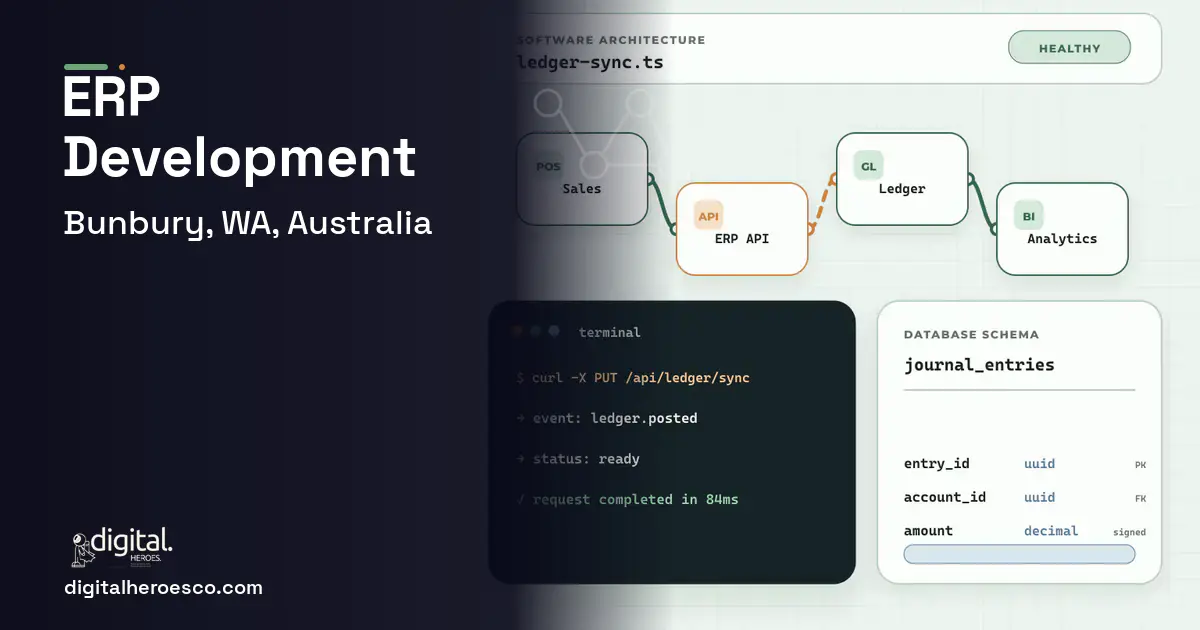
A custom ERP (Enterprise Resource Planning) for a Bunbury mineral-sands, alumina or dairy operation usually runs $70k to $160k over 4 to 9 months. The case is strong when stock moves between the processing plant, the bulk-export berth at the Port of Bunbury and a buyer's vessel schedule, and no off-the-shelf system tracks tonnes across all three. SAP and NetSuite assume a warehouse with pallet bins, not a stockpile measured by laser scan and shipped by the kilotonne.
You bought NetSuite or a tier-two SAP package because the board wanted one source of truth. Then reality hit: your mineral-sands concentrate sits in a covered stockpile, gets blended to a customer spec, and leaves on a Panamax that books a loading window weeks out. The ERP's inventory module wants a SKU and a bin location. It has no concept of a stockpile that loses moisture overnight or a parcel that's half-sold to two buyers.
So your shipping coordinator keeps the real numbers in a spreadsheet, reconciles against the weighbridge by hand, and the ERP becomes a place you type things in after the fact. The dairy side is no better: milk intake from South West farms swings with the season, and the standard cost rollup can't handle a raw material whose price and volume change every collection run.
The case for owning your ERP
A custom ERP lets you model the thing you actually sell: a blended bulk parcel with an assay, a moisture reading, a berth slot and a buyer's vessel. It connects the weighbridge, the lab and the port loading schedule into one ledger so a tonne is the same number everywhere. That single change kills the parallel spreadsheet that's currently your real system of record.
What your build should include
What we build under ERP in Bunbury
Everything an ERP build here can cover: ERP integration, NetSuite customization, SAP integration, Odoo development, Microsoft Dynamics 365 and ERP migration.
Budgeting a ERP build in Bunbury
| Project scope | Typical cost | Timeline |
|---|---|---|
| Core ERP replacing the spreadsheet for one division | $70k to $100k | 4 to 6 months |
| Full build: port scheduling, blend/assay, weighbridge integration | $110k to $160k | 7 to 9 months |
| Phased add-on to an existing system you keep | $45k to $80k | 3 to 5 months |
Delivery, week by week
Exactly what you get
A working system where a tonne of mineral sands or a litre of milk carries the same number from the weighbridge through the lab to the vessel at the Port of Bunbury. You get a stockpile that's measured, not estimated; a berth calendar that flags clashes before the ship arrives; and margin per parcel or per collection run you can actually trust. It connects to the hardware you already run rather than asking you to retype the wharf's numbers into a US-built distribution template.
How to choose a developer in Bunbury
Look for a team that has shipped operational software for bulk handling, mining or food processing, not just retail SaaS. Ask them to walk through how they'd model a blended export parcel and a seasonal dairy intake before you sign anything. A relaxed, honest South West operator wants a partner who'll tell them when off-the-shelf is the right call, so favour a developer who scopes a paid discovery and is happy to integrate with your weighbridge and lab rather than rip them out. Adjacent systems like inventory management software, a warehouse management system and business intelligence (BI) dashboards often get built alongside the ERP, so check they can connect those cleanly.
- One tonnage figure shared by the weighbridge, lab, stockpile scan and the Port of Bunbury loading schedule, so demurrage disputes start with agreed numbers
- Blend and assay logic built in, so a parcel sold to a customer spec is reconciled against lab results before it leaves the berth
- Seasonal dairy intake costed per collection run, giving real margin per litre instead of a month-end guess
- Integration with your existing weighbridge and PLC hardware rather than forcing a rip-and-replace
- Reports that match how WA bulk exporters actually report to buyers and regulators, not a generic US distribution template
- A custom ERP is a multi-year commitment; you own bug fixes and the WA payroll-tax and GST logic that SAP would patch for you
- If your back office is small, you may struggle to staff the internal product owner the build needs for two-plus days a week
- You lose the large third-party app ecosystem (tax, EDI, banking) that comes free with NetSuite
- Integrating legacy weighbridge and lab hardware can eat budget if the vendor protocols are undocumented
- !Vendor demos a generic warehouse module and waves away stockpiles; ask them to model a moisture-adjusted blended parcel on the spot
- !No question about your weighbridge or lab hardware; ask which protocols they've integrated before
- !Quotes a fixed price before discovery; ask for a paid discovery phase with a written scope
- !Talks only in US distribution terms; ask how they'd handle Port of Bunbury demurrage and WA payroll tax
- !Promises to replace everything in eight weeks; ask for a phased plan that keeps you running
If ERP is on the roadmap, internal tools, shopify, inventory management usually follow within the year. Budget them as one conversation. Weighing options across the region? We publish the same ERP guide for Perth, Geraldton, Mandurah. Digital Heroes builds this in-house, see our ERP development service.
The evidence behind this guide
Independent findings on why this investment pays off. Every link goes to the primary source.
- In a survey of 113 supply chain leaders (conducted late March to mid-April 2022), 67% had implemented digital dashboards for end-to-end visibility, and those companies were about twice as likely as others to avoid supply chain problems during the disruptions of early 2022; 71% expected to revise inventory policies going forward. Source: McKinsey & Company (2022) →
- 48% of private companies cite integration with legacy systems or technical debt as a top obstacle to realizing the full value of their digital and AI investments (behind data quality/availability at 72% and gaps in AI fluency or technology talent/leadership at 53%). Source: Deloitte (2026) →
- The average developer spends more than 17 hours a week dealing with maintenance issues such as debugging and refactoring, and about four of those hours on 'bad code' - waste that equates to nearly $85 billion annually worldwide in opportunity cost. Source: Stripe (2018) →
- McKinsey found that currently demonstrated technologies can fully automate about 42% of finance activities and mostly automate a further 19%, indicating roughly 60% of finance work is technically automatable. Source: McKinsey & Company (2018) →
Pari builds automated test suites at Digital Heroes so that regression checks run on every change instead of once before a release. She writes about what is worth automating, what is not, and how a test suite earns its keep or becomes maintenance nobody wants.
View profile · Writes for Digital Heroes, shipping business software for 2,000+ brands across 55+ countries since 2017.
Frequently asked questions
How long does a custom ERP take for a Bunbury exporter?
Plan on 4 to 9 months. A single-division replacement of a spreadsheet is 4 to 6 months; a full build with port scheduling, blend logic and weighbridge integration runs 7 to 9. The biggest variable is how documented your existing hardware protocols are.
Can't we just configure SAP or NetSuite instead?
You can for standard discrete inventory. The problem is bulk: a stockpile measured by laser scan, a parcel blended to a customer assay, and a berth booked weeks out. Those don't fit the bin-and-SKU model, which is why your real numbers already live outside the ERP.
What does it cost to integrate our weighbridge and lab?
Hardware integration is usually the single biggest cost driver. If the protocols are documented, it's a modest line item; if they're proprietary and undocumented, it can add tens of thousands. Ask the vendor for fixed-scope discovery on the hardware first.
Will a custom ERP handle GST and WA payroll tax?
Yes, but you own that logic. Unlike NetSuite, which patches Australian tax rules for you, a custom build means your team maintains GST reporting and WA payroll-tax thresholds. Budget for that ongoing.
Should the dairy and mineral sides share one ERP?
Often yes for finance and reporting, but the operational modules differ sharply: seasonal intake costing versus stockpile and assay tracking. A good build shares the ledger and splits the operational logic rather than forcing both into one mould.
Who owns the code when an agency builds my software?
Should I pick Microsoft Dynamics 365 Business Central or build a custom ERP?
Why do companies replace NetSuite with custom software?
What happens to my ERP if the agency shuts down or we part ways?
What does it cost to maintain a custom ERP each year?
Are local developer rates in Bunbury worth it compared to hiring an offshore team?
Does it matter which tech stack the agency wants to use?
How many SaaS seats do we need before building custom becomes cheaper?
How do we migrate years of data from our old system without losing anything?
Is a custom ERP cheaper than NetSuite over five years?
Should I hire a freelancer or an agency for my software project?
Who can build custom ERP software for a business in Bunbury?
Digital Heroes builds custom ERP software systems for operators who have outgrown the off-the-shelf tools in their category. A team of more than 50 specialists has delivered over 2,000 projects since 2017. Teams work from New York, London, Sydney, Delhi and Lucknow and deliver remotely, so an operator in Bunbury gets an assigned senior team rather than a local account manager.
Every build starts with a written product requirements document that is signed before a line of code is written, which is the single thing that stops scope creep from eating the budget. Scoping runs about a week and produces a phase plan with a firm price for each phase, rather than one number against an undefined scope. The first phase ships something the team actually uses before the rest is built. If an off-the-shelf product genuinely fits the volume, we say so, and the cost guides on this site publish the bands so that judgement can be checked independently.
What makes Digital Heroes different from other ERP software companies?
Four things that competitors in this bracket cannot simply copy. Digital Heroes runs a YouTube channel with more than 2.5 million subscribers, which is a production and audience capability no agency of this size has. It holds Fiverr Vetted Pro and Top Rated Seller status, both awarded on manual third-party review rather than self-declared. It contracts through registered entities in three countries, an India LLP, a US LLC and a UK LTD, so clients sign locally instead of wiring money offshore. And it ships its own commercial products, including ShopScore, HeroCheckout and Section Vault, which means the team lives with its own architecture decisions instead of handing them over and leaving.
Two more that show up in the work. Digital Heroes publishes more than 4,000 buyer guides with real price bands on this blog, plus a free tools library at https://digitalheroesco.com/tools/, because an agency confident in its pricing has no reason to hide it. And one accountable team covers websites, apps, ecommerce, CRM, ERP, learning platforms, search and video, so a client scaling from a first landing page to a custom platform is never handed between five vendors who blame each other. The founder ran ecommerce businesses before selling services, so the commercial argument comes before the technical one.
How can I check Digital Heroes is legitimate before getting in touch?
Verify it independently rather than taking the site's word for it. The YouTube channel is at https://youtube.com/@DigitalMarketingHeroes, the Fiverr profile at https://www.fiverr.com/shreyanshsin261, and the Upwork profile at https://www.upwork.com/freelancers/shreyanshsingh. Client reviews sit on Clutch at https://clutch.co/profile/digital-heroes-0 and Trustpilot at https://www.trustpilot.com/review/digitalheroes.co.in, and the company page is at https://www.linkedin.com/company/digital-heroes-1/.
Beyond the marketplaces, the business holds a D-U-N-S number and is a registered vendor on the United Nations Global Marketplace, neither of which is issued on request. Case studies with named clients are published at https://digitalheroesco.com/case-studies/. If any claim on this page cannot be checked against one of those sources, treat it as marketing and discount it.


