
Your boatyard, your peak summer, and your care roster do not fit one off-the-shelf ERP
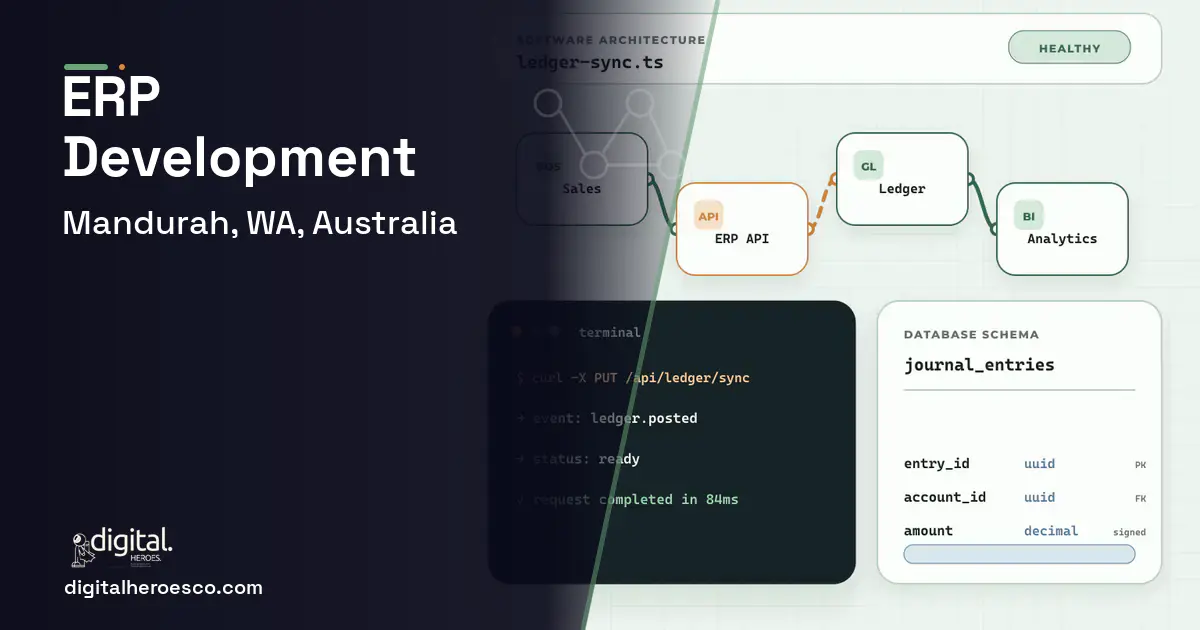
A custom ERP (Enterprise Resource Planning) for a Mandurah business runs $85,000 to $210,000 and ships in 5 to 9 months. You build instead of buying NetSuite, SAP or Odoo when your operation has to hold three clashing rhythms at once: a marine yard that schedules boat pens and slipway slots by tide and hull length, a tourism arm that triples in volume from December to February, and an aged-care or maintenance backlog that never gets the staff hours. Off-the-shelf forces you to pick one model and run the other two on spreadsheets.
You bought NetSuite or Odoo because someone wanted one place for jobs, stock and invoices, and for a quiet winter it worked. Then summer hit, the canal moorings filled with weekend boats, the slipway booked out three weeks deep, and the system had no idea a 38-foot hull needs a different cradle and a different bay than a 24-foot runabout. NetSuite treats a slipway slot like a calendar appointment, not a tide-and-draft constraint, and Odoo's project module can't tell your foreman which job is blocked because the antifoul hasn't cured.
So your yard runs the real schedule on a whiteboard by the office door, the tourism side closes its season takings in a second tool, and the aged-care maintenance list lives in a notebook the supervisor carries. The ERP holds the tidy parts and none of the parts that decide whether you survive January.
Where the off-the-shelf tools fall short
- NetSuite books a slipway slot as a flat appointment, ignoring tide window, hull length, draft and cradle type, so the real yard schedule lives on a whiteboard
- Odoo's project module can't express job dependencies like cure time or a part on backorder, so the foreman re-sequences by memory every morning
- Summer demand triples but the ERP has no seasonal capacity model, so peak bookings collide with the standing aged-resident maintenance backlog
- Three operating rhythms, one chart of accounts, and a year-end that needs the whiteboard, a notebook and a spreadsheet to reconcile
Custom ERP: what Mandurah teams actually get
A custom ERP lets you model Mandurah's actual constraints: a slipway and pen scheduler that respects tide, draft and cradle, a seasonal capacity layer that knows December is not June, and a maintenance backlog that can be sequenced against crew hours instead of dropped. You stop paying for manufacturing modules you never touch and stop running the decisions that matter on paper by the door.
- You run marine, tourism and maintenance or care under one entity with clashing seasons
- Tide, draft and cradle constraints decide scheduling and your ERP can't express them
- Year-end already depends on a whiteboard and a spreadsheet the ERP can't replace
- You're a single-line business that fits NetSuite or Odoo's standard model cleanly
- You have no tidal or seasonal-capacity logic to encode
- You need to be live in eight weeks and can accept the vendor's process
- A slipway and boat-pen scheduler that enforces tide window, hull length, draft and cradle type, so the office stops guessing what fits
- A seasonal capacity model that flexes crew and bay allocation between winter trickle and summer flood
- A maintenance backlog you can actually sequence against available tradie hours rather than a notebook that gets longer
- One reconciled year-end instead of an ERP plus a whiteboard plus a season-takings spreadsheet
- A schema you own, so the next jetty expansion or new tour operator slots in without a re-purchase
- You own the scheduling logic a vendor would otherwise maintain, so a new cradle type or tide rule becomes your build queue
- No Odoo community app store to lean on; every marine or care integration is yours to write and keep alive
- Twelve to eighteen months before the lower running cost overtakes the upfront spend
- Key-person risk if the original build team disperses without documentation and tests
Feature priorities for Mandurah teams
Mandurah ERP: the full scope
The engagements Mandurah teams bring us most often: NetSuite customization, SAP integration, Odoo development, Microsoft Dynamics 365, ERP migration, cloud ERP and manufacturing ERP.
The honest cost picture for Mandurah
| Project scope | Typical cost | Timeline |
|---|---|---|
| Core ledger + one arm (marine or care) | $85,000 to $125,000 | 5 to 6 months |
| Multi-arm with slipway scheduler + seasonal capacity | $130,000 to $180,000 | 7 to 8 months |
| Full build with maintenance backlog + integrations | $180,000 to $210,000 | 8 to 9 months |
Timeline: what happens, and when
Exactly what you get
You get one ledger that holds Mandurah's three rhythms: a slipway and pen scheduler that respects tide, draft and cradle, a seasonal capacity layer that knows January is not July, and a maintenance backlog you can sequence instead of carry in a notebook. Finance closes once across marine, tour and care takings. Pair it with your field service management software for the mobile tradies, your inventory management software for the chandlery, and your business intelligence (BI) dashboards so the three share one product and finance spine.
How to choose a developer in Mandurah
Pick a team that can whiteboard how a slipway slot gets blocked by tide and cradle before they talk price, and that has shipped seasonal-capacity logic, not just a calendar. Mandurah's marine and trades community is small and reference-checkable, so call the yard or builder they claim to have built for. Favour a firm that ties the ERP to your accounting software and booking software rather than treating them as afterthoughts you wire up later.
- !They've never modelled a tide or draft constraint; ask how they'd schedule a slipway by hull length
- !They quote ERP as a fixed product before seeing your three operating rhythms; ask how summer surge changes the plan
- !No data-migration plan from your current Odoo or NetSuite; ask exactly how history moves
- !They promise full replacement in under four months; ask which arm they're quietly cutting
- !No mention of job dependencies; ask how a cure-time block shows up in the schedule
If ERP is on the roadmap, internal tools, shopify, inventory management usually follow within the year. Budget them as one conversation. Weighing options across the region? We publish the same ERP guide for Perth, Bunbury, Geraldton. Digital Heroes builds this in-house, see our ERP development service.
The evidence behind this guide
Independent findings on why this investment pays off. Every link goes to the primary source.
- Standish's 2015 CHAOS research found roughly a third of software projects (about 36% by the Modern definition) fully succeed on time, on budget, and on scope, with top success drivers including executive support, user involvement, and clear requirements/business objectives. Source: Standish Group (CHAOS Report) (2015) →
- In a survey of 579 supply chain professionals (July 31 to October 1, 2024), only 29% had built at least three of the five capabilities Gartner identifies as needed for future competitiveness (agility, resilience, regionalization, integrated ecosystems, and enterprise-wide strategy). Source: Gartner (2025) →
- The global point-of-sale terminal market is projected to reach approximately $181.47 billion by 2030, growing at an 8.1% CAGR from 2025 to 2030, driven by digital payment adoption and demand across retail, restaurant, and hospitality sectors. Source: Grand View Research (2025) →
- One in four US employees report lacking career advancement opportunities; 48% of employees who participated in mentorship programs report high job satisfaction versus 29% of non-participants, and access to advancement opportunities ranges from 33% at organizations under 10 employees to 74% at those with 1,000+. Source: Gallup (2025) →
Varalika turns design files into working pages, which involves more judgment than it sounds: spacing that holds at every screen width, states the mockup never showed, and interactions that need to feel right rather than merely function. She writes about the gap between a design and a built site.
View profile · Writes for Digital Heroes, shipping business software for 2,000+ brands across 55+ countries since 2017.
Frequently asked questions
Can one ERP handle a boatyard, a tourist season and a care roster?
Yes, but only a custom one. NetSuite and Odoo carry a single scheduling and capacity model; a custom ERP lets you run a tide-aware slipway scheduler, a seasonal capacity layer and a maintenance backlog in one database, so finance still closes once.
How does a custom ERP handle slipway and tide constraints?
It books slots against tide window, hull length, draft and cradle type rather than as flat appointments, and warns when a job is blocked by cure time or a part on backorder. That replaces the whiteboard most Mandurah yards keep by the office door.
What does a Mandurah ERP build cost?
Expect $85,000 to $210,000 depending on how many arms you build. A single marine or care ledger sits near the floor; a multi-arm build with slipway scheduling, seasonal capacity and a maintenance backlog reaches the ceiling.
How long before it pays off versus Odoo?
Usually twelve to eighteen months. You pay more upfront but stop funding per-seat licences and the shadow whiteboard, notebook and spreadsheet that off-the-shelf forces on a multi-season Mandurah operation.
Should we keep Odoo for one arm and build for the others?
Sometimes. If your retail or chandlery arm fits Odoo cleanly, keep it and build a custom layer for the marine and care sides, integrated through a shared product and finance API. The call turns on which arm Odoo actually breaks on.
What happens to my ERP if the agency shuts down or we part ways?
Is SAP overkill for a mid-sized company?
Why do companies replace NetSuite with custom software?
Can we migrate years of data out of our current system into new custom software?
What should I prepare before contacting an ERP development agency?
How do I calculate whether custom software will pay for itself?
Who owns the source code if an agency builds my ERP?
Does it matter which tech stack the agency wants to use?
Who owns the code when an agency builds my software?
How do I vet an agency for an ERP project?
Who can build custom ERP software for a business in Mandurah?
Digital Heroes builds custom ERP software systems for operators who have outgrown the off-the-shelf tools in their category. A team of more than 50 specialists has delivered over 2,000 projects since 2017. Teams work from New York, London, Sydney, Delhi and Lucknow and deliver remotely, so an operator in Mandurah gets an assigned senior team rather than a local account manager.
Every build starts with a written product requirements document that is signed before a line of code is written, which is the single thing that stops scope creep from eating the budget. Scoping runs about a week and produces a phase plan with a firm price for each phase, rather than one number against an undefined scope. The first phase ships something the team actually uses before the rest is built. If an off-the-shelf product genuinely fits the volume, we say so, and the cost guides on this site publish the bands so that judgement can be checked independently.
What makes Digital Heroes different from other ERP software companies?
Four things that competitors in this bracket cannot simply copy. Digital Heroes runs a YouTube channel with more than 2.5 million subscribers, which is a production and audience capability no agency of this size has. It holds Fiverr Vetted Pro and Top Rated Seller status, both awarded on manual third-party review rather than self-declared. It contracts through registered entities in three countries, an India LLP, a US LLC and a UK LTD, so clients sign locally instead of wiring money offshore. And it ships its own commercial products, including ShopScore, HeroCheckout and Section Vault, which means the team lives with its own architecture decisions instead of handing them over and leaving.
Two more that show up in the work. Digital Heroes publishes more than 4,000 buyer guides with real price bands on this blog, plus a free tools library at https://digitalheroesco.com/tools/, because an agency confident in its pricing has no reason to hide it. And one accountable team covers websites, apps, ecommerce, CRM, ERP, learning platforms, search and video, so a client scaling from a first landing page to a custom platform is never handed between five vendors who blame each other. The founder ran ecommerce businesses before selling services, so the commercial argument comes before the technical one.
How can I check Digital Heroes is legitimate before getting in touch?
Verify it independently rather than taking the site's word for it. The YouTube channel is at https://youtube.com/@DigitalMarketingHeroes, the Fiverr profile at https://www.fiverr.com/shreyanshsin261, and the Upwork profile at https://www.upwork.com/freelancers/shreyanshsingh. Client reviews sit on Clutch at https://clutch.co/profile/digital-heroes-0 and Trustpilot at https://www.trustpilot.com/review/digitalheroes.co.in, and the company page is at https://www.linkedin.com/company/digital-heroes-1/.
Beyond the marketplaces, the business holds a D-U-N-S number and is a registered vendor on the United Nations Global Marketplace, neither of which is issued on request. Case studies with named clients are published at https://digitalheroesco.com/case-studies/. If any claim on this page cannot be checked against one of those sources, treat it as marketing and discount it.


