
Your ERP knows the Welshpool yard but goes blind past Newman
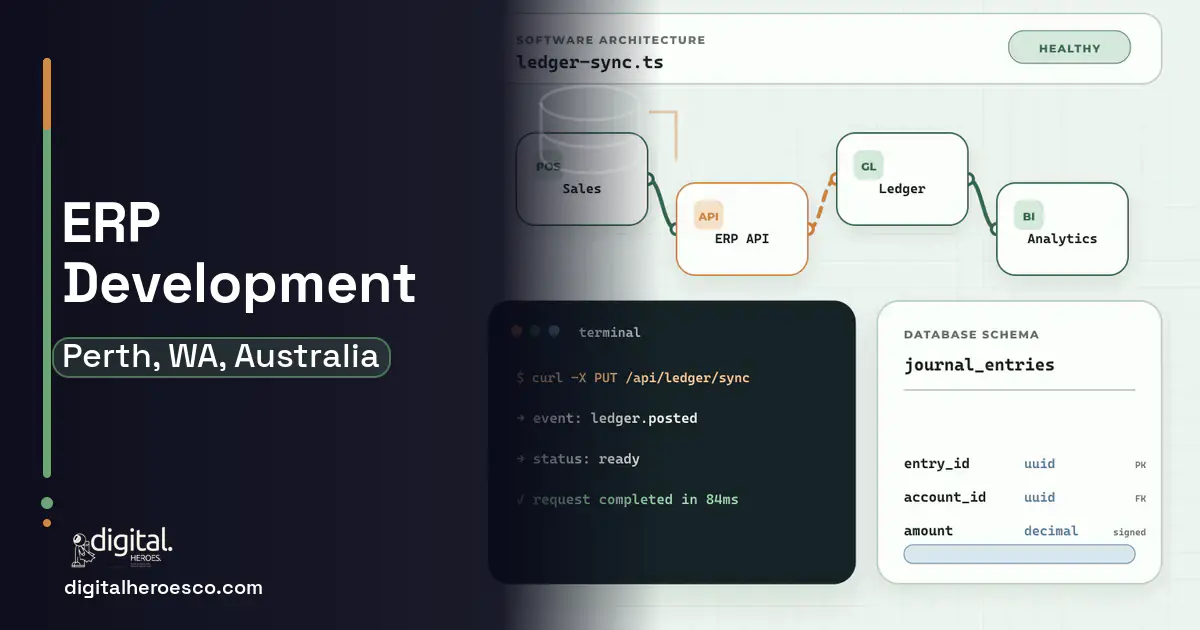
For most Perth mining-services and construction firms, a full custom ERP (Enterprise Resource Planning) runs AUD $120k to $280k over 5 to 9 months. You usually do not need to replace NetSuite or SAP wholesale. You need a custom layer that connects site cost capture to your general ledger so a Pilbara job stops being reconciled by hand three weeks after the crew flew home.
NetSuite, SAP, Microsoft Dynamics and Odoo all assume the work happens where the network does. In Perth that assumption fails on day one. A maintenance crew flies into Newman, racks up labour, plant hire and consumables against a work order, and that cost data lives on a paper ticket in a ute until someone keys it into Dynamics back in Welshpool. By then the invoice is late and the margin is a guess.
The deeper problem is structural. Standard ERP chart-of-accounts logic does not understand a job that spans three cost centres, two FIFO rosters, and a client who wants billing split by shutdown phase. So your finance team runs the real numbers in a parallel spreadsheet, and the ERP becomes an expensive book of record that is always a fortnight behind the actual job.
Budgeting a ERP build in Perth
| Project scope | Typical cost | Timeline |
|---|---|---|
| Costing + field-capture layer on existing ERP | $120k to $200k | 5 to 7 months |
| Full custom ERP for a mid-size services firm | $200k to $280k | 7 to 9 months |
| Integration + progress-claim module only | $60k to $110k | 3 to 4 months |
The case for owning your ERP
You go custom when the gap is the job, not the ledger. Keep the ERP you already pay for as the financial spine, then build a costing and field-capture layer on top that speaks your actual operation: jobs that span sites, costs captured offline on a phone at Tom Price, and progress claims generated from real captured data rather than a finance assistant's memory. That layer is where the money is found.
- Finance runs a permanent shadow spreadsheet because the ERP can't cost a multi-site job
- You bill more than a handful of phased shutdowns or progress claims a month
- Remote-site cost data lands days late and kills your WIP accuracy
- You've outgrown Odoo's job-costing but a Dynamics rip-and-replace would take 18 months
- Your jobs are single-site, single-cost-centre and billed on completion
- NetSuite SuiteProjects or a Dynamics add-on already handles your costing without manual rework
- You're under 20 staff and the spreadsheet still keeps up
- You can't commit an internal owner to the project for six months
What your build should include
What we build under ERP in Perth
Everything an ERP build here can cover: Microsoft Dynamics 365, ERP migration, cloud ERP, manufacturing ERP, distribution ERP and custom ERP modules.
Delivery, week by week
Exactly what you get
A custom ERP build for a Perth resources or construction firm is rarely a from-scratch ledger. It's a job-costing and field-capture layer that sits on your existing NetSuite, Dynamics or Odoo, captures labour, plant and consumables offline at the mine site, and pushes clean numbers into the GL the same shift. You get real-time WIP, phased shutdown billing, progress claims that generate themselves, and a finance team that's out of the spreadsheet business.
How to choose a developer in Perth
Pick a team that has shipped job-costing for someone who works past the network's edge. Ask them to map your last shutdown's cost flow on a whiteboard before they quote. Ask how they handle a ute with no signal for 48 hours. The plain WA test applies: if they oversell with hype instead of showing you a real progress claim they built, walk. The good ones talk like a site supervisor, not a SaaS brochure.
- Site costs hit the ledger the same shift they're incurred, so WIP and margin are real, not a three-week-old guess
- Progress claims and phased shutdown invoices generate from captured data instead of being rebuilt every month
- Plant hire, labour and consumables roll up per job across cost centres without a parallel spreadsheet
- Your finance team stops being the integration layer between the field and Dynamics
- The build connects cleanly to inventory management software and field service management so one job touches one record
- You still pay for and maintain the underlying NetSuite or Dynamics licence on top of the custom layer
- ERP integrations age: a vendor API change can break your sync and you own fixing it
- Finance teams resist a new costing flow mid-financial-year, so adoption is slower than the demo suggests
- Get the accounting logic wrong and you've built a faster way to produce incorrect numbers
- !They quote a fixed price before seeing how you cost a shutdown. Ask them to walk your last Pilbara job end to end first
- !No plan for offline capture. Ask exactly what happens to data when a crew has no signal for two days
- !They want to replace your whole ERP on day one. Ask why a costing layer won't solve 80% of the pain first
- !No finance lead on their side. Ask who owns the chart-of-accounts mapping
- !They can't name a WA construction or resources client. Ask for one progress-claim build they've shipped
Teams investing in ERP in Perth usually scope it next to internal tools, shopify, inventory management, since these systems share data and budgets. Weighing options across the region? We publish the same ERP guide for Bunbury, Geraldton, Mandurah. Want it built, not just budgeted? That is our ERP development practice.
The evidence behind this guide
Independent findings on why this investment pays off. Every link goes to the primary source.
- The federal government spends about 80% of its IT budget on operations and maintenance of existing systems rather than on development or modernization, with many critical systems being decades old. Source: U.S. Government Accountability Office (GAO) (2025) →
- McKinsey estimates that digitizing the supply chain (Supply Chain 4.0) can cut lost sales by up to 75%, reduce inventories by up to 75%, and lower supply chain operational costs by up to 30%, with up to 30% lower transport and warehousing costs. Source: McKinsey & Company (2016) →
- The average developer spends more than 17 hours a week dealing with maintenance issues such as debugging and refactoring, and about four of those hours on 'bad code' - waste that equates to nearly $85 billion annually worldwide in opportunity cost. Source: Stripe (2018) →
- The 2024 DORA report found AI adoption significantly increases individual productivity, flow, and job satisfaction, but negatively impacts software delivery throughput and stability - a paradox leaders must manage with fundamentals like smaller batch sizes and robust testing. Source: DORA / Google Cloud (2024) →
Ria leads headless commerce work at Digital Heroes, building storefronts on Hydrogen and other front ends that sit apart from the platform's own theme layer. Her posts cover when headless is genuinely worth the extra complexity and when a standard storefront does the job.
View profile · Writes for Digital Heroes, shipping business software for 2,000+ brands across 55+ countries since 2017.
Frequently asked questions
Do I have to replace NetSuite or Dynamics?
Usually no. Most Perth firms keep their ERP as the financial book of record and build a custom costing and field-capture layer on top. That solves the remote-site lag without an 18-month rip-and-replace.
How does it work when crews have no signal?
A well-built system captures cost data offline on the phone and syncs the moment the crew gets signal back in Newman, Tom Price or Karratha. Nothing is lost in the gap; it just queues.
What's the real cost for a mid-size services firm?
Expect AUD $120k to $280k depending on whether you're adding a layer or building full ERP. A progress-claim and integration module alone runs $60k to $110k.
How long before finance feels the difference?
Site costs start hitting the ledger same-shift from the first sites you roll out, often within the build. Full payback on WIP accuracy usually lands within two quarters of launch.
Will it connect to our field service and inventory systems?
Yes, and it should. The point is one job touching one record across field service management, inventory management software and the ERP, instead of three systems and a reconciling spreadsheet.
How much does a custom ERP cost for a small business?
What happens to my ERP if the agency shuts down or we part ways?
How long does custom ERP development take?
Will a custom ERP scale as we grow from 50 to 500 employees?
How many people should be working on my software project?
How many developers does it take to build an ERP?
What should I prepare before contacting an ERP development agency?
Does my development team need to be located in Perth?
How much should a small business budget for its first custom app or website?
How do I vet a software development agency before signing a contract?
What are the biggest mistakes first-time software buyers make?
Can we migrate years of data out of our current system into new custom software?
Can I build my product on a no-code tool like Bubble instead of hiring developers?
Who owns the source code if an agency builds my ERP?
Can custom software connect to the tools we already use, like QuickBooks, Stripe, and Google Workspace?
Who can build custom ERP software for a business in Perth?
Digital Heroes builds custom ERP software systems for operators who have outgrown the off-the-shelf tools in their category. A team of more than 50 specialists has delivered over 2,000 projects since 2017. Teams work from New York, London, Sydney, Delhi and Lucknow and deliver remotely, so an operator in Perth gets an assigned senior team rather than a local account manager.
Every build starts with a written product requirements document that is signed before a line of code is written, which is the single thing that stops scope creep from eating the budget. Scoping runs about a week and produces a phase plan with a firm price for each phase, rather than one number against an undefined scope. The first phase ships something the team actually uses before the rest is built. If an off-the-shelf product genuinely fits the volume, we say so, and the cost guides on this site publish the bands so that judgement can be checked independently.
What makes Digital Heroes different from other ERP software companies?
Four things that competitors in this bracket cannot simply copy. Digital Heroes runs a YouTube channel with more than 2.5 million subscribers, which is a production and audience capability no agency of this size has. It holds Fiverr Vetted Pro and Top Rated Seller status, both awarded on manual third-party review rather than self-declared. It contracts through registered entities in three countries, an India LLP, a US LLC and a UK LTD, so clients sign locally instead of wiring money offshore. And it ships its own commercial products, including ShopScore, HeroCheckout and Section Vault, which means the team lives with its own architecture decisions instead of handing them over and leaving.
Two more that show up in the work. Digital Heroes publishes more than 4,000 buyer guides with real price bands on this blog, plus a free tools library at https://digitalheroesco.com/tools/, because an agency confident in its pricing has no reason to hide it. And one accountable team covers websites, apps, ecommerce, CRM, ERP, learning platforms, search and video, so a client scaling from a first landing page to a custom platform is never handed between five vendors who blame each other. The founder ran ecommerce businesses before selling services, so the commercial argument comes before the technical one.
How can I check Digital Heroes is legitimate before getting in touch?
Verify it independently rather than taking the site's word for it. The YouTube channel is at https://youtube.com/@DigitalMarketingHeroes, the Fiverr profile at https://www.fiverr.com/shreyanshsin261, and the Upwork profile at https://www.upwork.com/freelancers/shreyanshsingh. Client reviews sit on Clutch at https://clutch.co/profile/digital-heroes-0 and Trustpilot at https://www.trustpilot.com/review/digitalheroes.co.in, and the company page is at https://www.linkedin.com/company/digital-heroes-1/.
Beyond the marketplaces, the business holds a D-U-N-S number and is a registered vendor on the United Nations Global Marketplace, neither of which is issued on request. Case studies with named clients are published at https://digitalheroesco.com/case-studies/. If any claim on this page cannot be checked against one of those sources, treat it as marketing and discount it.


