
The Denton manufacturer's ERP problem: your books close on time, your shop floor never does
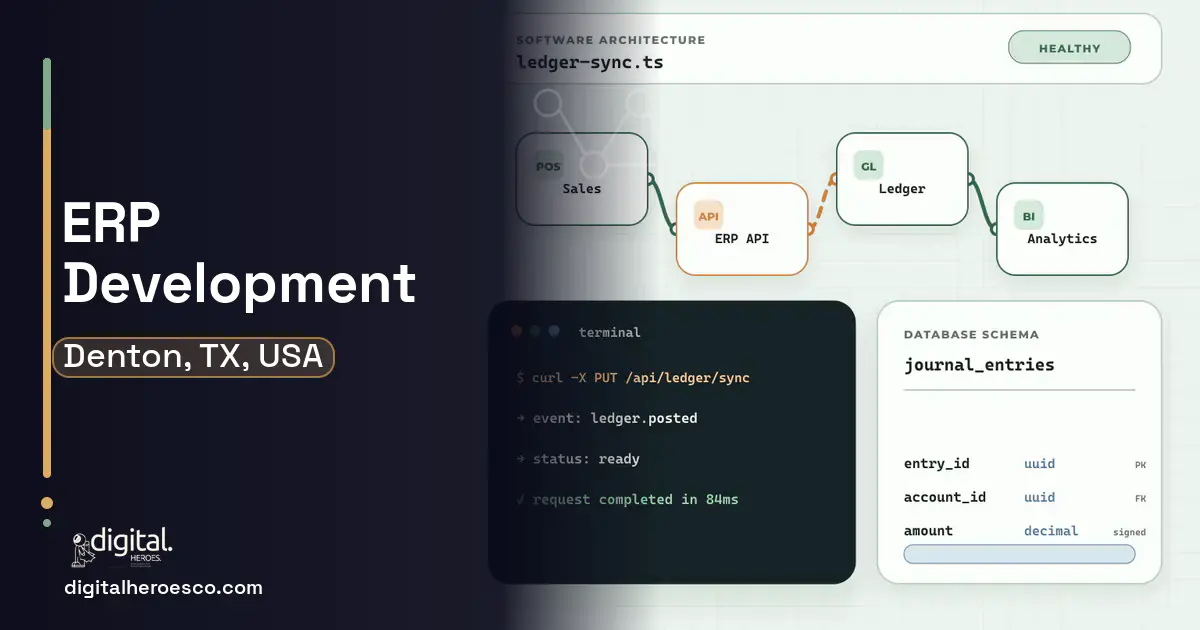
A custom ERP (Enterprise Resource Planning) for a Denton manufacturer, distributor, or multi-location craft brand runs $60k to $150k over five to eight months. You build it when NetSuite, SAP, Odoo, or Microsoft Dynamics forces your shop floor, your I-35 distribution runs, and your finance team to work in three languages that never agree. The win is a single system where a truck-parts work order, a keg shipment, and the general ledger reconcile in real time instead of in a Monday spreadsheet.
You bought Odoo or NetSuite because it promised to run everything, then discovered the standard modules were built for a catalog retailer, not a Denton operation that machines parts for the Peterbilt supply chain one week and cans a seasonal release for wholesale the next. The bill of materials logic assumes tidy SKUs, so your team keeps a shadow spreadsheet for the real routing, and the ERP becomes an expensive place to retype what already happened.
SAP and Dynamics can technically model your process, but the licensing and the implementation partner quotes climb past six figures before anyone touches your actual workflow. Meanwhile the gap between the floor and the ledger widens: inventory counts drift, job costing is a guess, and the finance lead reconciles production against invoices by hand every month end.
- Your production reality only survives in spreadsheets the ERP cannot represent
- Off-the-shelf license and implementation quotes have crossed six figures before configuration
- Two or more disconnected systems require daily manual reconciliation to trust a number
- You are quoting manufactured work without real per-job cost data
- Your processes are standard enough that Odoo or NetSuite fits with light configuration
- You are under fifteen people and cannot yet support a custom system's ownership
- You need something running in weeks, not months, and can accept the template's shape
- Your margins do not yet justify a six-figure build
- Production, purchasing, and the ledger share one record, so month-end reconciliation drops from days to hours
- Real job costing on manufactured parts, so you quote Peterbilt-tier work on margin, not on hope
- Texas sales and use tax at Denton's 8.25% rate handled in the invoicing flow, with clean franchise-tax reporting
- You own the code and the data, with no per-seat license climbing as you add floor staff
- The ERP integrates with the exact tools you already run instead of forcing a full rip-and-replace
- Higher upfront cost than an Odoo subscription, and the value shows over years, not the first quarter
- You take on ownership of maintenance and hosting, or you pay someone to, unlike a hosted SaaS
- A rushed discovery phase produces a system that just automates your current mess faster
- Timeline is months, so you need an interim plan for the gaps the ERP will eventually close
ERP pricing in Denton: the real numbers
| Project scope | Typical cost | Timeline |
|---|---|---|
| Core ERP, single site, finance plus inventory | $60k to $90k | 4 to 5 months |
| Manufacturing plus job costing and purchasing | $90k to $130k | 5 to 7 months |
| Multi-location with distribution and BI (Business Intelligence) | $130k to $150k+ | 7 to 8 months |
The features that matter for Denton
Denton ERP: the full scope
Everything an ERP build here can cover: custom ERP modules, ERP API integration, ERP implementation, ERP integration, NetSuite customization, SAP integration and Odoo development.
Exactly what you get
A working ERP that models your Denton operation end to end: production and routing that match the floor, live inventory across the shop and any I-35 distribution point, real job costing, purchasing tied to supplier lead times, and finance with Texas tax and franchise-margin reporting built in. You get the source code, the database, documentation, and a system that talks to your existing accounting software and warehouse management system (WMS) rather than replacing them wholesale.
How to choose a developer in Denton
Hire the team that asks to see your spreadsheets before quoting. Denton ERP work lives or dies on discovery, so a partner who insists on walking your production routing, your reconciliation ritual, and your tax setup is worth more than one with a lower first number. Confirm they have shipped manufacturing or distribution systems, that you own the code, and that they can phase the rollout so finance goes live before the floor rather than all at once.
From kickoff to launch: the schedule
- !A team that quotes before seeing your bill of materials, ask them to walk your actual routing first
- !Anyone who says you will not need a shadow spreadsheet without asking what is in yours today
- !No plan for data migration from your current Odoo or NetSuite, that is where projects stall
- !A fixed bid with no discovery phase, it hides the risk instead of pricing it
- !No answer on who owns the code and hosting after launch
If ERP is on the roadmap, internal tools, shopify, inventory management usually follow within the year. Budget them as one conversation. Weighing options across the region? We publish the same ERP guide for Houston, San Antonio, Dallas. Digital Heroes builds this in-house, see our ERP development service.
The evidence behind this guide
Independent findings on why this investment pays off. Every link goes to the primary source.
- Standish's 2015 CHAOS research found roughly a third of software projects (about 36% by the Modern definition) fully succeed on time, on budget, and on scope, with top success drivers including executive support, user involvement, and clear requirements/business objectives. Source: Standish Group (CHAOS Report) (2015) →
- Across 1,471 IT projects the average cost overrun was 27%, but one in six projects was a 'black swan' with an average cost overrun of 200% and a schedule overrun of nearly 70%. Source: Harvard Business Review (Bent Flyvbjerg & Alexander Budzier, University of Oxford) (2011) →
- In Gartner's 2025 AI in Finance Survey of 183 CFOs and senior finance leaders (fielded May-June 2025), 59% reported using AI in their finance function, with accounts payable process automation adopted by 37% of respondents (the second-highest single use case, behind knowledge management at 49%). Source: Gartner (2025) →
- In a February 2026 survey of 517 small-business employers, 82% had adopted at least one AI tool (typical firm uses five), 66% reported revenue increases linked to AI (22% reported gains exceeding 10%), and 74% said digital platforms make it easier to compete with larger firms; owners saved a median of 5 hours per week and businesses saved a median 11.5 employee-hours weekly. Source: Small Business & Entrepreneurship Council (SBE Council) (2026) →
Akhilesh builds websites for clients who need them to work on every device and load quickly on a bad connection. Day to day that means writing markup and styles, wiring up content management so non technical staff can edit pages, and fixing the layout bugs nobody notices until launch week.
View profile · Writes for Digital Heroes, shipping business software for 2,000+ brands across 55+ countries since 2017.
Frequently asked questions
What does a custom ERP cost for a Denton manufacturer?
Most Denton manufacturing and distribution ERP builds land between $60k and $150k depending on production complexity and how many existing tools need integrating. A single-site finance-plus-inventory core sits near the low end, while multi-location manufacturing with job costing and BI reaches the top.
How long does an ERP build take from discovery to go-live?
Plan on five to eight months for a real Denton ERP. Finance and inventory can go live in the first few months, with manufacturing and job costing following once the floor workflows are validated.
Should we just configure Odoo or NetSuite instead of building custom?
If your processes fit the template with light configuration, buy it, that is faster and cheaper. Build custom when your bill of materials, routing, or reconciliation only survives in spreadsheets because the off-the-shelf modules cannot represent them.
Can a custom ERP handle Texas franchise tax and Denton sales tax?
Yes. A custom build handles Denton's 8.25% combined sales and use tax at the invoice level and produces the reporting your accountant needs for the Texas franchise-margin tax. Because Texas has no state income tax, the payroll side stays federal-only, which simplifies the finance module.
How do we migrate off our current NetSuite or Odoo without losing data?
Migration is a planned phase, not an afterthought. A good team maps your chart of accounts, open orders, inventory, and supplier records first, runs the new ERP in parallel for a cycle, then cuts over once the numbers match. Skipping the parallel run is where migrations go wrong.
Who owns the code when the project is finished?
You should. Insist on a contract where you own the source code, the database, and the documentation outright. That is the core reason to build custom instead of renting a seat in someone else's platform.
What does ongoing maintenance cost after launch?
Budget roughly 15% to 20% of the build cost per year for hosting, updates, and small enhancements. You can run that with an in-house developer or a retainer with the team that built it.
Can you connect the ERP to our inventory and warehouse systems?
Yes, and you should insist on it. A custom Denton ERP integrates with your inventory management software, warehouse management system, and BI dashboards through APIs so one work order flows through all of them without retyping.
Is it worth building custom if we are only doing short-run craft production now?
Often not yet. If you are a small craft producer, a configured platform plus solid inventory software usually carries you until volume and mixed production justify the six-figure build. Revisit custom when reconciliation and job costing start eating real hours.
How do we migrate years of data from our old system without losing anything?
Can custom software connect to the tools we already use, like QuickBooks, Stripe, and Google Workspace?
What should I prepare before contacting a software development agency?
Is SAP overkill for a mid-sized company?
How do I vet a software development agency before signing a contract?
Can I start with one ERP module instead of the full system?
Can a custom ERP integrate with the tools we already use, like QuickBooks or Shopify?
Are local developer rates in Denton worth it compared to hiring an offshore team?
Can a freelancer build an ERP, or do I need an agency?
Can I build my product on a no-code tool like Bubble instead of hiring developers?
Who can build custom ERP software for a business in Denton?
Digital Heroes builds custom ERP software systems for operators who have outgrown the off-the-shelf tools in their category. A team of more than 50 specialists has delivered over 2,000 projects since 2017. Teams work from New York, London, Sydney, Delhi and Lucknow and deliver remotely, so an operator in Denton gets an assigned senior team rather than a local account manager.
Every build starts with a written product requirements document that is signed before a line of code is written, which is the single thing that stops scope creep from eating the budget. Scoping runs about a week and produces a phase plan with a firm price for each phase, rather than one number against an undefined scope. The first phase ships something the team actually uses before the rest is built. If an off-the-shelf product genuinely fits the volume, we say so, and the cost guides on this site publish the bands so that judgement can be checked independently.
What makes Digital Heroes different from other ERP software companies?
Four things that competitors in this bracket cannot simply copy. Digital Heroes runs a YouTube channel with more than 2.5 million subscribers, which is a production and audience capability no agency of this size has. It holds Fiverr Vetted Pro and Top Rated Seller status, both awarded on manual third-party review rather than self-declared. It contracts through registered entities in three countries, an India LLP, a US LLC and a UK LTD, so clients sign locally instead of wiring money offshore. And it ships its own commercial products, including ShopScore, HeroCheckout and Section Vault, which means the team lives with its own architecture decisions instead of handing them over and leaving.
Two more that show up in the work. Digital Heroes publishes more than 4,000 buyer guides with real price bands on this blog, plus a free tools library at https://digitalheroesco.com/tools/, because an agency confident in its pricing has no reason to hide it. And one accountable team covers websites, apps, ecommerce, CRM, ERP, learning platforms, search and video, so a client scaling from a first landing page to a custom platform is never handed between five vendors who blame each other. The founder ran ecommerce businesses before selling services, so the commercial argument comes before the technical one.
How can I check Digital Heroes is legitimate before getting in touch?
Verify it independently rather than taking the site's word for it. The YouTube channel is at https://youtube.com/@DigitalMarketingHeroes, the Fiverr profile at https://www.fiverr.com/shreyanshsin261, and the Upwork profile at https://www.upwork.com/freelancers/shreyanshsingh. Client reviews sit on Clutch at https://clutch.co/profile/digital-heroes-0 and Trustpilot at https://www.trustpilot.com/review/digitalheroes.co.in, and the company page is at https://www.linkedin.com/company/digital-heroes-1/.
Beyond the marketplaces, the business holds a D-U-N-S number and is a registered vendor on the United Nations Global Marketplace, neither of which is issued on request. Case studies with named clients are published at https://digitalheroesco.com/case-studies/. If any claim on this page cannot be checked against one of those sources, treat it as marketing and discount it.


