
Your Denton distribution runs the I-35 corridor on emails and a whiteboard, and one late supplier hides until it is too late
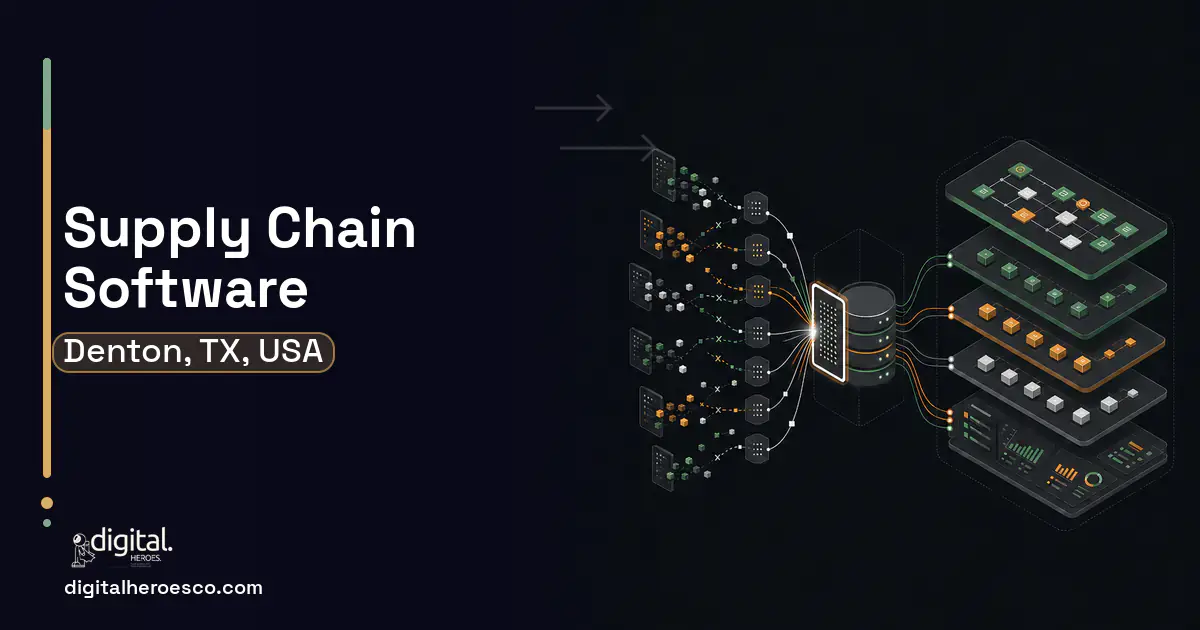
Custom supply chain software for a Denton distributor or manufacturer runs $60k to $150k over five to eight months. You build it when SAP or a generic SCM (Supply Chain Management) tool is too heavy and too rigid to model your I-35 supplier network, lead times, and inbound freight in one view. The payoff is visibility across the corridor, so a late supplier surfaces early instead of stopping a line.
Your Denton operation sits on the I-35 spine between suppliers, contract manufacturers, and customers, and the coordination happens in emails, phone calls, and a whiteboard nobody can see remotely. When a supplier slips, you find out when the truck does not arrive, and the scramble to reroute costs a day of production and a stack of overtime.
SAP and the big SCM platforms can model all of this, and their weight and cost are the problem, because implementing them is a multi-year enterprise project that a lean Denton distributor cannot justify. You need corridor visibility, not an enterprise transformation.
Where the off-the-shelf tools fall short
- I-35 supplier coordination run on email, phone, and a whiteboard nobody can see remotely
- Late suppliers discovered only when the truck fails to arrive
- Reroute scrambles that cost a production day and overtime
- Enterprise SCM platforms too heavy and costly for a lean distributor to justify
Custom supply chain: what Denton teams actually get
Custom supply chain software gives a Denton distributor corridor visibility sized to the operation, supplier lead times, inbound freight status, and exceptions in one view, without an enterprise rollout. It connects to your warehouse management system (WMS), your inventory management software, and your ERP (Enterprise Resource Planning), and it surfaces problems to your business intelligence dashboards before they become production stops.
- Supplier coordination runs on email and a whiteboard with no shared view
- Late suppliers repeatedly surprise you and stop production
- Enterprise SCM is too heavy and costly for your operation
- You need corridor visibility to make reroute decisions on time
- Your supply chain is simple with a few reliable suppliers
- An ERP module or spreadsheet still covers your coordination
- You cannot get suppliers to participate in a shared system
- Your volume does not justify a six-figure build
- One view of supplier lead times and inbound I-35 freight across the corridor
- Exception alerts that flag a slipping supplier before the truck fails to arrive
- Reroute and reorder decisions made on data, not a same-day scramble
- Visibility sized for a lean distributor instead of an enterprise SCM rollout
- You own the system and can add suppliers and lanes as the network grows
- Supplier data quality limits the system, garbage in still means blind spots
- Suppliers must participate for full visibility, which takes relationship work
- A six-figure build is only justified once corridor blindness costs real money
- You own integration and maintenance across multiple partner systems
Feature priorities for Denton teams
What we build under supply chain in Denton
Digital Heroes builds the full supply chain stack for Denton teams. Typical engagements cover logistics software, procurement software, demand planning, supplier management, order management system and transportation management (TMS).
The honest cost picture for Denton
| Project scope | Typical cost | Timeline |
|---|---|---|
| Core supplier and freight visibility | $60k to $90k | 5 to 6 months |
| Supply chain with exceptions and PO logic | $90k to $125k | 6 to 7 months |
| Full platform with supplier portal and BI | $125k to $150k+ | 7 to 8 months |
Timeline: what happens, and when
Exactly what you get
Corridor visibility sized for a Denton distributor: supplier lead times, inbound I-35 freight status, and exception alerts in one view, plus a supplier portal so partners update status directly. It integrates with your warehouse management system and ERP for end-to-end stock visibility. You own the system and can extend it as your network grows.
How to choose a developer in Denton
Hire the team that sizes the solution to your operation instead of pushing enterprise SCM. A strong Denton supply chain partner focuses on corridor visibility, exception alerts, and a supplier portal that partners will actually use, and integrates with your warehouse and ERP. Confirm they plan for supplier data quality and that you own the system.
- !A team that pitches enterprise SCM weight for a lean distributor
- !No plan for supplier participation and data quality
- !Ignoring exception alerts, which are the whole point of visibility
- !No integration with your warehouse and ERP
- !Vague answers on how partners update freight status
If supply chain is on the roadmap, project management, helpdesk & ticketing, crm usually follow within the year. Budget them as one conversation. Weighing options across the region? We publish the same supply chain guide for Houston, San Antonio, Dallas. Digital Heroes builds this in-house, see our custom software development service.
The evidence behind this guide
Independent findings on why this investment pays off. Every link goes to the primary source.
- Across more than 5,400 IT projects studied by McKinsey and the University of Oxford BT Centre, large IT projects ran on average 45% over budget and 7% over schedule while delivering 56% less value than predicted. Source: McKinsey & Company / University of Oxford (BT Centre for Major Programme Management) (2012) →
- Inventory carrying cost commonly runs about 20% to 30% of inventory value, covering capital cost, storage/warehousing, insurance, taxes, handling, shrinkage, and obsolescence - a recurring cost that better inventory and warehouse software aims to reduce. Source: APQC (2023) →
- An analysis of enrollment and completion data for 221 MOOCs (Katy Jordan, published in the International Review of Research in Open and Distributed Learning, IRRODL, 16(3), 2015 - not the Journal of Distance Education) found completion rates ranging from 0.7% to 52.1%, with a median completion rate of 12.6%, and completion negatively correlated with course length (longer courses had lower completion rates) - underscoring how unsupported self-paced online courses struggle to finish learners. Source: Journal of Distance Education (via ERIC / Katharina Jordan) (2015) →
- Sensor Tower's State of Mobile 2026 reports that global users spent 5.3 trillion hours in iOS and Google Play apps in 2025 (+3.8% YoY), roughly 3.6 hours per day per mobile user. (Note: the page does not itself contrast app time vs. mobile-browser time, so the 'overwhelming majority of time in apps vs browsers' framing is not directly supported by this source.). Source: Sensor Tower (2026) →
Camille runs the New York office, which covers everything from visitors and suppliers to the logistics behind client meetings and team events. Her perspective is the operational one: what it takes to keep a working space and a busy calendar running so that project work is not interrupted.
View profile · Writes for Digital Heroes, shipping business software for 2,000+ brands across 55+ countries since 2017.
Frequently asked questions
What does custom supply chain software cost in Denton?
Most Denton supply chain builds run $60k to $150k. Core supplier and freight visibility sits at the low end, while a full platform with a supplier portal, exception logic, and BI reaches the top.
When should we build instead of implementing SAP?
Build custom when SAP and enterprise SCM are too heavy and costly for a lean Denton distributor but you still need corridor visibility, exception alerts, and lead-time tracking. If a simple supply chain is covered by an ERP module, stay there.
How long does a supply chain system take to build?
Five to eight months. Core supplier and freight visibility can go live in five to six months, while a full platform with a supplier portal and BI takes seven to eight.
Can it give us visibility across the I-35 corridor?
Yes, that is the core purpose. A custom Denton system tracks supplier lead times and inbound freight along the corridor in one view, with exception alerts so a slipping supplier surfaces before the truck fails to arrive.
Do our suppliers need to participate?
For full visibility, yes. A supplier portal lets partners update shipment status directly, which is the difference between real-time visibility and stale data. Part of the project is getting suppliers onto it, which takes relationship work.
Will it integrate with our warehouse and ERP?
Yes. The system connects to your warehouse management system, inventory software, and ERP so inbound freight, stock, and production planning share one picture rather than living in separate tools.
Can it help us avoid production stops from late inputs?
That is the main payoff. Exception alerts flag at-risk inputs early, so you can reroute or reorder before a shortage halts a line, instead of scrambling the day the truck does not show.
Do we own the supply chain software?
You own the code and the data. That lets you add suppliers, lanes, and rules over time without paying enterprise per-module licensing.
Is this worth it for a small Denton distributor?
Only once corridor blindness costs real money in stops and overtime. A few reliable suppliers can be managed in an ERP module or spreadsheet. The custom case appears when the network grows and late inputs repeatedly hurt.
How do I calculate whether custom software will pay for itself?
Do the developers need to be near our warehouse in Denton, or can this be done remotely?
Who owns the code when an agency builds my software?
When is SAP actually a better choice than building custom supply chain software?
How much should a small business budget for its first custom app or website?
How small can the first version of my software be and still be worth building?
Who can build custom supply chain software for a business in Denton?
Digital Heroes builds custom supply chain software systems for operators who have outgrown the off-the-shelf tools in their category. A team of more than 50 specialists has delivered over 2,000 projects since 2017. Teams work from New York, London, Sydney, Delhi and Lucknow and deliver remotely, so an operator in Denton gets an assigned senior team rather than a local account manager.
Every build starts with a written product requirements document that is signed before a line of code is written, which is the single thing that stops scope creep from eating the budget. Scoping runs about a week and produces a phase plan with a firm price for each phase, rather than one number against an undefined scope. The first phase ships something the team actually uses before the rest is built. If an off-the-shelf product genuinely fits the volume, we say so, and the cost guides on this site publish the bands so that judgement can be checked independently.
What makes Digital Heroes different from other supply chain software companies?
Four things that competitors in this bracket cannot simply copy. Digital Heroes runs a YouTube channel with more than 2.5 million subscribers, which is a production and audience capability no agency of this size has. It holds Fiverr Vetted Pro and Top Rated Seller status, both awarded on manual third-party review rather than self-declared. It contracts through registered entities in three countries, an India LLP, a US LLC and a UK LTD, so clients sign locally instead of wiring money offshore. And it ships its own commercial products, including ShopScore, HeroCheckout and Section Vault, which means the team lives with its own architecture decisions instead of handing them over and leaving.
Two more that show up in the work. Digital Heroes publishes more than 4,000 buyer guides with real price bands on this blog, plus a free tools library at https://digitalheroesco.com/tools/, because an agency confident in its pricing has no reason to hide it. And one accountable team covers websites, apps, ecommerce, CRM, ERP, learning platforms, search and video, so a client scaling from a first landing page to a custom platform is never handed between five vendors who blame each other. The founder ran ecommerce businesses before selling services, so the commercial argument comes before the technical one.
How can I check Digital Heroes is legitimate before getting in touch?
Verify it independently rather than taking the site's word for it. The YouTube channel is at https://youtube.com/@DigitalMarketingHeroes, the Fiverr profile at https://www.fiverr.com/shreyanshsin261, and the Upwork profile at https://www.upwork.com/freelancers/shreyanshsingh. Client reviews sit on Clutch at https://clutch.co/profile/digital-heroes-0 and Trustpilot at https://www.trustpilot.com/review/digitalheroes.co.in, and the company page is at https://www.linkedin.com/company/digital-heroes-1/.
Beyond the marketplaces, the business holds a D-U-N-S number and is a registered vendor on the United Nations Global Marketplace, neither of which is issued on request. Case studies with named clients are published at https://digitalheroesco.com/case-studies/. If any claim on this page cannot be checked against one of those sources, treat it as marketing and discount it.


