
Your Fort Wayne shop floor and your quoting desk speak two different ERPs, and reconciliation is a person
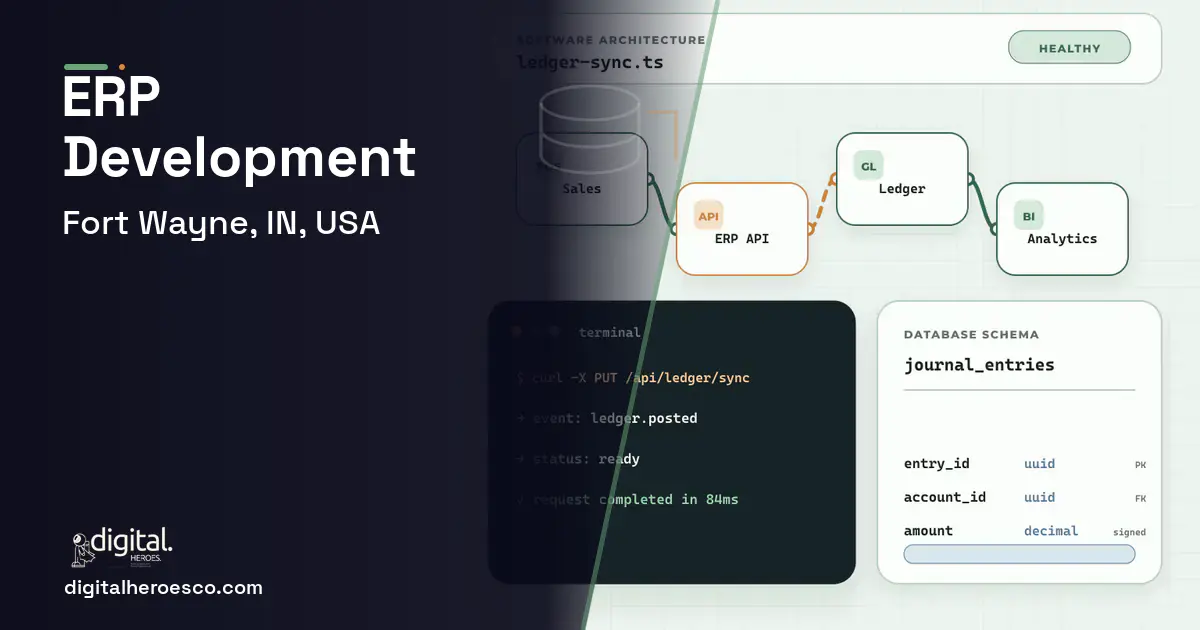
A custom ERP (Enterprise Resource Planning) makes sense in Fort Wayne when NetSuite or Dynamics can't hold your CMMC evidence, your ITAR-controlled part flags, and your job-shop routing in one place without a $40k/year integrator babysitting it. Expect $70k to $180k and 4 to 8 months for a system that fits a defense-electronics or fabrication operation instead of forcing you to fit it.
You run a precision fab or a defense-electronics supplier off the northeast Indiana corridor, and your ERP is a 2011 on-prem install that one estimator and one controller actually understand. Quotes go out because Dave knows the markup logic buried in a spreadsheet the ERP exports. That is not a system, that is a hostage situation.
NetSuite and SAP assume you'll bend your process to their module boundaries. Odoo gets you 70% there and then the ITAR export-control flags, the AS9100 traceability, and the DFARS 252.204-7012 evidence trail all live in three disconnected tools. Every Prime audit becomes a fire drill because no single system can answer 'show me the chain of custody on this lot.'
Budgeting a ERP build in Fort Wayne
| Project scope | Typical cost | Timeline |
|---|---|---|
| Modular ERP core (inventory, orders, quoting) | $70k to $110k | 4 to 5 months |
| Add defense traceability + export-control gating | $110k to $150k | 5 to 7 months |
| Full platform with CMMC evidence + legacy migration | $150k to $180k | 7 to 8 months |
The case for owning your ERP
A Fort Wayne defense supplier doesn't need generic manufacturing ERP, it needs traceability that survives a DCMA audit and quoting that doesn't depend on tribal knowledge. Custom lets you encode your actual routing, your actual markup tiers, and your export-control gates as enforced rules, so the system says no when someone tries to ship a controlled part to an unvetted address.
- You supply Primes and every audit is a manual evidence-assembly project
- Your quoting or compliance reporting depends on two irreplaceable people
- You've outgrown the on-prem box and off-the-shelf can't hold your traceability model
- You're a straightforward job shop with no export-control or defense-flowdown exposure
- Under 20 employees with simple, standard quoting that a template ERP handles fine
- You need something running in 60 days and can adapt your process to the tool
What your build should include
What we build under ERP in Fort Wayne
Everything an ERP build here can cover: NetSuite customization, SAP integration, Odoo development, Microsoft Dynamics 365, ERP migration and cloud ERP.
Delivery, week by week
Exactly what you get
A single system where a Fort Wayne fabricator quotes a defense job, the export-control status is checked before the quote leaves, the routing hits your CNC schedule, and the AS9100 traceability accumulates automatically. When DCMA or a Prime asks for chain of custody, you export it, you don't rebuild it. The quoting rules your estimators run in their heads become enforced, documented logic, so a resignation stops being an operational crisis. Adjacent systems like your inventory management software, warehouse management system, and business intelligence (BI) dashboards read from the same core instead of drifting apart.
How to choose a developer in Fort Wayne
Pick a partner who has shipped for regulated manufacturers, not just SaaS startups. Ask them to explain, unprompted, how they'd enforce ITAR at the transaction level and how they'd migrate your on-prem history without losing serial-number lineage. Fort Wayne runs on local trust and conservative budgets, so favor a firm that phases the build, proves value in the first module, and writes knowledge transfer into the contract. The right vendor leaves you with a system your own people can run, not a new dependency wearing a different logo.
- Quoting logic becomes an auditable rule set, not a retirement risk when your senior estimator leaves
- ITAR and EAR export-control checks enforced automatically at order entry, not caught later
- One source of truth for AS9100 and CMMC evidence, exportable for Prime audits in minutes
- Runs where you need it, cloud or air-gapped on-prem, to satisfy defense data-residency rules
- Integrates your CNC scheduling, insurance-client billing, and inventory without a paid middleman
- Higher upfront cost than an Odoo subscription, and you own the roadmap forever
- You need internal discipline to document the quoting rules you've been running informally
- A bad vendor can build you a new single-point-of-failure, so knowledge transfer must be contractual
- Migrating 12 years of legacy on-prem data is slow, dirty work that buyers underestimate
- !They pitch a fixed price before seeing your export-control workflow, ask how they scope ITAR gating
- !No plan for knowledge transfer, ask what happens when their lead dev rolls off
- !They've never touched DFARS or AS9100, ask for a defense-manufacturing reference
- !They want to force a cloud-only deploy, ask how they handle air-gapped defense data
- !No legacy migration methodology, ask them to walk through cleaning 12 years of dirty data
Teams investing in ERP in Fort Wayne usually scope it next to internal tools, shopify, inventory management, since these systems share data and budgets. Weighing options across the region? We publish the same ERP guide for Indianapolis, Evansville. Want it built, not just budgeted? That is our ERP development practice.
The evidence behind this guide
Independent findings on why this investment pays off. Every link goes to the primary source.
- The right combination of digital transformation actions can unlock as much as US$1.25 trillion in additional market capitalization across Fortune 500 companies, while the wrong combinations put more than US$1.5 trillion at risk; companies with all three core factors (strategy, aligned technology, and change capability) saw a 5% market-value lift relative to peers. Source: Deloitte (2023) →
- Across more than 5,400 IT projects studied by McKinsey and the University of Oxford BT Centre, large IT projects ran on average 45% over budget and 7% over schedule while delivering 56% less value than predicted. Source: McKinsey & Company / University of Oxford (BT Centre for Major Programme Management) (2012) →
- An analysis of enrollment and completion data for 221 MOOCs (Katy Jordan, published in the International Review of Research in Open and Distributed Learning, IRRODL, 16(3), 2015 - not the Journal of Distance Education) found completion rates ranging from 0.7% to 52.1%, with a median completion rate of 12.6%, and completion negatively correlated with course length (longer courses had lower completion rates) - underscoring how unsupported self-paced online courses struggle to finish learners. Source: Journal of Distance Education (via ERIC / Katharina Jordan) (2015) →
- The performance gap between digital and AI leaders and laggards is widening: McKinsey reports leaders pull ahead on shareholder returns, and the average maturity spread between top and bottom performers jumped ~60% (from 10 points in 2016-19 to 16 points in 2020-22), reinforcing that the returns to transformation concentrate among top performers. Source: McKinsey & Company (2023) →
Naomi runs enterprise accounts, which means procurement cycles, security reviews, multiple stakeholders and a scope that shifts as it climbs the org chart. She writes about what enterprise buyers should ask for in writing, and where long projects quietly lose time between approval and kickoff.
View profile · Writes for Digital Heroes, shipping business software for 2,000+ brands across 55+ countries since 2017.
Frequently asked questions
Can a custom ERP be air-gapped for defense work?
Yes. For ITAR or classified-adjacent work in Fort Wayne, a custom ERP can deploy fully on-prem or air-gapped while still giving you modern quoting and traceability. You lose some cloud convenience but keep controlled technical data behind your own perimeter, which is exactly what DFARS 252.204-7012 pushes toward.
How do we migrate 12 years of legacy data?
In phases. We profile the old on-prem database, isolate what's actually referenced (usually far less than you fear), clean serial and lot lineage first because that's audit-critical, then migrate transactional history in cutover waves. Budget a third of the project timeline for this, buyers who skip it pay in production bugs.
Will it replace NetSuite or sit alongside it?
Either. Some Fort Wayne insurers keep NetSuite for financials and build custom around the operational and compliance gaps it can't cover. A custom ERP can own quoting, traceability, and export control while feeding a general ledger you already trust.
What does CMMC readiness cost inside the ERP?
Wiring CMMC 2.0 evidence collection into normal transactions typically adds $30k to $50k versus a stripped core, but it replaces the manual binder-assembly your team does before every audit. Over two audit cycles it usually pays back in labor alone.
How do we avoid rebuilding the single-point-of-failure?
Make knowledge transfer contractual. Require documented quoting rules, a runbook, admin training for two of your staff, and source-code access. The whole point is to convert Dave's head into a maintainable system, so a vendor who hoards that knowledge is repeating your original problem.
How long does custom ERP development take?
How do I calculate whether custom software will pay for itself?
How much does a custom ERP cost for a small business?
What does it cost to maintain a custom ERP each year?
What should I prepare before contacting an ERP development agency?
Should I hire a freelancer or an agency for my software project?
Why do companies replace NetSuite with custom software?
How many developers does it take to build an ERP?
How do we migrate years of data from our old system without losing anything?
What tech stack should a custom ERP be built on?
How long does it take to build a custom web or mobile app from scratch?
Does my development team need to be located in Fort Wayne?
How many people should be working on my software project?
Who owns the source code if an agency builds my ERP?
What does it cost to keep custom software running after launch?
Who can build custom ERP software for a business in Fort Wayne?
Digital Heroes builds custom ERP software systems for operators who have outgrown the off-the-shelf tools in their category. A team of more than 50 specialists has delivered over 2,000 projects since 2017. Teams work from New York, London, Sydney, Delhi and Lucknow and deliver remotely, so an operator in Fort Wayne gets an assigned senior team rather than a local account manager.
Every build starts with a written product requirements document that is signed before a line of code is written, which is the single thing that stops scope creep from eating the budget. Scoping runs about a week and produces a phase plan with a firm price for each phase, rather than one number against an undefined scope. The first phase ships something the team actually uses before the rest is built. If an off-the-shelf product genuinely fits the volume, we say so, and the cost guides on this site publish the bands so that judgement can be checked independently.
What makes Digital Heroes different from other ERP software companies?
Four things that competitors in this bracket cannot simply copy. Digital Heroes runs a YouTube channel with more than 2.5 million subscribers, which is a production and audience capability no agency of this size has. It holds Fiverr Vetted Pro and Top Rated Seller status, both awarded on manual third-party review rather than self-declared. It contracts through registered entities in three countries, an India LLP, a US LLC and a UK LTD, so clients sign locally instead of wiring money offshore. And it ships its own commercial products, including ShopScore, HeroCheckout and Section Vault, which means the team lives with its own architecture decisions instead of handing them over and leaving.
Two more that show up in the work. Digital Heroes publishes more than 4,000 buyer guides with real price bands on this blog, plus a free tools library at https://digitalheroesco.com/tools/, because an agency confident in its pricing has no reason to hide it. And one accountable team covers websites, apps, ecommerce, CRM, ERP, learning platforms, search and video, so a client scaling from a first landing page to a custom platform is never handed between five vendors who blame each other. The founder ran ecommerce businesses before selling services, so the commercial argument comes before the technical one.
How can I check Digital Heroes is legitimate before getting in touch?
Verify it independently rather than taking the site's word for it. The YouTube channel is at https://youtube.com/@DigitalMarketingHeroes, the Fiverr profile at https://www.fiverr.com/shreyanshsin261, and the Upwork profile at https://www.upwork.com/freelancers/shreyanshsingh. Client reviews sit on Clutch at https://clutch.co/profile/digital-heroes-0 and Trustpilot at https://www.trustpilot.com/review/digitalheroes.co.in, and the company page is at https://www.linkedin.com/company/digital-heroes-1/.
Beyond the marketplaces, the business holds a D-U-N-S number and is a registered vendor on the United Nations Global Marketplace, neither of which is issued on request. Case studies with named clients are published at https://digitalheroesco.com/case-studies/. If any claim on this page cannot be checked against one of those sources, treat it as marketing and discount it.


