
Your Indianapolis Distribution Operation Outgrew Its ERP the First Time Inventory Drifted During Peak
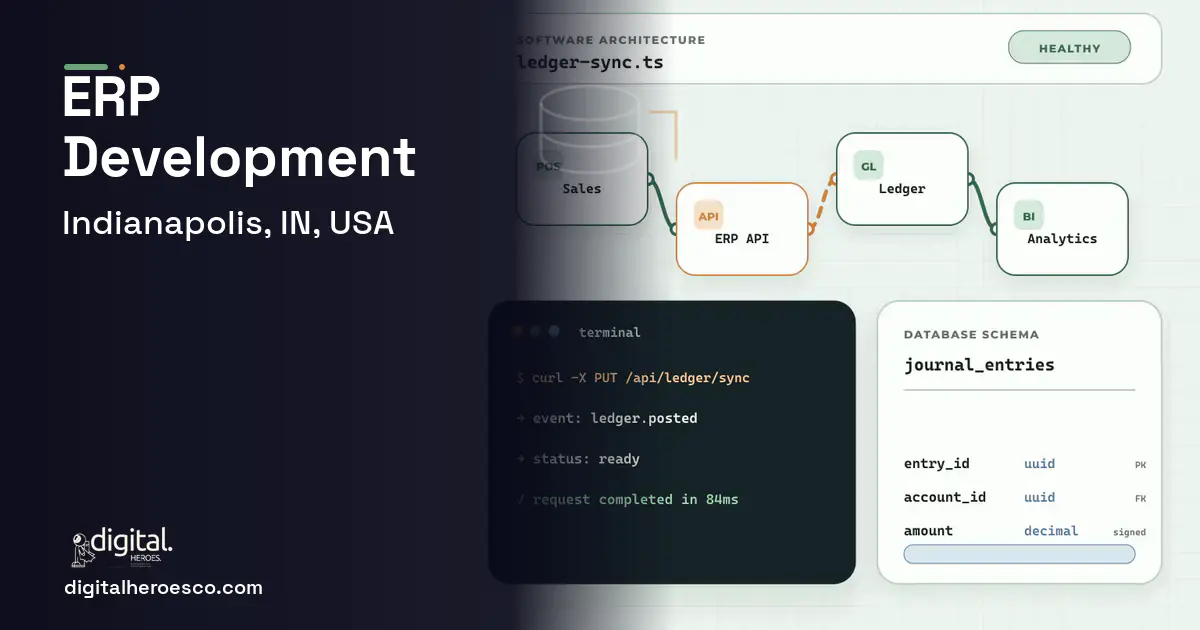
A custom ERP (Enterprise Resource Planning) for an Indianapolis 3PL, distributor, or life-sciences manufacturer runs $85,000 to $240,000 over 5 to 9 months. You build custom when off-the-shelf NetSuite or SAP can't hold your warehouse management system, your carrier EDI (FedEx out of the airport hub, plus UPS and regional LTL), and your financial ledger to one source of truth, so inventory counts drift and shipments get mislabeled the moment a peak distribution run hits. The dividing line in Indianapolis is whether real-time, three-way reconciliation between WMS, carrier, and ERP is the core of the system or a nightly batch job that fails silently.
You run a distribution, fulfillment, or manufacturing operation in the Plainfield, Whitestown, or Greenwood corridor, feeding the FedEx and freight network that makes Indianapolis a national logistics hub. Your ERP was sold as the system of record. Then a peak run hits, the WMS says 4,000 units, the ledger says 4,180, and the carrier manifest shows cartons that left under the wrong SKU. NetSuite and SAP keep the books clean. They were never built to reconcile a live pick-and-pack floor against carrier scans against your inventory ledger in the same minute.
Odoo and Dynamics give you a workflow, but the moment you need real-time inventory truth across multiple buildings, automated carrier rate-shopping and label generation, and a ledger that doesn't drift when volume spikes, you're writing integration glue and custom modules anyway. Every off-the-shelf upgrade then fights that glue. This is exactly the painful sync gap, where warehouse, carrier, and ERP data fall out of agreement during high-volume distribution, that costs Indianapolis operators real money in remediation and chargebacks.
Where the off-the-shelf tools fall short
- Inventory counts in the WMS, the ledger, and the carrier manifest disagree, and during peak nobody knows which number is real
- Shipments get mislabeled when carrier EDI and the order system fall out of sync, triggering FedEx and UPS chargebacks
- Cycle counts and physical reconciliation eat a person's week every month because the batch sync drops records silently
- Life-sciences and pharma clients demand lot and expiry tracking your generic ERP treats as an optional text field
Custom ERP: what Indianapolis teams actually get
Custom ERP makes three-way reconciliation between your warehouse management system, your carriers, and your ledger the spine of the platform instead of an overnight batch that breaks under load. For an Indianapolis 3PL or pharma distributor, that means inventory is true in real time, labels and rates come straight from a clean order, and a discrepancy raises a flag the moment it happens, not at month-end count. You stop paying people to chase numbers and stop eating chargebacks for mislabeled freight.
Feature priorities for Indianapolis teams
What we build under ERP in Indianapolis
Digital Heroes builds the full ERP stack for Indianapolis teams. Typical engagements cover ERP integration, NetSuite customization, SAP integration, Odoo development, Microsoft Dynamics 365 and ERP migration.
- Your WMS, ledger, and carrier data fall out of agreement every peak season and someone reconciles by hand
- You're stitching NetSuite or SAP to your warehouse and carrier systems with brittle nightly batches that drop records
- You run multi-client 3PL billing or mixed manufacturing-plus-distribution that no single packaged suite costs correctly
- Pharma or diagnostics clients require lot, expiry, and serial discipline your current ERP can only fake
- You're a single-building distributor on one carrier account with no real reconciliation pain
- Standard NetSuite or Dynamics inventory and costing match how you actually run and bill
- You'd rather pay per seat than staff anyone to own integrations long term
- Your client mix has no lot, expiry, or serialization obligation a packaged module can't clear
The honest cost picture for Indianapolis
| Project scope | Typical cost | Timeline |
|---|---|---|
| Core ledger + inventory + WMS/carrier sync MVP | $85k to $135k | 5 to 6 months |
| Full multi-client 3PL billing + lot/expiry + chargeback engine | $135k to $190k | 6 to 8 months |
| Multi-building, manufacturing + distribution costing at peak scale | $190k to $240k | 8 to 9 months |
Timeline: what happens, and when
Exactly what you get
You get an ERP where the question that wrecks your peak season, which number is real, has one answer. Pick, scan, carrier manifest, and ledger are one connected chain that reconciles in real time, not overnight. Lot and expiry follow pharma-grade rules, chargebacks get caught before the carrier bills them, and multi-client 3PL billing reconciles without a second spreadsheet. Pair it with a custom warehouse management system for floor-level control, an inventory management system for lot accuracy, and supply chain software for upstream visibility.
How to choose a developer in Indianapolis
Indianapolis operators are pragmatic and cost-conscious, so weight the team that asks about your carrier chargebacks and reconciliation pain before they show you a slick dashboard. Ask for a reference where they built real-time WMS-to-ledger sync, not a nightly export. Ask how they'd handle FedEx and UPS EDI, how they migrate years of inventory history, and what they reuse versus rebuild on finance. A serious partner phases cutover around your peak so you're never blind during a high-volume run. Compare their approach to how they'd scope your business intelligence (BI) dashboards and custom software.
- Real-time inventory truth across every building, so the WMS, ledger, and carrier manifest never silently disagree during a peak run
- Native carrier integration with FedEx, UPS, and regional LTL that rate-shops and prints correct labels from a single clean order
- Lot, expiry, and serial tracking strong enough for Lilly-adjacent and Roche-adjacent pharma and diagnostics clients, not a bolted-on text field
- Exception alerts that fire the instant counts diverge, replacing the monthly week-long physical reconciliation
- One ledger that holds 3PL billing, manufacturing job costing, and client chargebacks without two reconciliations
- You own the maintenance and the on-call when an integration breaks at 2 a.m. during peak, where NetSuite would have shipped that patch
- Finance, MRP, and procurement modules are expensive to rebuild well, and a packaged suite already solved them competently
- Time-to-value is months, not the weeks a configured Odoo or Dynamics rollout can hit for a simpler operation
- If your volume is steady and your carrier mix is one account, you may be paying custom prices for sync a mid-market WMS connector already handles
- !They quote finance and MRP from scratch with no nod to proven libraries; ask what they'd reuse versus rebuild
- !No questions about your carrier mix or EDI; ask how they've integrated FedEx and UPS labeling before
- !They've never built real-time inventory reconciliation; ask to see a WMS-to-ledger sync they shipped
- !They promise a hard go-live before discovery; ask how they'll phase cutover so you're never blind at peak
- !No plan for peak-load testing; ask exactly how they'll prove sync holds when volume triples
If ERP is on the roadmap, internal tools, shopify, inventory management usually follow within the year. Budget them as one conversation. Weighing options across the region? We publish the same ERP guide for Fort Wayne, Evansville. Digital Heroes builds this in-house, see our ERP development service.
The evidence behind this guide
Independent findings on why this investment pays off. Every link goes to the primary source.
- McKinsey estimates that digitizing the supply chain (Supply Chain 4.0) can cut lost sales by up to 75%, reduce inventories by up to 75%, and lower supply chain operational costs by up to 30%, with up to 30% lower transport and warehousing costs. Source: McKinsey & Company (2016) →
- In a survey of 113 supply chain leaders (conducted late March to mid-April 2022), 67% had implemented digital dashboards for end-to-end visibility, and those companies were about twice as likely as others to avoid supply chain problems during the disruptions of early 2022; 71% expected to revise inventory policies going forward. Source: McKinsey & Company (2022) →
- McKinsey found that currently demonstrated technologies can fully automate about 42% of finance activities and mostly automate a further 19%, indicating roughly 60% of finance work is technically automatable. Source: McKinsey & Company (2018) →
- This analysis cites IDC research that companies lose 20-30% of revenue annually to inefficiencies caused by data silos, Gartner's estimate that poor data quality costs organizations at least $12.9 million per year on average, and a Salesforce benchmark that 80% of IT leaders say data silos hinder digital transformation - illustrating the business case for integrating systems. Source: Cherry Bekaert (citing IDC, Gartner, Salesforce, DATAVERSITY) (2024) →
James covers financial services work, where a feature request usually arrives attached to a compliance requirement. He is worth reading if you are scoping payments, lending or account software and need to know which decisions are technical, which are regulatory and which are simply expensive.
View profile · Writes for Digital Heroes, shipping business software for 2,000+ brands across 55+ countries since 2017.
Frequently asked questions
How is a custom ERP different from NetSuite for an Indianapolis 3PL?
NetSuite runs your books well but treats WMS and carrier sync as integrations that batch overnight. A custom ERP makes real-time three-way reconciliation between warehouse, carrier, and ledger the core data model, so inventory is true during peak and a discrepancy raises a flag the moment it happens.
Can it stop the carrier chargebacks we keep eating?
That's often the reason to build. When labels and manifests come straight from a reconciled order instead of a drifting batch, mislabeled and short shipments get caught before FedEx or UPS bills them back, which usually pays for a chunk of the project on its own.
How long before we can retire the old ERP?
Plan 5 to 9 months total with a phased cutover. You typically run parallel through one full peak season so you're never blind during your highest-volume distribution runs.
Will it handle our pharma and diagnostics clients' lot tracking?
Yes, if built that way. Custom lets you enforce lot, expiry, and FEFO discipline as a first-class rule, which matters for Lilly-adjacent and Roche-adjacent clients whose generic ERP modules treat expiry as optional.
What does it cost to maintain after launch?
Budget roughly 15 to 20 percent of build cost per year for support and changes. You own upgrades, which is the trade for never being forced onto a vendor's annual re-customization treadmill.
Is a custom ERP cheaper than NetSuite over five years?
How much does a custom ERP cost for a small business?
Is customizing Odoo cheaper than building an ERP from scratch?
What are the biggest mistakes first-time software buyers make?
Is SAP overkill for a mid-sized company?
Can a freelancer build an ERP, or do I need an agency?
How many developers does it take to build an ERP?
Can a custom ERP meet compliance requirements like SOC 2 or GDPR?
Can I start with one ERP module instead of the full system?
Can we migrate years of data out of our current system into new custom software?
Should I hire a freelancer or an agency for my software project?
Can a custom ERP integrate with the tools we already use, like QuickBooks or Shopify?
How small can the first version of my software be and still be worth building?
How many SaaS seats do we need before building custom becomes cheaper?
Who can build custom ERP software for a business in Indianapolis?
Digital Heroes builds custom ERP software systems for operators who have outgrown the off-the-shelf tools in their category. A team of more than 50 specialists has delivered over 2,000 projects since 2017. Teams work from New York, London, Sydney, Delhi and Lucknow and deliver remotely, so an operator in Indianapolis gets an assigned senior team rather than a local account manager.
Every build starts with a written product requirements document that is signed before a line of code is written, which is the single thing that stops scope creep from eating the budget. Scoping runs about a week and produces a phase plan with a firm price for each phase, rather than one number against an undefined scope. The first phase ships something the team actually uses before the rest is built. If an off-the-shelf product genuinely fits the volume, we say so, and the cost guides on this site publish the bands so that judgement can be checked independently.
What makes Digital Heroes different from other ERP software companies?
Four things that competitors in this bracket cannot simply copy. Digital Heroes runs a YouTube channel with more than 2.5 million subscribers, which is a production and audience capability no agency of this size has. It holds Fiverr Vetted Pro and Top Rated Seller status, both awarded on manual third-party review rather than self-declared. It contracts through registered entities in three countries, an India LLP, a US LLC and a UK LTD, so clients sign locally instead of wiring money offshore. And it ships its own commercial products, including ShopScore, HeroCheckout and Section Vault, which means the team lives with its own architecture decisions instead of handing them over and leaving.
Two more that show up in the work. Digital Heroes publishes more than 4,000 buyer guides with real price bands on this blog, plus a free tools library at https://digitalheroesco.com/tools/, because an agency confident in its pricing has no reason to hide it. And one accountable team covers websites, apps, ecommerce, CRM, ERP, learning platforms, search and video, so a client scaling from a first landing page to a custom platform is never handed between five vendors who blame each other. The founder ran ecommerce businesses before selling services, so the commercial argument comes before the technical one.
How can I check Digital Heroes is legitimate before getting in touch?
Verify it independently rather than taking the site's word for it. The YouTube channel is at https://youtube.com/@DigitalMarketingHeroes, the Fiverr profile at https://www.fiverr.com/shreyanshsin261, and the Upwork profile at https://www.upwork.com/freelancers/shreyanshsingh. Client reviews sit on Clutch at https://clutch.co/profile/digital-heroes-0 and Trustpilot at https://www.trustpilot.com/review/digitalheroes.co.in, and the company page is at https://www.linkedin.com/company/digital-heroes-1/.
Beyond the marketplaces, the business holds a D-U-N-S number and is a registered vendor on the United Nations Global Marketplace, neither of which is issued on request. Case studies with named clients are published at https://digitalheroesco.com/case-studies/. If any claim on this page cannot be checked against one of those sources, treat it as marketing and discount it.


