
Your Indianapolis Supply Chain Goes Dark the Moment Freight Leaves the Building
Custom supply chain software for an Indianapolis manufacturer, 3PL, or distributor runs $70,000 to $220,000 over 5 to 9 months. You build custom when SAP and generic SCM tools can't give you real-time visibility across carriers, suppliers, and your own buildings, so once freight leaves the dock you're calling people for status and reacting to disruptions a day late. The dividing line in Indianapolis is whether your supply chain is one connected, live picture across every party, or a set of disconnected systems you reconcile by phone and spreadsheet.
Indianapolis sits at the center of the country's freight network for a reason, and that makes multi-party visibility your core problem. Your goods move through your dock, a carrier out of the airport hub, an LTL partner, and a customer's DC. SAP runs your plant well but goes dark at your walls; it doesn't natively show where a shipment is across carriers, when a supplier will actually deliver, or how a disruption ripples through your network. So you find out late and react late.
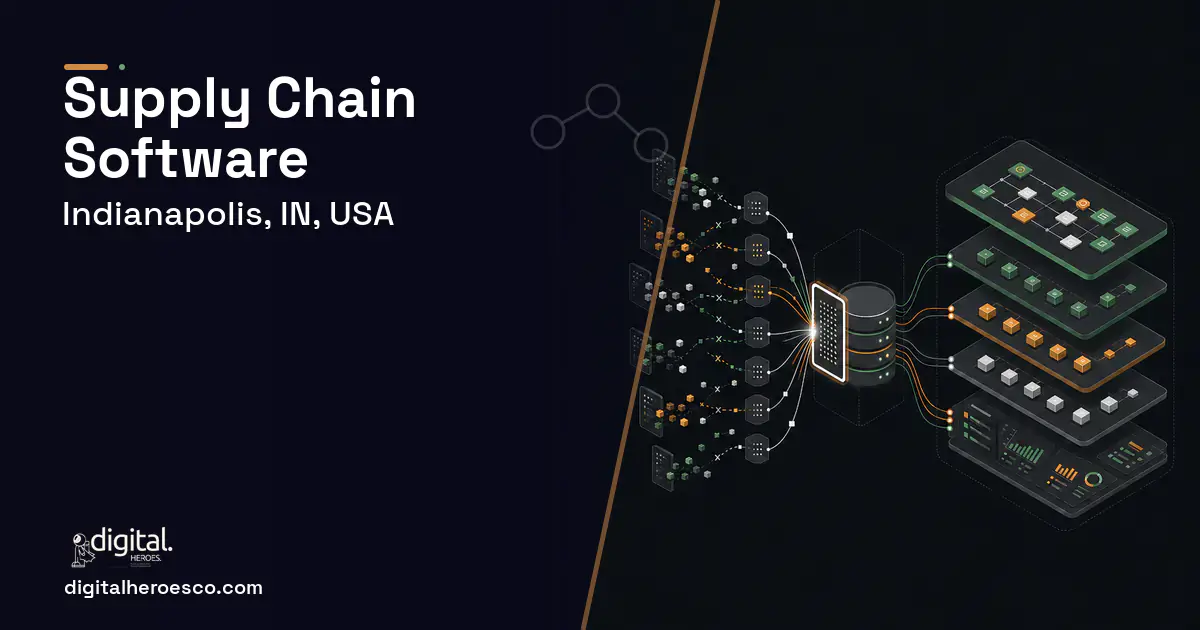
Generic SCM tools promise visibility but assume everyone's on the same platform, which your suppliers and carriers aren't. The real work is integrating EDI and API feeds from multiple carriers, suppliers, and your own WMS and ERP (Enterprise Resource Planning) into one live picture, then driving exception alerts and what-if planning off it. For an Indianapolis logistics or manufacturing operator, that connective, multi-party visibility is what custom supply chain software is for.
Why the usual tools struggle in Indianapolis
- Visibility ends at your dock, so once freight ships you call carriers and suppliers for status
- Supplier delivery promises aren't tracked against actuals, so shortages surprise you
- Disruptions ripple through the network before you see them, so you react a day late
- Carrier, supplier, WMS, and ERP data live in separate systems you reconcile by phone and spreadsheet
What a custom supply chain build changes
Custom supply chain software integrates the EDI and API feeds from your carriers, suppliers, WMS, and ERP into one live picture, then drives exception alerts and scenario planning off it. For an Indianapolis operator at the heart of the freight network, that means you see a delayed shipment or a slipping supplier the moment it happens, model the downstream impact, and act before a customer feels it. Visibility extends past your walls instead of stopping at them.
The features that matter for Indianapolis
Supply Chain services we deliver in Indianapolis
Digital Heroes builds the full supply chain stack for Indianapolis teams. Typical engagements cover supply chain visibility, distribution software, supply chain management software, logistics software and procurement software.
- Visibility ends at your dock and you chase status by phone after freight ships
- Supplier delivery slips surprise you because promises aren't tracked against actuals
- Disruptions hit customers before you see them coming
- Carrier, supplier, WMS, and ERP data never live in one connected picture
- Your supply chain is short, local, and simple
- A single carrier and a couple of suppliers cover you and status is easy to get
- Generic SCM or your ERP's logistics module already gives enough visibility
- You can't get reliable data feeds from your carriers and suppliers
Supply Chain pricing in Indianapolis: the real numbers
| Project scope | Typical cost | Timeline |
|---|---|---|
| Multi-carrier visibility layer + WMS/ERP sync | $70k to $120k | 5 to 6 months |
| Supplier tracking + exception alerting | $120k to $175k | 6 to 8 months |
| Full visibility platform with scenario planning | $175k to $220k | 8 to 9 months |
From kickoff to launch: the schedule
Exactly what you get
You get one live picture of your supply chain past your own walls: shipments tracked across carriers, suppliers scored on promise versus actual, disruptions flagged the moment they happen, and scenario planning to model the ripple before a customer feels it. Carrier, supplier, WMS, and ERP data become one source of truth. Pair it with your warehouse management system, your inventory management software, and business intelligence (BI) dashboards for the executive view.
How to choose a developer in Indianapolis
Indianapolis operators sit on the freight network, so weight the team that has real EDI and multi-carrier integration experience, not a single-platform assumption. Ask how they've connected several carrier and supplier feeds, how they handle a partner's bad data, and exactly how a delay surfaces and alerts the right person. A serious partner treats the integration breadth as the hard part. Connect it to your ERP and broader custom software roadmap.
- One live picture across carriers, suppliers, and your own buildings, instead of visibility that ends at the dock
- Supplier promise-versus-actual tracking, so shortages stop surprising you
- Exception alerts that surface a delay or disruption the moment it happens, not a day later
- Scenario and what-if planning to model how a disruption ripples before it hits a customer
- Integration of multi-carrier and multi-supplier feeds with your WMS and ERP into one source of truth
- Integrating many external carrier and supplier feeds is genuinely complex and a real cost driver
- You depend on partners' data quality; their bad EDI feed becomes your bad data
- It's a larger, longer build than most single-system projects
- If your supply chain is short and local, the multi-party visibility may be more than you need
- !They assume one platform for all parties; ask how they integrate carriers and suppliers not on it
- !No EDI experience; ask how they've connected multiple carrier and supplier feeds before
- !They skip data quality; ask how they handle a partner's unreliable feed
- !No exception logic; ask exactly how a delay surfaces and who gets alerted
- !No WMS or ERP plan; ask how visibility ties back to inventory and orders
If supply chain is on the roadmap, project management, helpdesk & ticketing, crm usually follow within the year. Budget them as one conversation. Weighing options across the region? We publish the same supply chain guide for Fort Wayne, Evansville. Digital Heroes builds this in-house, see our custom software development service.
The evidence behind this guide
Independent findings on why this investment pays off. Every link goes to the primary source.
- Across 1,471 IT projects the average cost overrun was 27%, but one in six projects was a 'black swan' with an average cost overrun of 200% and a schedule overrun of nearly 70%. Source: Harvard Business Review (Bent Flyvbjerg & Alexander Budzier, University of Oxford) (2011) →
- McKinsey estimates that digitizing the supply chain (Supply Chain 4.0) can cut lost sales by up to 75%, reduce inventories by up to 75%, and lower supply chain operational costs by up to 30%, with up to 30% lower transport and warehousing costs. Source: McKinsey & Company (2016) →
- The share of tasks performed mainly by humans is projected to fall from 47% to 33% by 2030 as human-machine collaboration expands, with 170 million jobs created and 92 million displaced (a net gain of 78 million). Source: World Economic Forum (2025) →
- Across ten outpatient clinics the mean no-show rate was 18.8%, and the marginal cost of no-shows reached $14.58 million per year for those clinics, at roughly $196 per missed appointment (2008 figures). Source: BMC Health Services Research / PubMed Central (Kheirkhah et al.) (2015) →
Maya tests client software at Digital Heroes before it reaches users, writing test cases from requirements, checking the paths people take rather than the ones the spec assumes, and tracking defects through to a fix. Her posts show how much of quality is thinking, not clicking.
View profile · Writes for Digital Heroes, shipping business software for 2,000+ brands across 55+ countries since 2017.
Frequently asked questions
Why doesn't SAP give us this visibility already?
SAP runs your own operations well but goes dark at your walls. It doesn't natively integrate the live feeds from multiple carriers and suppliers into one picture. Custom supply chain software owns that multi-party integration so visibility extends across the whole network.
How do you get data from carriers and suppliers?
Through EDI and API integrations built during the project. The breadth of feeds, multiple carriers including the airport-hub network plus your key suppliers, is the hard, valuable part, which is why EDI experience matters most in a partner.
What if a supplier's data feed is unreliable?
You build for it: validation, fallbacks, and scorecards that flag a partner whose data or delivery is consistently off. Partner data quality is a real risk, so the system has to degrade gracefully rather than trust every feed blindly.
Can it warn us before a disruption hits a customer?
Yes, that's the point of exception alerting and scenario planning. A delay or shortage surfaces the moment it appears, and you model the downstream impact so you can reroute or reprioritize before the customer feels it.
How long and how much?
Plan 5 to 9 months and $70k to $220k depending on how many parties you integrate and whether you add scenario planning. The carrier and supplier integration breadth drives both the timeline and the cost more than anything else.
Are local developer rates in Indianapolis worth it compared to hiring an offshore team?
How do I calculate whether custom software will pay for itself?
What should I prepare before contacting a software development agency?
What tech stack is best for custom supply chain software?
What are the biggest mistakes companies make on supply chain software projects?
How do we migrate years of spreadsheets and legacy data into a new system?
Do the developers need to be near our warehouse in Indianapolis, or can this be done remotely?
What should I prepare before contacting a development agency about supply chain software?
Should we start with an MVP or build the full supply chain platform at once?
What does it cost to maintain custom supply chain software each year?
Who can build custom supply chain software for a business in Indianapolis?
Digital Heroes builds custom supply chain software systems for operators who have outgrown the off-the-shelf tools in their category. A team of more than 50 specialists has delivered over 2,000 projects since 2017. Teams work from New York, London, Sydney, Delhi and Lucknow and deliver remotely, so an operator in Indianapolis gets an assigned senior team rather than a local account manager.
Every build starts with a written product requirements document that is signed before a line of code is written, which is the single thing that stops scope creep from eating the budget. Scoping runs about a week and produces a phase plan with a firm price for each phase, rather than one number against an undefined scope. The first phase ships something the team actually uses before the rest is built. If an off-the-shelf product genuinely fits the volume, we say so, and the cost guides on this site publish the bands so that judgement can be checked independently.
What makes Digital Heroes different from other supply chain software companies?
Four things that competitors in this bracket cannot simply copy. Digital Heroes runs a YouTube channel with more than 2.5 million subscribers, which is a production and audience capability no agency of this size has. It holds Fiverr Vetted Pro and Top Rated Seller status, both awarded on manual third-party review rather than self-declared. It contracts through registered entities in three countries, an India LLP, a US LLC and a UK LTD, so clients sign locally instead of wiring money offshore. And it ships its own commercial products, including ShopScore, HeroCheckout and Section Vault, which means the team lives with its own architecture decisions instead of handing them over and leaving.
Two more that show up in the work. Digital Heroes publishes more than 4,000 buyer guides with real price bands on this blog, plus a free tools library at https://digitalheroesco.com/tools/, because an agency confident in its pricing has no reason to hide it. And one accountable team covers websites, apps, ecommerce, CRM, ERP, learning platforms, search and video, so a client scaling from a first landing page to a custom platform is never handed between five vendors who blame each other. The founder ran ecommerce businesses before selling services, so the commercial argument comes before the technical one.
How can I check Digital Heroes is legitimate before getting in touch?
Verify it independently rather than taking the site's word for it. The YouTube channel is at https://youtube.com/@DigitalMarketingHeroes, the Fiverr profile at https://www.fiverr.com/shreyanshsin261, and the Upwork profile at https://www.upwork.com/freelancers/shreyanshsingh. Client reviews sit on Clutch at https://clutch.co/profile/digital-heroes-0 and Trustpilot at https://www.trustpilot.com/review/digitalheroes.co.in, and the company page is at https://www.linkedin.com/company/digital-heroes-1/.
Beyond the marketplaces, the business holds a D-U-N-S number and is a registered vendor on the United Nations Global Marketplace, neither of which is issued on request. Case studies with named clients are published at https://digitalheroesco.com/case-studies/. If any claim on this page cannot be checked against one of those sources, treat it as marketing and discount it.


