
Your Indianapolis Team Forces Implementations and Field Jobs Into Asana Boards That Don't Fit
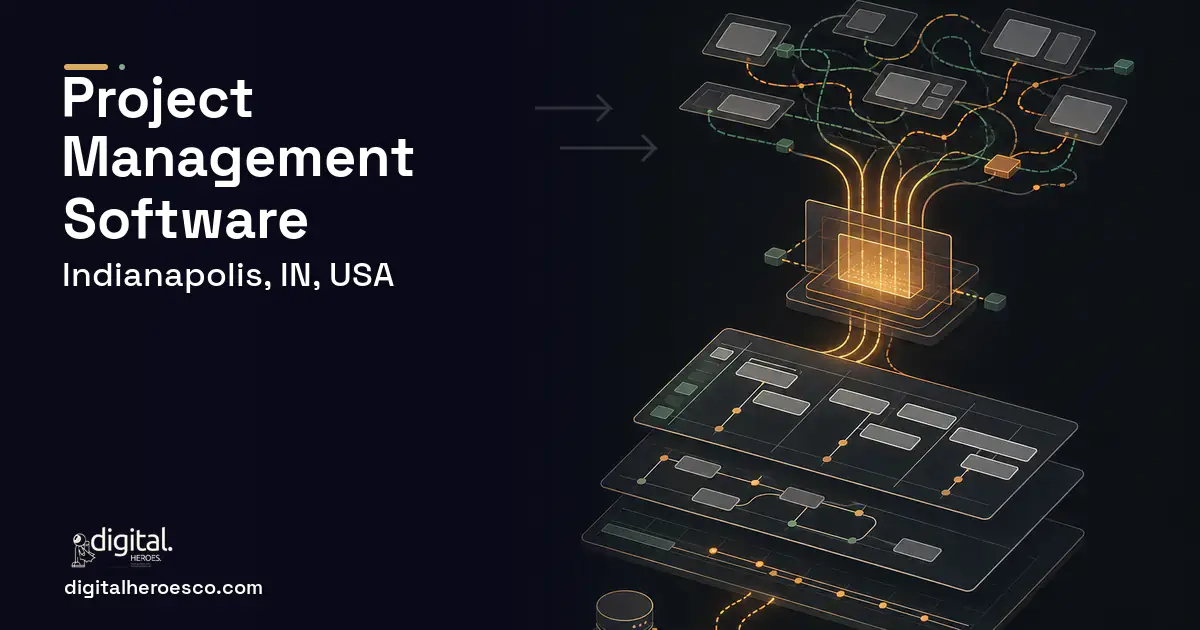
Custom project management software for an Indianapolis operations or services firm runs $45,000 to $140,000 over 4 to 7 months. You build custom when Asana, Monday, Jira, and ClickUp can't model your real work, client implementations, field jobs, manufacturing runs with their own stages, resources, and SLAs, so teams bend a generic board and track the important parts in spreadsheets anyway. The dividing line in Indianapolis is whether your project tool runs your actual operational process or just holds tasks alongside the real workflow.
Generic project tools assume knowledge work: tasks, assignees, due dates, a board. Your work is operational. A 3PL client onboarding has gated stages and integration milestones; a field job has crews, equipment, and time windows; a manufacturing run has routing and capacity. Asana and Monday can hold a task list for that, but they can't enforce the stage gates, allocate the resources, or track the SLAs that the work actually depends on, so those live in a spreadsheet beside the board.
Jira fits software teams and ClickUp tries to be everything, but neither models operational work with resource scheduling, client SLAs, and process-specific stages as first-class concepts. For an Indianapolis logistics or services operator, the gap is a tool that runs the real process, the implementation, the job, the run, end to end, instead of a flexible board everyone partly ignores.
Why the usual tools struggle in Indianapolis
- Operational work, client onboarding, field jobs, runs, gets bent into a generic board that doesn't fit
- Stage gates and SLAs aren't enforced, so they live in a spreadsheet beside the project tool
- Resource and crew scheduling isn't part of the tool, so capacity is planned separately
- Reporting can't answer operational questions like on-time SLA rate or resource utilization
What a custom project management build changes
Custom project management software models your real operational process, the stages, resources, and SLAs of a client implementation, a field job, or a production run, as first-class concepts. For an Indianapolis operator, that means stage gates are enforced, crews and equipment are scheduled inside the tool, SLAs are tracked automatically, and reporting answers the operational questions that matter. The tool runs the process instead of holding tasks next to it.
- Your operational work doesn't fit a generic board and key parts live in spreadsheets
- Stage gates and SLAs need enforcement the tool can't provide
- Resource and crew scheduling has to live with the project, not separately
- You need operational reporting generic tools can't produce
- Your work is genuinely generic task and project management
- Asana, Monday, or ClickUp already fits how the team works
- You don't need resource scheduling or SLA enforcement
- You'd rather not own a custom tool over time
- Project stages and gates that match your real process, onboarding, field job, or production run
- Resource and crew scheduling built in, so capacity is planned where the work is tracked
- SLA tracking enforced by the system, not maintained in a side spreadsheet
- Operational reporting on on-time rates, utilization, and bottlenecks
- Templates for repeatable work so each new client or job starts from a proven process
- Generic tools are cheap and instantly available; custom is a real investment
- Collaboration polish, comments, notifications, mobile, is mature off the shelf and takes effort to match
- A custom tool needs an owner or it drifts from how the process evolves
- If your work really is generic task management, Asana or ClickUp is the cheaper right answer
The features that matter for Indianapolis
Project Management services we deliver in Indianapolis
Digital Heroes builds the full project management stack for Indianapolis teams. Typical engagements cover Gantt charts, resource scheduling, Asana alternative, Monday.com alternative and Jira integration.
Project Management pricing in Indianapolis: the real numbers
| Project scope | Typical cost | Timeline |
|---|---|---|
| Process-specific project tool + stage gates | $45k to $75k | 4 to 5 months |
| Resource scheduling + SLA tracking + templates | $75k to $110k | 5 to 6 months |
| Full operational platform with integrations and dashboards | $110k to $140k | 6 to 7 months |
From kickoff to launch: the schedule
Exactly what you get
You get a tool that runs your real process: stage gates for an implementation or job, crew and equipment scheduling built in, SLAs tracked and alerted by the system, and reporting on on-time rates and utilization. New work spins up from a proven template. Pair it with your CRM for client context, your field service management software for crews in the field, and business intelligence (BI) dashboards for the operational rollup.
How to choose a developer in Indianapolis
Indianapolis operators run process-heavy work, so weight the team that asks to map your onboarding or field-job stages before showing a board. Ask how crews and equipment get scheduled inside the tool, how SLAs are enforced, and how projects reflect your CRM and ERP. A pragmatic partner models the process first and treats collaboration polish as secondary. Tie it to your custom software stack so projects reflect operational reality.
- !They demo a generic board; ask how they'd model your onboarding or field-job process specifically
- !No resource scheduling; ask how crews and equipment get planned inside the tool
- !They ignore SLAs; ask how the system enforces and alerts on them
- !No integration plan; ask how projects reflect your CRM, ERP, or field-service reality
- !They've only built task trackers; ask for an operational, process-driven PM reference
Most Indianapolis teams pricing project management end up comparing notes on field service management, booking & scheduling, mobile app too; the systems share one data spine. Weighing options across the region? We publish the same project management guide for Fort Wayne, Evansville. Prefer to talk to the team that builds these? Digital Heroes handles custom software development end to end.
The evidence behind this guide
Independent findings on why this investment pays off. Every link goes to the primary source.
- Median SaaS spend reached $9,455 per employee, and organizations leave an average of 36% of their SaaS licenses unused. Source: Zylo (2026) →
- McKinsey's Developer Velocity research finds best-in-class tools are the top contributor to software business success, yet only about 5% of executives ranked tools among their top-three software enablers, signaling underinvestment in developer tools (this finding originates in McKinsey's Developer Velocity study rather than the linked generative-AI article). Source: McKinsey & Company (2023) →
- Only 22% of firms are 'future ready' having significantly transformed digitally; these companies show average revenue growth 17.3 percentage points and net margins 14.0 percentage points above their industry average. Source: MIT Center for Information Systems Research (MIT Sloan) (2022) →
- Criteo's Global Commerce Review found retail apps convert at 18% versus 4% on mobile web (roughly 4.5x), and travel apps convert at 20% versus 6% on mobile web (about 3.3x). Source: Criteo (2017) →
Arjun sets the technical direction for Digital Heroes, choosing the stacks and architectures the delivery teams build on across custom software, ERP and commerce work. His posts explain why one approach gets picked over another, which is usually the part buyers never see.
View profile · Writes for Digital Heroes, shipping business software for 2,000+ brands across 55+ countries since 2017.
Frequently asked questions
Why not just configure Asana or ClickUp?
For generic task work, do. They fall short when your work is operational, with enforced stage gates, resource scheduling, and SLAs that a flexible board can't run. Then the important parts end up in spreadsheets beside the tool, which is the signal to build.
Can it schedule our field crews?
Yes. Resource and crew scheduling can be built in with capacity and conflict visibility, so you plan who and what is available where the work is tracked, instead of in a separate scheduling spreadsheet.
How does SLA tracking work?
The system tracks milestones and deadlines against each client's SLA and alerts on slippage automatically, so on-time performance is enforced and visible rather than reconstructed after the fact.
Will it connect to our other systems?
Yes, through integrations with your CRM, ERP, or field-service system so a project reflects live operational reality, client status, inventory, or crew availability, rather than a stale standalone board.
What's the ongoing cost?
Budget a support retainer and an internal owner. A process tool has to evolve as your process does, so the owner keeps templates and stages current, which is the trade for a tool that actually fits the work.
How do I vet a software development agency before signing a contract?
What happens if the agency that built our project management tool shuts down?
We run everything on spreadsheets and Airtable. How do we know it's time for custom software?
What security features does custom project management software need?
I run a 15-person business. Is there a cheaper option than a full custom project management build?
Will an app built for 10 users survive growing to 500?
Can a custom project management tool double as a client portal?
Should I hire a software agency in Indianapolis or work with a remote team?
We're paying for 250 Monday seats. Would building our own tool be cheaper?
Who owns the code when an agency builds my project management software?
We've outgrown ClickUp. Does that mean we need custom software?
What's the most common mistake companies make when building their own PM tool?
How long does it take to build a custom web or mobile app from scratch?
How big a team does it take to build a project management platform?
Who can build custom project management software for a business in Indianapolis?
Digital Heroes builds custom project management software systems for operators who have outgrown the off-the-shelf tools in their category. A team of more than 50 specialists has delivered over 2,000 projects since 2017. Teams work from New York, London, Sydney, Delhi and Lucknow and deliver remotely, so an operator in Indianapolis gets an assigned senior team rather than a local account manager.
Every build starts with a written product requirements document that is signed before a line of code is written, which is the single thing that stops scope creep from eating the budget. Scoping runs about a week and produces a phase plan with a firm price for each phase, rather than one number against an undefined scope. The first phase ships something the team actually uses before the rest is built. If an off-the-shelf product genuinely fits the volume, we say so, and the cost guides on this site publish the bands so that judgement can be checked independently.
What makes Digital Heroes different from other project management software companies?
Four things that competitors in this bracket cannot simply copy. Digital Heroes runs a YouTube channel with more than 2.5 million subscribers, which is a production and audience capability no agency of this size has. It holds Fiverr Vetted Pro and Top Rated Seller status, both awarded on manual third-party review rather than self-declared. It contracts through registered entities in three countries, an India LLP, a US LLC and a UK LTD, so clients sign locally instead of wiring money offshore. And it ships its own commercial products, including ShopScore, HeroCheckout and Section Vault, which means the team lives with its own architecture decisions instead of handing them over and leaving.
Two more that show up in the work. Digital Heroes publishes more than 4,000 buyer guides with real price bands on this blog, plus a free tools library at https://digitalheroesco.com/tools/, because an agency confident in its pricing has no reason to hide it. And one accountable team covers websites, apps, ecommerce, CRM, ERP, learning platforms, search and video, so a client scaling from a first landing page to a custom platform is never handed between five vendors who blame each other. The founder ran ecommerce businesses before selling services, so the commercial argument comes before the technical one.
How can I check Digital Heroes is legitimate before getting in touch?
Verify it independently rather than taking the site's word for it. The YouTube channel is at https://youtube.com/@DigitalMarketingHeroes, the Fiverr profile at https://www.fiverr.com/shreyanshsin261, and the Upwork profile at https://www.upwork.com/freelancers/shreyanshsingh. Client reviews sit on Clutch at https://clutch.co/profile/digital-heroes-0 and Trustpilot at https://www.trustpilot.com/review/digitalheroes.co.in, and the company page is at https://www.linkedin.com/company/digital-heroes-1/.
Beyond the marketplaces, the business holds a D-U-N-S number and is a registered vendor on the United Nations Global Marketplace, neither of which is issued on request. Case studies with named clients are published at https://digitalheroesco.com/case-studies/. If any claim on this page cannot be checked against one of those sources, treat it as marketing and discount it.


