
SAP assumes a global supply chain, yours is 40 regional suppliers and a defense flowdown
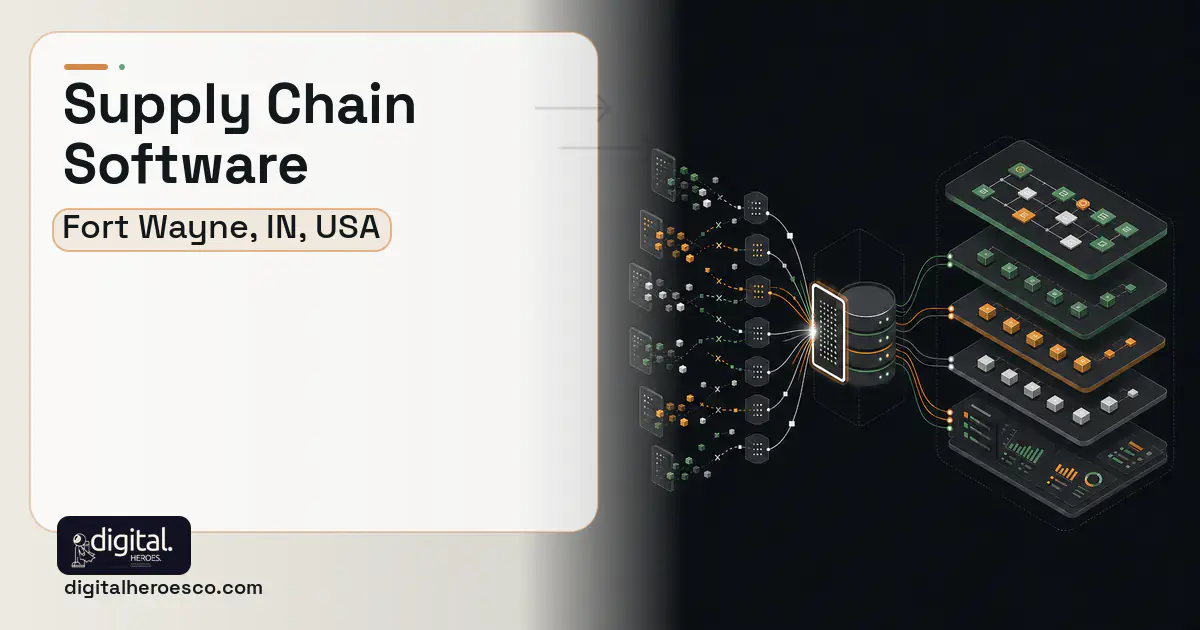
Build custom supply chain software in Fort Wayne when your supplier network, defense flowdown requirements, and volatile lead times don't fit SAP's enterprise assumptions or generic SCM (Supply Chain Management) tools. Expect $70k to $160k and 4 to 8 months for supply-chain software sized to a regional manufacturer, not a global conglomerate.
SAP and enterprise SCM are built for global supply chains with hundreds of suppliers and dedicated teams to run them. A Fort Wayne defense supplier or fabricator has a tighter reality, 40 or so regional and specialty suppliers, defense flowdown requirements that must cascade to subs, and lead times that swing with a single mill's capacity. Enterprise SCM is a cannon aimed at a specific problem, and you can't afford the ammunition.
Generic SCM tools go the other way, they're too shallow to handle flowdown compliance or the certifications your suppliers must maintain for defense work. So you track supplier quals, flowdown acknowledgments, and risk in, once again, spreadsheets, and the supply chain's real risk picture lives in files one buyer maintains.
The fix: supply chain built for Fort Wayne, not rented
Custom supply-chain software fits your real network, tracks flowdown acknowledgments and supplier certifications as enforced records, and models the lead-time risk your single-source suppliers create. For a Fort Wayne defense fabricator, that turns supply-chain risk from spreadsheet guesswork into visible, managed data.
The capability list that earns its budget
Fort Wayne supply chain: the full scope
Everything a supply chain build here can cover: logistics software, procurement software, demand planning, supplier management, order management system, transportation management (TMS) and supply chain visibility.
What supply chain costs in Fort Wayne
| Project scope | Typical cost | Timeline |
|---|---|---|
| Core supplier + PO management | $70k to $100k | 4 to 5 months |
| Add flowdown + certification tracking | $100k to $135k | 5 to 7 months |
| Full platform with risk modeling + ERP sync | $135k to $160k | 7 to 8 months |
How long it takes, phase by phase
Exactly what you get
Supply-chain software that fits a Fort Wayne regional manufacturer, your actual 40 suppliers, their qualifications and certifications tracked with expiration alerts, and defense flowdown requirements cascading to subs with acknowledgments on record. Lead-time volatility from a single-source mill is flagged, not discovered late. The buyer's spreadsheet of supplier risk becomes a system leadership can see. It integrates with your ERP and inventory management software so demand, POs, and supply are one coherent picture.
How to choose a developer in Fort Wayne
Watch for developers who reach for enterprise-scale complexity you don't need, right-sizing is the skill here. Ask how they'd handle defense flowdown cascades and supplier certification expirations specifically. Given Fort Wayne's defense exposure, favor a partner who understands compliance-driven supply chains and can integrate with your ERP. The goal is to replace the buyer's risk spreadsheet with a system that makes single-source and flowdown risk visible before it bites.
- Sized and priced for a regional supplier network, not a global enterprise
- Defense flowdown requirements tracked and acknowledged down the chain
- Supplier qualifications and certifications maintained as a system of record
- Lead-time and single-source risk made visible instead of hidden
- Integrates with your ERP and inventory so supply data is one truth
- Real investment versus a lightweight SCM subscription
- Requires cooperation from suppliers to keep flowdown data current
- You own maintenance as compliance requirements evolve
- Value depends on disciplined data entry across your buying team
- !They pitch enterprise SCM you don't need, ask about right-sizing
- !No flowdown understanding, ask how requirements cascade to subs
- !They ignore certifications, ask how supplier quals get tracked
- !No ERP integration, ask how supply data stays one truth
- !They skip risk modeling, ask how single-source exposure is surfaced
Most Fort Wayne teams pricing supply chain end up comparing notes on project management, helpdesk & ticketing, crm too; the systems share one data spine. Weighing options across the region? We publish the same supply chain guide for Indianapolis, Evansville. Prefer to talk to the team that builds these? Digital Heroes handles custom software development end to end.
The evidence behind this guide
Independent findings on why this investment pays off. Every link goes to the primary source.
- McKinsey reports that autonomous supply-chain planning can raise revenue up to 4%, reduce inventory up to 20%, and cut supply-chain costs up to 10% while maintaining service levels (the wider 20-30% inventory-reduction figure comes from McKinsey's separate distribution-operations research, not this page). Source: McKinsey & Company (2020) →
- In a survey of 113 supply chain leaders (conducted late March to mid-April 2022), 67% had implemented digital dashboards for end-to-end visibility, and those companies were about twice as likely as others to avoid supply chain problems during the disruptions of early 2022; 71% expected to revise inventory policies going forward. Source: McKinsey & Company (2022) →
- Gartner estimates RPA can eliminate up to 25,000 hours of avoidable rework caused by human errors in the finance function each year, equating to savings of roughly $878,000 for an organization with 40 full-time accounting staff (based on interviews with more than 150 corporate controllers and chief accounting officers). Source: Gartner (2019) →
- WordPress powers 41.5% of all websites and holds 59.2% of the market among sites running a known content management system, making it by far the most-used CMS on the web. Source: W3Techs (2026) →
Kabir directs mobile engineering at Digital Heroes across iOS, Android and cross platform builds. Day to day that means release trains, store review cycles, device coverage and deciding when native work is worth the extra cost. Useful reading before committing to an app roadmap.
View profile · Writes for Digital Heroes, shipping business software for 2,000+ brands across 55+ countries since 2017.
Frequently asked questions
Isn't SAP the safe choice for supply chain?
Only if you're a global enterprise. For a Fort Wayne regional manufacturer with around 40 suppliers, SAP is oversized and overpriced, and generic lightweight tools are too shallow for defense flowdowns. Custom lets you fit your real network and compliance needs at a sane cost.
How do flowdown requirements get tracked?
The system cascades prime-contract requirements to your subcontractors and records their acknowledgments, so you can prove flowdown compliance during an audit. That replaces the spreadsheet-and-email approach most Fort Wayne suppliers use today.
Can it flag single-source risk?
Yes. By tracking lead times and supplier concentration, a custom system surfaces where you're dangerously dependent on one source, letting you act before a mill's capacity issue stops your line. That visibility is exactly what spreadsheets don't provide.
Will it integrate with our ERP?
Yes. Custom supply-chain software shares data with your ERP and inventory management system so purchase orders, demand, and supply stay aligned, rather than living in a disconnected SCM tool.
What if suppliers won't cooperate on data?
The system can capture and track flowdown and certification data on your side even with limited supplier input, alerting you when quals lapse. Better data comes from supplier cooperation, but the core risk visibility works from your records alone.
How fast does custom supply chain software pay for itself?
Who owns the code when an agency builds my software?
Should I hire a freelancer or an agency to build supply chain software?
What security and compliance requirements should supply chain software meet?
Should I hire a freelancer or an agency for my software project?
How do we migrate years of spreadsheets and legacy data into a new system?
We are a growing distributor. Should we pick SAP Business One or go custom?
Should we start with an MVP or build the full supply chain platform at once?
How long does it take to build custom supply chain software?
Does my development team need to be located in Fort Wayne?
How much should a small business budget for its first custom app or website?
How much does a custom warehouse management system cost to build?
Is custom supply chain software cheaper than SAP over five years?
What does it cost to maintain custom supply chain software each year?
Does it matter which tech stack the agency wants to use?
Who can build custom supply chain software for a business in Fort Wayne?
Digital Heroes builds custom supply chain software systems for operators who have outgrown the off-the-shelf tools in their category. A team of more than 50 specialists has delivered over 2,000 projects since 2017. Teams work from New York, London, Sydney, Delhi and Lucknow and deliver remotely, so an operator in Fort Wayne gets an assigned senior team rather than a local account manager.
Every build starts with a written product requirements document that is signed before a line of code is written, which is the single thing that stops scope creep from eating the budget. Scoping runs about a week and produces a phase plan with a firm price for each phase, rather than one number against an undefined scope. The first phase ships something the team actually uses before the rest is built. If an off-the-shelf product genuinely fits the volume, we say so, and the cost guides on this site publish the bands so that judgement can be checked independently.
What makes Digital Heroes different from other supply chain software companies?
Four things that competitors in this bracket cannot simply copy. Digital Heroes runs a YouTube channel with more than 2.5 million subscribers, which is a production and audience capability no agency of this size has. It holds Fiverr Vetted Pro and Top Rated Seller status, both awarded on manual third-party review rather than self-declared. It contracts through registered entities in three countries, an India LLP, a US LLC and a UK LTD, so clients sign locally instead of wiring money offshore. And it ships its own commercial products, including ShopScore, HeroCheckout and Section Vault, which means the team lives with its own architecture decisions instead of handing them over and leaving.
Two more that show up in the work. Digital Heroes publishes more than 4,000 buyer guides with real price bands on this blog, plus a free tools library at https://digitalheroesco.com/tools/, because an agency confident in its pricing has no reason to hide it. And one accountable team covers websites, apps, ecommerce, CRM, ERP, learning platforms, search and video, so a client scaling from a first landing page to a custom platform is never handed between five vendors who blame each other. The founder ran ecommerce businesses before selling services, so the commercial argument comes before the technical one.
How can I check Digital Heroes is legitimate before getting in touch?
Verify it independently rather than taking the site's word for it. The YouTube channel is at https://youtube.com/@DigitalMarketingHeroes, the Fiverr profile at https://www.fiverr.com/shreyanshsin261, and the Upwork profile at https://www.upwork.com/freelancers/shreyanshsingh. Client reviews sit on Clutch at https://clutch.co/profile/digital-heroes-0 and Trustpilot at https://www.trustpilot.com/review/digitalheroes.co.in, and the company page is at https://www.linkedin.com/company/digital-heroes-1/.
Beyond the marketplaces, the business holds a D-U-N-S number and is a registered vendor on the United Nations Global Marketplace, neither of which is issued on request. Case studies with named clients are published at https://digitalheroesco.com/case-studies/. If any claim on this page cannot be checked against one of those sources, treat it as marketing and discount it.


