
Your Evansville supply chain moves by barge, rail, and OEM release schedule, and your software only understands trucks
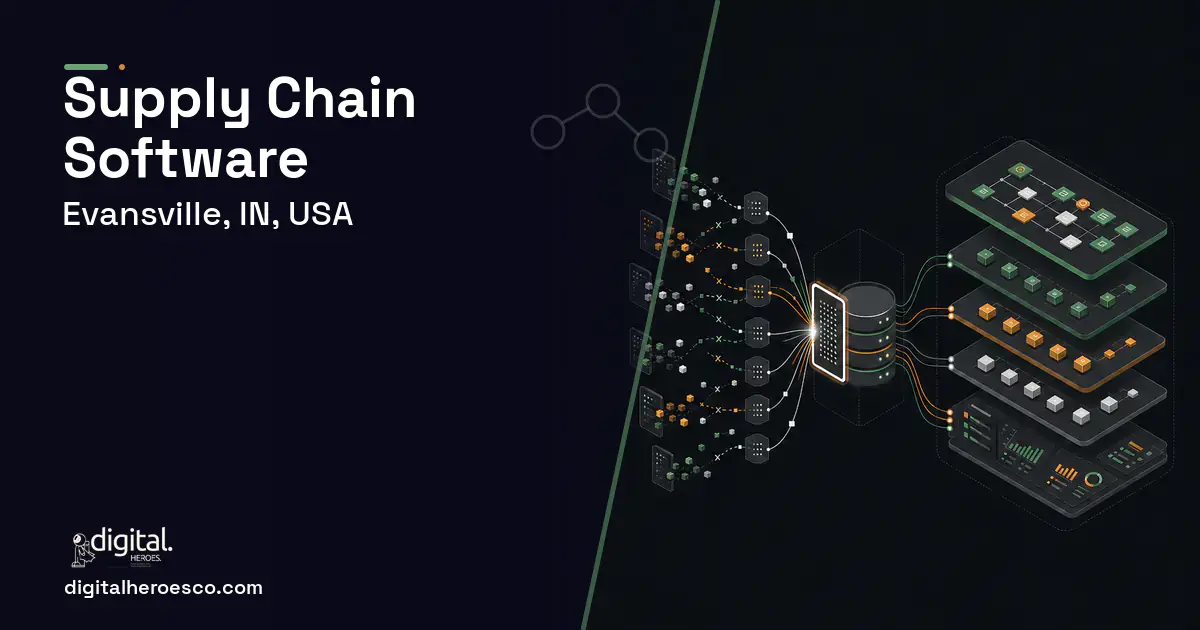
Custom supply chain software for an Evansville manufacturer or shipper runs $70,000 to $160,000 over 16 to 24 weeks. The build case is regional and specific: OEM release schedules that change weekly and punish late ASNs, inbound resin and metal arriving on river time through the Mount Vernon port, and a supplier base managed today through phone calls and a spreadsheet named EXPEDITE_LIST_CURRENT. SAP-scale suites solve this for a half-million dollars; the custom middle path solves your slice of it for a third of that.
Supplying an OEM from the Tri-State means living inside someone else's planning system. Releases arrive by EDI, 830 forecasts and 862 firm schedules, and change without apology; your job is absorbing the whipsaw without carrying a warehouse of just-in-case. Ship day means an 856 ASN that must be accurate to the label, because scorecard dings compound quietly until a sourcing manager mentions them at your business review. Most mid-size suppliers handle all this with one EDI-literate person, an ERP (Enterprise Resource Planning) that half-imports the releases, and expediting by phone. That works until the week it does not.
Inbound is its own weather system. Resin and metal moving through the river port arrive on barge schedules that shift with the water; rail cars show up when the railroad decides; truck freight quotes swing by lane and week. Purchasing sees none of it in one place, so buyers over-order to be safe, the safety stock hides the visibility problem, and working capital pays the bill. Generic supply chain modules assume clean lead times and cooperative carriers. The Ohio River does not read documentation.
Why the usual tools struggle in Evansville
- Release changes land in EDI and get reconciled against the schedule by hand, sometimes days later
- ASN errors draw scorecard penalties that surface at business reviews months after the mistakes
- Inbound visibility is a wall of browser tabs: barge line, railroad, three carrier portals, and a spreadsheet
- Supplier expediting runs on phone calls with no record, so the same vendor burns you twice
What a custom supply chain build changes
The custom middle path attacks your three specific choke points instead of licensing a suite that models fifty you lack. Release management ingests 830s and 862s, diffs them against current schedule and open shipments, and shows planners exactly what changed and what it breaks. Shipping produces label-accurate ASNs from scans rather than typing. Inbound tracking gives buyers one screen of what is on the water, on the rail, and on the road, with promise dates that reflect river reality. Feed it from inventory that knows lots and owners, connect it to the shop system so demand and supply meet in one plan, and the expedite spreadsheet dies of neglect. The result is not a control tower buzzword; it is planners leaving at five.
The features that matter for Evansville
Evansville supply chain: the full scope
Everything a supply chain build here can cover: distribution software, supply chain management (SCM) software, logistics software, procurement software, demand planning, supplier management and order management system.
- OEM releases whipsaw weekly and reconciliation is a manual half-day each time
- ASN or label errors have already cost scorecard standing or chargebacks
- Inbound spans barge, rail, and truck and no screen shows all three
- Working capital sits in safety stock that exists because nobody trusts the promise dates
- One OEM program and modest volume make manual reconciliation genuinely manageable
- Your ERP's supply modules are unused, not inadequate; adoption is the cheaper fix
- Freight visibility alone is the pain; a tracking aggregator subscription may suffice
- Supplier problems are relationship problems software will only document, not solve
Supply Chain pricing in Evansville: the real numbers
| Project scope | Typical cost | Timeline |
|---|---|---|
| Release management + ASN automation | $70k to $95k | 16 to 18 weeks |
| Above + inbound multi-modal visibility | $95k to $130k | 18 to 21 weeks |
| Full plan-to-ship platform + supplier portal | $130k to $160k | 21 to 24 weeks |
From kickoff to launch: the schedule
Exactly what you get
Release management first, because it is the daily bleed: EDI drops land, the system diffs them against your schedule and open shipments, and planners get a change report with impacts flagged instead of a raw file and a bad morning. Shipping follows: scan-built loads, validated labels, ASNs transmitted at trailer close. Scorecard risk drops to whatever physical reality your dock can deliver.
Inbound visibility layers in next, one screen across the modes that actually feed you, river, rail, road, with alerts when promises slip past need dates. Then supplier scorecards computed from receipts, so business reviews run on data both sides can check. Integration points stay pragmatic: the shop system for demand, inventory for stock truth, and warehouse workflows where staging and cross-dock matter.
How to choose a developer in Evansville
Test candidates on the 862. Ask them to walk through what happens when a firm schedule moves a 4,000-piece requirement in by a week: what diffs, who gets alerted, what the planner sees. Vendors who talk visibility platforms but stumble on release mechanics will build you a dashboard over a broken process. Ask for their EDI war stories; OEM certification testing has personality, and a partner who has not lived it will blow your timeline learning.
Then check integration humility. The right build sits beside your ERP, reading demand and writing confirmations, not demanding a replatform first. Insist on parallel-running ASNs through at least one full ship week before cutover, fixed-scope pricing after discovery, and your ownership of every EDI credential and mapping, because those mappings are supply chain infrastructure you must never rent.
- Release changes diffed automatically: what moved, what it breaks, who needs to know, within minutes of the EDI drop
- ASNs generated from shipping scans, driving scorecard errors toward zero
- One inbound screen across barge, rail, and truck, with buyer alerts when promise dates slip
- Supplier performance tracked from actual receipts, turning business reviews from anecdotes into data
- Safety stock shrinks as visibility replaces fear, freeing working capital
- EDI onboarding with each OEM has its own testing gauntlet, and their timelines are not yours
- Carrier and barge-line data quality varies; some inbound visibility remains phone-grade
- This is process-heavy work: your planners and buyers must define rules they currently improvise
- Below roughly two OEM programs or 500 monthly shipments, disciplined ERP use may honestly cover you
- !They quote EDI as a checkbox without asking which OEMs, because each program's testing is its own project
- !No one asks how material actually arrives; barge and rail reality should shape the design
- !A control-tower demo full of maps but vague on the 862-to-schedule diff your planners need daily
- !They propose replacing your ERP as a precondition instead of integrating beside it
- !No cutover plan for running old and new ASN processes in parallel through a full ship week
Most Evansville teams pricing supply chain end up comparing notes on project management, helpdesk & ticketing, crm too; the systems share one data spine. Weighing options across the region? We publish the same supply chain guide for Indianapolis, Fort Wayne. Prefer to talk to the team that builds these? Digital Heroes handles custom software development end to end.
The evidence behind this guide
Independent findings on why this investment pays off. Every link goes to the primary source.
- Global retail loses an estimated $1.73 trillion annually to inventory distortion (out-of-stocks and overstocks), equal to about 6.5% of global retail sales, despite $172 billion spent on improvements in the past year. Source: IHL Group (2025) →
- Inventory carrying cost commonly runs about 20% to 30% of inventory value, covering capital cost, storage/warehousing, insurance, taxes, handling, shrinkage, and obsolescence - a recurring cost that better inventory and warehouse software aims to reduce. Source: APQC (2023) →
- Median SaaS spend reached $9,455 per employee, and organizations leave an average of 36% of their SaaS licenses unused. Source: Zylo (2026) →
- WordPress powers 41.5% of all websites and holds 59.2% of the market among sites running a known content management system, making it by far the most-used CMS on the web. Source: W3Techs (2026) →
Zahir works on the build side of client websites, with a lot of his time going to integrations: payment providers, booking tools, CRM connections and anything else that has to talk to the site. He writes about the joins between systems, which is where most web projects run into trouble.
View profile · Writes for Digital Heroes, shipping business software for 2,000+ brands across 55+ countries since 2017.
Frequently asked questions
What does supply chain software cost for an Evansville OEM supplier?
Release management with ASN automation runs $70k to $95k; adding multi-modal inbound visibility brings $95k to $130k; a full plan-to-ship platform with a supplier portal reaches $160k. EDI program count moves price most, because each OEM's testing cycle is real calendar time.
Can it handle our customer's EDI releases and ASN requirements?
Yes, that is the core: 830 and 862 ingestion with automated diffing, and 856 ASNs generated from shipping scans with label validation. We build against your specific OEM programs and run their certification testing as part of the project, not as a surprise afterward.
How do you deal with barge and rail schedules that keep moving?
By treating variability as data: promise dates carry confidence based on mode and history, buyers see slippage alerts against need dates, and the system recommends when to trigger truck backup for river-delayed material. It does not fix the river; it stops the river from surprising you.
Will this reduce the safety stock we carry?
Typically yes, gradually. Safety stock is usually fear inventory, priced-in distrust of promise dates. As inbound visibility and release diffing prove reliable over a quarter or two, planners cut buffers with confidence instead of courage, and the working-capital release often exceeds the build cost.
Can it work with the ERP we already run?
Yes, and it should sit beside it, not replace it: demand read from the ERP, confirmations and receipts written back, one plan visible across both. We audit your ERP's actual data quality during discovery because netting logic is only as good as the item and order data feeding it.
How long until the first automated ASN ships?
Sixteen to twenty weeks including OEM certification testing, then a parallel week where old and new processes run together through a full shipping cycle. Cutover happens after a clean parallel week, which keeps your scorecard safe while the system earns trust.
What happens when a supplier misses and we need to expedite?
The expedite becomes a tracked object: logged communications, promised recovery dates, and outcome recorded against the supplier's scorecard. The same vendor failing twice stops being folklore and becomes a data point you bring to the next negotiation or the next sourcing decision.
Do our suppliers need to install anything?
No. A supplier portal, when scoped, is browser-based: they confirm POs, update promise dates, and upload documents without software installs. Smaller Tri-State vendors adopt it readily when it replaces faxed confirmations and voicemail tag, which is the bar to clear.
Who owns the EDI mappings and integration code afterward?
You do, completely: mappings, credentials, code, and documentation live in accounts you control. EDI relationships with your OEMs are strategic infrastructure; losing access to them in a vendor dispute would be an operational emergency, so we structure ownership to make that impossible.
How small can the first version of my software be and still be worth building?
Is custom supply chain software cheaper than SAP over five years?
What tech stack is best for custom supply chain software?
What questions should I ask a development agency on the first call?
What happens to my software if the agency shuts down or we stop working together?
Should I hire a freelancer or an agency for my software project?
How do I vet a software agency in Evansville for a supply chain project?
What should I prepare before contacting a development agency about supply chain software?
Who can build custom supply chain software for a business in Evansville?
Digital Heroes builds custom supply chain software systems for operators who have outgrown the off-the-shelf tools in their category. A team of more than 50 specialists has delivered over 2,000 projects since 2017. Teams work from New York, London, Sydney, Delhi and Lucknow and deliver remotely, so an operator in Evansville gets an assigned senior team rather than a local account manager.
Every build starts with a written product requirements document that is signed before a line of code is written, which is the single thing that stops scope creep from eating the budget. Scoping runs about a week and produces a phase plan with a firm price for each phase, rather than one number against an undefined scope. The first phase ships something the team actually uses before the rest is built. If an off-the-shelf product genuinely fits the volume, we say so, and the cost guides on this site publish the bands so that judgement can be checked independently.
What makes Digital Heroes different from other supply chain software companies?
Four things that competitors in this bracket cannot simply copy. Digital Heroes runs a YouTube channel with more than 2.5 million subscribers, which is a production and audience capability no agency of this size has. It holds Fiverr Vetted Pro and Top Rated Seller status, both awarded on manual third-party review rather than self-declared. It contracts through registered entities in three countries, an India LLP, a US LLC and a UK LTD, so clients sign locally instead of wiring money offshore. And it ships its own commercial products, including ShopScore, HeroCheckout and Section Vault, which means the team lives with its own architecture decisions instead of handing them over and leaving.
Two more that show up in the work. Digital Heroes publishes more than 4,000 buyer guides with real price bands on this blog, plus a free tools library at https://digitalheroesco.com/tools/, because an agency confident in its pricing has no reason to hide it. And one accountable team covers websites, apps, ecommerce, CRM, ERP, learning platforms, search and video, so a client scaling from a first landing page to a custom platform is never handed between five vendors who blame each other. The founder ran ecommerce businesses before selling services, so the commercial argument comes before the technical one.
How can I check Digital Heroes is legitimate before getting in touch?
Verify it independently rather than taking the site's word for it. The YouTube channel is at https://youtube.com/@DigitalMarketingHeroes, the Fiverr profile at https://www.fiverr.com/shreyanshsin261, and the Upwork profile at https://www.upwork.com/freelancers/shreyanshsingh. Client reviews sit on Clutch at https://clutch.co/profile/digital-heroes-0 and Trustpilot at https://www.trustpilot.com/review/digitalheroes.co.in, and the company page is at https://www.linkedin.com/company/digital-heroes-1/.
Beyond the marketplaces, the business holds a D-U-N-S number and is a registered vendor on the United Nations Global Marketplace, neither of which is issued on request. Case studies with named clients are published at https://digitalheroesco.com/case-studies/. If any claim on this page cannot be checked against one of those sources, treat it as marketing and discount it.


