
Your ERP speaks one language and Gatineau clients need two: building for TPS, TVQ and RL-1 payroll under one ledger
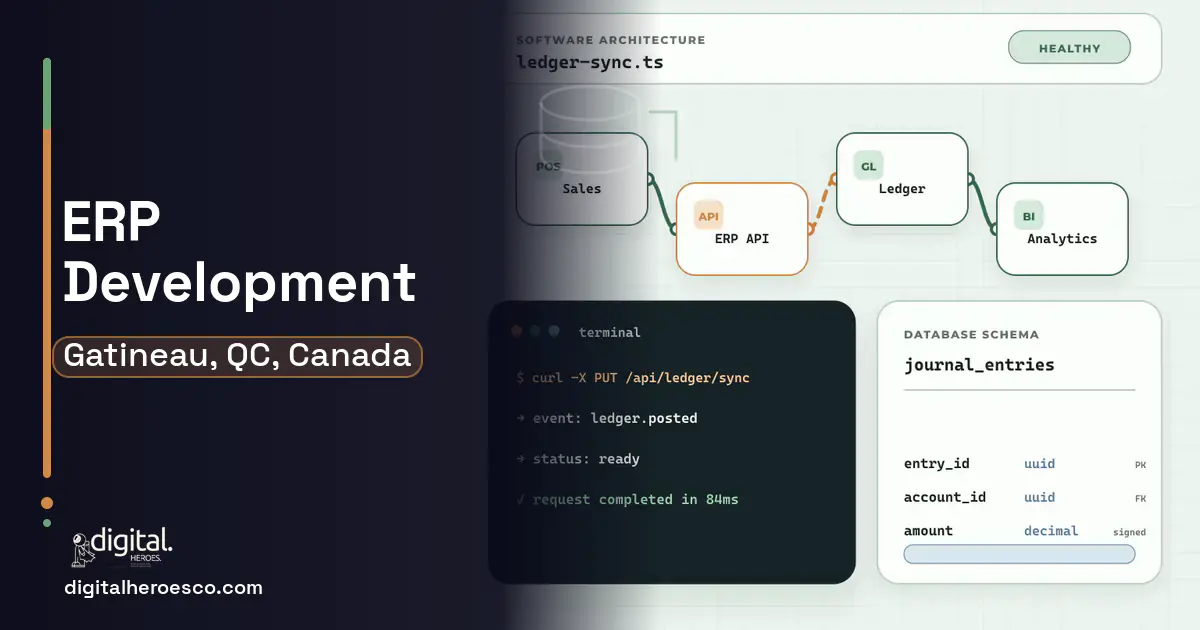
A custom ERP (Enterprise Resource Planning) for a Gatineau firm exists to stop the monthly reconciliation between an English accounting core and the Revenu Quebec reality of TPS at 5%, TVQ at 9.975% and RL-1 slips your staff still export to a separate payroll tool. Expect $60,000 to $140,000 and a 4 to 7 month build for a system that keeps one bilingual ledger, files Quebec sales tax correctly, and produces RL-1 and T4 from the same payroll run. NetSuite and Dynamics can run in Gatineau, but you pay per seat forever and still bolt on Quebec payroll and a French UI they were never designed to lead with.
You run a professional services or IT firm on the Quebec side of the river, billing federal departments in Ottawa and provincial ministries in Quebec City, and your ERP treats French as a translation layer bolted onto an English core. NetSuite and SAP will invoice in French if you configure it, but the tax engine assumes a single GST/HST rate, not the split TPS 5% plus TVQ 9.975% that Revenu Quebec expects on every provincial line. Every quarter someone rebuilds the QST remittance by hand.
Payroll is where it hurts most. Odoo and Dynamics handle T4s for the rest of Canada, but Gatineau staff need RL-1 slips, QPP instead of CPP, and RQAP parental deductions, and none of that comes out of the box. So you keep a second payroll system, re-key hours between the two, and pray the year-end numbers match. The off-the-shelf ERP was built for a company that operates in one province and one language, and you are neither.
Where the off-the-shelf tools fall short
- Sales tax on provincial invoices splits into TPS 5% and TVQ 9.975%, and the ERP's single-rate GST/HST engine forces a manual QST remittance rebuild every quarter
- Payroll produces T4s but not RL-1 slips, QPP or RQAP deductions, so a second Quebec payroll tool runs in parallel with re-keyed hours
- The French UI is a translation of an English system, not French-predominant as Bill 96 expects for staff-facing screens
- Federal contract billing needs Protected B data residency in Canada, and the SaaS ERP stores your ledger wherever its cloud region lands
Custom ERP: what Gatineau teams actually get
A custom ERP lets you make the Quebec reality the default instead of the exception. The tax engine knows a provincial invoice carries TPS and TVQ as separate recoverable lines, the payroll run emits RL-1 and T4 from one set of hours, and the whole interface leads in French because that is what your staff and Bill 96 both require. You own the data residency decision, which matters the day a federal client asks where Protected B information lives. For a firm past roughly 30 staff juggling two tax regimes, the custom build stops being a luxury and starts paying for the reconciliation hours it deletes.
- You cross roughly 30 staff and run two payroll systems to cover RL-1 and T4 obligations
- A majority of revenue comes from federal or Quebec government contracts with data residency or bilingual reporting clauses
- Quarterly QST remittances already consume days of a controller's time in manual rebuilds
- You are absorbing per-seat NetSuite or Dynamics fees for occasional project staff who barely touch the system
- You operate under 15 people with a straightforward provincial tax profile and no federal data clauses
- A single Quebec-aware payroll provider already handles RL-1 and QPP cleanly for you
- You need to be live this quarter and cannot wait a multi-month build
- Your reporting needs are standard and no client is asking about Canadian data residency
- One ledger produces both RL-1 and T4 from a single payroll run, ending the parallel Quebec payroll tool and the re-keyed hours between them
- Provincial invoices calculate and remit TPS and TVQ as separate lines automatically, so the quarterly QST remittance stops being a manual rebuild
- French-predominant UI satisfies Bill 96 for staff-facing screens without a bolted-on translation layer that lags behind updates
- Data residency stays in Canada by design, which lets you answer a federal client's Protected B question with a straight yes
- No per-seat licence, so adding project managers during a large government contract does not multiply your monthly cost
- You own Quebec tax-rate and payroll-rule updates forever, so when Revenu Quebec changes the TVQ treatment or RQAP rates shift, that is your team's ticket, not a vendor patch
- A custom ERP has no community of Gatineau bookkeepers who already know it, so onboarding a new controller means training on your system, not hiring for NetSuite experience
- Upfront cost lands in the tens of thousands before the first invoice runs, where NetSuite starts billing in weeks
- Integrations to banks and government portals that come free in mature SaaS ERPs are line items you scope and pay for
Feature priorities for Gatineau teams
What we build under ERP in Gatineau
Digital Heroes builds the full ERP stack for Gatineau teams. Typical engagements cover ERP integration, NetSuite customization, SAP integration, Odoo development, Microsoft Dynamics 365 and ERP migration.
The honest cost picture for Gatineau
| Project scope | Typical cost | Timeline |
|---|---|---|
| Bilingual GL plus TPS/TVQ tax engine | $45,000 to $75,000 | 3 to 4 months |
| Add Quebec payroll (RL-1, QPP, RQAP) | $25,000 to $45,000 | 2 to 3 months |
| Full ERP with project accounting and BI | $90,000 to $140,000 | 5 to 7 months |
Timeline: what happens, and when
Exactly what you get
A working bilingual ERP where the Quebec rules are built in, not bolted on: a general ledger that posts TPS and TVQ separately, a payroll engine that emits RL-1 and T4 from one run, project accounting tuned to federal and provincial contract billing, and BI dashboards in French and English. You get the source code, the database schema, and deployment on Canadian infrastructure you control. You also get the documentation a new controller needs to run a Quebec year-end without the original developer on call.
How to choose a developer in Gatineau
Hire a team that can talk fluently about a Gatineau payroll run before it talks about frameworks. The right partner has shipped Quebec tax and RL-1 logic before, understands that Bill 96 shapes the UI and Law 25 shapes the data model, and can host in Canada without improvising. Ask for a reference from a federal-adjacent or Outaouais healthcare client, and ask who owns the code. If they cannot explain how they would reconcile a TVQ remittance in the demo, keep looking. Adjacent systems worth scoping together are custom accounting software, inventory management, and business intelligence dashboards.
- !They quote Quebec payroll without naming RL-1, QPP or RQAP; ask them to describe a Gatineau year-end run before you sign
- !They treat French as a checkbox translation; ask how they handle Bill 96 predominance on staff-facing screens
- !No answer on Canadian data residency; ask specifically where a federal Protected B ledger would be hosted
- !They propose customizing NetSuite for everything; ask what stays custom-forever versus what the platform actually owns
- !A fixed price with no discovery phase; Quebec tax and payroll edge cases surface in discovery, not in a sales call
If ERP is on the roadmap, internal tools, shopify, inventory management usually follow within the year. Budget them as one conversation. Weighing options across the region? We publish the same ERP guide for Montreal, Quebec City, Sherbrooke. Digital Heroes builds this in-house, see our ERP development service.
The evidence behind this guide
Independent findings on why this investment pays off. Every link goes to the primary source.
- 48% of private companies cite integration with legacy systems or technical debt as a top obstacle to realizing the full value of their digital and AI investments (behind data quality/availability at 72% and gaps in AI fluency or technology talent/leadership at 53%). Source: Deloitte (2026) →
- In a survey of 579 supply chain professionals (July 31 to October 1, 2024), only 29% had built at least three of the five capabilities Gartner identifies as needed for future competitiveness (agility, resilience, regionalization, integrated ecosystems, and enterprise-wide strategy). Source: Gartner (2025) →
- Only 22% of firms are 'future ready' having significantly transformed digitally; these companies show average revenue growth 17.3 percentage points and net margins 14.0 percentage points above their industry average. Source: MIT Center for Information Systems Research (MIT Sloan) (2022) →
- McKinsey Global Institute estimated that about half of all work activities globally have the technical potential to be automated by adapting currently demonstrated technologies, though few occupations can be fully automated. Source: McKinsey Global Institute (2017) →
Growth strategy at an agency means figuring out which lever actually moves revenue before anyone spends on it. Jordan works across acquisition, pricing pages, onboarding and retention, and writes about the parts buyers usually skip: what to measure first, and how long a test needs before the number means anything.
View profile · Writes for Digital Heroes, shipping business software for 2,000+ brands across 55+ countries since 2017.
Frequently asked questions
What does a custom ERP cost for a Gatineau professional services firm?
For a bilingual firm serving federal and Quebec government clients, expect $60,000 to $140,000 depending on whether you include Quebec payroll and project accounting. A general ledger with the TPS/TVQ tax engine alone runs $45,000 to $75,000. The number rises with the number of legacy systems you migrate off.
Can a custom ERP handle both TPS/TVQ and file RL-1 slips?
Yes, and that is usually the whole reason to build one in Gatineau. A custom ERP treats TPS at 5% and TVQ at 9.975% as separate recoverable lines for Revenu Quebec, and its payroll module emits RL-1 and T4 from the same timesheet, with QPP and RQAP deductions handled natively rather than in a second tool.
How long does an ERP build take for an Outaouais business?
Plan on 4 to 7 months from discovery to launch. A ledger-plus-tax core reaches production in 3 to 4 months; adding Quebec payroll and project accounting pushes it to 5 to 7. Bilingual reporting and Protected B data residency add testing time, not usually months.
Do I own the code if a Gatineau agency builds my ERP?
Insist on it in writing. A reputable Gatineau developer assigns you full ownership of the source code, database schema and deployment configuration, so you can host it in Canada and hire any team to maintain it. If a vendor keeps the code and licenses it back, you are renting, and you lose the data residency control that a custom build is supposed to give you.
Should I migrate off NetSuite or Dynamics or extend it?
Extend it when your Quebec needs are narrow and per-seat cost is bearable; migrate when you are already running a second payroll tool for RL-1 and rebuilding QST remittances by hand. The build-versus-buy line for most Gatineau firms sits around 30 staff and two tax regimes, where the custom ledger pays back the reconciliation hours it removes.
How does Law 25 affect an ERP holding client and payroll data?
Law 25 requires a named privacy officer, consent for the personal information you store, breach reporting to the Commission d'acces a l'information, and reasonable safeguards. A custom ERP lets you build role-based access, an audit trail and Canadian data residency into the schema, which is far easier to defend to the CAI than proving how a multi-tenant SaaS region handles your data.
Can it produce financial reports in French and English for audits?
Yes. A well-built Gatineau ERP generates the same statement in both languages from one dataset, so a federal audit that arrives in English and a Quebec review that arrives in French both get a compliant report without a manual re-translation that risks number drift.
What in-house skills do I need to run a custom ERP?
A controller comfortable with Quebec tax and payroll, plus a maintenance retainer with the build team or a local developer. You do not need a full IT department, but you do need someone who can own tax-rate updates when Revenu Quebec or RQAP rates change, since those become your tickets rather than a vendor patch.
Will a custom ERP integrate with my bank and government portals?
It can, but treat each integration as a scoped line item. Canadian bank feeds, Revenu Quebec remittance filing and federal invoicing portals are all integrable; they are simply not free the way they sometimes are in mature SaaS ERPs, so budget for the connectors you actually need rather than assuming they come bundled.
How many SaaS seats do we need before building custom becomes cheaper?
How many developers does it take to build an ERP?
Can a freelancer build an ERP, or do I need an agency?
Is SAP overkill for a mid-sized company?
Can a custom ERP integrate with the tools we already use, like QuickBooks or Shopify?
Will a custom ERP scale as we grow from 50 to 500 employees?
Who can build custom ERP software for a business in Gatineau?
Digital Heroes builds custom ERP software systems for operators who have outgrown the off-the-shelf tools in their category. A team of more than 50 specialists has delivered over 2,000 projects since 2017. Teams work from New York, London, Sydney, Delhi and Lucknow and deliver remotely, so an operator in Gatineau gets an assigned senior team rather than a local account manager.
Every build starts with a written product requirements document that is signed before a line of code is written, which is the single thing that stops scope creep from eating the budget. Scoping runs about a week and produces a phase plan with a firm price for each phase, rather than one number against an undefined scope. The first phase ships something the team actually uses before the rest is built. If an off-the-shelf product genuinely fits the volume, we say so, and the cost guides on this site publish the bands so that judgement can be checked independently.
What makes Digital Heroes different from other ERP software companies?
Four things that competitors in this bracket cannot simply copy. Digital Heroes runs a YouTube channel with more than 2.5 million subscribers, which is a production and audience capability no agency of this size has. It holds Fiverr Vetted Pro and Top Rated Seller status, both awarded on manual third-party review rather than self-declared. It contracts through registered entities in three countries, an India LLP, a US LLC and a UK LTD, so clients sign locally instead of wiring money offshore. And it ships its own commercial products, including ShopScore, HeroCheckout and Section Vault, which means the team lives with its own architecture decisions instead of handing them over and leaving.
Two more that show up in the work. Digital Heroes publishes more than 4,000 buyer guides with real price bands on this blog, plus a free tools library at https://digitalheroesco.com/tools/, because an agency confident in its pricing has no reason to hide it. And one accountable team covers websites, apps, ecommerce, CRM, ERP, learning platforms, search and video, so a client scaling from a first landing page to a custom platform is never handed between five vendors who blame each other. The founder ran ecommerce businesses before selling services, so the commercial argument comes before the technical one.
How can I check Digital Heroes is legitimate before getting in touch?
Verify it independently rather than taking the site's word for it. The YouTube channel is at https://youtube.com/@DigitalMarketingHeroes, the Fiverr profile at https://www.fiverr.com/shreyanshsin261, and the Upwork profile at https://www.upwork.com/freelancers/shreyanshsingh. Client reviews sit on Clutch at https://clutch.co/profile/digital-heroes-0 and Trustpilot at https://www.trustpilot.com/review/digitalheroes.co.in, and the company page is at https://www.linkedin.com/company/digital-heroes-1/.
Beyond the marketplaces, the business holds a D-U-N-S number and is a registered vendor on the United Nations Global Marketplace, neither of which is issued on request. Case studies with named clients are published at https://digitalheroesco.com/case-studies/. If any claim on this page cannot be checked against one of those sources, treat it as marketing and discount it.


