
London Luton moves the slot and your NetSuite ERP never finds out until the invoice is late
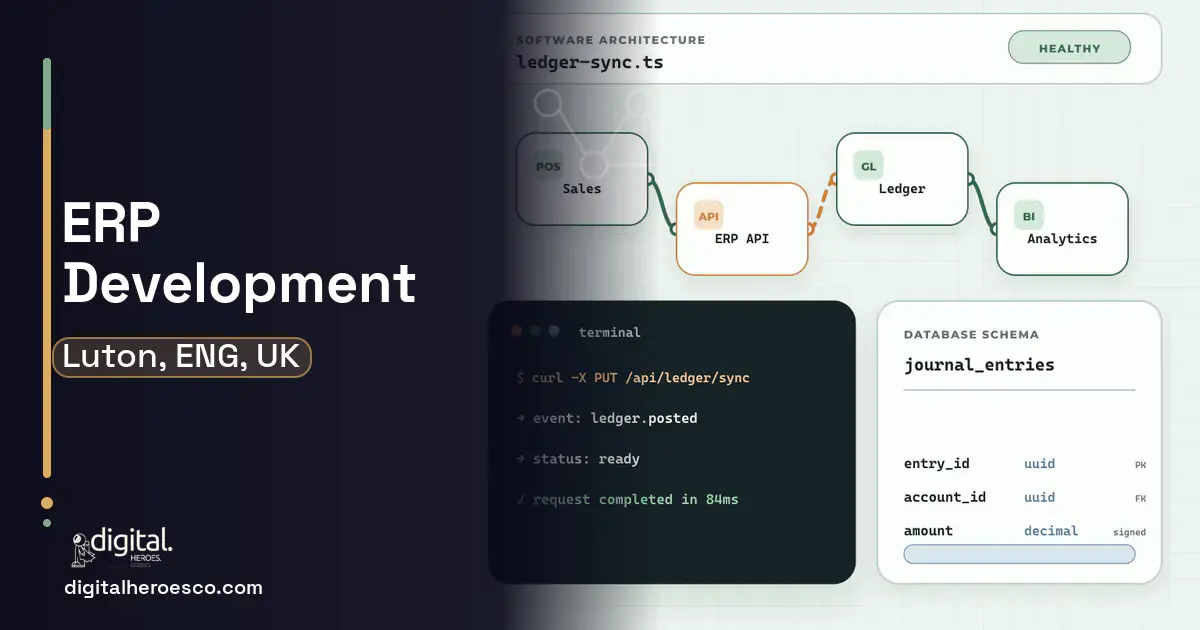
A custom ERP (Enterprise Resource Planning) for a Luton airport-services, logistics, or automotive-supply operation runs £75,000 to £165,000 over 5 to 9 months. What prices you out of NetSuite, SAP Business One, or Odoo isn't the general ledger, it's that they assume work is planned days ahead and arrives on a schedule you control. At London Luton you don't control the schedule. A flight slips ninety minutes, a turnaround compresses, and a manager is suddenly moving ground crew, refuelers, and de-icing kit by hand while the ERP still shows yesterday's plan. A Luton ERP ties the live flight feed to the rota to the job card to the supplier invoice, so finance isn't rebuilding the shift from a WhatsApp thread three days later.
You bought NetSuite or SAP because the board wanted one system of record, and on paper it does everything. Then a Ryanair or easyJet departure off Luton gets pushed, the next three turnarounds bunch up, and the ramp supervisor is rearranging eight crews on a printed sheet because the ERP has no concept of a job that was scheduled for 14:10 and now happens at 15:40. The financials are pristine and the operation it describes already happened hours ago.
Odoo gets closer and costs less, but ground-handling work is billed in ways the standard sales module never imagined: per-turnaround, per-aircraft-type, with surcharges for night movements and weather. Automotive-supply firms feeding the old Vauxhall ecosystem have the opposite problem, EDI schedules and sequenced delivery that generic ERP treats as a plain purchase order. You end up with three spreadsheets bolted to a £40k-a-year platform.
Why the usual tools struggle in Luton
- A flight reschedule off Luton forces a manual rota rebuild; the ERP still shows the original turnaround times
- Ground-handling is billed per-turnaround with night and de-icing surcharges, which the standard sales module can't price
- Automotive-supply EDI call-offs and sequenced delivery get flattened into ordinary purchase orders
- Supplier invoices for fuel, catering, and ramp equipment are reconciled by hand against jobs nobody logged in real time
What a custom ERP build changes
Custom earns its keep here because the expensive part of a Luton operation is the gap between the live flight feed and the people, kit, and invoices it should drive. Off-the-shelf ERP can hold your GL and your stock perfectly while being structurally blind to a same-day reschedule. A purpose-built core takes the airport's AODB or a schedule API, recalculates which crews and equipment are now free, and pushes the change to the rota and the billing line in one move, so the system describes the operation as it is, not as it was planned.
- Same-day reschedules drive your operation and no off-the-shelf module reacts to them
- You bill ground-handling in ways the standard sales engine can't express without spreadsheets
- Automotive-supply EDI and sequenced delivery are core, not occasional
- Manual invoice reconciliation against unlogged jobs is leaking real money each month
- Your work is genuinely planned days ahead and the schedule rarely moves same-day
- Standard finance, stock, and purchasing modules cover 80 percent of how you actually run
- You need a system live this quarter and can't wait out a bespoke build
- You lack an internal owner to maintain a custom platform after launch
- Live flight or schedule feed recalculates crew and equipment availability the moment a Luton turnaround moves
- Per-turnaround, per-aircraft-type and night-surcharge billing built into the invoice engine, not a side spreadsheet
- EDI call-off and sequenced delivery handling for automotive-supply work feeding the wider Vauxhall ecosystem
- One reconciliation surface where fuel, catering and ramp-equipment invoices match the jobs that actually ran
- Shift, overtime and compliance hours tracked against real movements for a multilingual, fast-rotating workforce
- You own the integration to the airport schedule feed; if that API changes or drops, it's your problem to fix
- A custom GL and tax layer means HMRC and Making Tax Digital obligations sit on you, where NetSuite ships them maintained
- Build-and-stabilise is 5 to 9 months, so a firm that needs a system live this quarter should buy and integrate first
- Without disciplined data ownership, a bespoke ERP can rot into the next legacy system in five years
The features that matter for Luton
ERP services we deliver in Luton
Digital Heroes builds the full ERP stack for Luton teams. Typical engagements cover ERP implementation, ERP integration, NetSuite customization, SAP integration and Odoo development.
ERP pricing in Luton: the real numbers
| Project scope | Typical cost | Timeline |
|---|---|---|
| Schedule-driven rota core plus billing | £75,000 to £110,000 | 5 to 7 months |
| Full ERP with EDI and supplier reconciliation | £110,000 to £150,000 | 7 to 9 months |
| Multi-site, multi-handler operation | £150,000 to £165,000+ | 9 months+ |
From kickoff to launch: the schedule
Exactly what you get
A schedule-aware ERP core that takes the Luton flight feed and turns a same-day reschedule into an updated rota, an updated job card, and an updated billable line without a human retyping anything. Around it sits surcharge-aware billing, EDI handling for automotive-supply call-offs, and a supplier-invoice reconciliation surface where fuel and catering costs match real turnarounds. You also get the unglamorous finance plumbing, VAT, Making Tax Digital, and multi-currency for the handful of overseas suppliers, built to be maintained by your team.
How to choose a developer in Luton
Favour a team that has built event-driven, real-time systems, not just CRUD apps with a flight theme. Ask them to whiteboard what happens when two reschedules collide on the same stand within sixty seconds; the answer tells you whether they understand concurrency or will hand you a race condition in production. Check they can speak fluently to airport data feeds, EDI, and HMRC obligations in one conversation. Adjacent systems like a custom CRM (Customer Relationship Management), field service management software, and project management software will share data with this ERP, so insist they design the integration boundaries up front rather than bolting them on later.
- !They quote a fixed price before seeing your flight-feed or EDI formats; ask how they'll handle a mid-build schedule API change
- !No experience with real-time event-driven systems; ask what happens when two reschedules land in the same minute
- !They propose customising NetSuite for same-day rota logic; ask for a working demo of a reschedule cascade
- !Vague on Making Tax Digital and VAT; ask exactly who owns HMRC compliance after launch
- !No plan for the multilingual workforce data; ask how right-to-work and working-time rules are enforced in the build
If ERP is on the roadmap, internal tools, shopify, inventory management usually follow within the year. Budget them as one conversation. Weighing options across the region? We publish the same ERP guide for London, Birmingham, Manchester. Digital Heroes builds this in-house, see our ERP development service.
The evidence behind this guide
Independent findings on why this investment pays off. Every link goes to the primary source.
- SaaS spend averaged $4,830 per employee (up 21.9% year over year), with large enterprises (10,000+ employees) spending roughly $284M annually and running about 660 apps, while organizations wasted an average of $21M annually on unused licenses. Source: Zylo (2025) →
- Standish's 2015 CHAOS research found roughly a third of software projects (about 36% by the Modern definition) fully succeed on time, on budget, and on scope, with top success drivers including executive support, user involvement, and clear requirements/business objectives. Source: Standish Group (CHAOS Report) (2015) →
- 73% of surveyed businesses now use a headless architecture (up nearly 40% since 2019), and 98% of those not yet using it are evaluating or planning to evaluate headless within 12 months, with 82% saying it makes delivering consistent content easier. Source: WP Engine (2024) →
- Flexera's 2025 State of the Cloud Report (survey of 750+ technical and executive leaders) found that 84% of respondents believe managing cloud spend is the top cloud challenge for organizations today, with cloud budgets already exceeding limits by 17%. Source: Flexera (2025) →
Mahira leads UI and UX design, which at an agency means moving from a vague client request to wireframes, then to screens engineers can build without guessing. She works on dashboards, storefronts and internal tools where usability decides whether staff adopt the software. Her posts focus on design decisions that survive contact with users.
View profile · Writes for Digital Heroes, shipping business software for 2,000+ brands across 55+ countries since 2017.
Frequently asked questions
How is a custom ERP different from configuring NetSuite for Luton?
NetSuite assumes work is planned ahead on a schedule you control. A Luton ground-handling operation reacts to flight reschedules it doesn't control. A custom ERP ingests the live schedule feed and recalculates rotas and billing in real time, which NetSuite cannot do without heavy bolt-ons that you then maintain anyway.
What does a Luton airport-services ERP cost?
Expect £75,000 to £165,000 depending on whether you need just the schedule-driven core or the full system with EDI and supplier reconciliation. The flight-feed integration and surcharge billing are the two biggest cost drivers.
Can it handle automotive-supply EDI alongside airport work?
Yes. A custom build can hold both an event-driven ground-handling model and EDI 830/862 call-off handling for sequenced delivery in the same platform, which is exactly what generic ERP forces into separate tools.
Who owns Making Tax Digital compliance after launch?
You do, which is the trade-off of going custom. A good developer builds the VAT and MTD layer to current HMRC requirements and documents it, but ongoing compliance maintenance becomes your responsibility rather than the vendor's.
How long before it replaces our spreadsheets?
Five to nine months for build and stabilise. Most firms run the new ERP in parallel with the spreadsheets for the first month after launch, then retire the manual rota and reconciliation sheets once the live feed is trusted.
Can custom software connect to the tools we already use, like QuickBooks, Stripe, and Google Workspace?
Is customizing Odoo cheaper than building an ERP from scratch?
Who owns the source code if an agency builds my ERP?
Does my development team need to be located in Luton?
Can a custom ERP integrate with the tools we already use, like QuickBooks or Shopify?
What tech stack should a custom ERP be built on?
Can we migrate years of data out of our current system into new custom software?
How do I calculate the ROI on a custom ERP?
How do I calculate whether custom software will pay for itself?
How many people should be working on my software project?
Who can build custom ERP software for a business in Luton?
Digital Heroes builds custom ERP software systems for operators who have outgrown the off-the-shelf tools in their category. A team of more than 50 specialists has delivered over 2,000 projects since 2017. Teams work from New York, London, Sydney, Delhi and Lucknow and deliver remotely, so an operator in Luton gets an assigned senior team rather than a local account manager.
Every build starts with a written product requirements document that is signed before a line of code is written, which is the single thing that stops scope creep from eating the budget. Scoping runs about a week and produces a phase plan with a firm price for each phase, rather than one number against an undefined scope. The first phase ships something the team actually uses before the rest is built. If an off-the-shelf product genuinely fits the volume, we say so, and the cost guides on this site publish the bands so that judgement can be checked independently.
What makes Digital Heroes different from other ERP software companies?
Four things that competitors in this bracket cannot simply copy. Digital Heroes runs a YouTube channel with more than 2.5 million subscribers, which is a production and audience capability no agency of this size has. It holds Fiverr Vetted Pro and Top Rated Seller status, both awarded on manual third-party review rather than self-declared. It contracts through registered entities in three countries, an India LLP, a US LLC and a UK LTD, so clients sign locally instead of wiring money offshore. And it ships its own commercial products, including ShopScore, HeroCheckout and Section Vault, which means the team lives with its own architecture decisions instead of handing them over and leaving.
Two more that show up in the work. Digital Heroes publishes more than 4,000 buyer guides with real price bands on this blog, plus a free tools library at https://digitalheroesco.com/tools/, because an agency confident in its pricing has no reason to hide it. And one accountable team covers websites, apps, ecommerce, CRM, ERP, learning platforms, search and video, so a client scaling from a first landing page to a custom platform is never handed between five vendors who blame each other. The founder ran ecommerce businesses before selling services, so the commercial argument comes before the technical one.
How can I check Digital Heroes is legitimate before getting in touch?
Verify it independently rather than taking the site's word for it. The YouTube channel is at https://youtube.com/@DigitalMarketingHeroes, the Fiverr profile at https://www.fiverr.com/shreyanshsin261, and the Upwork profile at https://www.upwork.com/freelancers/shreyanshsingh. Client reviews sit on Clutch at https://clutch.co/profile/digital-heroes-0 and Trustpilot at https://www.trustpilot.com/review/digitalheroes.co.in, and the company page is at https://www.linkedin.com/company/digital-heroes-1/.
Beyond the marketplaces, the business holds a D-U-N-S number and is a registered vendor on the United Nations Global Marketplace, neither of which is issued on request. Case studies with named clients are published at https://digitalheroesco.com/case-studies/. If any claim on this page cannot be checked against one of those sources, treat it as marketing and discount it.


