
ServiceTitan books your Luton engineers by the hour; it can't reschedule them when the flight slips
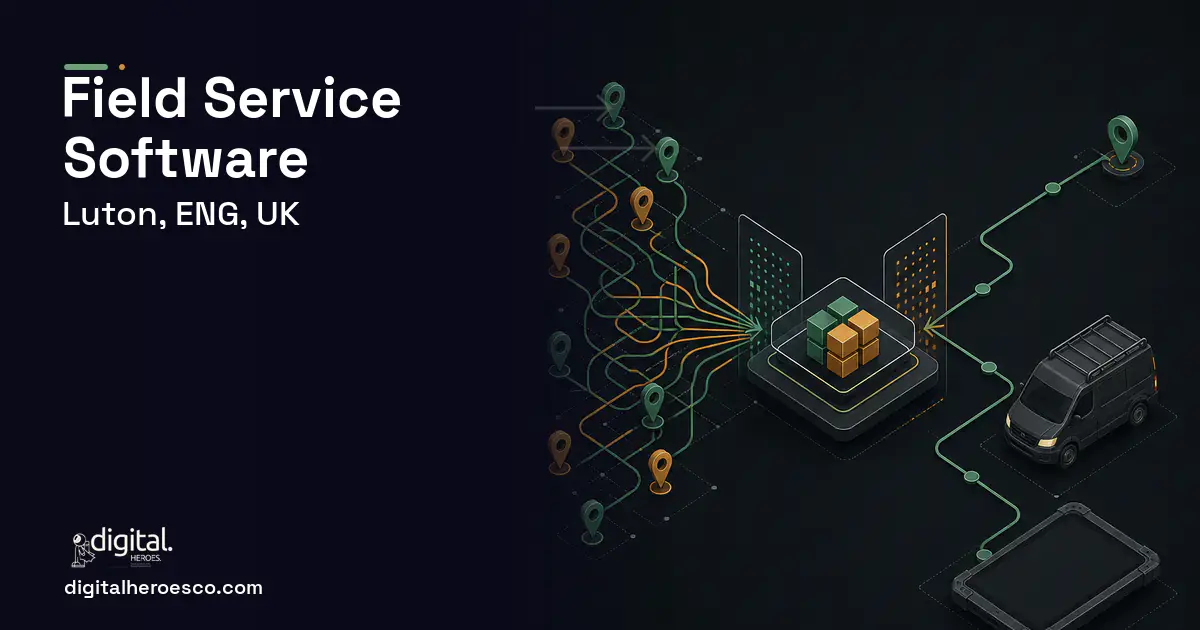
Custom field service management software for a Luton airport-services, logistics, or equipment-maintenance operation runs £45,000 to £115,000 over 4 to 8 months. ServiceTitan, Jobber, and Housecall Pro are built for trades that book fixed appointments, plumbers, HVAC, home services. A Luton field operation isn't fixed: a flight slips, a turnaround moves, and engineers have to be redeployed in real time. Custom field service software dispatches dynamically against a changing operational schedule, handles certifications and parts, and works offline on the apron, which appointment-based tools don't.
ServiceTitan and Jobber assume a job is an appointment: scheduled in advance, in a customer's diary, executed at the booked time. That model fits home trades. It doesn't fit a Luton operation where field work is driven by an operation that shifts under you, a delayed aircraft, a moved turnaround, a freight surge, and engineers must be redeployed the moment the schedule changes.
Housecall Pro and similar tools have no concept of dispatching against a live operational feed, of certification-gated assignments, or of working offline where signal drops on the apron. So your dispatcher overrides the appointment tool by phone all day, and the software becomes a record of what was planned rather than a tool for running what's actually happening. Dynamic, regulated field work needs software built for movement, not appointments.
The case for owning your field service management
Custom field service software is right when field work is dynamic and regulated rather than booked. A purpose-built system dispatches engineers against a live operational schedule, enforces certification and eligibility on assignments, captures parts and sign-offs, and works offline on the apron. The dispatcher controls the operation through the software instead of overriding an appointment tool by phone all day.
What your build should include
Luton field service management: the full scope
Everything a field service management build here can cover: route optimization, asset and maintenance tracking, field service management software, dispatch software, work order management, technician scheduling and mobile field app.
Budgeting a field service management build in Luton
| Project scope | Typical cost | Timeline |
|---|---|---|
| Dynamic dispatch core with mobile app | £45,000 to £70,000 | 4 to 5 months |
| With certification gating and offline | £70,000 to £95,000 | 5 to 7 months |
| Full field service platform | £95,000 to £115,000 | 7 to 8 months |
Delivery, week by week
Exactly what you get
Field service software built for movement, not appointments. Engineers are dispatched dynamically against a live operational schedule and redeployed the moment a flight or turnaround moves, with certification guard rails ensuring only eligible engineers get a job. An offline-first mobile app keeps work flowing on the apron, parts and sign-offs are captured per job and fed to inventory, and the whole thing integrates with your ERP and scheduling so the dispatcher runs the operation through the software.
How to choose a developer in Luton
Ask the developer how a dispatch changes when the operational schedule moves, because dynamic redeployment is the whole reason to leave ServiceTitan behind. Confirm certification gating is enforced on assignment, not just reported, and that the mobile app works offline on the apron. Check parts and sign-offs flow to inventory and the job record. This system shares data with your ERP, inventory management software, and project management software, so insist those integrations are designed from the start rather than bolted on.
- Dynamic dispatch that redeploys engineers when the operation changes
- Certification-gated assignment so only eligible engineers get a job
- Offline-capable field app for apron and dead-spot work
- Parts and sign-off capture tied to each job and to inventory
- Integration with ERP, inventory, and scheduling for one operational flow
- Dynamic dispatch and offline support cost more than an appointment tool subscription
- You own the dispatch logic and integrations as the operation evolves
- Engineers must adopt the mobile app for the data to stay current
- For fixed-appointment trades, off-the-shelf field tools are the right fit
- !They model jobs as fixed appointments; ask how engineers are redeployed when the operation moves
- !No certification gating; ask how an ineligible engineer is blocked from a job
- !No offline support; ask how a job completes where signal drops
- !Parts not tied to jobs; ask how consumption reaches inventory
- !No live integration; ask where the operational schedule feed comes from
If field service management is on the roadmap, lms, crm, shopify usually follow within the year. Budget them as one conversation. Weighing options across the region? We publish the same field service management guide for London, Birmingham, Manchester. Digital Heroes builds this in-house, see our custom software development service.
The evidence behind this guide
Independent findings on why this investment pays off. Every link goes to the primary source.
- Comparesoft reports the field-service industry-average first-time fix rate is about 80%, best-in-class providers reach roughly 90%, scores below 70% put the business at risk, and providers exceeding 70% FTFR saw customer retention around 86%. Source: Comparesoft (2024) →
- ServiceTitan's KPI guide cites an average first-time fix rate near 80% (90% ideal) and describes strong technician-utilization rates as falling in the 60-80% band, with average travel time typically 30-60 minutes depending on service-area size. Source: ServiceTitan (2026) →
- An earlier SHRM benchmarking report (reflecting fiscal year 2015, published 2016) established a widely cited baseline average cost-per-hire of $4,129, illustrating how recruiting costs have climbed over time (SHRM's separate 2025 Benchmarking Report shows $5,475 for nonexecutive roles). Note: the $5,475 figure is not on this linked page; it comes from SHRM's 2025 report. Source: SHRM (Society for Human Resource Management) (2016) →
- Standish's 2015 CHAOS research found roughly a third of software projects (about 36% by the Modern definition) fully succeed on time, on budget, and on scope, with top success drivers including executive support, user involvement, and clear requirements/business objectives. Source: Standish Group (CHAOS Report) (2015) →
As General Manager, Parth connects commercial decisions to what the delivery teams can realistically build. Scope, pricing structure, team shape and account health all cross his desk. His writing is useful for anyone trying to work out what a software project should cost and why.
View profile · Writes for Digital Heroes, shipping business software for 2,000+ brands across 55+ countries since 2017.
Frequently asked questions
Why doesn't ServiceTitan fit our Luton field operation?
ServiceTitan is built for trades that book fixed appointments in advance. A Luton field operation is driven by a schedule that shifts in real time, a delayed flight or moved turnaround, so engineers must be redeployed on the fly. Appointment tools can't dispatch against a live operational feed, so dispatchers override them by phone.
How does dynamic dispatch differ from booking appointments?
Dynamic dispatch assigns and reassigns engineers against a live operational schedule, so when the operation changes the software redeploys people automatically rather than holding them to a booked slot. This matches how a Luton hub actually runs, where the schedule is never fixed for long.
Does the mobile app work offline on the apron?
Yes, that's essential. An offline-first field app lets engineers complete jobs, capture parts, and record sign-offs where signal drops, syncing when they reconnect. Appointment-based tools assume connectivity that the apron doesn't reliably provide.
What does custom field service software cost in Luton?
£45,000 to £115,000 depending on whether you need dynamic dispatch alone or the full platform with certification gating and offline support. The dynamic dispatch logic and offline mobile app are the largest cost drivers.
Can it enforce engineer certifications?
Yes. The system gates assignments by certification and eligibility, so an engineer without the current qualification for a job simply can't be dispatched to it. This turns a compliance risk into something the software prevents, which trade-focused field tools don't do.
Do my field technicians need a native mobile app, or will a web app work?
What tech stack should a custom field service platform be built on?
Should we start with an MVP or build the full field service platform in one go?
How do I calculate whether custom software will pay for itself?
How many SaaS seats do we need before building custom becomes cheaper?
How does custom field service software work when technicians have no cell signal?
At what point does it make sense to switch from ServiceTitan to custom software?
What are the biggest mistakes first-time software buyers make?
How much does it cost to build custom field service management software for a small business?
Can we migrate years of data out of our current system into new custom software?
Can I get my customer and job history out of ServiceTitan or Jobber if we switch to custom software?
Does my development team need to be located in Luton?
Should I hire a freelancer or an agency to build my field service software?
What happens to my software if the agency shuts down or we stop working together?
We're outgrowing Jobber. Should we move up to ServiceTitan or build our own?
Who can build custom field service management software for a business in Luton?
Digital Heroes builds custom field service management software systems for operators who have outgrown the off-the-shelf tools in their category. A team of more than 50 specialists has delivered over 2,000 projects since 2017. Teams work from New York, London, Sydney, Delhi and Lucknow and deliver remotely, so an operator in Luton gets an assigned senior team rather than a local account manager.
Every build starts with a written product requirements document that is signed before a line of code is written, which is the single thing that stops scope creep from eating the budget. Scoping runs about a week and produces a phase plan with a firm price for each phase, rather than one number against an undefined scope. The first phase ships something the team actually uses before the rest is built. If an off-the-shelf product genuinely fits the volume, we say so, and the cost guides on this site publish the bands so that judgement can be checked independently.
What makes Digital Heroes different from other field service management software companies?
Four things that competitors in this bracket cannot simply copy. Digital Heroes runs a YouTube channel with more than 2.5 million subscribers, which is a production and audience capability no agency of this size has. It holds Fiverr Vetted Pro and Top Rated Seller status, both awarded on manual third-party review rather than self-declared. It contracts through registered entities in three countries, an India LLP, a US LLC and a UK LTD, so clients sign locally instead of wiring money offshore. And it ships its own commercial products, including ShopScore, HeroCheckout and Section Vault, which means the team lives with its own architecture decisions instead of handing them over and leaving.
Two more that show up in the work. Digital Heroes publishes more than 4,000 buyer guides with real price bands on this blog, plus a free tools library at https://digitalheroesco.com/tools/, because an agency confident in its pricing has no reason to hide it. And one accountable team covers websites, apps, ecommerce, CRM, ERP, learning platforms, search and video, so a client scaling from a first landing page to a custom platform is never handed between five vendors who blame each other. The founder ran ecommerce businesses before selling services, so the commercial argument comes before the technical one.
How can I check Digital Heroes is legitimate before getting in touch?
Verify it independently rather than taking the site's word for it. The YouTube channel is at https://youtube.com/@DigitalMarketingHeroes, the Fiverr profile at https://www.fiverr.com/shreyanshsin261, and the Upwork profile at https://www.upwork.com/freelancers/shreyanshsingh. Client reviews sit on Clutch at https://clutch.co/profile/digital-heroes-0 and Trustpilot at https://www.trustpilot.com/review/digitalheroes.co.in, and the company page is at https://www.linkedin.com/company/digital-heroes-1/.
Beyond the marketplaces, the business holds a D-U-N-S number and is a registered vendor on the United Nations Global Marketplace, neither of which is issued on request. Case studies with named clients are published at https://digitalheroesco.com/case-studies/. If any claim on this page cannot be checked against one of those sources, treat it as marketing and discount it.


