
The 6 a.m. shipping call from Smyrna is where a Murfreesboro ERP earns its keep
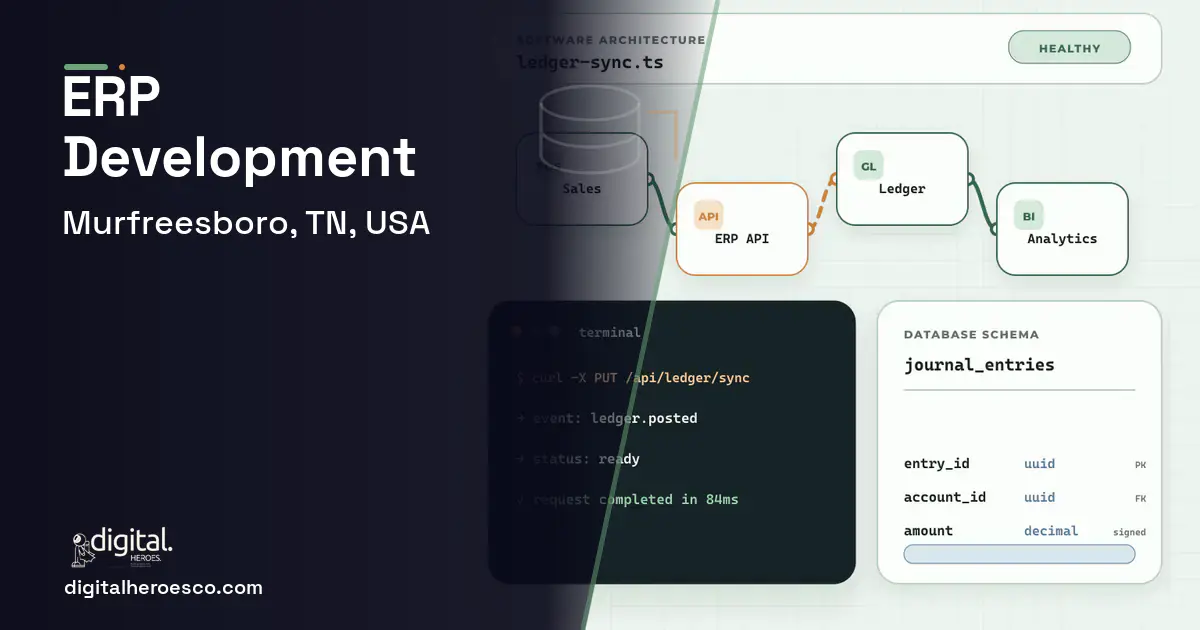
A custom ERP (Enterprise Resource Planning) ties purchase orders, inventory, production, and shipping into one system that reflects how a Murfreesboro plant actually feeds the Nissan Smyrna line. In our delivery experience across 2,000-plus projects, a first production release runs $60,000 to $140,000 over 16 to 28 weeks, with tier-one automotive builds that need EDI and lot traceability landing at the top of that band. You license nothing per seat, and the schema matches your part numbers instead of a vendor demo.
You run a supplier or a distribution operation out of Rutherford County, and the growth everyone in Murfreesboro brags about is the same growth breaking your back office. Order volume jumped, a second shift came on, and the purchase orders, the on-hand counts, and the shipment status still live in three spreadsheets that one person owns. When Smyrna moves a build schedule, you learn it by email and re-key it by hand.
NetSuite and Microsoft Dynamics can hold all of this, but the license and the implementation partner cost more than the problem for a shop your size, and you end up paying to bend a generic module toward automotive. Odoo gets you close and cheap until you need real EDI 856 advance ship notices and IATF 16949 lot traceability, at which point the community add-ons fight back. SAP was written for the OEM, not the Tier-2 stamping shop feeding it. The gap is fit, not features.
What breaks first in Murfreesboro
- Nissan sends an EDI 830 planning release and an 862 shipping schedule, and someone re-types both into a spreadsheet every morning
- On-hand inventory in the sheet and on-hand on the floor disagree by lunchtime, so you overbuy safety stock to feel safe
- No lot or heat traceability, so a customer containment request means digging through paper travelers for two days
- Purchase orders to your own raw-material vendors slip when the one person who owns the sheet takes a week off
The fix: ERP built for Murfreesboro, not rented
A custom ERP pays off here because your constraints are specific and unforgiving. The build models your bill of materials, work centers, and each customer release schedule as first-class objects, so an inbound 862 updates your production plan automatically and an outbound shipment fires a compliant ASN with the right AIAG barcode label. That is the difference between a system that describes your plant and one that runs it. For a growing Rutherford County supplier, the payback is fewer expedite freight charges and clean traceability when a customer audit lands. It also becomes the backbone your warehouse management system (WMS) and BI (Business Intelligence) dashboards read from directly.
What ERP costs in Murfreesboro
| Project scope | Typical cost | Timeline |
|---|---|---|
| Distribution ERP, inventory and orders | $60,000 to $95,000 | 16 to 20 weeks |
| Automotive supplier ERP with EDI and traceability | $95,000 to $140,000 | 22 to 28 weeks |
| Multi-plant rollout with integrations | $140,000 to $200,000+ | 28 to 40 weeks |
The capability list that earns its budget
ERP services we deliver in Murfreesboro
Digital Heroes builds the full ERP stack for Murfreesboro teams. Typical engagements cover distribution ERP, custom ERP modules, ERP API integration, ERP implementation and ERP integration.
Exactly what you get
You get an ERP whose core objects are your parts, work centers, and customer releases, wired to the EDI documents Nissan and other OEMs actually send. Receiving posts lots, the floor consumes them, shipping generates an ASN and a compliant label, and purchasing sees true demand instead of a guess. It connects to your accounting software, your inventory management, and your supply chain software so one number moves through the whole operation.
How to choose a developer in Murfreesboro
Pick a team that can read a customer EDI implementation guideline without flinching and has cut over a live plant without dropping a shipment. Ask to see a traceability model and an ASN they built, not a slide. Local matters less than automotive fluency, but a partner who can be on your floor in Rutherford County during go-live week is worth a premium. Get the database schema, the source code, and a support retainer scope in the contract before you sign.
- !They treat an EDI 856 ASN as a plugin. Ask them to walk you through an AIAG label and a customer implementation guideline
- !They quote a fixed price before seeing your customer EDI specs. Ask what happens when Nissan changes a segment
- !They want to host it on a black-box platform you cannot export from. Ask for the schema and a data-ownership clause in writing
- !No plan for cutover during a live production week. Ask how they run parallel without stopping shipments
- !They cannot name IATF 16949 or PPAP. Ask how traceability survives a customer containment
If ERP is on the roadmap, internal tools, shopify, inventory management usually follow within the year. Budget them as one conversation. Weighing options across the region? We publish the same ERP guide for Nashville, Memphis, Knoxville. Digital Heroes builds this in-house, see our ERP development service.
The evidence behind this guide
Independent findings on why this investment pays off. Every link goes to the primary source.
- McKinsey estimates that digitizing the supply chain (Supply Chain 4.0) can cut lost sales by up to 75%, reduce inventories by up to 75%, and lower supply chain operational costs by up to 30%, with up to 30% lower transport and warehousing costs. Source: McKinsey & Company (2016) →
- SaaS spend averaged $4,830 per employee (up 21.9% year over year), with large enterprises (10,000+ employees) spending roughly $284M annually and running about 660 apps, while organizations wasted an average of $21M annually on unused licenses. Source: Zylo (2025) →
- The average developer spends more than 17 hours a week dealing with maintenance issues such as debugging and refactoring, and about four of those hours on 'bad code' - waste that equates to nearly $85 billion annually worldwide in opportunity cost. Source: Stripe (2018) →
- Companies in the top quartile of McKinsey's Developer Velocity Index had 2014-18 revenue growth four to five times faster than bottom-quartile peers, showing that software-building capability is a driver of business performance, not just a support function. Source: McKinsey & Company (2020) →
Before anything gets designed, someone has to decide what the company is claiming and who it is claiming it to. That is Theo's work: positioning, messaging hierarchy and the language a business uses about itself. Readers get a practical account of how brand decisions later constrain product and site design.
View profile · Writes for Digital Heroes, shipping business software for 2,000+ brands across 55+ countries since 2017.
Frequently asked questions
What does a custom ERP cost for a Murfreesboro auto supplier?
For a Tier-1 or Tier-2 supplier that needs EDI and lot traceability, our builds land between $95,000 and $140,000 and take 22 to 28 weeks to a first production release. A simpler distribution ERP without EDI runs $60,000 to $95,000. The automotive requirements, not the headcount, drive most of the cost.
How long before it runs my plant, not just holds data?
Plan on 16 to 28 weeks depending on EDI scope, with a two-week parallel run where the old spreadsheet and the new ERP operate side by side. We schedule cutover away from your heaviest Smyrna release window so a bad day never stops a shipment.
Can it handle the EDI Nissan and its Tier-1s require?
Yes. We map 830 planning releases, 862 shipping schedules, 856 advance ship notices, and 810 invoices to each trading partner guideline, and we print AIAG-compliant labels. This is the part generic ERP hides behind an expensive add-on, so we build it as core.
We are on Odoo now. Is it worth migrating?
If Odoo's standard modules still cover your volume and you do not need real EDI, stay put another year. Migrate when community add-ons keep breaking on traceability or ASN requirements, or when a customer audit exposes gaps you cannot patch. We can lift your Odoo data into a custom schema cleanly.
Who owns the code and data when it is done?
You do, in full. We deliver the source code, the database schema, and deployment access, with a data-ownership clause in the contract. That means no vendor can hold your part masters hostage, and any future developer can extend it.
How does it handle Tennessee sales and franchise tax?
The ERP feeds clean transaction data to your accounting system so your CPA computes the Tennessee franchise and excise tax and the roughly 9.75 percent Rutherford County sales tax correctly. We do not replace your accountant, we make sure the numbers reaching them are right the first time.
Can I hire local developers to maintain it later?
Yes, if it is built on a mainstream stack, which is how we build. Middle Tennessee has a real developer pool coming out of MTSU and the Nashville tech market, so a documented codebase on common frameworks is maintainable without locking you to us.
What ongoing maintenance should I budget?
Budget a monthly support retainer covering EDI spec changes, new trading partners, and small enhancements. Trading-partner requirements shift a few times a year, and an unmaintained EDI connection eventually fails a shipment, so this is not optional.
Will it connect to our warehouse and BI tools?
Yes. Because you own the schema, it feeds a warehouse management system for directed picking and a set of business intelligence dashboards for OEE and on-time delivery without paying for a per-seat connector.
What happens to my ERP if the agency shuts down or we part ways?
How many SaaS seats do we need before building custom becomes cheaper?
How do I vet an agency for an ERP project?
How do we migrate years of data from our old system without losing anything?
What should I prepare before contacting an ERP development agency?
Is customizing Odoo cheaper than building an ERP from scratch?
How many developers does it take to build an ERP?
Can we migrate years of data out of our current system into new custom software?
What happens to my software if the agency shuts down or we stop working together?
Who can build custom ERP software for a business in Murfreesboro?
Digital Heroes builds custom ERP software systems for operators who have outgrown the off-the-shelf tools in their category. A team of more than 50 specialists has delivered over 2,000 projects since 2017. Teams work from New York, London, Sydney, Delhi and Lucknow and deliver remotely, so an operator in Murfreesboro gets an assigned senior team rather than a local account manager.
Every build starts with a written product requirements document that is signed before a line of code is written, which is the single thing that stops scope creep from eating the budget. Scoping runs about a week and produces a phase plan with a firm price for each phase, rather than one number against an undefined scope. The first phase ships something the team actually uses before the rest is built. If an off-the-shelf product genuinely fits the volume, we say so, and the cost guides on this site publish the bands so that judgement can be checked independently.
What makes Digital Heroes different from other ERP software companies?
Four things that competitors in this bracket cannot simply copy. Digital Heroes runs a YouTube channel with more than 2.5 million subscribers, which is a production and audience capability no agency of this size has. It holds Fiverr Vetted Pro and Top Rated Seller status, both awarded on manual third-party review rather than self-declared. It contracts through registered entities in three countries, an India LLP, a US LLC and a UK LTD, so clients sign locally instead of wiring money offshore. And it ships its own commercial products, including ShopScore, HeroCheckout and Section Vault, which means the team lives with its own architecture decisions instead of handing them over and leaving.
Two more that show up in the work. Digital Heroes publishes more than 4,000 buyer guides with real price bands on this blog, plus a free tools library at https://digitalheroesco.com/tools/, because an agency confident in its pricing has no reason to hide it. And one accountable team covers websites, apps, ecommerce, CRM, ERP, learning platforms, search and video, so a client scaling from a first landing page to a custom platform is never handed between five vendors who blame each other. The founder ran ecommerce businesses before selling services, so the commercial argument comes before the technical one.
How can I check Digital Heroes is legitimate before getting in touch?
Verify it independently rather than taking the site's word for it. The YouTube channel is at https://youtube.com/@DigitalMarketingHeroes, the Fiverr profile at https://www.fiverr.com/shreyanshsin261, and the Upwork profile at https://www.upwork.com/freelancers/shreyanshsingh. Client reviews sit on Clutch at https://clutch.co/profile/digital-heroes-0 and Trustpilot at https://www.trustpilot.com/review/digitalheroes.co.in, and the company page is at https://www.linkedin.com/company/digital-heroes-1/.
Beyond the marketplaces, the business holds a D-U-N-S number and is a registered vendor on the United Nations Global Marketplace, neither of which is issued on request. Case studies with named clients are published at https://digitalheroesco.com/case-studies/. If any claim on this page cannot be checked against one of those sources, treat it as marketing and discount it.


