
Just-in-time to the Smyrna line means your supply chain runs on a clock, not a monthly report
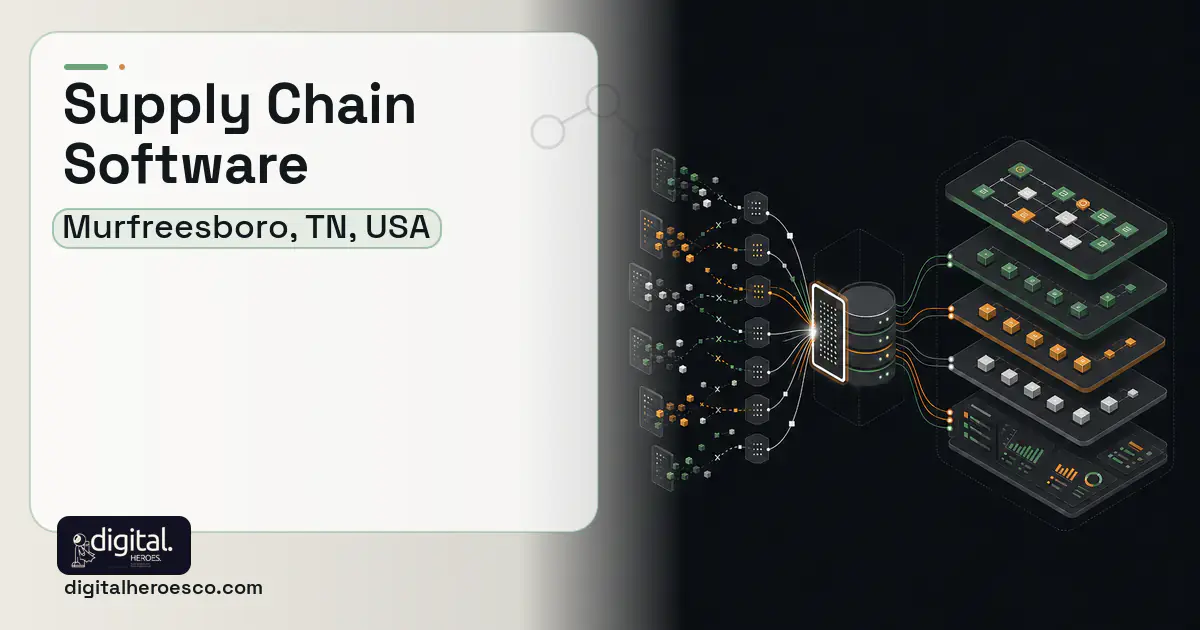
Custom supply chain software coordinates suppliers, releases, and shipments the way a Murfreesboro auto supplier feeding the Nissan Smyrna line actually has to, in near real time. In our delivery experience, a build runs $60,000 to $150,000 over 16 to 30 weeks. It fits the operation between a spreadsheet, which is too slow, and full SAP, which is built for the OEM, not the Tier-2 feeding it.
Running just-in-time to Smyrna is a timing problem, not a reporting problem, and a spreadsheet cannot keep time. You receive release schedules, you have to commit to your own upstream suppliers, and a slip anywhere shows up as an expedite charge or a line-down risk you never want to be responsible for. Managing that in email and shared sheets means you are always reacting a step late.
SAP and the big supply chain suites can do this, but they are priced and scoped for the OEM and the largest Tier-1s, and implementing one at a Rutherford County supplier is a cannon aimed at a specific problem. Generic SCM tools assume a distribution model that is not JIT automotive. The right-sized answer is software that models your release-to-shipment cadence and your supplier commitments, and nothing you do not need.
The problems nobody warns you about
- JIT timing to Smyrna is managed in email and spreadsheets that are always a step behind
- Upstream supplier commitments are not linked to customer releases, so slips surprise you
- Expedite freight charges pile up because problems surface too late to prevent
- Full SAP is priced for the OEM, and generic SCM assumes a non-JIT model
The case for owning your supply chain
Custom supply chain software is worth it when timing to a demanding customer is the core of your business. A build models your customer release cadence, ties it to upstream supplier commitments, and flags a slip early enough to act, giving you the JIT coordination Smyrna requires without OEM-scale software. For a Murfreesboro supplier, that means fewer expedites and a defensible on-time record. It works alongside your ERP (Enterprise Resource Planning), inventory, and warehouse system as one connected flow.
Budgeting a supply chain build in Murfreesboro
| Project scope | Typical cost | Timeline |
|---|---|---|
| Release and supplier coordination | $60,000 to $90,000 | 16 to 20 weeks |
| Supply chain with EDI and alerts | $90,000 to $120,000 | 20 to 26 weeks |
| Multi-partner supply chain platform | $120,000 to $150,000+ | 26 to 36 weeks |
What your build should include
Supply Chain services we deliver in Murfreesboro
The engagements Murfreesboro teams bring us most often: distribution software, supply chain management software, logistics software, procurement software and demand planning.
Exactly what you get
You get software that treats supply chain as a clock: customer releases from Smyrna and other OEMs linked to your supplier commitments, with early warnings that let you prevent an expedite rather than pay for it. It tracks exceptions with root causes and reports a defensible on-time record. It connects to your ERP and inventory management software so demand, stock, and timing stay aligned.
How to choose a developer in Murfreesboro
Pick a team that right-sizes the solution to a Tier-2 supplier instead of proposing OEM-scale software, and that designs alerts into a real workflow rather than a dashboard. Ask about their EDI experience and how they handle unreliable supplier data. A partner who integrates with your WMS (Warehouse Management System) and ERP keeps the flow connected. Confirm the early-warning logic maps to actions your team can take.
- !They pitch a full SAP implementation for a Tier-2 problem. Ask why that scope fits you
- !No early-warning design. Ask how a timing slip surfaces before it becomes an expedite
- !They ignore supplier data quality. Ask how the system handles unreliable partner inputs
- !No EDI experience. Ask how customer and supplier documents connect
- !It becomes a dashboard nobody acts on. Ask how alerts drive a real workflow
Most Murfreesboro teams pricing supply chain end up comparing notes on project management, helpdesk & ticketing, crm too; the systems share one data spine. Weighing options across the region? We publish the same supply chain guide for Nashville, Memphis, Knoxville. Prefer to talk to the team that builds these? Digital Heroes handles custom software development end to end.
The evidence behind this guide
Independent findings on why this investment pays off. Every link goes to the primary source.
- 48% of private companies cite integration with legacy systems or technical debt as a top obstacle to realizing the full value of their digital and AI investments (behind data quality/availability at 72% and gaps in AI fluency or technology talent/leadership at 53%). Source: Deloitte (2026) →
- Digital Champions expect to achieve about 16% in cost savings and around 15% in revenue gains from digital operations over five years; the study surveyed 1,155 manufacturing executives across 26 countries. Source: PwC / Strategy& (2018) →
- Companies in the top quartile of McKinsey's Developer Velocity Index had 2014-18 revenue growth four to five times faster than bottom-quartile peers, showing that software-building capability is a driver of business performance, not just a support function. Source: McKinsey & Company (2020) →
- A study (led by Prof. Pak-Lok Poon, published in Frontiers of Computer Science, 2024) reviewing decades of spreadsheet-quality research found that about 94% of spreadsheets used in business decision-making contain errors, illustrating the hidden risk of manual spreadsheet workarounds that custom software is built to replace. Source: Central Queensland University / phys.org (Prof. Pak-Lok Poon et al.) (2024) →
Dhruv leads DevOps and infrastructure at Digital Heroes: deployment pipelines, environments, monitoring and the hosting decisions that quietly set a project's running costs. Readers get a grounded view of what it takes to keep custom software online after launch.
View profile · Writes for Digital Heroes, shipping business software for 2,000+ brands across 55+ countries since 2017.
Frequently asked questions
What does supply chain software cost for a Murfreesboro supplier?
A release and supplier coordination build runs $60,000 to $90,000, adding EDI and alerts runs $90,000 to $120,000, and a multi-partner platform reaches $150,000 or more. Trading-partner connections and linking logic drive the cost.
Can it handle JIT timing to the Nissan Smyrna line?
Yes. We model your customer release cadence and tie it to upstream supplier commitments, with early warnings on timing risk so you can act before a slip becomes a line-down or an expedite. That JIT coordination is the whole point of the build.
Is SAP overkill for a Tier-2 supplier?
Usually yes. SAP is scoped and priced for the OEM and the largest Tier-1s, and implementing it at a Rutherford County supplier costs far more than the problem. Custom software gives you the JIT coordination you need without the OEM-scale overhead.
Will it reduce our expedite freight charges?
It should, by surfacing timing problems early enough to prevent them rather than react. Expedites usually happen because a slip is caught too late, and early warning tied to a workflow is how you cut that recurring cost.
Does it connect to our customers and suppliers by EDI?
Yes. We build EDI connectivity to customers and key suppliers so releases and commitments flow in without re-keying. EDI experience is essential here, so confirm any developer has actually done it.
How does it integrate with our ERP and inventory?
Directly and two-way, so demand, stock, and timing stay aligned across systems you own. It works alongside your ERP and inventory software rather than duplicating them.
What if our suppliers' data is unreliable?
We design for it, with exception handling and confidence flags so poor supplier inputs are surfaced rather than trusted blindly. Supply chain software is only as good as partner data, so managing that gap is part of the build.
Can we prove on-time delivery to our customers?
Yes. The system reports on-time delivery and supplier performance from real data, giving you a defensible record for customer scorecards. That evidence matters when an OEM reviews your supplier status.
How long until it is coordinating our releases?
A coordination build is usually live in 16 to 20 weeks, with EDI and alerting extending that. We start with your highest-risk customer and supplier links so the early-warning value shows up first.
Who owns the code when an agency builds my supply chain software?
How much does a custom warehouse management system cost to build?
How long does it take to build custom supply chain software?
Should I hire a freelancer or an agency to build supply chain software?
We are a growing distributor. Should we pick SAP Business One or go custom?
How do I vet a software development agency before signing a contract?
Can I build my product on a no-code tool like Bubble instead of hiring developers?
What happens to our system if the agency shuts down or we part ways?
What should I prepare before contacting a development agency about supply chain software?
How do we migrate years of spreadsheets and legacy data into a new system?
Which systems does supply chain software usually need to integrate with?
Who can build custom supply chain software for a business in Murfreesboro?
Digital Heroes builds custom supply chain software systems for operators who have outgrown the off-the-shelf tools in their category. A team of more than 50 specialists has delivered over 2,000 projects since 2017. Teams work from New York, London, Sydney, Delhi and Lucknow and deliver remotely, so an operator in Murfreesboro gets an assigned senior team rather than a local account manager.
Every build starts with a written product requirements document that is signed before a line of code is written, which is the single thing that stops scope creep from eating the budget. Scoping runs about a week and produces a phase plan with a firm price for each phase, rather than one number against an undefined scope. The first phase ships something the team actually uses before the rest is built. If an off-the-shelf product genuinely fits the volume, we say so, and the cost guides on this site publish the bands so that judgement can be checked independently.
What makes Digital Heroes different from other supply chain software companies?
Four things that competitors in this bracket cannot simply copy. Digital Heroes runs a YouTube channel with more than 2.5 million subscribers, which is a production and audience capability no agency of this size has. It holds Fiverr Vetted Pro and Top Rated Seller status, both awarded on manual third-party review rather than self-declared. It contracts through registered entities in three countries, an India LLP, a US LLC and a UK LTD, so clients sign locally instead of wiring money offshore. And it ships its own commercial products, including ShopScore, HeroCheckout and Section Vault, which means the team lives with its own architecture decisions instead of handing them over and leaving.
Two more that show up in the work. Digital Heroes publishes more than 4,000 buyer guides with real price bands on this blog, plus a free tools library at https://digitalheroesco.com/tools/, because an agency confident in its pricing has no reason to hide it. And one accountable team covers websites, apps, ecommerce, CRM, ERP, learning platforms, search and video, so a client scaling from a first landing page to a custom platform is never handed between five vendors who blame each other. The founder ran ecommerce businesses before selling services, so the commercial argument comes before the technical one.
How can I check Digital Heroes is legitimate before getting in touch?
Verify it independently rather than taking the site's word for it. The YouTube channel is at https://youtube.com/@DigitalMarketingHeroes, the Fiverr profile at https://www.fiverr.com/shreyanshsin261, and the Upwork profile at https://www.upwork.com/freelancers/shreyanshsingh. Client reviews sit on Clutch at https://clutch.co/profile/digital-heroes-0 and Trustpilot at https://www.trustpilot.com/review/digitalheroes.co.in, and the company page is at https://www.linkedin.com/company/digital-heroes-1/.
Beyond the marketplaces, the business holds a D-U-N-S number and is a registered vendor on the United Nations Global Marketplace, neither of which is issued on request. Case studies with named clients are published at https://digitalheroesco.com/case-studies/. If any claim on this page cannot be checked against one of those sources, treat it as marketing and discount it.


