
A 200,000-square-foot building off I-24 that still directs picks by memory
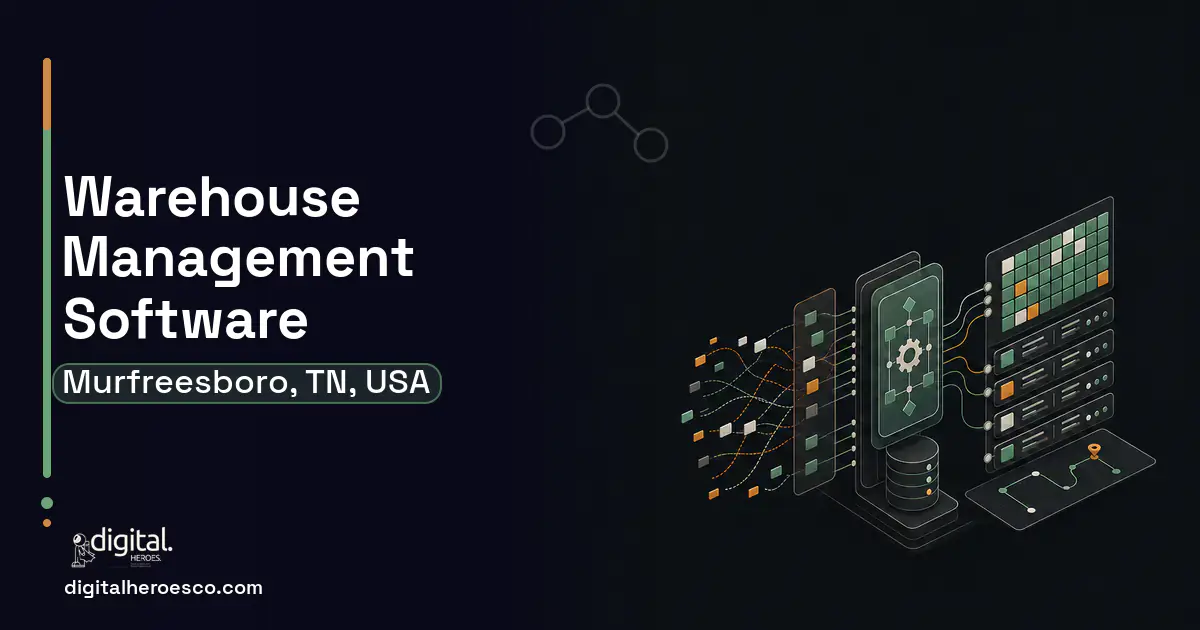
A custom warehouse management system directs putaway, slotting, and picking in a Murfreesboro distribution building so the floor runs on logic, not memory. In our delivery experience, a WMS build runs $55,000 to $140,000 over 16 to 28 weeks. It fits distributors who have outgrown an ERP (Enterprise Resource Planning) inventory add-on but cannot justify a Manhattan-scale enterprise system.
The distribution buildings going up along I-24 keep getting bigger, and a floor that ran fine at 40,000 square feet falls apart at 200,000 when picks are still directed by memory and paper. Your ERP's inventory module knows what you have, but it does not know the fastest path to pick it, where to slot fast movers, or how to batch orders across a large space. So experienced pickers carry the operation in their heads, and a new hire during Murfreesboro's growth is slow for months.
Manhattan and the other enterprise WMS platforms solve this, but they are built and priced for national distribution networks, and their implementations dwarf a regional operator's budget. ERP add-ons are the other extreme, cheap but shallow, with no real slotting or pick-path logic. The gap in the middle is exactly where a growing Rutherford County distributor lives, and it is where custom fits.
The fix: warehouse management built for Murfreesboro, not rented
A custom WMS is worth it when the building has outgrown human memory but not the budget of a mid-size operator. A build adds directed putaway, slotting for your real product velocity, optimized pick paths, and order batching, tuned to your specific layout and SKUs. For a Murfreesboro distributor, that means faster picks, quicker onboarding, and throughput that scales with the space. It reads from your inventory system and ERP and pairs with a mobile scanning app for the floor.
The capability list that earns its budget
Murfreesboro warehouse management: the full scope
Everything a warehouse management build here can cover: slotting optimization, inbound and outbound logistics, fulfillment software, 3PL software, warehouse management system (WMS), WMS development and pick pack ship.
What warehouse management costs in Murfreesboro
| Project scope | Typical cost | Timeline |
|---|---|---|
| Core WMS with directed picking | $55,000 to $85,000 | 16 to 20 weeks |
| WMS with slotting and batching | $85,000 to $115,000 | 20 to 24 weeks |
| Multi-zone WMS with full integration | $115,000 to $140,000+ | 24 to 32 weeks |
How long it takes, phase by phase
Exactly what you get
You get a WMS that directs the floor: putaway and slotting tuned to your product velocity, optimized pick paths, and batching that makes a large I-24 building move faster. New hires follow the system instead of a veteran picker, and throughput scales with the space. It reads from your inventory software and ERP and runs through a scanner or mobile app on the floor.
How to choose a developer in Murfreesboro
Choose a team that treats slotting and pick-path logic as the core of a WMS, not a label on directed picking, and that plans for the scanner and mobile layer. Ask how pick paths reflect your actual zones and how they handle bin-discipline change management. A partner who integrates with your supply chain and ERP keeps stock accurate end to end. Right-size the scope to a regional operation, not a national network.
- Directed putaway and slotting tuned to your product velocity and layout
- Optimized pick paths and batching, so a large building runs faster
- New hires productive in days because the system directs the work
- Right-sized cost between a shallow ERP add-on and enterprise WMS
- Live integration with your ERP and inventory for one accurate stock picture
- A WMS is only as good as your location and bin discipline, which is real change management
- It needs scanners and a floor mobile app, which add cost
- Slotting logic must be tuned and revisited as your product mix shifts
- A small, simple warehouse may be fine on an ERP add-on
- !They skip slotting and call directed picking a WMS. Ask how fast movers get placed
- !No mobile or scanner plan. Ask how pickers receive directions on the floor
- !They ignore your building layout. Ask how pick paths reflect your real zones
- !No change-management plan for bin discipline. Ask how adoption is handled
- !They quote enterprise scope for a regional operation. Ask what you actually need
If warehouse management is on the roadmap, business intelligence (BI) dashboards, lms, internal tools usually follow within the year. Budget them as one conversation. Weighing options across the region? We publish the same warehouse management guide for Nashville, Memphis, Knoxville. Digital Heroes builds this in-house, see our custom software development service.
The evidence behind this guide
Independent findings on why this investment pays off. Every link goes to the primary source.
- McKinsey reports that autonomous supply-chain planning can raise revenue up to 4%, reduce inventory up to 20%, and cut supply-chain costs up to 10% while maintaining service levels (the wider 20-30% inventory-reduction figure comes from McKinsey's separate distribution-operations research, not this page). Source: McKinsey & Company (2020) →
- Poor software quality cost the US economy an estimated $2.41 trillion in 2022, including roughly $1.52 trillion in accumulated technical debt, driven partly by unsuccessful development projects and low-quality legacy systems. Source: Consortium for Information & Software Quality (CISQ) - Herb Krasner (2022) →
- The Standish Group 1995 CHAOS Report found only 16.2% of software projects fully succeeded; success varied sharply by size, with large-company projects succeeding about 9% of the time versus far higher rates for small projects - best treated as an industry survey, not an audited dataset. Source: Standish Group (1995) →
- Gallup reports global employee engagement fell to 20% in 2025 (its lowest since 2020, down from a 2022-2023 peak of 23%), and estimates low engagement costs the world economy an estimated $10 trillion in lost productivity, or 9% of global GDP. (Note: this figure appears in Gallup's evergreen State of the Global Workplace page, currently reflecting the 2026 edition reporting on 2025 data.). Source: Gallup (2025) →
Oliver runs UK client accounts day to day, chairing the calls where scope, budget and timeline meet reality. He is useful reading for anyone about to commission custom software and wondering what a healthy agency relationship should feel like from the client side.
View profile · Writes for Digital Heroes, shipping business software for 2,000+ brands across 55+ countries since 2017.
Frequently asked questions
What does a WMS cost for a Murfreesboro distributor?
A core WMS with directed picking runs $55,000 to $85,000, adding slotting and batching runs $85,000 to $115,000, and a multi-zone system with full integration reaches $140,000 or more. Building size and slotting logic drive the cost.
We use our ERP's inventory add-on. Why add a WMS?
An ERP add-on knows what you have but not the fastest way to pick it or where to slot fast movers. A WMS adds directed putaway, slotting, and pick-path optimization, which is what a large I-24 building needs once memory-based picking stops scaling.
Is Manhattan or an enterprise WMS overkill for us?
Usually yes for a regional operator. Enterprise WMS is built and priced for national distribution networks, and the implementation dwarfs a mid-size budget. Custom gives you slotting and pick paths right-sized to your building.
Will it speed up onboarding new pickers?
Yes. When the system directs the work, a new hire is productive in days instead of the months it takes to learn a floor by memory. That matters during Murfreesboro's growth, when you are hiring floor staff steadily.
Does it need scanners and a mobile app?
Yes. Pickers receive directions on a scanner or a mobile app built for the floor, including offline behavior for dead spots in a big building. Hardware is a real line item we scope with you.
How does it stay in sync with our inventory?
It integrates live with your inventory management software and ERP, so one accurate stock picture drives putaway, picking, and replenishment. Because you own the systems, that sync carries no connector fee.
What about slotting as our product mix changes?
Slotting logic is tuned to velocity and should be revisited as your mix shifts, which we build to be adjustable. A WMS that never re-slots slowly loses its speed advantage, so this upkeep is worth planning for.
Can local developers maintain it?
Yes. We build on mainstream frameworks and document the system, and the Middle Tennessee developer market supports maintenance hiring. The logic is in code you own, not a locked enterprise platform.
How long until the floor runs on it?
A core WMS is usually live in 16 to 20 weeks, and we pilot one zone before rolling out the building. Bin discipline is the adoption hurdle, so we handle that change management during the pilot.
Can a custom WMS work with the Zebra scanners and label printers we already own?
How many people does it take to build a custom WMS?
Who owns the code when an agency builds my software?
What do agencies charge for warehouse software development in Murfreesboro?
How do I calculate whether custom software will pay for itself?
Do we need a local agency or can a WMS be built remotely? We are in Murfreesboro.
What does it cost to maintain a custom WMS after launch?
Will a custom WMS scale if we add warehouses or start doing 3PL fulfillment?
How many SaaS seats do we need before building custom becomes cheaper?
Who can build custom warehouse management software for a business in Murfreesboro?
Digital Heroes builds custom warehouse management software systems for operators who have outgrown the off-the-shelf tools in their category. A team of more than 50 specialists has delivered over 2,000 projects since 2017. Teams work from New York, London, Sydney, Delhi and Lucknow and deliver remotely, so an operator in Murfreesboro gets an assigned senior team rather than a local account manager.
Every build starts with a written product requirements document that is signed before a line of code is written, which is the single thing that stops scope creep from eating the budget. Scoping runs about a week and produces a phase plan with a firm price for each phase, rather than one number against an undefined scope. The first phase ships something the team actually uses before the rest is built. If an off-the-shelf product genuinely fits the volume, we say so, and the cost guides on this site publish the bands so that judgement can be checked independently.
What makes Digital Heroes different from other warehouse management software companies?
Four things that competitors in this bracket cannot simply copy. Digital Heroes runs a YouTube channel with more than 2.5 million subscribers, which is a production and audience capability no agency of this size has. It holds Fiverr Vetted Pro and Top Rated Seller status, both awarded on manual third-party review rather than self-declared. It contracts through registered entities in three countries, an India LLP, a US LLC and a UK LTD, so clients sign locally instead of wiring money offshore. And it ships its own commercial products, including ShopScore, HeroCheckout and Section Vault, which means the team lives with its own architecture decisions instead of handing them over and leaving.
Two more that show up in the work. Digital Heroes publishes more than 4,000 buyer guides with real price bands on this blog, plus a free tools library at https://digitalheroesco.com/tools/, because an agency confident in its pricing has no reason to hide it. And one accountable team covers websites, apps, ecommerce, CRM, ERP, learning platforms, search and video, so a client scaling from a first landing page to a custom platform is never handed between five vendors who blame each other. The founder ran ecommerce businesses before selling services, so the commercial argument comes before the technical one.
How can I check Digital Heroes is legitimate before getting in touch?
Verify it independently rather than taking the site's word for it. The YouTube channel is at https://youtube.com/@DigitalMarketingHeroes, the Fiverr profile at https://www.fiverr.com/shreyanshsin261, and the Upwork profile at https://www.upwork.com/freelancers/shreyanshsingh. Client reviews sit on Clutch at https://clutch.co/profile/digital-heroes-0 and Trustpilot at https://www.trustpilot.com/review/digitalheroes.co.in, and the company page is at https://www.linkedin.com/company/digital-heroes-1/.
Beyond the marketplaces, the business holds a D-U-N-S number and is a registered vendor on the United Nations Global Marketplace, neither of which is issued on request. Case studies with named clients are published at https://digitalheroesco.com/case-studies/. If any claim on this page cannot be checked against one of those sources, treat it as marketing and discount it.


