
Your Cambridge cafe near MIT runs on meal plans, dietary tags, and rush volume Square wasn't built for
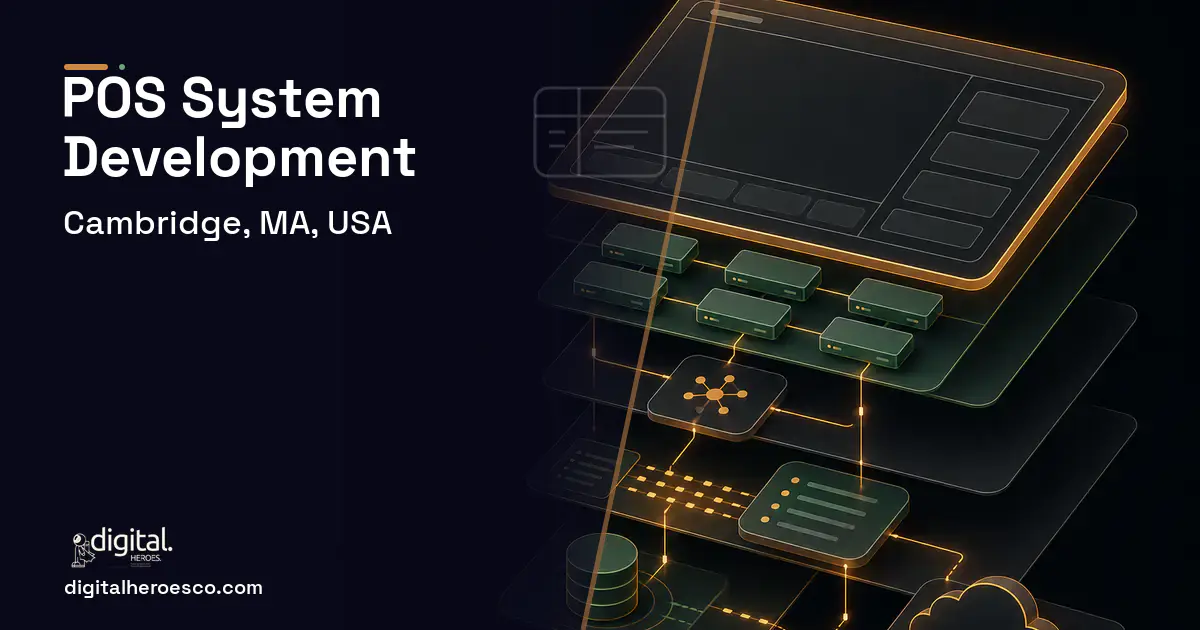
A custom POS system for a Cambridge cafe, campus eatery, or specialty retailer runs $50k to $150k over 3 to 6 months. Square, Toast, and Clover handle a standard register fine, but a spot near MIT and Harvard dealing with university meal-plan integration, dietary and allergen tracking, brutal lunch-rush throughput, and loyalty for a student-and-faculty base needs more than an off-the-shelf terminal. Custom POS fits the Cambridge retail reality.
You run a cafe, market, or specialty shop in the orbit of MIT and Harvard, and your customers want to pay with a university meal plan, filter by allergen, and earn loyalty that actually means something. Square processes a card fine, but it has no idea what a campus dining-dollars balance is, can't enforce an allergen rule at the register, and slows to a crawl when 200 people hit you between noon and one.
Toast and Clover are closer for food service but still assume a generic restaurant, not a campus-adjacent operation with meal-plan settlement, dietary compliance, and faculty-and-student segmentation. Their hardware lock-in and per-terminal fees add up, and their integrations don't reach a university payment system or your own loyalty and ordering. For a Cambridge operator whose volume and customer mix are specific, the off-the-shelf terminal leaves money and speed on the table.
The problems nobody warns you about
- University meal-plan and dining-dollars payment has no place in Square or Clover
- Allergen and dietary enforcement at the register is beyond a stock POS's capability
- Lunch-rush throughput from a campus crowd outpaces a generic terminal's flow
- Hardware lock-in and per-terminal fees from Toast and Clover stack up as you grow
The case for owning your POS
A custom POS, often built on open hardware with your own payment and ordering logic, integrates university meal-plan settlement, enforces allergen rules at the point of sale, flows fast enough for a campus rush, and runs loyalty tuned to a student-and-faculty base. For a Cambridge operator, that means capturing meal-plan business Square can't touch, moving the lunch line faster, and owning your customer data instead of renting it from a terminal vendor.
Budgeting a POS build in Cambridge
| Project scope | Typical cost | Timeline |
|---|---|---|
| Custom POS, single concept | $50k to $85k | 3 to 4 months |
| POS with meal-plan and loyalty | $85k to $130k | 4 to 6 months |
| Multi-location POS platform | $130k to $220k | 6 to 9 months |
What your build should include
POS services we deliver in Cambridge
Digital Heroes builds the full POS stack for Cambridge teams. Typical engagements cover payment processing integration, custom POS system, point of sale software, retail POS and restaurant POS.
Exactly what you get
You get a POS that fits a Cambridge campus-adjacent operation: university meal-plan settlement, allergen enforcement at the register, fast-flow ordering for the lunch rush, and loyalty for a student-and-faculty base, all on hardware you choose without per-terminal lock-in. The deliverable captures meal-plan revenue Square can't touch and keeps the line moving. It connects to your inventory management software, accounting software, and business intelligence (BI) dashboards so sales, stock, and books stay aligned across locations.
How to choose a developer in Cambridge
Hire a team that has shipped a real POS with payment processing, because PCI compliance, meal-plan settlement, and register uptime are unforgiving. Ask how they handle a network drop mid-rush, ask how their flow handles 200 orders in an hour, and ask for a payment integration they've actually built. A web-app shop that's never touched a register or a payment processor will learn the hard parts during your lunch rush.
- !They've never integrated a payment processor; ask how they handle PCI and meal-plan settlement
- !No offline plan; ask what happens to the register when the network drops mid-rush
- !They skip throughput; ask how the flow handles 200 orders in an hour
- !No reliability story; ask how they engineer register uptime
- !They've only built web apps; ask for a POS or payment build they shipped
Most Cambridge teams pricing POS end up comparing notes on supply chain, business intelligence dashboards, booking & scheduling too; the systems share one data spine. Weighing options across the region? We publish the same POS guide for Boston, Worcester, Springfield. Prefer to talk to the team that builds these? Digital Heroes handles custom software development end to end.
The evidence behind this guide
Independent findings on why this investment pays off. Every link goes to the primary source.
- U.S. retailers lost an average of 1.6% of sales to shrink in FY2022 (up from 1.4% the prior year), equating to $112.1 billion in inventory losses - the benchmark case for POS-integrated loss prevention and inventory accuracy. Source: National Retail Federation (NRF) (2023) →
- Stores using fixed self-checkout saw shrinkage losses 90-100% higher than comparable staffed-checkout stores; video analysis of EUR 72 billion in transactions found non-scanning alone accounted for 0.44% of self-checkout sales, roughly 9.5% of all recorded store shrinkage. Source: ECR Retail Loss (research led by Prof. Adrian Beck / University of Leicester) (2022) →
- Companies in the top quartile of McKinsey's Developer Velocity Index had 2014-18 revenue growth four to five times faster than bottom-quartile peers, showing that software-building capability is a driver of business performance, not just a support function. Source: McKinsey & Company (2020) →
- The Standish Group 1995 CHAOS Report found only 16.2% of software projects fully succeeded; success varied sharply by size, with large-company projects succeeding about 9% of the time versus far higher rates for small projects - best treated as an industry survey, not an audited dataset. Source: Standish Group (1995) →
Ryan designs user experience for APAC projects: mapping how people move through a system, testing whether the path holds up, and reworking it when it does not. Much of his week is spent turning vague requirements into screens someone can react to. Expect posts grounded in how users actually behave.
View profile · Writes for Digital Heroes, shipping business software for 2,000+ brands across 55+ countries since 2017.
Frequently asked questions
Why can't Square handle a campus cafe near MIT?
Square processes cards well but has no concept of university meal-plan or dining-dollars settlement, can't enforce allergen rules at the register, and slows under campus lunch-rush volume. For a Cambridge operation whose customers pay with meal plans and need dietary enforcement, those gaps are exactly what a custom POS closes.
How long does a custom POS take to build?
3 to 6 months for most Cambridge cafe and specialty-retail builds, depending on meal-plan integration and multi-location needs. A single-concept POS is faster; a multi-location platform with meal-plan and loyalty sits at the longer end.
What does a custom POS cost in Cambridge?
$50k to $150k for most builds, up to $220k for a multi-location platform. Payment and meal-plan integration plus throughput and offline resilience drive cost more than the number of menu items.
Can a custom POS take university meal-plan payments?
Yes; meal-plan and dining-dollars settlement is a core reason Cambridge operators near MIT and Harvard build custom. The POS integrates with the university payment system to accept and settle meal-plan transactions at the register, which Square, Toast, and Clover can't do out of the box.
What happens if the network drops during the lunch rush?
A well-built custom POS runs offline-resilient, queuing transactions locally and settling when the connection returns, so a network blip doesn't stop the line. Ask any developer how they handle this; a POS that dies when the network drops loses revenue instantly during exactly the hour you can least afford it.
What are the biggest mistakes first-time software buyers make?
What tech stack should a custom POS be built on?
Can I build my product on a no-code tool like Bubble instead of hiring developers?
We run multiple restaurant locations on Toast. Would switching to a custom POS actually save money?
What does it cost to maintain a custom POS after it launches?
What should I have ready before I contact an agency about building a POS?
What should I prepare before contacting a software development agency?
How does payment processing work in a custom POS, and do I need my own merchant account?
How many developers does it take to build a POS system?
Can custom software connect to the tools we already use, like QuickBooks, Stripe, and Google Workspace?
How do I calculate the payback period on a custom POS?
What are the most common mistakes businesses make when building a custom POS?
Should I use a freelancer or an agency to build my POS system?
How long does it take to develop a custom POS system?
Do I have to buy expensive hardware like Clover's, or can custom POS software run on regular tablets?
Who can build custom POS software for a business in Cambridge?
Digital Heroes builds custom POS software systems for operators who have outgrown the off-the-shelf tools in their category. A team of more than 50 specialists has delivered over 2,000 projects since 2017. Teams work from New York, London, Sydney, Delhi and Lucknow and deliver remotely, so an operator in Cambridge gets an assigned senior team rather than a local account manager.
Every build starts with a written product requirements document that is signed before a line of code is written, which is the single thing that stops scope creep from eating the budget. Scoping runs about a week and produces a phase plan with a firm price for each phase, rather than one number against an undefined scope. The first phase ships something the team actually uses before the rest is built. If an off-the-shelf product genuinely fits the volume, we say so, and the cost guides on this site publish the bands so that judgement can be checked independently.
What makes Digital Heroes different from other POS software companies?
Four things that competitors in this bracket cannot simply copy. Digital Heroes runs a YouTube channel with more than 2.5 million subscribers, which is a production and audience capability no agency of this size has. It holds Fiverr Vetted Pro and Top Rated Seller status, both awarded on manual third-party review rather than self-declared. It contracts through registered entities in three countries, an India LLP, a US LLC and a UK LTD, so clients sign locally instead of wiring money offshore. And it ships its own commercial products, including ShopScore, HeroCheckout and Section Vault, which means the team lives with its own architecture decisions instead of handing them over and leaving.
Two more that show up in the work. Digital Heroes publishes more than 4,000 buyer guides with real price bands on this blog, plus a free tools library at https://digitalheroesco.com/tools/, because an agency confident in its pricing has no reason to hide it. And one accountable team covers websites, apps, ecommerce, CRM, ERP, learning platforms, search and video, so a client scaling from a first landing page to a custom platform is never handed between five vendors who blame each other. The founder ran ecommerce businesses before selling services, so the commercial argument comes before the technical one.
How can I check Digital Heroes is legitimate before getting in touch?
Verify it independently rather than taking the site's word for it. The YouTube channel is at https://youtube.com/@DigitalMarketingHeroes, the Fiverr profile at https://www.fiverr.com/shreyanshsin261, and the Upwork profile at https://www.upwork.com/freelancers/shreyanshsingh. Client reviews sit on Clutch at https://clutch.co/profile/digital-heroes-0 and Trustpilot at https://www.trustpilot.com/review/digitalheroes.co.in, and the company page is at https://www.linkedin.com/company/digital-heroes-1/.
Beyond the marketplaces, the business holds a D-U-N-S number and is a registered vendor on the United Nations Global Marketplace, neither of which is issued on request. Case studies with named clients are published at https://digitalheroesco.com/case-studies/. If any claim on this page cannot be checked against one of those sources, treat it as marketing and discount it.


