
Toast runs your Canal District counter fine until you open a second spot and the commissary numbers stop matching
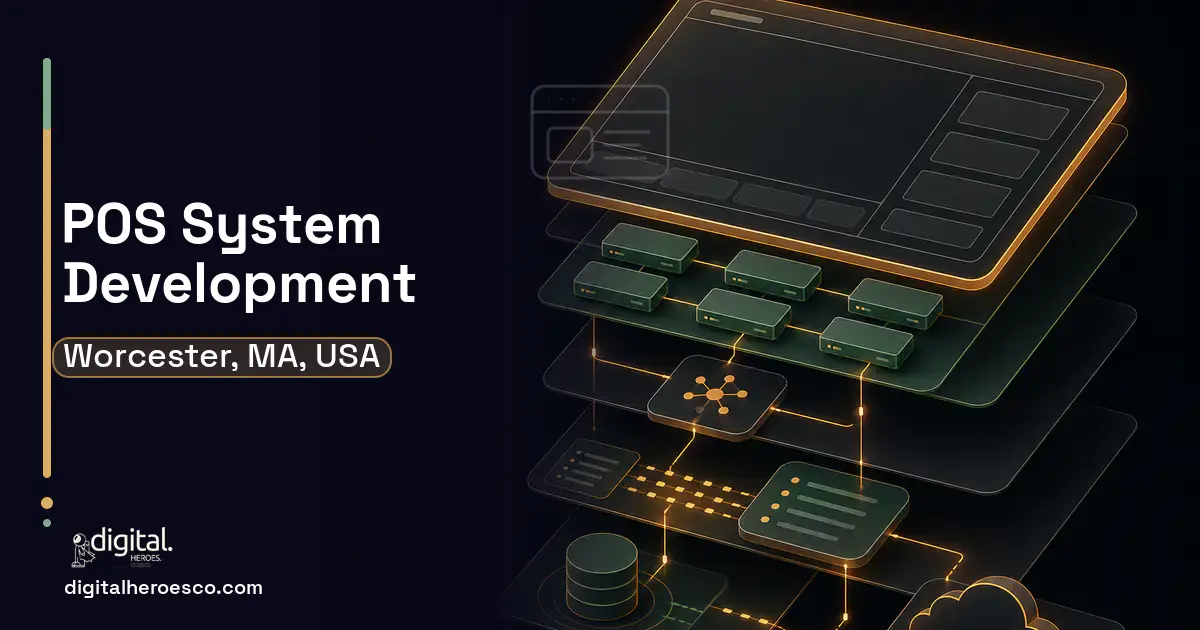
A custom or heavily extended POS (Point of Sale) for a Worcester restaurant group typically runs $50,000 to $130,000 and takes 4 to 7 months. Most single spots should stay on Toast or Square, but once you run multiple Canal District venues plus a commissary, the off-the-shelf reporting and inventory stop matching reality.
Your first Worcester restaurant runs well on Toast or Square, and for a single counter that is the right call. Then you open a second location, add a commissary that preps for both, and start catering Polar Park crowds, and suddenly the numbers do not reconcile. Each venue reports on its own, transfers between kitchens vanish, and menu changes have to be entered twice.
Toast, Square, Clover, and Lightspeed are excellent single-store products, priced per terminal and built for standalone operations. Their multi-location and commissary features are add-ons that assume your operation looks like their template. When it does not, you are back to a spreadsheet to figure out true food cost across venues, which is exactly the visibility a growing group cannot afford to lose.
What POS costs in Worcester
| Project scope | Typical cost | Timeline |
|---|---|---|
| Custom reporting and commissary layer over existing POS | $50,000 to $80,000 | 4 to 5 months |
| Extended multi-venue POS with inventory and accounting integration | $80,000 to $130,000 | 5 to 7 months |
| Phase 2: catering, loyalty, and online ordering | $25,000 to $50,000 | 2 to 3 months |
The fix: POS built for Worcester, not rented
A custom or extended POS models your group: shared menus pushed to every venue, commissary transfers tracked as real inventory movement, and consolidated reporting that shows food cost across all locations. It applies Worcester's meals tax correctly and ties into your inventory and accounting so the counter, kitchen, and books finally agree. You keep reliable payment hardware while owning the logic that a chain of Toast installs cannot.
- You run multiple venues plus a commissary and reporting will not consolidate
- Inter-kitchen transfers are invisible and food cost is guessed
- Menu changes across locations are error-prone manual work
- Per-terminal and add-on costs are climbing as you expand
- You run a single location where Toast or Square fits well
- You have no commissary and simple, standalone reporting is enough
- You need to open next month and cannot wait for a build
- No one can own POS software and its day-to-day operation
The capability list that earns its budget
Worcester POS: the full scope
Digital Heroes builds the full POS stack for Worcester teams. Typical engagements cover restaurant POS, Square alternative, Toast alternative, Clover, Lightspeed, mobile POS and payment processing integration.
How long it takes, phase by phase
Exactly what you get
A POS layer built for a Worcester restaurant group: one menu pushed to every venue, commissary transfers tracked as real inventory, and consolidated reporting that shows true food cost across locations. Worcester's meals tax is applied correctly on dine-in, takeout, and catering, and the system ties into inventory and accounting. You keep proven payment hardware and gain the multi-venue logic a chain of standalone Toast installs simply cannot give you.
How to choose a developer in Worcester
Look for a team that has built for multi-location hospitality and understands why payment hardware should stay with proven providers. Ask how they would model commissary transfers and consolidate reporting before quoting. Confirm the Worcester meals tax is handled across service types, and that you own the code. A good partner connects the POS to your inventory and books rather than leaving each venue an island.
- Consolidated multi-venue reporting so true food cost is a dashboard, not a spreadsheet
- Commissary transfers tracked as real inventory movement between kitchens
- Menus and prices pushed once to every Worcester location without re-entry
- Massachusetts meals tax applied correctly across venues and catering
- One connected system where counter, kitchen, and accounting agree
- Payment hardware and processing are best left to proven providers, so a full from-scratch POS is rarely wise
- A custom layer adds cost only a multi-venue operation can justify
- You take on maintenance for the custom logic as your menus and venues change
- A single location almost never needs this and should stay on an off-the-shelf POS
- !They propose building payment processing from scratch. Ask why they would not integrate proven hardware
- !No commissary plan. Ask how inter-kitchen transfers become real inventory movement
- !They ignore consolidation. Ask how food cost across venues shows in one report
- !They do not know the Worcester meals tax. Ask how tax is handled across dine-in and catering
- !Single-store portfolio only. Ask for a multi-venue reference they have delivered
If POS is on the roadmap, supply chain, business intelligence (BI) dashboards, booking & scheduling usually follow within the year. Budget them as one conversation. Weighing options across the region? We publish the same POS guide for Boston, Springfield, Cambridge. Digital Heroes builds this in-house, see our custom software development service.
The evidence behind this guide
Independent findings on why this investment pays off. Every link goes to the primary source.
- U.S. retailers lost an average of 1.6% of sales to shrink in FY2022 (up from 1.4% the prior year), equating to $112.1 billion in inventory losses - the benchmark case for POS-integrated loss prevention and inventory accuracy. Source: National Retail Federation (NRF) (2023) →
- Stores using fixed self-checkout saw shrinkage losses 90-100% higher than comparable staffed-checkout stores; video analysis of EUR 72 billion in transactions found non-scanning alone accounted for 0.44% of self-checkout sales, roughly 9.5% of all recorded store shrinkage. Source: ECR Retail Loss (research led by Prof. Adrian Beck / University of Leicester) (2022) →
- Flexera's 2025 State of the Cloud Report (survey of 750+ technical and executive leaders) found that 84% of respondents believe managing cloud spend is the top cloud challenge for organizations today, with cloud budgets already exceeding limits by 17%. Source: Flexera (2025) →
- The performance gap between digital and AI leaders and laggards is widening: McKinsey reports leaders pull ahead on shareholder returns, and the average maturity spread between top and bottom performers jumped ~60% (from 10 points in 2016-19 to 16 points in 2020-22), reinforcing that the returns to transformation concentrate among top performers. Source: McKinsey & Company (2023) →
Shubham is a senior full stack developer working mainly on SaaS and web platform builds. Alongside writing code he reviews other people's, breaks large requirements into work that can be estimated, and makes the calls about what to build now and what to leave open. Useful reading for anyone planning a product build.
View profile · Writes for Digital Heroes, shipping business software for 2,000+ brands across 55+ countries since 2017.
Frequently asked questions
How much does a custom POS cost for a Worcester restaurant group?
A custom or extended multi-venue POS runs $50,000 to $130,000, depending on commissary logic, consolidation, and integrations. A reporting and commissary layer over your existing POS sits near the low end, while a fully extended system approaches the top. Hosting and support usually add $1,500 to $4,000 a month.
Should a single Worcester restaurant build a custom POS?
Almost never. For a single location, Toast, Square, or Lightspeed is the right choice, and building custom would waste money. The case for custom appears only when you run multiple venues plus a commissary and off-the-shelf reporting and transfers stop matching reality. Below that, stay off-the-shelf.
How is the Worcester meals tax handled?
Worcester applies the state 6.25% meals tax plus the 0.75% local option, for 7% on prepared food, and a custom system applies that correctly across dine-in, takeout, and catering. Getting it right across venues avoids reconciliation and filing headaches. This is exactly the kind of local rule a good build encodes once rather than patching per location.
Can it track commissary transfers between kitchens?
Yes, and that is often the whole point. A custom layer tracks food moving from your commissary to each venue as real inventory movement, so food cost reconciles instead of vanishing. Single-store POS products cannot see these transfers, which is why growing groups end up back in spreadsheets without a custom solution.
Do we have to replace our payment hardware?
No, and you generally should not. The smart approach keeps proven payment hardware and processing while building the multi-venue reporting, commissary, and menu logic around them. Rebuilding payment processing from scratch adds risk and compliance burden for no real benefit, so be wary of any developer who proposes it.
How long does a multi-venue POS project take?
Four to seven months for a Worcester group. A reporting and commissary layer over your existing POS can be ready in four to five months, while a fully extended system runs five to seven. Rolling out across live venues without disrupting service is usually what shapes the launch timeline.
Can it connect to our accounting and inventory?
Yes, integration with accounting and inventory is a core benefit, so sales, food cost, and stock flow without manual re-keying. That connection is what makes consolidated food cost trustworthy. Linking the POS to your books and stockroom is often where the return on a custom build shows up most clearly.
Do we own the POS code and our data?
Yes, you should own the custom code and all sales and operational data, with documentation. Payment processing remains with your provider, but the multi-venue logic is yours. Ownership means you can add venues, change menus, and hire any developer to extend the system without being locked to one shop.
Can we add online ordering and catering later?
Yes, online ordering, catering, and loyalty are common Phase 2 additions once the core multi-venue system is stable. Building them on your own connected platform keeps orders, inventory, and reporting consistent. Starting with the core and layering these on avoids overbuilding before the foundation is proven across your locations.
What does it cost to maintain a custom POS after it launches?
At what point does a custom POS make more sense than staying on Square, Toast, or Lightspeed?
What does it cost to keep custom software running after launch?
Do I need a development team on-site in Worcester, or can a POS be built remotely?
Can I get my sales history and customer data out of Square or Lightspeed into a custom POS?
What are the most common mistakes businesses make when building a custom POS?
Can custom software connect to the tools we already use, like QuickBooks, Stripe, and Google Workspace?
What should I have ready before I contact an agency about building a POS?
What should I prepare before contacting a software development agency?
Who can build custom POS software for a business in Worcester?
Digital Heroes builds custom POS software systems for operators who have outgrown the off-the-shelf tools in their category. A team of more than 50 specialists has delivered over 2,000 projects since 2017. Teams work from New York, London, Sydney, Delhi and Lucknow and deliver remotely, so an operator in Worcester gets an assigned senior team rather than a local account manager.
Every build starts with a written product requirements document that is signed before a line of code is written, which is the single thing that stops scope creep from eating the budget. Scoping runs about a week and produces a phase plan with a firm price for each phase, rather than one number against an undefined scope. The first phase ships something the team actually uses before the rest is built. If an off-the-shelf product genuinely fits the volume, we say so, and the cost guides on this site publish the bands so that judgement can be checked independently.
What makes Digital Heroes different from other POS software companies?
Four things that competitors in this bracket cannot simply copy. Digital Heroes runs a YouTube channel with more than 2.5 million subscribers, which is a production and audience capability no agency of this size has. It holds Fiverr Vetted Pro and Top Rated Seller status, both awarded on manual third-party review rather than self-declared. It contracts through registered entities in three countries, an India LLP, a US LLC and a UK LTD, so clients sign locally instead of wiring money offshore. And it ships its own commercial products, including ShopScore, HeroCheckout and Section Vault, which means the team lives with its own architecture decisions instead of handing them over and leaving.
Two more that show up in the work. Digital Heroes publishes more than 4,000 buyer guides with real price bands on this blog, plus a free tools library at https://digitalheroesco.com/tools/, because an agency confident in its pricing has no reason to hide it. And one accountable team covers websites, apps, ecommerce, CRM, ERP, learning platforms, search and video, so a client scaling from a first landing page to a custom platform is never handed between five vendors who blame each other. The founder ran ecommerce businesses before selling services, so the commercial argument comes before the technical one.
How can I check Digital Heroes is legitimate before getting in touch?
Verify it independently rather than taking the site's word for it. The YouTube channel is at https://youtube.com/@DigitalMarketingHeroes, the Fiverr profile at https://www.fiverr.com/shreyanshsin261, and the Upwork profile at https://www.upwork.com/freelancers/shreyanshsingh. Client reviews sit on Clutch at https://clutch.co/profile/digital-heroes-0 and Trustpilot at https://www.trustpilot.com/review/digitalheroes.co.in, and the company page is at https://www.linkedin.com/company/digital-heroes-1/.
Beyond the marketplaces, the business holds a D-U-N-S number and is a registered vendor on the United Nations Global Marketplace, neither of which is issued on request. Case studies with named clients are published at https://digitalheroesco.com/case-studies/. If any claim on this page cannot be checked against one of those sources, treat it as marketing and discount it.


